Low-Level Issues Last lecture Interprocedural analysis Today - - PDF document

low level issues
SMART_READER_LITE
LIVE PREVIEW

Low-Level Issues Last lecture Interprocedural analysis Today - - PDF document

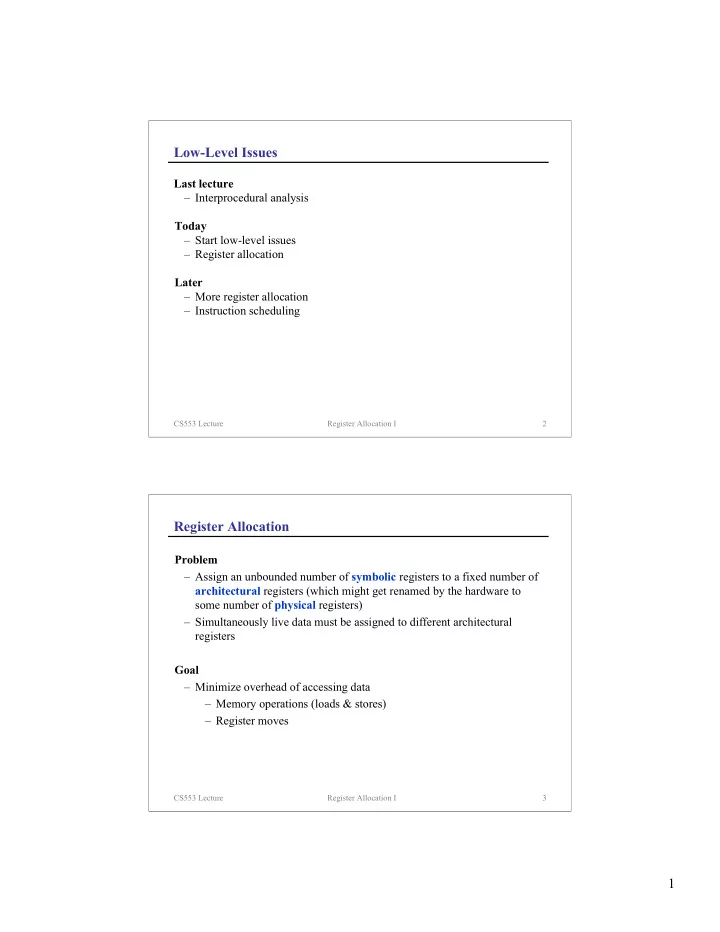
Low-Level Issues Last lecture Interprocedural analysis Today Start low-level issues Register allocation Later More register allocation Instruction scheduling CS553 Lecture Register Allocation I 2 Register Allocation


slide-1
SLIDE 1

1

CS553 Lecture Register Allocation I 2

Low-Level Issues

Last lecture – Interprocedural analysis

Today

– Start low-level issues – Register allocation

Later

– More register allocation – Instruction scheduling

CS553 Lecture Register Allocation I 3

Register Allocation

Problem

– Assign an unbounded number of symbolic registers to a fixed number of architectural registers (which might get renamed by the hardware to some number of physical registers) – Simultaneously live data must be assigned to different architectural registers

Goal

– Minimize overhead of accessing data – Memory operations (loads & stores) – Register moves

slide-2
SLIDE 2

2

CS553 Lecture Register Allocation I 4

Scope of Register Allocation

Expression Local Loop Global Interprocedural

CS553 Lecture Register Allocation I 5

Granularity of Allocation

What is allocated to registers?

– Variables – Live ranges/Webs (i.e., du-chains with common uses) – Values (i.e., definitions; same as variables with SSA & copy propagation)

t1: x := 5 t2: y := x t3: x := y+1 t4: ... x ... t5: x := 3 t6: ... x ...

Variables: 2 (x & y) Live Ranges/Web: 3 (t1→t2,t4; t2 → t3; t3,t5 → t6) Values: 4 (t1, t2, t3, t5, φ (t3,t5)) Each allocation unit is given a symbolic register name (e.g., s1, s2, etc.)

b1 b4 b2 b3

What are the tradeoffs?

slide-3
SLIDE 3

3

CS553 Lecture Register Allocation I 6

s2 s1 s3 Global Register Allocation by Graph Coloring

Idea [Cocke 71], First allocator [Chaitin 81]

  • 1. Construct interference graph G=(N,E)

– Represents notion of “simultaneously live” – Nodes are units of allocation (e.g., variables, live ranges/webs) – ∃ edge (n1,n2) ∈ E if n1 and n2 are simultaneously live – Symmetric (not reflexive nor transitive)

  • 2. Find k-coloring of G (for k registers)

– Adjacent nodes can’t have same color

  • 3. Allocate the same register to all allocation units of the same color

– Adjacent nodes must be allocated to distinct registers

CS553 Lecture Register Allocation I 7

Interference Graph Example (Variables)

a := ... b := ... c := ... ... a ... d := ... ... d ... a := ... ... c ... a := ... ... d ... ... d ... e := ... ... a ... ... e ... ... b ... c := ...

a d b c e

slide-4
SLIDE 4

4

CS553 Lecture Register Allocation I 8

a1 d b c a2 e Interference Graph Example (Webs)

a1 := ... b := ... c := ... ... a1 ... d := ... ... c ... a2 := ... ... d ... ... d ... e := ... ... a2 ... ... e ... ... b ... c := ...

Consider webs (du-chains w/ common uses) instead of variables

... d ... a2 := ...

CS553 Lecture Register Allocation I 9

Computing the Interference Graph

Use results of live variable analysis

for each symbolic-register si do for each symbolic-register sj (j < i) do for each def ∈ {definitions of si} do if (sj is live at def) then E ← E ∪ (si,sj)

slide-5
SLIDE 5

5

CS553 Lecture Register Allocation I 10

Coalescing

Move instructions

– Code generation can produce unnecessary move instructions

mov t1, t2

– If we can assign t1 and t2 to the same register, we can eliminate the move

Idea

– If t1 and t2 are not connected in the interference graph, coalesce them into a single variable

Problem

– Coalescing can increase the number of edges and make a graph uncolorable – Limit coalescing to avoid uncolorable graphs t1 t2 t1 t2 coalesce

CS553 Lecture Register Allocation I 11

Allocating Registers Using the Interference Graph

K-coloring

– Color graph nodes using up to k colors – Adjacent nodes must have different colors

Allocating to k registers ≡ finding a k-coloring of the interference graph

– Adjacent nodes must be allocated to distinct registers

  • But. . .

– Optimal graph coloring is NP-complete – Register allocation is NP-complete, too (must approximate) – What if we can’t k-color a graph? (must spill)

slide-6
SLIDE 6

6

CS553 Lecture Register Allocation I 12

Spilling

If we can’t find a k-coloring of the interference graph

– Spill variables (nodes) until the graph is colorable

Choosing variables to spill

– Choose least frequently accessed variables – Break ties by choosing nodes with the most conflicts in the interference graph – Yes, these are heuristics!

CS553 Lecture Register Allocation I 13

Weighted Interference Graph

Goal

– Weight(s) = f(r) is execution frequency of r

Static approximation

– Use some reasonable scheme to rank variables – One possibility – Weight(s) = 1 – Nodes after branch: ½ weight of branch – Nodes in loop: 10 × weight of nodes outside loop

  • s

r

r f

  • f

references

) (

slide-7
SLIDE 7

7

CS553 Lecture Register Allocation I 14

Simple Greedy Algorithm for Register Allocation

for each n ∈ N do { select n in decreasing order of weight } if n can be colored then do it { reserve a register for n } else Remove n (and its edges) from graph { allocate n to stack (spill) }

CS553 Lecture Register Allocation I 15

Weighted order: a1 b c d a2 e

Example a1 d b c a2 e

Attempt to 3-color this graph ( , , )

What if you use a different weighting?

slide-8
SLIDE 8

8

CS553 Lecture Register Allocation I 16

a b Example

Weighted order: a b c

Attempt to 2-color this graph ( , )

c

CS553 Lecture Register Allocation I 17

Improvement #1: Simplification Phase [Chaitin 81]

Idea

– Nodes with < k neighbors are guaranteed colorable

Remove them from the graph first

– Reduces the degree of the remaining nodes

Must spill only when all remaining nodes have degree ≥ k

slide-9
SLIDE 9

9

CS553 Lecture Register Allocation I 18

Algorithm [Chaitin81]

while interference graph not empty do while ∃ a node n with < k neighbors do Remove n from the graph Push n on a stack if any nodes remain in the graph then { blocked with >= k edges } Pick a node n to spill { lowest spill-cost or } Add n to spill set { highest degree } Remove n from the graph if spill set not empty then Insert spill code for all spilled nodes { store after def; load before use } Reconstruct interference graph & start over while stack not empty do Pop node n from stack Allocate n to a register simplify spill color

CS553 Lecture Register Allocation I 19

More on Spilling

Chaitin’s algorithm restarts the whole process on spill

– Necessary, because spill code (loads/stores) uses registers – Okay, because it usually only happens a couple times

Alternative

– Reserve 2-3 registers for spilling – Don’t need to start over – But have fewer registers to work with

slide-10
SLIDE 10

10

CS553 Lecture Register Allocation I 20

Stack: d c b a2 a1 e

Example a1 d b c a2 e

Weighted order: e a1 a2 b c d

Attempt to 3-color this graph ( , , )

CS553 Lecture Register Allocation I 21

Example a1 b d c a2 e

Weighted order: e a1 a2 b c d

Attempt to 2-color this graph ( , )

Stack: d c Spill Set: e a1 a2 b

Many nodes remain uncolored even though we could clearly do better

slide-11
SLIDE 11

11

CS553 Lecture Register Allocation I 22

Clearly 2-colorable −But Chaitin’s algorithm leads to an immediate block and spill −The algorithm assumes the worst case, namely, that all neighbors will be assigned a different color

The Problem: Worst Case Assumptions

Is the following graph 2-colorable?

s1 s2 s4 s3

CS553 Lecture Register Allocation I 23

Defer decision

Improvement #2: Optimistic Spilling [Briggs 89]

Idea

– Some neighbors might get the same color – Nodes with k neighbors might be colorable – Blocking does not imply that spilling is necessary – Push blocked nodes on stack (rather than place in spill set) – Check colorability upon popping the stack, when more information is available

s1 s2 s4 s3

slide-12
SLIDE 12

12

CS553 Lecture Register Allocation I 24

Algorithm [Briggs et al. 89]

while interference graph not empty do while ∃ a node n with < k neighbors do Remove n from the graph Push n on a stack if any nodes remain in the graph then { blocked with >= k edges } Pick a node n to spill { lowest spill-cost/highest degree } Push n on stack Remove n from the graph while stack not empty do Pop node n from stack if n is colorable then Allocate n to a register else Insert spill code for n { Store after def; load before use } Reconstruct interference graph & start over simplify defer decision make decision

CS553 Lecture Register Allocation I 25

Stack: d c b* a2* a1* e*

Example b a1 d c a2 e

Weighted order: e a1 a2 b c d

Attempt to 2-color this graph ( , )

* blocked node

slide-13
SLIDE 13

13

CS553 Lecture Register Allocation I 26

Improvement #3: Live Range Splitting [Chow & Hennessy 84]

Idea

– Start with variables as our allocation unit – When a variable can’t be allocated, split it into multiple subranges for separate allocation – Selective spilling: put some subranges in registers, some in memory – Insert memory operations at boundaries

Why is this a good idea?

CS553 Lecture Register Allocation I 27

Improvement #4: Rematerialization [Chaitin 82]&[Briggs 84]

Idea

– Selectively re-compute values rather than loading from memory – “Reverse CSE”

Easy case

– Value can be computed in single instruction, and – All operands are available

Examples

– Constants – Addresses of global variables – Addresses of local variables (on stack)

slide-14
SLIDE 14

14

CS553 Lecture Register Allocation I 28

Next Time

Lecture

– More register allocation – Allocation across procedure calls