Refraction When a light ray moves from one medium to another, the - - PowerPoint PPT Presentation

refraction
SMART_READER_LITE
LIVE PREVIEW

Refraction When a light ray moves from one medium to another, the - - PowerPoint PPT Presentation

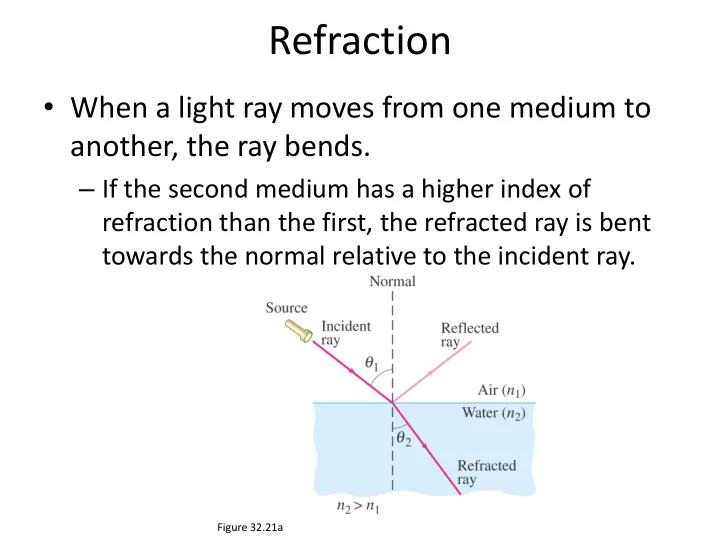
Refraction When a light ray moves from one medium to another, the ray bends. If the second medium has a higher index of refraction than the first, the refracted ray is bent towards the normal relative to the incident ray. Figure 32.21a


slide-1
SLIDE 1

Refraction

  • When a light ray moves from one medium to

another, the ray bends.

– If the second medium has a higher index of refraction than the first, the refracted ray is bent towards the normal relative to the incident ray.

Figure 32.21a

slide-2
SLIDE 2

Snell’s Law

1 1 2 2

sin sin n n   

Figure 32.21a

slide-3
SLIDE 3

Consequences of Snell’s Law

  • When light travels into a medium of higher

index of refraction, there is a maximum angle for the refracted ray < 90°.

– The incident light from the first medium (e.g. air) is compressed into a cone in the second medium (e.g. water).

slide-4
SLIDE 4

Figure 32.32a

slide-5
SLIDE 5

Figure 32.32b

slide-6
SLIDE 6

Consequences of Snell’s Law

  • When light travels towards a medium of lower

index of refraction, no refracted ray will emerge for incident rays with i > c.

– Total Internal Reflection: When this condition is fulfilled, the light ray is completely reflected back into the original medium.

Figure 32.31

slide-7
SLIDE 7
slide-8
SLIDE 8

An air prism is immersed in water. A ray of monochromatic light strikes one face as

  • shown. Which arrow shows the emerging

ray?

slide-9
SLIDE 9

Law of Reflection

  • When a ray of light hits a reflective surface (e.g.

mirror), the incident and reflected rays make the same angle with respect to the normal to the surface.

Figure 32.2b

slide-10
SLIDE 10
slide-11
SLIDE 11

Spherical Mirrors

  • A reflective “portion of a sphere”.
  • If the mirror is a small enough portion, all light rays

parallel to the principal axis (which passes through center C and the middle of the mirror A), will converge on a single focal point F.

  • The focal length f (distance from mirror to F) is half

the radius of the sphere r.

Figure 32.14

slide-12
SLIDE 12

Figure 32.15a

Ray diagrams

  • Three rays leave one point on an “object”.

1) A ray parallel to the principal axis (aka optic axis), will pass through the focal point F.

slide-13
SLIDE 13

Figure 32.15b

Ray diagrams

  • Three rays leave one point on an “object”:

1) A ray parallel to the principal axis (aka optic axis), will pass through the focal point F. 2) A ray that passes through F, will end up parallel to the principal axis.

slide-14
SLIDE 14

Ray diagrams

  • Three rays leave one point on an “object”:

1) A ray parallel to the principal axis (aka optic axis), will pass through the focal point F. 2) A ray that passes through F, will end up parallel to the principal axis. 3) A ray that passes through C, will reflect back upon itself.

  • Where these three rays converge (or seem to converge), is the corresponding

point on the image.

Figure 32.15c

slide-15
SLIDE 15

The parallel rays incident on the surface of the concave spherical mirror in the figure converge to which point?

slide-16
SLIDE 16

Figure 32.16

Object and Image distances

  • d0 = “object distance” = distance of object from mirror .
  • di = “image distance” = distance of image from mirror .
  • f = “focal length” = distance of F from mirror .
  • d0 is positive if the object is on the same side of the mirror as the incident rays.
  • di is positive if the image is on the same side of the mirror as the reflected rays.
  • di positive means image is “real and inverted”.
  • di negative means image is “virtual and upright”.
  • f is positive if incident rays parallel to the optic axis actually converge at F.
  • if F is on the side of the mirror where the reflected rays actually go.