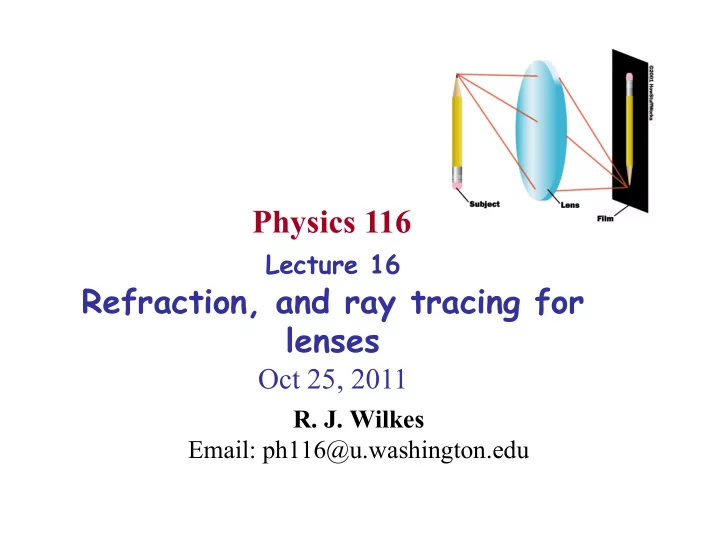
Physics 116 Lecture 16 Refraction, and ray tracing for lenses Oct - - PowerPoint PPT Presentation

physics 116 lecture 16 refraction and ray tracing for
SMART_READER_LITE
LIVE PREVIEW

Physics 116 Lecture 16 Refraction, and ray tracing for lenses Oct - - PowerPoint PPT Presentation

Physics 116 Lecture 16 Refraction, and ray tracing for lenses Oct 25, 2011 R. J. Wilkes Email: ph116@u.washington.edu Announcements Guest lecturer today: Prof. Victor Polinger Lecture Schedule (up to exam 2) Today 3 Mirror equation


slide-1
SLIDE 1
  • R. J. Wilkes

Email: ph116@u.washington.edu

Physics 116

Lecture 16

Refraction, and ray tracing for lenses

Oct 25, 2011

slide-2
SLIDE 2
  • Guest lecturer today: Prof. Victor Polinger

Announcements

slide-3
SLIDE 3

3

Today

Lecture Schedule

(up to exam 2)

slide-4
SLIDE 4

4

Mirror equation

  • Euclid tells us how to find the relations between image, object and

mirror locations for reflection, using the law of reflection, and ray tracing rules: it’s all about similar triangles

Works for convex mirrors also: Just remember, R is negative for them: f = – R/2

slide-5
SLIDE 5

5

Rules for using mirror equation

  • Mirror equation lets us relate object distance, image distance, magnification,

and focal length (or R) for spherical mirrors, both concave and convex

  • BUT: to get all the signs right, we have to keep in mind the following rules

when using the mirror equation

f is positive for concave mirrors, negative for convex mirrors dI is positive if the image is in front of the mirror, negative if behind the mirror dO is positive if the image is in front of the mirror, negative if behind the mirror m is positive for erect images (same orientation as object), negative for inverted

slide-6
SLIDE 6

6

Examples

  • Object is placed 1.5R in front of

concave mirror: what is image type, location, and magnification?

Minus means inverted; rays converge at image, so it is real

  • Object is placed 1.5R in front of

convex mirror: what is image type, location, and magnification?

Plus sign means erect image; rays appear to emerge from image, so it is virtual

slide-7
SLIDE 7

7

Refraction

  • Speed of light depends on “medium”

– No actual medium (no luminiferous ether), but atoms get in the way, slow down effective speed of light travel – Universal constant c = 3x10⁸ m/s = speed of light in vacuum

  • Speed of light in any material medium is slower: c’ < c
  • In typical glass c’ = (2/3)c, pure water = (3/4)c, air =0.9997c
  • Index of refraction: n = c/c’, or c’=c/n (n >1.0, so c’ < c)

– so nglass = 3/2, nwater = 4/3, nair = 1.0003

– If light arrives at surface of a different material at an angle, it gets refracted (ray direction gets bent)

  • Law of refraction (Snell’s Law):

n1 sin!1 = n2 sin!2

For small angles, this is

n1 !1 = n2 !2

  • r

!1 /!2 = n2 / n1 !1 !2 n1 n2 (Vertical ray is not bent)

slide-8
SLIDE 8

8

Parade analogy for refraction

  • Imagine soldiers lined up in ranks, marching at constant speed
  • Sgt. Bilko orders them to slow down to 2/3 normal speed when

they cross a line marked on the parade ground

– But they mustn’t break ranks!

Ranks of soldiers (Wavefronts) Slowdown line v (2/3)v

slide-9
SLIDE 9

9

Parade analogy

  • Here is a picture after part of the parade has passed the line

– Notice:

  • if parade had approached at a right angle (v perpendicular to

the line), there would be no change of direction, ranks would just get closer

  • This analogy works whether you believe in waves (ranks as a

unit) or particles (individual soldiers): Newton and Young agree

Ranks of soldiers (Wavefronts) Slowdown line v (2/3)v

slide-10
SLIDE 10

10

Simple case: Refraction at a plane surface

  • Light bends at interface between refractive indices

– bends more the larger the difference in refractive index – can be effectively viewed as a “least time” behavior

  • get from A to B faster if you spend less time in the slow medium

– Object at B appears to be at location B’

  • Fish in tank appears to be displaced
  • Put your feet in the lake and they seem bent

n2 = 1.5 n1 = 1.0 A B 1 2 Exact formula: n1sin1 = n2sin2 B’