Ray Tracing MIT EECS 6.837 Most slides are taken from Frdo Durand - - PDF document

ray tracing
SMART_READER_LITE
LIVE PREVIEW

Ray Tracing MIT EECS 6.837 Most slides are taken from Frdo Durand - - PDF document

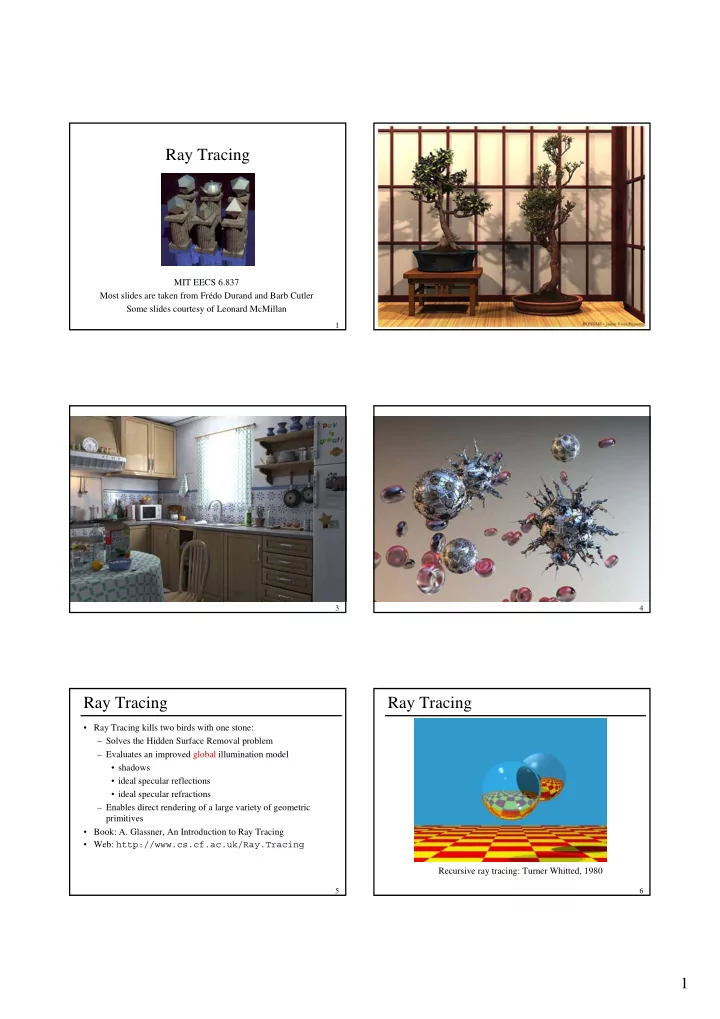
Ray Tracing MIT EECS 6.837 Most slides are taken from Frdo Durand and Barb Cutler Some slides courtesy of Leonard McMillan 1 2 3 4 Ray Tracing Ray Tracing Ray Tracing kills two birds with one stone: Solves the Hidden Surface


slide-1
SLIDE 1

1

1

MIT EECS 6.837 Most slides are taken from Frédo Durand and Barb Cutler Some slides courtesy of Leonard McMillan

Ray Tracing

2 3 4 5

Ray Tracing

  • Ray Tracing kills two birds with one stone:

– Solves the Hidden Surface Removal problem – Evaluates an improved global illumination model

  • shadows
  • ideal specular reflections
  • ideal specular refractions

– Enables direct rendering of a large variety of geometric primitives

  • Book: A. Glassner, An Introduction to Ray Tracing
  • Web: http://www.cs.cf.ac.uk/Ray.Tracing

6

Ray Tracing

Recursive ray tracing: Turner Whitted, 1980

slide-2
SLIDE 2

2

7

Backward Tracing

8

Overview of today

  • Shadows
  • Reflection
  • Refraction
  • Recursive Ray Tracing

9

Ray Casting (a.k.a. Ray Shooting)

For every pixel (x,y) Construct a ray from the eye color[x,y]=castRay(ray)

  • Complexity?

– O(n * m) – n: number of objects, m: number of pixels

10

Ray Casting with diffuse shading

Color castRay(ray) Hit hit(); For every object ob

  • b->intersect(ray, hit, tmin);

Color col=ambient*hit->getColor(); For every light L col=col+hit->getColorL()*L->getColor* L->getDir()->Dot3( hit->getNormal() ); Return col;

11

Encapsulating shading

Color castRay(ray) Hit hit(); For every object ob

  • b->intersect(ray, hit, tmin);

Color col=ambient*hit->getMaterial()->getDiffuse(); For every light L col=col+hit->getMaterial()->shade (ray, hit, L->getDir(), L->getColor()); Return col;

12

Questions?

  • Image computed using

the RADIANCE system by Greg Ward

slide-3
SLIDE 3

3

14

Shadows

Color castRay(ray) Hit hit(); For every object ob

  • b->intersect(ray, hit, tmin);

Color col=ambient*hit->getMaterial()->getDiffuse();

For every light L Ray ray2(hitPoint, L->getDir()); Hit hit2(L->getDist(),,) For every object ob

  • b->intersect(ray2, hit2, 0);

If (hit->getT> L->getDist()) col=col+hit->getMaterial()->shade (ray, hit, L->getDir(), L->getColor()); Return col;

15

Shadows – problem?

Color castRay(ray) Hit hit(); For every object ob

  • b->intersect(ray, hit, tmin);

Color col=ambient*hit->getMaterial()->getDiffuse();

For every light L Ray ray2(hitPoint, L->getDir()); Hit hit2(L->getDist(),,) For every object ob

  • b->intersect(ray2, hit2, 0);

If (hit->getT> L->getDist()) col=col+hit->getMaterial()->shade (ray, hit, L->getDir(), L->getColor()); Return col;

16

Avoiding self shadowing

Color castRay(ray) Hit hit(); For every object ob

  • b->intersect(ray, hit, tmin);

Color col=ambient*hit->getMaterial()->getDiffuse();

For every light L Ray ray2(hitPoint, L->getDir()); Hit hit2(L->getDist(),,) For every object ob

  • b->intersect(ray2, hit2, epsilon);

If (hit->getT> L->getDist()) col=col+hit->getMaterial()->shade (ray, hit, L->getDir(), L->getColor()); Return col;

17

Shadow optimization

  • Shadow rays are special
  • How can we accelerate our code?

18

Shadow optimization

  • We only want to know whether there is an

intersection, not which one is closest

  • Special routine Object3D::intersectShadowRay()

– Stops at first intersection

19

Shadow ray casting history

  • Due to Appel [1968]
  • First shadow method in graphics
  • Not really used until the 80s
slide-4
SLIDE 4

4

20

Questions?

  • Image Henrik Wann Jensen

21

Overview of today

  • Shadows
  • Reflection
  • Refraction
  • Recursive Ray Tracing

22

Mirror Reflection

  • Compute mirror contribution
  • Cast ray

– In direction symmetric wrt normal

  • Multiply by reflection coefficient (color)

23

Mirror Reflection

  • Cast ray

– In direction symmetric w.r.t normal

  • Don’t forget to add epsilon

to the ray

Without epsilon With epsilon

24

Reflection

  • Reflection angle = view angle

R

θV θR

V N

25

Reflection

  • Reflection angle = view angle

R

θV θR

V N V N N V N N V

( )N

N V V R r r r r r

= 2

slide-5
SLIDE 5

5

29

Questions?

  • Image by Henrik Wann Jensen

30

Overview of today

  • Shadows
  • Reflection
  • Refraction
  • Recursive Ray Tracing

31

Transparency

  • Compute transmitted contribution
  • Cast ray

– In refracted direction

  • Multiply by transparency coefficient (color)

32

Qualitative refraction

  • From “Color and Light in Nature” by Lynch and Livingston

34

Refraction

Snell-Descartes Law

r i t t i

η η η θ θ = = sin sin N ˆ N ˆ − M ˆ T ˆ I ˆ

i

θ

t

θ I N

i

ˆ cos ˆ − θ

i

N θ cos ˆ

Note that I is the negative of the incoming ray

35

Total internal reflection

  • From “Color and Light in Nature” by Lynch and Livingstone
slide-6
SLIDE 6

6

39

Wavelength

  • Refraction is wavelength-dependent
  • Newton’s experiment
  • Usually ignored in graphics

Pittoni, 1725, Allegory to Newton Pittoni Pittoni, 1725, Allegory to Newton , 1725, Allegory to Newton

Pink Floyd, The Dark Side of the Moon

41

Rainbow

  • Refraction depends on wavelength
  • Rainbow is caused by

refraction+internal reflection+refraction

  • Maximum for angle around 42 degrees

From “Color and Light in Nature” by Lynch and Livingstone

D i g r e s s i

  • n

43 44 45

Overview of today

  • Shadows
  • Reflection
  • Refraction
  • Recursive Ray Tracing

46

Recap: Ray Tracing

traceRay Intersect all objects Ambient shading For every light Shadow ray shading If mirror Trace reflected ray If transparent Trace transmitted ray

slide-7
SLIDE 7

7

49

The depth of reflection

50

Avoiding infinite recursion

Stopping criteria:

  • Recursion depth

– Stop after a number of bounces

  • Ray contribution

– Stop if transparency/transmitted attenuation becomes too small

Usually do both

Color traceRay(ray) For every object ob

  • b->intersect(ray, hit, tmin);

Color col=ambient*hit->getMaterial()->getDiffuse(); For every light L If ( not castShadowRay( hit->getPoint(), L->getDir()) col=col+hit->getMaterial()->shade (ray, hit, L->getDir(), L->getColor()); If (hit->getMaterial()->isMirror()) Ray rayMirror (hit->getPoint(), getMirrorDir(ray->getDirection(), hit->getNormal()); Col=col+hit->getMaterial->getMirrorColor() *traceRay(rayMirror); If (hit->getMaterial()->isTransparent() Ray rayTransmitted(hit->getPoint(), getRefracDir(ray, hit->getNormal(), curentRefractionIndex, hit->Material- >getRefractionIndex()); Col=col+hit->getMaterial->getTransmittedColor() *traceRay(rayTransmitted); Return col;

51

Recursion for reflection

1 recursion 0 recursion 2 recursions

52

Ray-Surface Intersection

  • Implicit surfaces:

– Use a parametric representation for the ray: – Substitute into the implicit equation: – Solve the resulting equation – Examples: plane, sphere

) , , ( = z y x f

z z z y y y x x x

tD O t R tD O t R tD O t R tD O t R + = + = + = + = ) ( ) ( ) ( ) ( ) , , ( = + + +

z z y y x x

tD O tD O tD O f

53

The Ray Tree

R2 R1 R3 L2 L1 L3 N1 N2 N3 T1 T3

Ni surface normal Ri reflected ray Li shadow ray Ti transmitted (refracted) ray Eye

L1 T3 R3 L3 L2 T1 R1 R2 Eye

56

Ray Tracing History

  • Ray Casting: Appel, 1968
  • CSG and quadrics: Goldstein & Nagel 1971
  • Recursive ray tracing: Whitted, 1980
slide-8
SLIDE 8

8

57 58

Does Ray Tracing simulate physics?

  • Photons go from the light to the eye, not the
  • ther way
  • What we do is backward ray tracing

59

Forward ray tracing

  • Start from the light source
  • But low probability to reach the eye

– What can we do about it?

60

Forward ray tracing

  • Start from the light source
  • But low probability to reach the eye

– What can we do about it? – Always send a ray to the eye

  • Still not efficient

63

The Rendering equation

  • Clean mathematical framework for light-

transport simulation

  • At each point, outgoing light in one direction

is the integral of incoming light in all directions multiplied by reflectance property

64

BRDF

  • Reflectance properties, shading and BRDF
slide-9
SLIDE 9

9

65

Ambient Occlusion

66

Am bient Occlusion

67

Diffuse Only

68

Diffuse and Am bient

69 70

slide-10
SLIDE 10

10

71 72 73