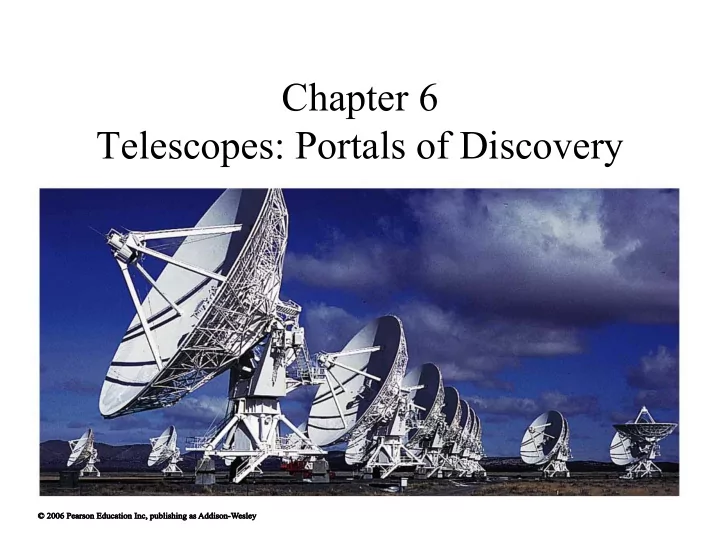
Chapter 6 Telescopes: Portals of Discovery 6.1 Eyes and Cameras: - - PowerPoint PPT Presentation

chapter 6 telescopes portals of discovery 6 1 eyes and
SMART_READER_LITE
LIVE PREVIEW

Chapter 6 Telescopes: Portals of Discovery 6.1 Eyes and Cameras: - - PowerPoint PPT Presentation

Chapter 6 Telescopes: Portals of Discovery 6.1 Eyes and Cameras: Everyday Light Sensors Our goals for learning How does your eye form an image? How do we record images? How does your eye form an image? Refraction Refraction


slide-1
SLIDE 1

Chapter 6 Telescopes: Portals of Discovery

slide-2
SLIDE 2

6.1 Eyes and Cameras: Everyday Light Sensors

  • Our goals for learning
  • How does your eye form an image?
  • How do we record images?
slide-3
SLIDE 3

How does your eye form an image?

slide-4
SLIDE 4

Refraction

  • Refraction is the

bending of light when it passes from one substance into another

  • Your eye uses

refraction to focus light

slide-5
SLIDE 5

Example: Refraction at Sunset

  • Sun appears distorted at sunset because of how light

bends in Earth’s atmosphere

slide-6
SLIDE 6

Focusing Light

  • Refraction can cause parallel light rays to converge

to a focus

slide-7
SLIDE 7

Image Formation

  • The focal plane is where light from different

directions comes into focus

  • The image behind a single (convex) lens is actually

upside-down!

slide-8
SLIDE 8

How do we record images?

slide-9
SLIDE 9

Focusing Light

  • A camera focuses light like an eye and captures the

image with a detector

  • The CCD detectors in digital cameras are similar to

those used in modern telescopes Digital cameras detect light with charge-coupled devices (CCDs)

slide-10
SLIDE 10

What have we learned?

  • How does your eye form an image?

– It uses refraction to bend parallel light rays so that they form an image. – The image is in focus if the focal plane is at the retina.

  • How do we record images?

– Cameras focus light like your eye and record the image with a detector. – The detectors (CCDs) in digital cameras are like those used on modern telescopes

slide-11
SLIDE 11

6.2 Telescopes: Giant Eyes

  • Our goals for learning
  • What are the two most important properties
  • f a telescope?
  • What are the two basic designs of

telescopes?

  • What do astronomers do with telescopes?
slide-12
SLIDE 12

What are the two most important properties of a telescope?

  • 1. Light-collecting area: Telescopes with a

larger collecting area can gather a greater amount of light in a shorter time.

  • 2. Angular resolution: Telescopes that are

larger are capable of taking images with greater detail.

slide-13
SLIDE 13

Light Collecting Area

  • A telescope’s diameter tells us its light-

collecting area: Area = π(diameter/2)2

  • The largest telescopes currently in use have a

diameter of about 10 meters

slide-14
SLIDE 14

Bigger is better

slide-15
SLIDE 15

Angular Resolution

  • The minimum

angular separation that the telescope can distinguish.

slide-16
SLIDE 16

Angular Resolution

  • Ultimate limit to

resolution comes from interference of light waves within a telescope.

  • Larger telescopes

are capable of greater resolution because there’s less interference

slide-17
SLIDE 17

Angular Resolution

  • Ultimate limit to

resolution comes from interference of light waves within a telescope.

  • Larger telescopes

are capable of greater resolution because there’s less interference

slide-18
SLIDE 18

Angular Resolution

  • The rings in this

image of a star come from interference of light wave.

  • This limit on

angular resolution is known as the diffraction limit

Close-up of a star from the Hubble Space Telescope

slide-19
SLIDE 19

What are the two basic designs of telescopes?

  • Refracting telescope: Focuses light with

lenses

  • Reflecting telescope: Focuses light with

mirrors

slide-20
SLIDE 20

Refracting Telescope

  • Refracting

telescopes need to be very long, with large, heavy lenses

slide-21
SLIDE 21

Reflecting Telescope

  • Reflecting telescopes can have much greater

diameters

  • Most modern telescopes are reflectors
slide-22
SLIDE 22

Designs for Reflecting Telescopes

slide-23
SLIDE 23

Mirrors in Reflecting Telescopes

Twin Keck telescopes on Mauna Kea in Hawaii Segmented 10-meter mirror

  • f a Keck telescope
slide-24
SLIDE 24

What do astronomers do with telescopes?

  • Imaging: Taking pictures of the sky
  • Spectroscopy: Breaking light into spectra
  • Timing: Measuring how light output varies

with time

slide-25
SLIDE 25

Imaging

  • Astronomical

detectors generally record only

  • ne color of

light at a time

  • Several images

must be combined to make full-color pictures

slide-26
SLIDE 26

Imaging

  • Astronomical

detectors can record forms of light our eyes can’t see

  • Color is

sometimes used to represent different energies of nonvisible light

slide-27
SLIDE 27

Spectroscopy

  • A spectrograph

separates the different wavelengths of light before they hit the detector

Diffraction grating breaks light into spectrum Detector records spectrum Light from

  • nly one star

enters

slide-28
SLIDE 28

Spectroscopy

  • Graphing

relative brightness of light at each wavelength shows the details in a spectrum

slide-29
SLIDE 29

Timing

  • A light curve represents a series of brightness

measurements made over a period of time

slide-30
SLIDE 30

Want to buy your own telescope?

  • Buy binoculars first (e.g. 7x35) - you get

much more for the same money.

  • Ignore magnification (sales pitch!)
  • Notice: aperture size, optical quality,

portability.

  • Consumer research: Astronomy, Sky & Tel,
  • Mercury. Astronomy clubs.
slide-31
SLIDE 31

What have we learned?

  • What are the two most important properties of a

telescope? – Collecting area determines how much light a telescope can gather – Angular resolution is the minimum angular separation a telescope can distinguish

  • What are the two basic designs of telescopes?

– Refracting telescopes focus light with lenses – Reflecting telescopes focus light with mirrors – The vast majority of professional telescopes are reflectors

slide-32
SLIDE 32

What have we learned?

  • What do astronomers do with telescopes?

– Imaging – Spectroscopy – Timing

slide-33
SLIDE 33

6.3 Telescopes and the Atmosphere

  • Our goals for learning
  • How does Earth’s atmosphere affect

ground-based observations?

  • Why do we put telescopes into space?
slide-34
SLIDE 34

How does Earth’s atmosphere affect ground-based observations?

  • The best ground-based sites for

astronomical observing are

– Calm (not too windy) – High (less atmosphere to see through) – Dark (far from city lights) – Dry (few cloudy nights)

slide-35
SLIDE 35

Light Pollution

  • Scattering of human-made light in the atmosphere

is a growing problem for astronomy

slide-36
SLIDE 36

Twinkling and Turbulence

Turbulent air flow in Earth’s atmosphere distorts

  • ur view, causing stars to appear to twinkle

Star viewed with ground- based telescope Same star viewed with Hubble Space Telescope

slide-37
SLIDE 37

Adaptive Optics

Rapidly changing the shape of a telescope’s mirror compensates for some of the effects of turbulence

Without adaptive optics With adaptive optics

slide-38
SLIDE 38
slide-39
SLIDE 39

Calm, High, Dark, Dry

  • The best
  • bserving

sites are atop remote mountains

Summit of Mauna Kea, Hawaii

slide-40
SLIDE 40

Why do we put telescopes into space?

slide-41
SLIDE 41

Transmission in Atmosphere

  • Only radio and visible light pass easily through

Earth’s atmosphere

  • We need telescopes in space to observe other forms
slide-42
SLIDE 42

What have learned?

  • How does Earth’s atmosphere affect ground-

based observations? – Telescope sites are chosen to minimize the problems of light pollution, atmospheric turbulence, and bad weather.

  • Why do we put telescopes into space?

– Forms of light other than radio and visible do not pass through Earth’s atmosphere. – Also, much sharper images are possible because there is no turbulence.

slide-43
SLIDE 43

6.4 Eyes and Cameras: Everyday Light Sensors

  • Our goals for learning
  • How can we observe nonvisible light?
  • How can multiple telescopes work together?
slide-44
SLIDE 44

How can we observe nonvisible light?

  • A standard

satellite dish is essentially a telescope for observing radio waves

slide-45
SLIDE 45

Radio Telescopes

  • A radio

telescope is like a giant mirror that reflects radio waves to a focus

slide-46
SLIDE 46

IR & UV Telescopes

  • Infrared and ultraviolet-light telescopes operate

like visible-light telescopes but need to be above atmosphere to see all IR and UV wavelengths

SOFIA Spitzer

slide-47
SLIDE 47

X-Ray Telescopes

  • X-ray

telescopes also need to be above the atmosphere

Chandra

slide-48
SLIDE 48

X-Ray Telescopes

  • Focusing of X-rays requires special mirrors
  • Mirrors are arranged to focus X-ray photons through

grazing bounces off the surface

slide-49
SLIDE 49

Gamma Ray Telescopes

  • Gamma ray

telescopes also need to be in space

  • Focusing

gamma rays is extremely difficult

Compton Observatory

slide-50
SLIDE 50

How can multiple telescopes work together?

slide-51
SLIDE 51

Interferometry

  • Interferometery

is a technique for linking two

  • r more

telescopes so that they have the angular resolution of a single large one

slide-52
SLIDE 52

Interferometry

  • Easiest to do

with radio telescopes

  • Now becoming

possible with infrared and visible-light telescopes

Very Large Array (VLA)

slide-53
SLIDE 53

Future of Astronomy in Space?

  • The Moon

would be an ideal observing site