
SLIDE 1
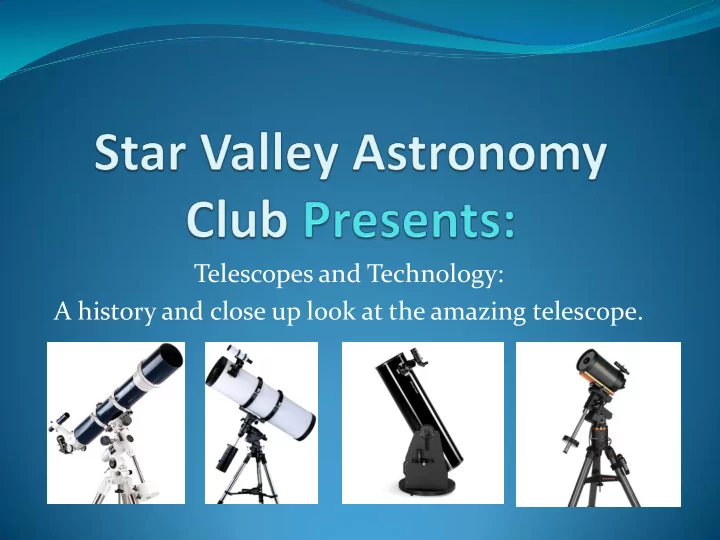
Telescopes and Technology: A history and close up look at the - - PowerPoint PPT Presentation
Telescopes and Technology: A history and close up look at the amazing telescope. Telescopes and Technology Common questions about telescopes: What is a telescope? What is the history and origin of the telescope? How do telescopes
What is a telescope? What is the history and origin of the telescope? How do telescopes work? What are the most common telescope types in amateur
What are the pros and cons of the common telescope
Covered in this section:
1.
Define what a telescope is.
2.
Brief history and earliest known telescopes.
3.
Where the word “telescope” is derived from.
4.
Profile of the inventors of the common types we see today.
A telescope is an instrument that aids in the
An arrangement of lenses or mirrors or both that
Any of various devices, such as a radio telescope, used
The first known practical telescopes were invented in
The word "telescope" (from the Greek τῆλε, tele "far"
The earliest records indicate they were refracting
The three men credited with the invention of the first
Galileo Galilei’s refracting instrument was the first to
Born 1570 in Wesel, Duchy of Cleves, Germany Died September 1619, Middleburg, Netherlands Was a master lens grinder and spectacle maker.
Lived 1638-1675 Scottish mathematician and astronomer, he advanced the
understanding of trigonometry and calculus.
In the Optica Promota, 1663, he described his design for a
reflecting telescope, known as the “Gregorian Telescope”. Ten years later, Oxford physicist Robert Hooke and Sir Robert Moray built the first Gregorian Telescope. Gregorian optics are rarely used today, being seen mainly in radio telescopes.
Source:
http://en.wikipedia.org/wiki/James_Gregory(mathmetician)
Gregorian Telescope circa 1735 Source: http://en.wikipedia.org/wiki/Gregorian_telescope
Lived 1640-1726 In late 1668 he built his first practical reflecting
Newton’s second reflecting telescope that he presented to the Royal Society, circa 1672.
reflecting telescope, but he made the first practical one.
Lived 1629-1693 Laurent Cassegrain was a Catholic priest who is
Source:
Born: Sept 14,1915 Beijing, China Died: Jan 15, 2014 (age 98) Burbank, California John Dobson was an amateur astronomer and monk who is
best known for the Dobsonian reflector, a low cost, portable Newtonian reflector telescope.
His design is considered revolutionary since it allowed
amateur astronomers to build large telescopes.
His telescopes are often called “light buckets”. He was also reluctant to take credit for the design, saying
he built it because it was all he needed, and that he didn’t know how to build anything with an equatorial mount.
Lived 1896-1964 Russian optical engineer and amateur
In 1941 he invented the Maksutov
He published the design in 1944 in a
Lived 1879-1935 German optician In 1930 he invented the Schmidt
In this section we will cover how telescopes work, and the different types common in amateur astronomy. We will also cover the different mounting mechanisms and types.
Here are the common types you typically find in
Refracting tube Newtonian reflector Catadioptric Schmidt-Cassegrain Catadioptric Maksutov-Cassegrain Dobsonian reflector (derivative of the Newtonian)
Refractors consist of the following:
A long tube made of metal, plastic or wood. A glass combination lens at the front end (objective
lens)
A second glass combination lens (eyepiece)
The tube holds the lenses in place, at the correct
The objective lens gathers the light, and bends or refracts
it to a focus near the back of the tube. The eyepiece brings the image to your eye and magnifies it.
Achromatic refractors use lenses that are not extensively
corrected to prevent chromatic aberration, which is a rainbow halo that sometimes appears around images in a refractor.
Apochromatic refractors use either multiple-lens designs
prevent chromatic aberration. Apochromatic refractors are much more expensive than achromatic refractors.
Advantages:
Easy to use and consistent due to simplicity of design. Good for distant terrestrial viewing. Excellent for lunar, planetary and binary stargazing
especially with larger apertures.
Sealed tube protects optics and reduces image degrading
air currents.
Rugged, need little or no maintenance.
Disadvantages:
Generally have small apertures, typically 3 to 5 inches. Less suited for viewing small and faint deep sky objects
such as distant galaxies and nebulae.
Heavier, longer and bulkier than equivalent aperture
reflectors and catadioptrics.
Limited practical usefulness. Good-quality refractors cost more per inch of aperture
than any other kind of telescope.
The largest refractor telescope ever built is the in the Yerkes Observatory at the University of Chicago in Williams Bay, Wisconsin. The 40” refractor located there was built by master optician Alvan Clark. It is the largest refractor telescope used for scientific research.
Newtonian Reflectors consist of the following:
Parabolic mirror (primary mirror)at the end of the
tube focuses the light back at the front of the tube, where the eyepiece sits. This is after it has been deflected by a small small secondary mirror in the light path.
The secondary mirror is small enough that it does not
block the image.
No chromatic aberration is inherent in this design.
1. Tube assembly
diagonal mirror support, also called the “spider mirror”.
Advantages:
Free of chromatic aberration found in refractor type
telescopes.
They are usually less expensive for any given objective
diameter (or aperture).
Only one surface needs to be ground and polished into a
complex shape, resulting in simpler manufacturing.
A short focal ratio can be more easily obtained, leading to a
wider field of view.
The eyepiece is located at the top of end of the telescope. Combined with short f-ratios this can allow for a much more
compact mounting system, reducing cost and adding to portability.
Disadvantages:
Secondary obstruction results in loss of some contrast. Newtonians, like other reflecting telescope designs using
parabolic mirrors, suffer from coma, an off-axis aberration which causes imagery to flare inward and towards the optical axis (stars towards edge of the field of view take on a "comet- like" shape).
Collimation of the mirror is required, especially in portable
secondary mirrors to get out of alignment.
For visual observing, most notably on equatorial telescope
mounts, tube orientation can put the eyepiece in a very poor viewing position, and larger telescopes require ladders or support structures to access it.
The Dobsonian telescope is a Newtonian style
It uses an altazimuth “rocker style” mount in place of
This type of telescope is popular with amateur
It is often called a “light bucket”. Dobson telescopes tend to be more affordable, even
The Cassegrain reflector uses a combination of a concave
primary mirror and a secondary convex mirror.
The “classic Cassegrain” design uses a parabolic mirror as
the primary, and the secondary mirror is hyberbolic.
Modern variants often have a hyperbolic primary for
increased performance( for example, the Ritchey–Chrétien design), or the primary and/or secondary are spherical or elliptical for ease of manufacturing.
The Cassegrain reflector is named after a published
reflecting telescope design that appeared in the April 25, 1672 Journal des sçavans which has been attributed to Laurent Cassegrain.
The Ritchey-Chrétien uses two hyperbolic mirrors,
This design is very good for wide field and
The most noteworthy telescope that uses this design is
The Dall-Kirkham is a variation of the Cassegrain, that
uses a concave elliptical primary and a convex spherical secondary.
The design was created by Horace Dall in 1928 took on the
name in an article published in Scientific American in 1930 following discussion between amateur astronomer Allan Kirkham and Albert G. Ingalls, the magazine editor at the time.
The Modified Dall-Kirkham telescope utilizes an
elliptical primary and spherical secondary mirror as in the conventional Dall-Kirkham configuration, but also includes a lens group (usually two or three lens elements) ahead of the focal point to improve off-axis image quality.
A modified Dall- Kirkham (also called a “corrected” Dall- Kirkham) from PlaneWave
is a 20” CDK20 model.
A catadioptric optical system is one where refraction
Examples of this type include:
Schmidt-Cassegrain Maksutov-Cassegrain Argunov-Cassegrian Klevtsov-Cassegrain
The Schmidt-Cassegrain combines a Cassegrain’s
Commercial versions have shorter tubes, enabling a
The astronomer and lens designer James Gilbert Baker
A Schmidt corrector plate is an aspheric lens which is designed
to correct the spherical aberration in the spherical primary mirror it is combined with. It was invented by Bernhard Schmidt in 1931. Schmidt originally designed it as part of a wide field photographic catadioptric telescope, the Schmidt camera, and is also used in other telescope designs, camera lenses and image projection systems.
The Schmidt corrector is thicker in the middle and the edge.
This corrects the light paths so light reflected from the outer part
mirror is brought to the same common focus "F". The Schmidt corrector only corrects for spherical aberration. It does not change the focal length of the system.
Exaggerated cross section of a Schmidt corrector plate. The real curves are hard to detect visually giving the corrector plate the appearance of being an optically flat window.
A method invented in 1970 for Celestron, by Tom
Tom Johnson’s technique has enabled the mass
The Schmidt-Newton is a Newtonian reflector, with a Schmidt
less expensive to manufacture over Schmidt-Cassegrains due to the simpler design of the Newtonian reflector.
Advantages:
Most versatile of the telescopes. Best near focus capability of any telescope. Deep sky object observing. Astrophotography with fast film or CCD camera’s. Compact design allows for larger apertures.
Disadvantages:
More expensive than reflectors of an equal aperture. Obstruction of the primary mirror results in some light loss. Narrower field of view.
The Maksutov is a catadioptric telescope design that
combines a spherical mirror with a weakly negative meniscus lens in a design that takes advantage of all the surfaces being nearly "spherically symmetrical".
The negative lens is usually full diameter and placed at the
entrance pupil of the telescope (commonly called a "corrector plate" or "meniscus corrector shell").
It was patented in 1941 by Russian optician Dmitri
Dmitrievich Maksutov.
Maksutov based his design on the idea behind the Schmidt
camera of using the spherical errors of a negative lens to correct the opposite errors in a spherical primary mirror.
A meniscus corrector is a negative meniscus lens that
It works by having the equal but opposite spherical
Secondary “spot” is often a piece of aluminum.
Meade Instruments ETX series Celestron Nexstar 4SE
Summary:
The Maksutov-Cassegrain telescope design has basically the same
advantages and disadvantages as the Schmidt. It uses a thick meniscus-correcting lens with a strong curvature and a secondary mirror that is usually an aluminized spot on the corrector. The Maksutov secondary mirror is typically smaller than the Schmidt's giving it slightly better resolution for planetary observing because it has a smaller obstruction in the light path.
However, the Maksutov is heavier than the Schmidt and because of
the thick correcting lens, it takes a long time to reach thermal stability at night in larger apertures. The Maksutov optical design typically is easier to make but requires more material for the corrector lens than the Schmidt Cassegrain.
In this section we will cover the mounting methods used for telescopes.
Altazimuth mounts are also called alt-az The altazimuth mount allows the telescope to swing
They are the easiest type to use for observing the night
This type of mount is not as accurate as an equatorial
To compensate for this, manufactures of Schmidt-
The equatorial mount has north-south "polar axis"
Slewing or mechanically driving the mounts polar axis
In the German equatorial
mount, (sometimes called a "GEM" for short) the primary structure is a T-shape, where the lower bar is the right ascension axis and the upper bar is the declination axis. The telescope is placed on
axis, and a suitable counterweight on other end
has bearings below the T- joint, that is, it is not supported above the declination axis.
The Open Fork mount has a Fork
attached to a right ascension axis at its base. The telescope is attached to two pivot points at the other end of the fork so it can swing in
produced catadioptric reflecting telescopes (200 mm or larger diameter) tend to be of this type. The mount resembles an Altazimuth mount, but with the azimuth axis tilted and lined up to match earth rotation axis with a piece of hardware usually called a "wedge".
The English mount or Yoke mount has
a frame or "yoke" with right ascension axis bearings at the top and the bottom ends, and a telescope attached inside the midpoint of the yoke allowing it to swing on the declination axis.
The telescope is usually fitted entirely
inside the fork and there are no counterweights as with the German mount. The original English fork design is disadvantaged in that it does not allow the telescope to point too near the north
Horseshoe mount
The Horseshoe
mount overcomes the design disadvantage
mounts by replacing the polar bearing with an open "horseshoe" structure to allow the telescope to access Polaris and stars near
is the most prominent example of a Horseshoe mount in use.
The Cross-axis or English
cross axis mount is like a big "plus" sign (+). The right ascension axis is supported at both ends, and the declination axis is attached to it at approximately midpoint with the telescope on one end of the declination axis and a counter weight
The telescope has an amazing history. The principle element remains the same today as it has for centuries. Modern technology has only enhanced the quality of amateur astronomy, enabling us to enjoy the night sky easier than ever before.