Recollections of a Fores ight Cons ultant An Insiders Guide - - PowerPoint PPT Presentation

recollections of a fores ight cons ultant
SMART_READER_LITE
LIVE PREVIEW

Recollections of a Fores ight Cons ultant An Insiders Guide - - PowerPoint PPT Presentation

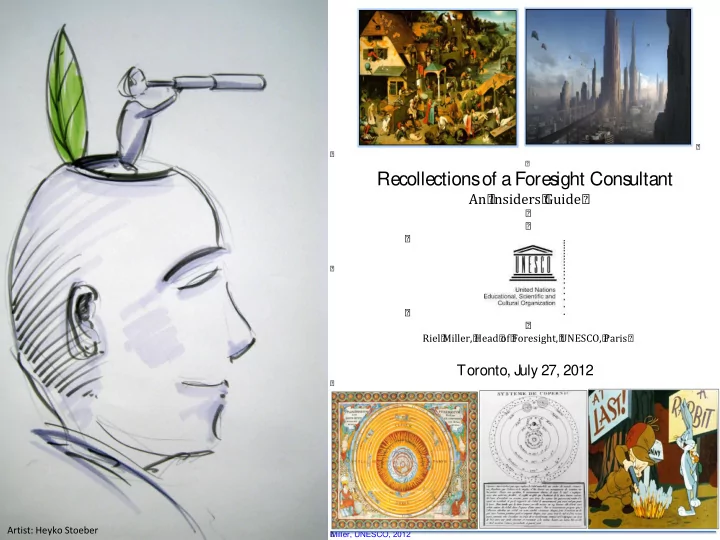
Recollections of a Fores ight Cons ultant An Insiders Guide Riel Miller, Head of Foresight, UNESCO, Paris Toronto, July 27, 2012 Artist: Heyko


slide-1
SLIDE 1

Riel Miller, UNESCO, 2012

Artist: Heyko Stoeber

  • Recollections
  • f a Fores

ight Cons ultant

An Insiders Guide

  • Riel

Miller, Head

  • f

Foresight, UNESCO, Paris

Toronto, July 27, 2012

slide-2
SLIDE 2

Riel Miller, UNESCO, 2012

2005 to 2012 Public Sector Clients

Brunei: Ministry of Education; Canada: Agriculture Canada, Alberta Health Services, Alberta Innovates Technology Futures, Defence Research and Development Canada, Health Canada; Office of the National Science Advisor, Policy Research Initiative; European Commission: Directorate of Administration, Directorate for Employment, Directorate for Research, Institute for Prospective Technological Studies, European Joint Research Council, Office of Harmonization of the Internal Market; Finland: Ministry of Labour, Tekes; France: Ministry of Finance, La Poste; Ireland: National Economic and Social Development Office; Korea: Korean Development Institute; NATO: Joint Intelligence Center; New Zealand: Ministry of Labour, SecondaryFutures; Norway: NordFosk: The Nordic Research Council, Research Council of Norway; Oman: Research Council; OECD: Directorate for Public Governance and Territorial Development; Organisation of African States: Observatory of Science and Innovation; Singapore: Prime Minister’s Office; Scotland: Scottish Enterprise; Spain: Consortium for the Commercial Promotion of Catalonia; Turkey: Turkish Council of Higher Education; United Nations: UNSECO, UNDP; United States of America: US Army

slide-3
SLIDE 3

Riel Miller, UNESCO, 2012

2005 to 2012 Private Sector Clients

Telebrasil, Brasil; Europ Assistance, France; Cartes Bancaires, France; Gemalto, France; Philips Design, Netherlands; Alstom, Switzerland; Promethean Ltd., UK; Cisco Systems, USA.

2005 to 2012 Post-Secondary Clients

Ottawa University, Canada; Aalto University, Finland; Turku School of Economics, Finland; American University of Paris, France; Université Montpellier, France; Sciences-Po, France; Autonomous University of Mexico, Mexico; University of Minho, Portugal; The Open University, UK; The Oxford Internet Institute, Oxford, UK; University of Jyväskylä, Finland.

2005 to 2012 NGO & Foundation Clients

Ateliers de la Terre, France; The Renault Foundation, France; Center for Curriculum Redesign, USA; McGraw-Hill Foundation, USA; Open Society Institute, Hungary; Quality and Leadership for Romanian Higher Education, Romania; Climate Change and Development Knowledge Network, UK; SMART( Global Change SysTem for Analysis, Research and Training), USA.
slide-4
SLIDE 4

Riel Miller, UNESCO, 2012

slide-5
SLIDE 5

Riel Miller, UNESCO, 2012

In 1898 the first international urban-planning conference convened in New York. It was abandoned after three days, instead of the scheduled ten, because none of the delegates could see any solution to the growing crisis posed by urban horses and their output.

slide-6
SLIDE 6

Riel Miller, UNESCO, 2012

Agenda

9–10:30 Preparing Why foresight (Riel 30 minutes) Know yourself (Andy 30 minutes) Personal branding Know your audience (Andy 30 minutes) Foresight Audit 10:30–10:45 BREAK 10:45– 12:00 Preparing How we spend our time (Riel 30 minutes) 1/3 selling, 1/3 marketing, 1/3 billable hours, 1/3 R&D Approaching Engagements (Andy 30 minutes) TATF framework Kickoff diagnostic Challenges of Foresight work (Riel 15 min.) 12:00–1:00 pm LUNCH

slide-7
SLIDE 7

Riel Miller, UNESCO, 2012

  • Is there a need?
  • Is the product distinctive?
  • Can you supply it AND at high quality?
  • Can you market the product?
  • Can you sell the product at a price that

sustains your business?

  • Can you continue to develop the product?
  • Are you motivated by the product?
  • Does the product sell itself?
  • Distinguishing yourself and the product…

Start With a Product!

slide-8
SLIDE 8

Riel Miller, UNESCO, 2012

  • reconcile greater freedom with collective

choices?

  • embrace greater diversity without inviting

fragmentation & chaos?

  • foster greater creativity without increasing

burn-out & stress?

  • inspire responsibility?
  • motivate change without resorting to fear?
  • manage risk without hierarchy?
  • combine respect for complexity while still

gaining depth of understanding?

Motivating Questions

slide-9
SLIDE 9

Riel Miller, UNESCO, 2012

“The poverty of historicism is a poverty of imagination. The historicist continuously upbraids those who cannot imagine a change in their little worlds; yet it seems the historicist is himself deficient in imagination for he cannot imagine a change in the conditions of change.”

Karl Popper, The Poverty of Historicism, 1944

slide-10
SLIDE 10

Riel Miller, UNESCO, 2012

slide-11
SLIDE 11

Riel Miller, UNESCO, 2012

slide-12
SLIDE 12

Riel Miller, UNESCO, 2012

slide-13
SLIDE 13

Riel Miller, UNESCO, 2012

slide-14
SLIDE 14

Riel Miller, UNESCO, 2012

slide-15
SLIDE 15

Riel Miller, UNESCO, 2012

slide-16
SLIDE 16

Riel Miller, UNESCO, 2012

A fifth wheel?

Who does it better?

  • Disciplinary specific

information gathering & sharing, analysis & policy

  • Existing communities

and cross-disciplinary problem solving

  • Systems analysis and

predictive sciences

  • Visionary leaders,

gurus, and herd extrapolation

  • Democratic institutions

and processes

  • Planners with critical

path capabilities and

  • Information gathering
  • Information sharing
  • Branching probabilistic

studies (forecasting)

  • Agenda setting
  • Due diligence on

long-run

  • Legitimacy through

surveys and participation

  • Planning…
slide-17
SLIDE 17

Riel Miller, UNESCO, 2012

Downside… Upside… where else to:

  • Embrace complexity and

the beauty of novel emergence

  • To improve the way we

“use the future” across a wide range of futures

  • Develop and diffuse the

capacity to match our aspiration for freedom with

  • ur approach to the future
  • Building capacity to both
  • vercome poverty of the

imagination as systemic change, birth and death generate changes in the conditions of change

  • Go faster in the

wrong direction

  • Muddle the picture
  • Hypocritical – claim

to address change but the aim is preservation & rejection of the inconsistent, systemically contradictory

  • Seeding fear…
slide-18
SLIDE 18

Riel Miller, UNESCO, 2012

Agenda

9–10:30 Preparing Why foresight (Riel 30 minutes) Know yourself (Andy 30 minutes) Personal branding Know your audience (Andy 30 minutes) Foresight Audit 10:30–10:45 BREAK 10:45– 12:00 Preparing How we spend our time (Riel 30 minutes) 1/3rd selling, 1/3rd marketing, 1/3rd billable hours, 1/3 R&D Approaching Engagements (Andy 30 minutes) TATF framework Kickoff diagnostic Challenges of Foresight work (Riel 15 min.) 12:00–1:00 pm LUNCH

slide-19
SLIDE 19

Riel Miller, UNESCO, 2012

Process as Product: 4 in 1 This was the xperidox approach

Experimeintalism: “action research” and learning-by-doing enables a process as product approach that integrates:

1) client search and development, 2) marketing, 3) billable days, and 4) research and development.

Through a doing it approach: speeches, workshops, courses, designing projects, implementing

slide-20
SLIDE 20

Riel Miller, UNESCO, 2012

What is Futures Literacy?

slide-21
SLIDE 21

Riel Miller, UNESCO, 2012

Futures Literacy is the capacity to tell anticipatory stories using rigorous imagining based on sharing depth

  • f knowledge from across

the community.

slide-22
SLIDE 22

Riel Miller, UNESCO, 2012

Futures Literacy is a way

  • f internalizing the

constant development of

  • ur understanding of the

emergent present and of changing anticipatory assumptions.

slide-23
SLIDE 23

Riel Miller, UNESCO, 2012

Futures Literacy is:

Three basic building blocks:

  • A. Anticipatory systems perspective that

encompasses both animate and inanimate anticipation.

  • B. Three distinct dimensions for imagining the

future and the different methods that are related to each dimension.

  • C. Action research & collective intelligence: A

learning process that uses collective intelligence – action research processes for reframing and questioning anticipatory assumptions – building the capacity to embrace complexity, spontaneity, improvisation.

slide-24
SLIDE 24

Riel Miller, UNESCO, 2012

Step A: Bugs Bunny Anticipates

slide-25
SLIDE 25

Riel Miller, UNESCO, 2012

slide-26
SLIDE 26

Riel Miller, UNESCO, 2012

Taking an Anticipatory Systems View

S : object system M : model of S E : effector system

Source: Robert Rosen, Anticipatory Systems: Philosophical, Mathematical, & Methodological Foundations., Pergamon Press, Oxford, 1985. Slide by A. H. Louie, Mathematical Biologist

slide-27
SLIDE 27

Riel Miller, UNESCO, 2012

Step B: Distinguishin g three dimensions

  • f the

potential of the present

slide-28
SLIDE 28

Riel Miller, UNESCO, 2012

slide-29
SLIDE 29

Riel Miller, UNESCO, 2012

Contingency futures: winning the lottery

slide-30
SLIDE 30

Riel Miller, UNESCO, 2012

How does the anticipatory system function? Simulation

slide-31
SLIDE 31

Riel Miller, UNESCO, 2012

Optimization Futures: Chess, Farming, Assembly Line

  • Goal, known

in advance & fixed

  • Rules, given

in advance & fixed

  • Resources,

given in

slide-32
SLIDE 32

Riel Miller, UNESCO, 2012

Optimization is Complicated: A Computer Can Do It

slide-33
SLIDE 33

Riel Miller, UNESCO, 2012

Embracing complexity: use the future, imagining the potential of the present

slide-34
SLIDE 34

Riel Miller, UNESCO, 2012

slide-35
SLIDE 35

Riel Miller, UNESCO, 2012

  • Contingency: simulation and drill,

sensing and transparency.

  • Optimization: better calculation -

extrapolations, gain clarity and familiarity with the rules, reform strategies.

  • Embrace complexity: imagining

changes in the conditions of change, constantly reinventing the potential of the present, multi-

  • ntology anticipatory system.
slide-36
SLIDE 36

Riel Miller, UNESCO, 2012

Anticipatory Methods: Context Makes a Difference

Embrace complexity

Complex Simple Closed Open

Optimization (chess game)

Align Dimensions of the Future with Methods Use Futures Literacy

slide-37
SLIDE 37

Riel Miller, UNESCO, 2012

Step C: Rigorous Imagining

Action research & collective intelligenc e: Using

reframing of anticipatory assumptions to develop rich stories of imaginary

slide-38
SLIDE 38

Riel Miller, UNESCO, 2012

Rigorous Knowledge Creation: Action Research

Narrative Capacity Capacity to Reframe Collective Intelligence

(interactive sense making)

slide-39
SLIDE 39

Riel Miller, UNESCO, 2012

Becoming Futures Literate as Knowledge Creation

  • Level 1 Making the Future Explicit

–Temporal awareness, values, expectations – initial anticipatory assumptions

  • Level 2 Frames and Sense Making

–Rigorous imagining - reframing

  • Level 3 Making Sense and Doing

–Strategic choices

slide-40
SLIDE 40

Riel Miller, UNESCO, 2012

Learning Curve

Tacit to explicit Learning to Learn - Reframing New Questions

slide-41
SLIDE 41

Riel Miller, UNESCO, 2012

Deliberate Thinking: Policy- Action(from Edward de Bono)

Target and Task Contract and Conclude Expand and Explore

slide-42
SLIDE 42

Riel Miller, UNESCO, 2012

Agenda

1:00-2:30 Doing Framing case: CLA pitch Scanning case: Dow hunting platforms Forecasting case: Scenario Indicators FuturesIreland: National Futures Visioning case: APF case Planning/Acting case: integration process France – sud-Nivernais: regional 2:30–2:45 pm BREAK 2:45–5:00 Reflecting: Case sharing Success framework Cases: The contact, The pitch, How it unfolded Audience cases 5:00 ADJOURN

slide-43
SLIDE 43

Riel Miller, UNESCO, 2012

The central argument of this report is that Irish people—in business, society and public service—are ready for much greater innovation, more widespread learning and richer accountability; but the capabilities and practices that support these are inhibited by some features of our

  • rganisational system.

This argument has significant implications for how we address the current acute crisis and how we lay the foundations for future

slide-44
SLIDE 44

Riel Miller, UNESCO, 2012

Convergence: Catch-up with the leader

slide-45
SLIDE 45

Riel Miller, UNESCO, 2012

Leap-frog: From behind to being ahead

Leap-frog to where?

slide-46
SLIDE 46

Riel Miller, UNESCO, 2012

FuturesIreland HSS

  • Two groups engaged in 3 Level process

– Advisory Committee and Consultative Panel – each went through phases

  • Expert Panel contributed to development
  • f rigorous imagining frameworks –

helped develop and encourage Level 2 reframing

  • Process as product and seeds of a

paradigm change – a strategic choice

slide-47
SLIDE 47

Riel Miller, UNESCO, 2012

From vision to action Diversity and level of Participation

A few decision- makers Citizen participation Large societal debate Stakeholder expert groups

Phase I: Diagnosis

Vision How to get there + recommendations Measures, actions Diagnosis

Phase II: Exploration Phase III: Strategic

  • rientation

Phase IV: Making choices Phase V: Implementation and coordination

From vision to action Diversity and level of Participation

A few decision- makers Citizen participation Large societal debate Stakeholder expert groups A few decision- makers Citizen participation Large societal debate Stakeholder expert groups

Phase I: Diagnosis

Vision How to get there + recommendations Measures, actions Diagnosis Vision How to get there + recommendations Measures, actions Diagnosis

Phase II: Exploration Phase III: Strategic

  • rientation

Phase IV: Making choices Phase V: Implementation and coordination

Da Costa, Foresight Impact on Policy Making, IPTS, 2006

HSS Level 1 HSS Level 2 HSS Level 3

Hybrid Strategic Scenario Method for Developing Futures Literacy

slide-48
SLIDE 48

Riel Miller, UNESCO, 2012

FuturesIreland Three Levels of FL

Consultative Panel 1

  • Innovation
  • Experienc

es

Consultative Panel 2

  • Ireland in

2030

  • Thinking
  • f a

specific communit

y

Consultative Panel 3

  • Workin

g with dis- ruptive change

slide-49
SLIDE 49

Riel Miller, UNESCO, 2012

Sense Making Framework

Social Integration and Creation Public Governance Business/W ealth Creation Institutional Inter- personal Intra- personal

slide-50
SLIDE 50

Riel Miller, UNESCO, 2012

slide-51
SLIDE 51

Riel Miller, UNESCO, 2012

SudNivernais Three Levels of FL

Session 1

  • Workshop

with Innovators

  • Four

sectors

Session 2

  • Level 1 &

2 Workshop with Elected Officials

Session 3

  • Level 3

Workshop with Eleected Officials

Permanent Secretariat from two local “regional development”

  • ffices reporting to a large and representative regional

development committee

slide-52
SLIDE 52

Riel Miller, UNESCO, 2012

Level 1 Futures Literacy

Temporal awareness, values, expectations

slide-53
SLIDE 53

Riel Miller, UNESCO, 2012

Bear Scenarios: Papa, Mama and Baby

slide-54
SLIDE 54

Riel Miller, UNESCO, 2012

Demographics

Population Time

Baby Mama Papa

slide-55
SLIDE 55

Riel Miller, UNESCO, 2012

Ennio Morricone

slide-56
SLIDE 56

Riel Miller, UNESCO, 2012

The Good, The Bad & The Ugly

Global Warming: Scenarios New Agreement (good) No agreements (bad) Muddle through (ugly) Human impact

  • n climate

change reduced Massive climate disruption Moderate human induced disruption of climate

Build composite scenarios combining trends & preferences

slide-57
SLIDE 57

Riel Miller, UNESCO, 2012

The Good, The Bad and The Ugly Bear Scenarios Knowledge Driven Commercially Driven Mixed Model Low rate of tech change Low enrollement growth Scenario 1 Scenario 2 Scenario 3 Medium enrollment growth Scenario 4 Scenario 5 Scenario 6 High Enrollment growth Scenario 7 Scenario 8 Scenario 9 High rate of tech change Low enrollement growth Scenario 10 Scenario 11 Scenario 12 Medium enrollment growth Scenario 13 Scenario 14 Scenario 15 High Enrollment growth Scenario 16 Scenario 17 Scenario 18

slide-58
SLIDE 58

Riel Miller, UNESCO, 2012

Level 2 Futures Literacy

a) Rigorous imagining b) Telling good stories c) Distinct operational stories within the frames

slide-59
SLIDE 59

Riel Miller, UNESCO, 2012

  • A. Models for Rigorous

Imagining?

Select:

–Specific topic –Theory (social science) underlying attributes –Variables (metrics) underlying attributes

An example:

–Specific topic: electricity –Dimension of change: pervasiveness –Model variable space of pervasiveness: a) ease-of-use b) range-of-uses

slide-60
SLIDE 60

Riel Miller, UNESCO, 2012

An Example of an Analytical Frame

Ease of use

Simple Difficult Limited & homogeneous Unlimited & heterogeneous

Range of uses

Ubiquitous

  • Ambient

Rich Analytical Stories of Imaginary Futures

Central Dynamo

slide-61
SLIDE 61

Riel Miller, UNESCO, 2012

  • B. Telling good stories –

five narrative criteria for framing scenarios

  • 1. Purpose/genre
  • 2. Point-of-view
  • 3. Temporal-chronological frame
  • 4. Protagonists
  • 5. Causal rules – the “physics of

the situation”

slide-62
SLIDE 62

Riel Miller, UNESCO, 2012

  • 1. What is the type or purpose of

the story?

Not tragedy or comedy, thriller or romance; but basic types:

  • contingency planning/simulation training
  • optimisation testing
  • discovery - exploration -imagining
slide-63
SLIDE 63

Riel Miller, UNESCO, 2012

  • 2. What is the point-of-view?

Not first or third person, stream-of- consciousness or dialogue; but is the story told in terms of:

  • the choices people make in their

everyday lives (micro) or

  • aggregate outcomes (macro) – or
  • both explicit relationship between

micro & macro

slide-64
SLIDE 64

Riel Miller, UNESCO, 2012

  • 3. What is the temporal or

chronological frame?

Not beginning, middle and end; but

  • comparative static (two or more cross-

sections) or

  • dynamic/path (time-series) or
  • backcasting (reverse engineered)
slide-65
SLIDE 65

Riel Miller, UNESCO, 2012

  • 4. Who are the main

protagonists?

Not hero and villain; but who makes the

decisions

  • a specific institution (sub-unit) or
  • a social/economic system (nation, sector, etc.)
  • r
  • institutions nested within a dynamic

socio/economic context - interaction

slide-66
SLIDE 66

Riel Miller, UNESCO, 2012

  • 5. What rules apply to the action?

Not is time travel allowed or Matrix like suspension of the rules of physics; but what arethe assumptions that provide the analytical definitions and causal relationships that make for robust social science.

slide-67
SLIDE 67

Riel Miller, UNESCO, 2012

  • C. Six Electrification Scenarios

Function s

Organisation

Centralised Decentralised Only as a Weapon

Scenario 1

Scenario 2

Scenario 3

Scenario 4

Consumer Power

Scenario 5

Scenario 6

Industrial Power

slide-68
SLIDE 68

Riel Miller, UNESCO, 2012

Constrain the form and function scenarios Using the possibility space variables and the general form/function framework to focus on imagining functional – day-in- the-life alternatives based on distinct forms and function outcome scenarios – these scenarios will differ on the basis of :

  • Distinct values
  • Distinct organisational options
slide-69
SLIDE 69

Riel Miller, UNESCO, 2012

Dual frame for the scenarios: analytical and narrative – then different scenarios (ways of achieving the same

  • utcome) within the frame

(iso-probable, iso- desirable)

slide-70
SLIDE 70

Riel Miller, UNESCO, 2012

slide-71
SLIDE 71

Riel Miller, UNESCO, 2012

slide-72
SLIDE 72

Riel Miller, UNESCO, 2012

Stories within the frames

slide-73
SLIDE 73

Riel Miller, UNESCO, 2012

Level 3 Futures Literacy

Strategic scenarios

– Using the contrast between imagined futures and the present assumptions: – Clarify systemic boundaries and identify changes in the conditions of change – Reintroduce values and expectations – Focus on the assumptions and how choices might make a difference (defensive, neutral, transformative)

slide-74
SLIDE 74

Riel Miller, UNESCO, 2012

Change within the system

Thinking about systemic change?

Inside-in

Change outside the system

Inside-out Outside-in Outside-out

slide-75
SLIDE 75

Riel Miller, UNESCO, 2012

Thank you

Riel Miller

Image: Sempe

How we anticipate matters, it changes the present, help people to use the future more effecitvely