after implantation of drug eluting stents in patients non-resistant - - PowerPoint PPT Presentation

after implantation of drug eluting stents
SMART_READER_LITE
LIVE PREVIEW

after implantation of drug eluting stents in patients non-resistant - - PowerPoint PPT Presentation

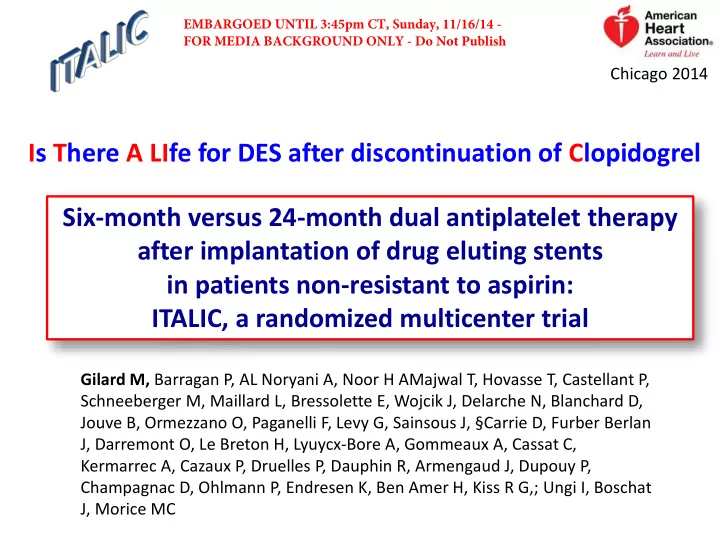
FOR MEDIA BACKGROUND ONLY - Do Not Publish EMBARGOED UNTIL 3:45pm CT, Sunday, 11/16/14 - Chicago 2014 Is There A LIfe for DES after discontinuation of Clopidogrel Six-month versus 24-month dual antiplatelet therapy after implantation of drug


slide-1
SLIDE 1

Chicago 2014

Six-month versus 24-month dual antiplatelet therapy after implantation of drug eluting stents in patients non-resistant to aspirin: ITALIC, a randomized multicenter trial Is There A LIfe for DES after discontinuation of Clopidogrel

Gilard M, Barragan P, AL Noryani A, Noor H AMajwal T, Hovasse T, Castellant P, Schneeberger M, Maillard L, Bressolette E, Wojcik J, Delarche N, Blanchard D, Jouve B, Ormezzano O, Paganelli F, Levy G, Sainsous J, §Carrie D, Furber Berlan J, Darremont O, Le Breton H, Lyuycx-Bore A, Gommeaux A, Cassat C, Kermarrec A, Cazaux P, Druelles P, Dauphin R, Armengaud J, Dupouy P, Champagnac D, Ohlmann P, Endresen K, Ben Amer H, Kiss R G,; Ungi I, Boschat J, Morice MC

EMBARGOED UNTIL 3:45pm CT, Sunday, 11/16/14 - FOR MEDIA BACKGROUND ONLY - Do Not Publish

slide-2
SLIDE 2

Background

  • Background. The currently recommended duration of dual antiplatelet

therapy (DAPT) in drug-eluting stent (DES) recipients is 12 months, to reduce the risk of late stent thrombosis, particularly in acute coronary syndrome. Objectives: It was hypothesized that antiplatelet treatment with DAPT for 6 versus may be non-inferior to DAPT for 24 months in aspirin-sensitive patients

slide-3
SLIDE 3

Background

Cassese et al European Heart Journal 2012; 33: 3078-3087

Death Myocardial Infarction Stent Thrombosis Cerebrovascular Accident TIMI Major Bleeding Odds Ration M-H Random 95% CI 1.15 |0.85, 1.54] 0.95 [0.66, 1.36] 0.88 [0.43, 1.81] 1.51 [0.92, 2.47] 2.64 [1.31, 5.30]

Extended Better Control Better

Clinical Impact of Extended DAPT after PCI

A metanalysis of Randomized trials (n=8231)

N Engl J Med 2010;362:1374–1382 Circulation 2012;125:2015–2026 Circulation 2012;125:505–513. J Am Coll Cardiol. 2012 Oct 9;60(15):1340-8.

slide-4
SLIDE 4

Objectives

It was hypothesized that antiplatelet treatment with DAPT for 6 versus may be non-inferior to DAPT for 24 months To be sure that patients would be protected by their antiplatelet therapy in either situation, patients resistant to aspirin were excluded

slide-5
SLIDE 5

Methods

A prospective open-label randomized trial 70 sites in Europe and the Middle East.

48 French sites

11- 2008 to 12-2010

7 European - Middle East sites

11- 2008 to 12-2010

slide-6
SLIDE 6

Methods

slide-7
SLIDE 7

Methods

  • Patients aged 18 years or over, eligible for PCI
  • At least one Xience V DES (Abbott Vascular Devices) implanted
  • Patients were not pre-treated with abciximab during hospital stay.
  • Aspirin resistance was checked.
  • Patients were pre-treated with aspirin + clopidogrel (prasugrel or

ticagrelor)

Inclusion criteria

slide-8
SLIDE 8

Methods

  • Known platelet level less than 100,000/μl or known hemorrhagic diathesis
  • Oral anticoagulation therapy
  • Contraindications to aspirin or clopidogrel (prasugrel or ticagrelor)

Exclusion criteria

  • Major surgery within the preceding 6 weeks
  • Evidence of active gastrointestinal or urogenital bleeding
  • Severe liver failure; any surgery scheduled during the year after enrolment
  • Severe concomitant disease with less than 2 years’ life expectancy
  • Prior DES implantation within 1 year
  • Primary PCI for acute myocardial infarction
  • Treatment of the left main artery
slide-9
SLIDE 9

Methods

Aspirin resistant

With or without dose adjustment

Good aspirin responders

Randomization

Randomization applied

No events during first 6 months

Resistant group

Clopidogrel (prasugrel or ticagrelor) + aspirin, duration decided by the team

Group 1:

Dual oral antiplatelet regimen for 24 months followed by aspirin alone

Group 2:

Dual oral antiplatelet regimen for 6 months followed by aspirin alone

Patient with Xience V implantation

slide-10
SLIDE 10

Methods

Patient aspirin responder : PFA-100 >165 seconds Multiplate electrical impedance aggregometry ≥30% VerifyNow Aspirin ≥ 550 aspirin reaction units.

Aspirin Resistance Tests: 3 The type of test depends of the centre

slide-11
SLIDE 11

Methods

Primary endpoint : death, MI, emergency TVR, stroke or major bleeding according to the TIMI criteria within 12 months Secondary endpoints : Same composite endpoint at 24 and 36 months Individual endpoints used in the composite major Incidence of minor and minimal bleeding complications (TIMI criteria)

Endpoints

Academic Research Consortium criteria

slide-12
SLIDE 12

Results

Aspirin resistant 137 pts Good aspirin responders 1894 pts Randomization applied 1850 pts

Resistant group

131 pts at 1-Y

Group 1: 24 months

924 910 at 1-Y

Group 2: 6 months

926 912 at 1-Y Patient with Xience V implantation 2031 pts

slide-13
SLIDE 13

Results

Resistant Group n=131 24-month DAPT n=910 6-Month DAPT n=912 P Age, yrs 62.6 (10.8) 61.5 (11.1) 61.7 (10.9) 0.792 Male gender, n (%) 106 (80.9%) 721 (79.2%) 737 (80.8%) 0.399 Body Mass Index (kg/m2) 27.5 (4.2) 27.1 (4.7) 27.0 (4.6) 0.549 Type-2 diabetes, n (%) 42 (32.1%) 344 (37.8%) 331 (36.3%) 0.505 Hypertension, n (%) 76 (58.0%) 589 (64.7%) 595 (65.2%) 0.817 Hyperlipidemia, n (%) 84 (64.1%) 611 (67.1%) 612 (67.1%) 0.986 Smoker, n (%) 69 (52.7%) 480 (52.7%) 464 (50.9%) 0.424 Family history, n (%) 50 (38.2%) 325 (35.7%) 322 (35.3%) 0.856 Previous MI, n (%) 36 (27.5%) 134 (14.7%) 142 (15.6%) 0.615 Previous PCI, n (%) 39 (29.8%) 205 (22.5%) 220 (24.1%) 0.421 Previous CABG, n (%) 6 (4.6%) 45 (4.9%) 61 (6.7%) 0.111 Previous stroke, n (%) 6 (4.6%) 26 (2.9%) 25 (2.7%) 0.881 Renal insufficiency 4 (3.1%) 25 (2.7%) 28 (3.1%) 0.682

Baseline Characteristics

slide-14
SLIDE 14

Results

Baseline Characteristics

slide-15
SLIDE 15

Results

Procedural Characteristics

slide-16
SLIDE 16

Results

In the short-DAPT arm: 221 patients (24.2%) did not respect the 6-month TTT 83 patients (8.9%) continuing treatment longer In the long-DAPT arm: 49 patients (5.4%) discontinued TTT before 24 months.

slide-17
SLIDE 17

Results

End Point @ 1 year

1 2 3 4 5 24M DAPT 6M DAPT

910 910 910 910 905 901 896 24M DAPT 912 912 912 911 905 900 897 6M DAPT

Time ( in months)

Cumulative Death? MI, Stroke,Major bleeding rate (%)

Logrank p=0,8518 1,6% 1,5%

0 2 4 6 8 10 12

slide-18
SLIDE 18

Results

1-year clinical outcomes in the intention-to-treat study population

slide-19
SLIDE 19

Results

slide-20
SLIDE 20

Results

Non-inferiority was established for 6-month versus 24-month DAPT

0.11% (95% CI: -1.04 to 1.26; p for non-inferiority = 0.0002) The trial was prematurely terminated due to problems with

  • recruitment. However:

Rate of events of 1.5% (compared to 3% expected) Far from the boundary

slide-21
SLIDE 21

Conclusion

ITALIC showed that rates of bleeding and thrombotic events were not significantly different between the 6- and 24-month DAPT groups after PCI with new-generation DES 6-month DAPT was non-inferior to 24-month DAPT in good aspirin responders. Non-inferiority was also observed in the subgroup of unstable patients (one half of patients). Larger trials are needed to assess the effect of antiplatelet duration in ACS patients.