Recall from Last Lecture: XPath bib matches a bib element * - - PDF document

recall from last lecture xpath
SMART_READER_LITE
LIVE PREVIEW

Recall from Last Lecture: XPath bib matches a bib element * - - PDF document

Recall from Last Lecture: XPath bib matches a bib element * matches any element CS/INFO 330 / matches the root element /bib matches a bib element under root XQuery bib/paper matches a paper in bib bib//paper matches a paper in bib, at


slide-1
SLIDE 1

1

1

CS/INFO 330 XQuery

October 23, 2005: Guest lecture by Al Demers October 26: Continuation by JG Slides courtesy of Dan Suciu, University of Washington

2

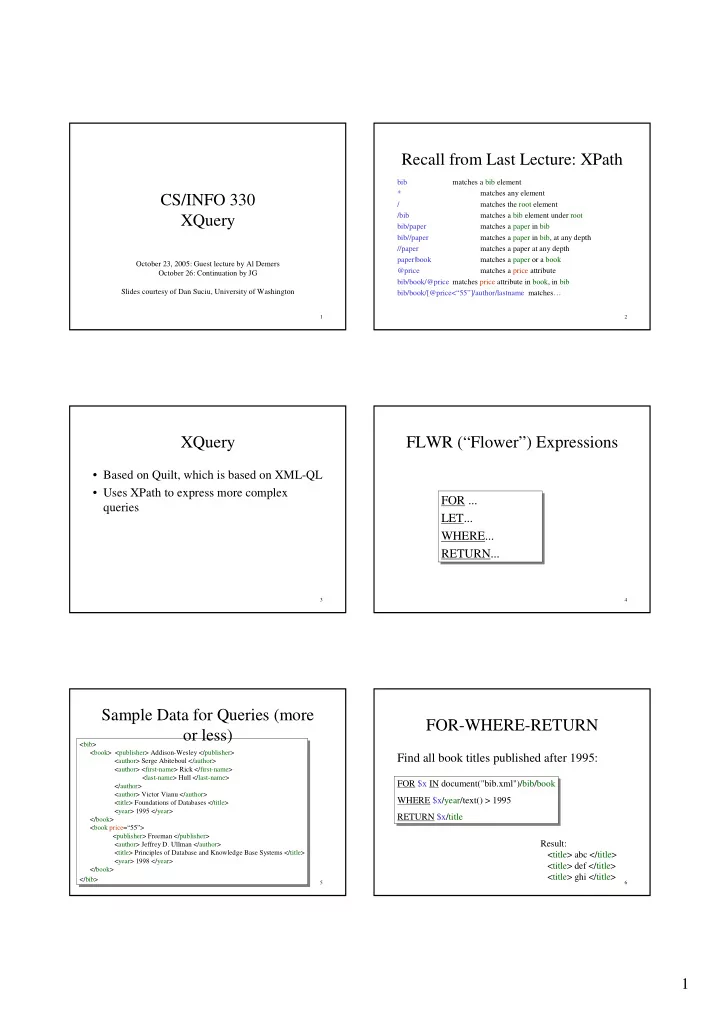
Recall from Last Lecture: XPath

bib matches a bib element * matches any element / matches the root element /bib matches a bib element under root bib/paper matches a paper in bib bib//paper matches a paper in bib, at any depth //paper matches a paper at any depth paper|book matches a paper or a book @price matches a price attribute bib/book/@price matches price attribute in book, in bib bib/book/[@price<“55”]/author/lastname matches…

3

XQuery

  • Based on Quilt, which is based on XML-QL
  • Uses XPath to express more complex

queries

4

FLWR (“Flower”) Expressions

FOR ... LET... WHERE... RETURN... FOR ... LET... WHERE... RETURN...

5

<bib> <book> <publisher> Addison-Wesley </publisher> <author> Serge Abiteboul </author> <author> <first-name> Rick </first-name> <last-name> Hull </last-name> </author> <author> Victor Vianu </author> <title> Foundations of Databases </title> <year> 1995 </year> </book> <book price=“55”> <publisher> Freeman </publisher> <author> Jeffrey D. Ullman </author> <title> Principles of Database and Knowledge Base Systems </title> <year> 1998 </year> </book> </bib> <bib> <book> <publisher> Addison-Wesley </publisher> <author> Serge Abiteboul </author> <author> <first-name> Rick </first-name> <last-name> Hull </last-name> </author> <author> Victor Vianu </author> <title> Foundations of Databases </title> <year> 1995 </year> </book> <book price=“55”> <publisher> Freeman </publisher> <author> Jeffrey D. Ullman </author> <title> Principles of Database and Knowledge Base Systems </title> <year> 1998 </year> </book> </bib>

Sample Data for Queries (more

  • r less)

6

FOR-WHERE-RETURN

Find all book titles published after 1995:

FOR $x IN document("bib.xml")/bib/book WHERE $x/year/text() > 1995 RETURN $x/title FOR $x IN document("bib.xml")/bib/book WHERE $x/year/text() > 1995 RETURN $x/title Result: <title> abc </title> <title> def </title> <title> ghi </title>

slide-2
SLIDE 2

2

7

FOR-WHERE-RETURN

Equivalently (perhaps more geekish)

FOR $x IN document("bib.xml")/bib/book[year/text() > 1995] /title RETURN $x FOR $x IN document("bib.xml")/bib/book[year/text() > 1995] /title RETURN $x And even shorter: document("bib.xml")/bib/book[year/text() > 1995] /title document("bib.xml")/bib/book[year/text() > 1995] /title

8

FOR-WHERE-RETURN

  • Find all book titles and the year when they

were published:

FOR $x IN document("bib.xml")/bib/book RETURN <answer> <what>{ $x/title/text() } </what> <when>{ $x/year/text() } </when> </answer> FOR $x IN document("bib.xml")/bib/book RETURN <answer> <what>{ $x/title/text() } </what> <when>{ $x/year/text() } </when> </answer> We can construct whatever XML results we want !

9

Answer

<answer> <what> How to cook a Turkey </what> <when> 2003 </when> </answer> <answer> <what> Cooking While Watching TV </what> <when> 2004 </when> </answer> <answer> <what> Turkeys on TV</what> <when> 2002 </when> </answer> . . . . . <answer> <what> How to cook a Turkey </what> <when> 2003 </when> </answer> <answer> <what> Cooking While Watching TV </what> <when> 2004 </when> </answer> <answer> <what> Turkeys on TV</what> <when> 2002 </when> </answer> . . . . .

10

FOR-WHERE-RETURN

  • Notice the use of “{“ and “}”
  • What is the result without them ?

FOR $x IN document("bib.xml")/bib/book RETURN <answer> <title> $x/title/text() </title> <year> $x/year/text() </year> </answer> FOR $x IN document("bib.xml")/bib/book RETURN <answer> <title> $x/title/text() </title> <year> $x/year/text() </year> </answer>

11

XQuery: Nesting

For each author of a book by Morgan Kaufmann, list all books she published:

FOR $b IN document(“bib.xml”)/bib, $a IN $b/book[publisher /text()=“Morgan Kaufmann”]/author RETURN <result> { $a, FOR $t IN $b/book[author/text()=$a/text()]/title RETURN $t } </result> FOR $b IN document(“bib.xml”)/bib, $a IN $b/book[publisher /text()=“Morgan Kaufmann”]/author RETURN <result> { $a, FOR $t IN $b/book[author/text()=$a/text()]/title RETURN $t } </result> In the RETURN clause comma concatenates XML fragments

12

XQuery

<result> <author>Jones</author> <title> abc </title> <title> def </title> </result> <result> <author> Smith </author> <title> ghi </title> </result> <result> <author>Jones</author> <title> abc </title> <title> def </title> </result> <result> <author> Smith </author> <title> ghi </title> </result> Result:

slide-3
SLIDE 3

3

13

Aggregates

Find all books with more than 3 authors:

count = a function that counts avg = computes the average sum = computes the sum distinct-values = eliminates duplicates FOR $x IN document("bib.xml")/bib/book WHERE count($x/author)>3 RETURN $x FOR $x IN document("bib.xml")/bib/book WHERE count($x/author)>3 RETURN $x

14

Aggregates

Same thing:

FOR $x IN document("bib.xml")/bib/book[count(author)>3] RETURN $x FOR $x IN document("bib.xml")/bib/book[count(author)>3] RETURN $x

15

Aggregates

Print all authors who published more than 3 books

FOR $b IN document("bib.xml")/bib, $a IN $b/book/author/text()) WHERE count($b/book[author/text()=$a)>3 RETURN <author> { $a } </author> FOR $b IN document("bib.xml")/bib, $a IN $b/book/author/text()) WHERE count($b/book[author/text()=$a)>3 RETURN <author> { $a } </author> What’s wrong ?

16

Aggregates

Be aware of duplicates !

FOR $b IN document("bib.xml")/bib, $a IN distinct-values($b/book/author/text()) WHERE count($b/book[author/text()=$a)>3 RETURN <author> { $a } </author> FOR $b IN document("bib.xml")/bib, $a IN distinct-values($b/book/author/text()) WHERE count($b/book[author/text()=$a)>3 RETURN <author> { $a } </author>

17

XQuery

Find books whose price is larger than average:

FOR $b in document(“bib.xml”)/bib LET $a:=avg($b/book/price/text()) FOR $x in $b/book WHERE $x/price/text() > $a RETURN $x FOR $b in document(“bib.xml”)/bib LET $a:=avg($b/book/price/text()) FOR $x in $b/book WHERE $x/price/text() > $a RETURN $x

LET binds a variable to one value; FOR iterates a variable over a list of values We will come back to that

18

FOR-WHERE-RETURN

  • “Flatten” the authors, i.e. return a list of

(author, title) pairs

FOR $b IN document("bib.xml")/bib/book, $x IN $b/title/text(), $y IN $b/author/text() RETURN <answer> <title> { $x } </title> <author> { $y } </author> </answer> FOR $b IN document("bib.xml")/bib/book, $x IN $b/title/text(), $y IN $b/author/text() RETURN <answer> <title> { $x } </title> <author> { $y } </author> </answer>

Answer: <answer> <title> abc </title> <author> efg </author> </answer> <answer> <title> abc </title> <author> hkj </author> </answer>

slide-4
SLIDE 4

4

19

FOR-WHERE-RETURN

  • For each author, return all book titles he/she

wrote

FOR $b IN document("bib.xml")/bib, $x IN $b/book/author/text() RETURN <answer> <author> { $x } </author> { FOR $y IN $b/book[author/text()=$x]/title RETURN $y } </answer> FOR $b IN document("bib.xml")/bib, $x IN $b/book/author/text() RETURN <answer> <author> { $x } </author> { FOR $y IN $b/book[author/text()=$x]/title RETURN $y } </answer> What about duplicate authors ?

Answer: <answer> <author> efg </author> <title> abc </title> <title> klm </title> . . . . </answer>

20

FOR-WHERE-RETURN

  • Same, but eliminate duplicate authors:

FOR $b IN document("bib.xml")/bib LET $a := distinct-values($b/book/author/text()) FOR $x IN $a RETURN <answer> <author> $x </author> { FOR $y IN $b/book[author/text()=$x]/title RETURN $y } </answer> FOR $b IN document("bib.xml")/bib LET $a := distinct-values($b/book/author/text()) FOR $x IN $a RETURN <answer> <author> $x </author> { FOR $y IN $b/book[author/text()=$x]/title RETURN $y } </answer>

21

FOR-WHERE-RETURN

  • Same thing:

FOR $b IN document("bib.xml")/bib, $x IN distinct-values($b/book/author/text()) RETURN <answer> <author> $x </author> { FOR $y IN $b/book[author/text()=$x]/title RETURN $y } </answer> FOR $b IN document("bib.xml")/bib, $x IN distinct-values($b/book/author/text()) RETURN <answer> <author> $x </author> { FOR $y IN $b/book[author/text()=$x]/title RETURN $y } </answer>

22

SQL and XQuery Side-by-side

Product(pid, name, maker, price) Find all product names, prices, sort by price SELECT x.name, x.price FROM Product x ORDER BY x.price SELECT x.name, x.price FROM Product x ORDER BY x.price SQL FOR $x in document(“db.xml”)/db/Product/row ORDER BY $x/price/text() RETURN <answer> { $x/name, $x/price } </answer> FOR $x in document(“db.xml”)/db/Product/row ORDER BY $x/price/text() RETURN <answer> { $x/name, $x/price } </answer> XQuery

23

<answer> <name> abc </name> <price> 7 </price> </answer> <answer> <name> def </name> <price> 23 </price> </answer> . . . .

Answers

Notice: this is NOT a well-formed document ! (WHY ???) . . . . . . 23 def 7 abc Price Name

24

Producing a Well-Formed Answer

<myQuery> { FOR $x in document(“db.xml”)/db/Product/row ORDER BY $x/price/text() RETURN <answer> { $x/name, $x/price } </answer> } </myQuery> <myQuery> { FOR $x in document(“db.xml”)/db/Product/row ORDER BY $x/price/text() RETURN <answer> { $x/name, $x/price } </answer> } </myQuery>

slide-5
SLIDE 5

5

25

<myQuery> <answer> <name> abc </name> <price> 7 </price> </answer> <answer> <name> def </name> <price> 23 </price> </answer> . . . . </myQuery>

Xquery’s Answer

Now it is well-formed !

26

SQL and XQuery Side-by-side

Product(pid, name, maker, price) Company(cid, name, city, revenues) Find all products made in Seattle SELECT x.name FROM Product x, Company y WHERE x.maker=y.cid and y.city=“Seattle” SELECT x.name FROM Product x, Company y WHERE x.maker=y.cid and y.city=“Seattle” SQL FOR $r in document(“db.xml”)/db, $x in $r/Product/row, $y in $r/Company/row WHERE $x/maker/text()=$y/cid/text() and $y/city/text() = “Seattle” RETURN { $x/name } FOR $r in document(“db.xml”)/db, $x in $r/Product/row, $y in $r/Company/row WHERE $x/maker/text()=$y/cid/text() and $y/city/text() = “Seattle” RETURN { $x/name } XQuery FOR $y in /db/Company/row[city/text()=“Seattle”], $x in /db/Product/row[maker/text()=$y/cid/text()] RETURN { $x/name } FOR $y in /db/Company/row[city/text()=“Seattle”], $x in /db/Product/row[maker/text()=$y/cid/text()] RETURN { $x/name } Cool XQuery

27

<product> <row> <pid> 123 </pid> <name> abc </name> <maker> efg </maker> </row> <row> …. </row> … </product> <product> . . . </product> . . . .

28

SQL and XQuery Side-by-side

For each company with revenues < 1M count the products over $100 SELECT y.name, count(*) FROM Product x, Company y WHERE x.price > 100 and x.maker=y.cid and y.revenue < 1000000 GROUP BY y.cid, y.name SELECT y.name, count(*) FROM Product x, Company y WHERE x.price > 100 and x.maker=y.cid and y.revenue < 1000000 GROUP BY y.cid, y.name

FOR $r in document(“db.xml”)/db, $y in $r/Company/row[revenue/text()<1000000] RETURN <proudCompany> <companyName> { $y/name/text() } </companyName> <numberOfExpensiveProducts> { count($r/Product/row[maker/text()=$y/cid/text()][price/text()>100]) } </numberOfExpensiveProducts> </proudCompany> FOR $r in document(“db.xml”)/db, $y in $r/Company/row[revenue/text()<1000000] RETURN <proudCompany> <companyName> { $y/name/text() } </companyName> <numberOfExpensiveProducts> { count($r/Product/row[maker/text()=$y/cid/text()][price/text()>100]) } </numberOfExpensiveProducts> </proudCompany>

29

SQL and XQuery Side-by-side

Find companies with at least 30 products, and their average price

SELECT y.name, avg(x.price) FROM Product x, Company y WHERE x.maker=y.cid GROUP BY y.cid, y.name HAVING count(*) > 30 SELECT y.name, avg(x.price) FROM Product x, Company y WHERE x.maker=y.cid GROUP BY y.cid, y.name HAVING count(*) > 30 FOR $r in document(“db.xml”)/db, $y in $r/Company/row LET $p := $r/Product/row[maker/text()=$y/cid/text()] WHERE count($p) > 30 RETURN <theCompany> <companyName> { $y/name/text() } </companyName> <avgPrice> avg($p/price/text()) </avgPrice> </theCompany> FOR $r in document(“db.xml”)/db, $y in $r/Company/row LET $p := $r/Product/row[maker/text()=$y/cid/text()] WHERE count($p) > 30 RETURN <theCompany> <companyName> { $y/name/text() } </companyName> <avgPrice> avg($p/price/text()) </avgPrice> </theCompany>

A collection An element

30

FOR v.s. LET

FOR

  • Binds node variables iteration

LET

  • Binds collection variables one value
slide-6
SLIDE 6

6

31

FOR v.s. LET

FOR $x IN /bib/book RETURN <result> { $x } </result> FOR $x IN /bib/book RETURN <result> { $x } </result>

Returns:

<result> <book>...</book></result> <result> <book>...</book></result> <result> <book>...</book></result> ...

LET $x := /bib/book RETURN <result> { $x } </result> LET $x := /bib/book RETURN <result> { $x } </result>

Returns:

<result> <book>...</book> <book>...</book> <book>...</book> ... </result>

32

Collections in XQuery

  • Ordered and unordered collections

– /bib/book/author/text() = an ordered collection: result is in document order – distinct-values(/bib/book/author/text()) = an unordered collection: the output order is implementation dependent

  • LET $a := /bib/book $a is a collection
  • $b/author a collection (several authors...)

RETURN <result> { $b/author } </result> RETURN <result> { $b/author } </result>

Returns:

<result> <author>...</author> <author>...</author> <author>...</author> ... </result>

33

XQuery

Summary:

  • FOR-LET-WHERE-RETURN = FLWR

FOR/LET Clauses WHERE Clause RETURN Clause List of tuples List of tuples Instance of Xquery data model