XPATH and XQUERY Two query language to search for features in XML - - PDF document

xpath and xquery
SMART_READER_LITE
LIVE PREVIEW

XPATH and XQUERY Two query language to search for features in XML - - PDF document

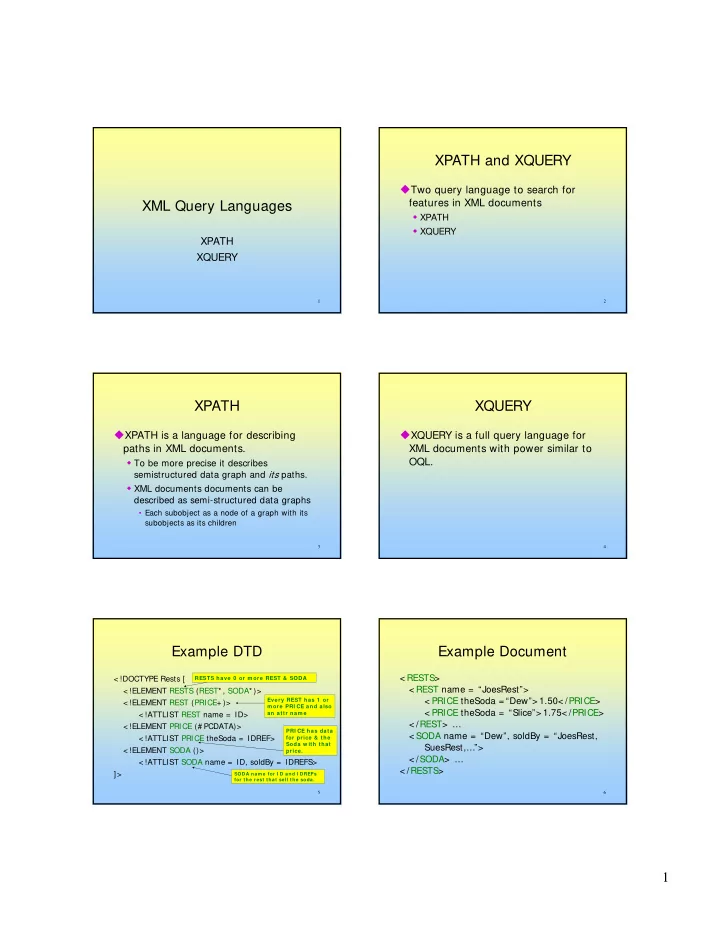
XPATH and XQUERY Two query language to search for features in XML documents XML Query Languages XPATH XQUERY XPATH XQUERY 1 2 XPATH XQUERY XPATH is a language for describing XQUERY is a full query language for paths in


slide-1
SLIDE 1

1

1

XML Query Languages

XPATH XQUERY

2

XPATH and XQUERY

Two query language to search for

features in XML documents

XPATH XQUERY

3

XPATH

XPATH is a language for describing

paths in XML documents.

To be more precise it describes semistructured data graph and its paths. XML documents documents can be described as semi-structured data graphs

  • Each subobject as a node of a graph with its

subobjects as its children

4

XQUERY

XQUERY is a full query language for

XML documents with power similar to OQL.

5

Example DTD

< !DOCTYPE Rests [ < !ELEMENT RESTS (REST* , SODA* )> < !ELEMENT REST (PRICE+ )> < !ATTLIST REST name = ID> < !ELEMENT PRICE (# PCDATA)> < !ATTLIST PRICE theSoda = IDREF> < !ELEMENT SODA ()> < !ATTLIST SODA name = ID, soldBy = IDREFS> ]>

RESTS have 0 or m ore REST & SODA Every REST has 1 or m ore PRI CE and also an attr nam e PRI CE has data for price & the Soda w ith that price.

SODA nam e for I D and I DREFs for the rest that sell the soda. 6

Example Document

< RESTS> < REST name = “JoesRest”> < PRICE theSoda = “Dew”> 1.50< /PRICE> < PRICE theSoda = “Slice”> 1.75< /PRICE> < /REST> … < SODA name = “Dew”, soldBy = “JoesRest, SuesRest,…”> < /SODA> … < /RESTS>

slide-2
SLIDE 2

2

7

XPATH Path Descriptors

Queries are really path descriptors

Look like UNIX path description with tags instead of directories and files Tags are separated by /

Simple path descriptors are sequences

  • f tags separated by slashes (/).

8

XPATH Path Descriptors

If the descriptor begins with /, then the

path starts at the root and has those tags, in order.

If the descriptor begins with //, then

the path can start anywhere.

9

Example: /RESTS/REST/PRICE

< RESTS> < REST name = “JoesRest”> < PRICE theSoda = “Dew”> 1.50< /PRICE> < PRICE theSoda = “Slice”> 1.75< /PRICE> < /REST> … < SODA name = “Dew”, soldBy = “JoesRest, SuesRest,…”> < /SODA> … < /RESTS>

/RESTS/REST/PRICE describes the set with these two PRICE objects as well as the PRICE objects for any other bars.

10

Example: //PRICE

< RESTS> < REST name = “JoesRest”> < PRICE theSoda = “Dew”> 1.50< /PRICE> < PRICE theSoda = “Slice”> 1.75< /PRICE> < /REST> … < SODA name = “Dew”, soldBy = “JoesRest, SuesRest,…”> < /SODA> … < /RESTS>

//PRICE describes the same PRICE

  • bjects, but only because the DTD

forces every PRICE to appear within a RESTS and a REST.

11

Wild-Card *

A star (* ) in place of a tag represents

any one tag.

Acts as a “wildcard”

Example: /* /* /PRICE represents all

price objects at the third level of nesting.

12

Example: /RESTS/*

< RESTS> < REST name = “JoesRest”> < PRICE theSoda = “Dew”> 1.50< /PRICE> < PRICE theSoda = “Slice”> 1.75< /PRICE> < /REST> … < SODA name = “Dew”, soldBy = “JoesRest, SuesRest,…”> < /SODA> … < /RESTS>

/RESTS/* captures all REST and SODA objects, such as these.

slide-3
SLIDE 3

3

13

Attributes

We may refer to attributes in addition

to tags.

In XPATH, we refer to attributes by

prepending @ to their name.

Attributes of a tag may appear in paths

as if they were nested within that tag.

14

Example: /RESTS/* /@name

< RESTS> < REST name = “JoesRest”> < PRICE theSoda = “Dew”> 1.50< /PRICE> < PRICE theSoda = “Slice”> 1.75< /PRICE> < /REST> … < SODA name = “Dew”, soldBy = “JoesRest, SuesRest,…”> < /SODA> … < /RESTS>

/RESTS/* /@name selects all name attributes of immediate subobjects of the RESTS object.

15

Selection Conditions

A condition inside […] may follow a tag. If so, the only paths included in the

result of a path expression are ones that

have that tag and also satisfy the condition

16

Example: Selection Condition

/RESTS/REST/PRICE[PRICE < 1.60]

< RESTS> < REST name = “JoesRest”> < PRICE theSoda = “Dew”> 1.50< /PRICE> < PRICE theSoda = “Slice”> 1.75< /PRICE> < /REST> …

The condition that the PRICE be < $1.60 makes this price but not the Slice price satisfy the path descriptor.

17

Example: Attribute in Selection

/RESTS/REST/PRICE[@theSoda = “Slice”] < RESTS> < REST name = “JoesRest”> < PRICE theSoda = “Dew”> 1.50< /PRICE> < PRICE theSoda = “Slice”> 1.75< /PRICE> < /REST> …

Now, this PRICE object is selected, along with any

  • ther prices for Slice.

18

Axes

In general, path expressions allow us to

start at the root and execute a sequence

  • f steps to find a set of nodes at each

step.

At each step, we may follow any one of several axes.

The default axis is child:: --- go to any

child of the current set of nodes.

slide-4
SLIDE 4

4

19

Example: Axes

/RESTS/SODA is really shorthand for

/RESTS/child::SODA .

@ is really shorthand for the attribute::

  • axis. Thus,

/RESTS/SODA[@name = “Dew” ] is shorthand for /RESTS/SODA[attribute::name = “Dew”]

20

More Axes

Some other useful axes are:

  • 1. parent:: = parent(s) of the current

node(s).

  • 2. descendant-or-self:: = the current

node(s) and all descendants.

  • Note: // is really a shorthand for this axis.
  • 3. ancestor::, ancestor-or-self, etc.

21

XQUERY

XQUERY allows us to query XML

documents, using path expressions from XPATH to describe important sets.

Corresponding to SQL’s select-from-

where is the XQUERY FLWR (pronounced “flower”) expression, standing for “for-let-where-return.”

22

XQUERY SQL

where WHERE return SELECT for FROM

23

FLWR Expressions

  • 1. One or more FOR and/or LET clauses.
  • 2. Then an optional WHERE clause.
  • 3. A RETURN clause.

24

FOR Clauses

FOR < variable> IN < path expression> ,…

Variables begin with $. A FOR variable takes on each object in

the set denoted by the path expression, in turn.

Whatever follows this FOR is executed

  • nce for each value of the variable.

Creates a loop

slide-5
SLIDE 5

5

25

Example: FOR

FOR $soda IN /RESTS/SODA/@name RETURN < SODANAME> $soda< /SODANAME>

$soda ranges over the name attributes

  • f all sodas in our example document.

Result is a list of tagged names, like

< SODANAME> Dew< /SODANAME> < SODANAME> Slice< /SODANAME> …

26

LET Clauses

LET < variable> := < path expression> ,…

Value of the variable becomes the set

  • f objects defined by the path

expression.

Note LET does not cause iteration; FOR

does.

27

Example: LET

LET $sodas := /RESTS/SODA/@name RETURN < SODANAMES> $sodas< /SODANAMES>

Returns one object with all the names of

the sodas, like:

< SODANAMES> Dew, Slice,…< /SODANAMES>

28

Following IDREF’s

XQUERY (but not XPATH) allows us to

use paths that follow attributes that are IDREF’s.

If x denotes a set of IDREF’s, then

x = > y denotes all the objects with tag y whose ID’s are one of these IDREF’s.

29

Example

Find all the soda objects where the soda

is sold by Joe’s Rest for less than 1.60.

Strategy:

  • 1. $soda will for-loop over all soda objects.
  • 2. For each $soda, let $joe be either the Joe’s-

Rest object, if Joe sells the soda, or the empty set of rest objects.

  • 3. Test whether $joe sells the soda for < 1.60.

30

Example: The Query

FOR $soda IN /RESTS/SODA LET $joe := $soda/@soldBy= > REST[@name= “JoesRest”] LET $joePrice := $joe/PRICE[@theSoda= $soda/@name] WHERE $joePrice < 1.60 RETURN < CHEAPSODA> $soda< /CHEAPSODA>

Attribute soldBy is of type

  • IDREFS. Follow each ref

to a REST and check if its name is Joe’s Bar. Find that PRICE subobject

  • f the Joe’s Bar object that

represents whatever soda is currently $soda. Only pass the values of $soda, $joe, $joePrice to the RETURN clause if the string inside the PRICE

  • bject $joePrice is < 1. 60