
SLIDE 1
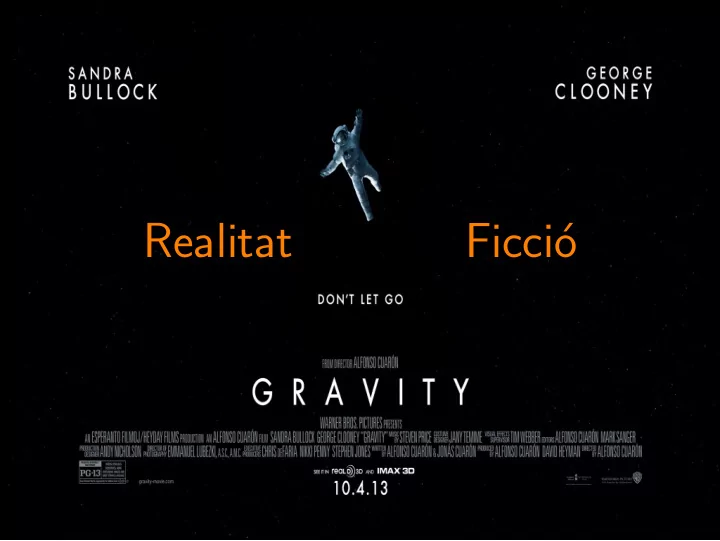
Realitat Ficci o Feel free to leave the room if you are not - - PowerPoint PPT Presentation
Realitat Ficci o Feel free to leave the room if you are not prepared. A. Farr es (UB) Gravity: Science or Fiction SIMBa 2 / 23 Quick Synopsis of the Movie It all starts with a classical operation mission at the Hubble
Feel free to leave the room if you are not prepared.
es (UB) Gravity: Science or Fiction SIMBa 2 / 23
(STS-157).
cloud of debris.
telecommunication satellites may be off. Danger for the ISS and Hubble Telescope.
es (UB) Gravity: Science or Fiction SIMBa 3 / 23
(STS-157).
cloud of debris.
telecommunication satellites may be off. Danger for the ISS and Hubble Telescope.
es (UB) Gravity: Science or Fiction SIMBa 3 / 23
The Hubble telescope was launched in April 1997 and it has been working for more that 23 years. Orbital Parameters
(14 − 15 rev/day)
es (UB) Gravity: Science or Fiction SIMBa 4 / 23
There have been only 5 Serving Missions to the Hubble Telescope (SM1 December 1993, SM2 February 1997, SM3A December 1999, SM3B March 2002, SM4 May 2009)
es (UB) Gravity: Science or Fiction SIMBa 5 / 23
es (UB) Gravity: Science or Fiction SIMBa 6 / 23
es (UB) Gravity: Science or Fiction SIMBa 7 / 23
es (UB) Gravity: Science or Fiction SIMBa 8 / 23
es (UB) Gravity: Science or Fiction SIMBa 8 / 23
Source: http://www.celestrak.com/events/collision/
es (UB) Gravity: Science or Fiction SIMBa 9 / 23
es (UB) Gravity: Science or Fiction SIMBa 10 / 23
es (UB) Gravity: Science or Fiction SIMBa 11 / 23
ablation cascade), was proposed by the NASA scientist Donald J. Kessler in 1978.
high enough that collisions between objects could cause a cascade, each collision generating space debris which increases the probability of further collisions.
exploration, and even the use of satellites, unfeasible for many generations. [ Watch Video Iridium 33 and Cosmos 2251 Collision.mp4 ] [ Watch Video Dispersion.wmv ]
es (UB) Gravity: Science or Fiction SIMBa 12 / 23
es (UB) Gravity: Science or Fiction SIMBa 13 / 23
es (UB) Gravity: Science or Fiction SIMBa 14 / 23
es (UB) Gravity: Science or Fiction SIMBa 14 / 23
es (UB) Gravity: Science or Fiction SIMBa 14 / 23
es (UB) Gravity: Science or Fiction SIMBa 15 / 23
Orbital Parameters
rev/day)
Orbital Parameters
rev/day)
es (UB) Gravity: Science or Fiction SIMBa 16 / 23
ISS orbit: 51.65° inclination 417-420 km altitude HST orbit: 28.5° inclination 559 km altitude Cape Canaveral Baikonur North pole Equator
es (UB) Gravity: Science or Fiction SIMBa 17 / 23
es (UB) Gravity: Science or Fiction SIMBa 18 / 23
No Parachute = No Landing !! What can we do ?
es (UB) Gravity: Science or Fiction SIMBa 18 / 23
Orbital Parameters
rev/day)
Orbital Parameters
rev/day)
es (UB) Gravity: Science or Fiction SIMBa 19 / 23
es (UB) Gravity: Science or Fiction SIMBa 20 / 23
Summary of orbital Parameters:
Source: http://sattrackcam.blogspot.com.es/2013/10/a-space-buff-watches-gravity.html
es (UB) Gravity: Science or Fiction SIMBa 21 / 23
es (UB) Gravity: Science or Fiction SIMBa 22 / 23
es (UB) Gravity: Science or Fiction SIMBa 22 / 23
es (UB) Gravity: Science or Fiction SIMBa 23 / 23