Theme Address Rupamanjari Ghosh Co- Chair, FICCI Higher Education - - PowerPoint PPT Presentation

theme address
SMART_READER_LITE
LIVE PREVIEW

Theme Address Rupamanjari Ghosh Co- Chair, FICCI Higher Education - - PowerPoint PPT Presentation

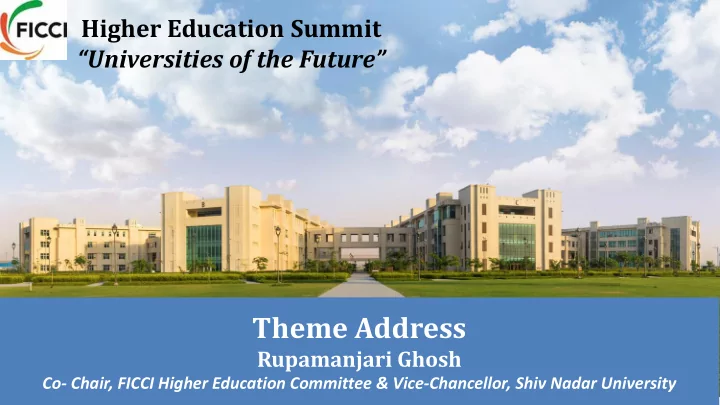
Higher Education Summit Universities of the Future Theme Address Rupamanjari Ghosh Co- Chair, FICCI Higher Education Committee & Vice-Chancellor, Shiv Nadar University FICCI Summit Program 30-31 October 2018 University 4.0 &


slide-1
SLIDE 1

Theme Address

Rupamanjari Ghosh

Co- Chair, FICCI Higher Education Committee & Vice-Chancellor, Shiv Nadar University

Higher Education Summit “Universities of the Future”

slide-2
SLIDE 2

FICCI Summit Program – 30-31 October 2018

  • University 4.0 & beyond
  • Financing Model 4.0
  • University as a Gateway to Knowledge
  • Future of University Degrees
  • Program Designs & Learning Systems – Integrating high-order skills
  • The way I learn – A student in University 4.0
  • Brand India – the opportunity to educate the world
  • Blended Learning integrates the best of face-to-face teaching (and

learning) interactions with those that occur outside-of-classroom type settings. (Blended) Learning is a designed endeavor -- one size (model / approach) does not fit all.

slide-3
SLIDE 3

University 1.0

Gurukuls of India and the Academies of Greece

  • High quality
  • high teacher-to-student ratio
  • flexible schedules and syllabi that were highly personalized to every

student’s requirements

  • wide span of subjects - from astronomy to zoology
  • Fundamentally unscalable
  • limited knowledge that was closely guarded
  • restricted access only to the most fortunate and influential
slide-4
SLIDE 4

University 2.0

Broadcast + Assembly Line Model

  • Mass enrolment
  • one-to-many information dissemination
  • focus on rote learning and term-based testing
  • one method to teach all
  • Poor quality
  • prioritize literacy and recall over problem-solving and curiosity-driven

exploration

  • forced-expansion of access at the cost of personalization and dedicated

attention

  • knowledge still limited to books and syllabus
slide-5
SLIDE 5

University 3.0

Focus on Quality while Upscaling, with Technology as the Lever

  • Open Public Infrastructure
  • public spending must expand the install base of the fundamental layers of

innovation

  • create a free open national knowledge base
  • eliminate friction - allow for infrastructure to scale and optimize for quality

cross-institutional, cross-cultural educational opportunities

  • Tech-enabled Pedagogy
  • collaborate with best-in-class technology companies to unleash solutions

at scale

  • knowledge networks, personalized and adaptive learning, blended

education, data-driven continuous assessments, multi-format simulations and practice environments…

slide-6
SLIDE 6

What is ‘Knowledge’?...

Knowledge is not a body of totally-certain beliefs. In the academic tradition, knowledge is a body of rationally justified conclusions beyond reasonable doubt. It leaves an opening for questioning / reasonable doubt when that doubt comes up, and this is how Knowledge progresses.

slide-7
SLIDE 7

Purpose: Learner at the center

  • It is our responsibility as educators to ensure that our students

are 'trained' in the practice of these norms of academic knowledge.

  • Changes in the “Knowledge Society Discourse” are driven by

changes in the higher education, reflecting the challenges & expectations generated for higher education.

slide-8
SLIDE 8

Today’s context: Industry 4.0

Current trend of automation & data exchange in manufacturing technologies Includes cyber-physical systems

Christoph Roser at AllAboutLean.com

slide-9
SLIDE 9

“Future of work”

  • There is widespread concern over the potential impact of Industry

4.0 on employment.  Education needs to stay aligned with the fundamental changes in the nature of work, and address the issue of employability.

  • With the job market changing very fast in today’s world, many of

the skills that were needed yesterday are not relevant today. Ongoing ‘skill acquisition’ is critical to persistent professional relevance…

slide-10
SLIDE 10
  • If skill development is taken outside the higher education

system and given a narrow mandate, the people being ‘skilled’ today will become unemployable in no time!

“The value of an education in a liberal arts college is not the learning

  • f many facts but the training of the mind to think something that

cannot be learned from textbooks.”

  • - Einstein (1921), on Thomas Edison's opinion that a college education is useless;

quoted in Frank, Einstein: His Life and Times, p.185

“Future of Work”: Education ↔ Livelihood

Liberal (= free, without boundary) studies

slide-11
SLIDE 11

University 4.0?

Education 3.0 "is characterized by rich, cross-institutional, cross- cultural educational

  • pportunities

within which the learners themselves play a key role as creators of knowledge artifacts that are shared, and where social networking and social benefits outside the immediate scope of activity play a strong role ".

  • - Prof. Derek Keats [& J. Philipp Schmidt]
  • But contemporary universities have been motivated by self-interest

in the face of a competitive market landscape.

  • Universities have to shift from being self-focused to being ‘for
  • thers’, the industries and communities around them – the

“ecological university”.

slide-12
SLIDE 12

Knowledge triangle

  • Universities have been charged with being “knowledge incubators”. They need

to now step up, and become “knowledge economy incubators”.

  • Serious logistic issues:

Access to Knowledge Delivery of Services

University + Partners Knowledge Concepts Knowledge Applications Creation of Knowledge University + Partners

slide-13
SLIDE 13

Governance strategies

Two kinds of governance strategies needed in Higher Education: (a) a unique vision-oriented, top-down approach to provide directions, and then (b) an inclusive, bottom-up, organic approach for stable systems of delivery. The system has to have all 8 major characteristics of good governance-- participatory, consensus oriented, accountable, transparent, responsive, effective & efficient, equitable & inclusive, and legal.

  • Leadership?
slide-14
SLIDE 14

Ecosystems, not stand-alone institutions

“If you look at history, innovation doesn't come just from giving people incentives; it comes from creating environments where their ideas can connect.”

  • - Steven Johnson
  • The teaching-learning process has to be research & innovation

driven.

  • Effective blending of brick-&-mortar and virtual learning

environments

  • Strong, equitable and credible partnerships – national &

international, academic & industrial, public & private.  Ecosystems of partners centered around universities are competitive necessities, in which everyone can win.

slide-15
SLIDE 15

New India

  • Technology is a great ‘enabler’. But technology alone will not

enable, since it functions in a social system… Social challenges are far more serious than the technological challenges.

  • Rather than digital platforms and AI be just 'disruptive' to a

lagging education sector, I would like to control such powerful technology to serve our purpose/ vision of education… through innovation.

slide-16
SLIDE 16

New India…

  • Like before, University education should drive, and not just

respond to industry/ technology.

  • We need competent leadership and resources… to enable.
slide-17
SLIDE 17

University 4.0 & beyond

  • Highly nonlinear evolution – subsuming all future versions!
  • Universities of the future will have a new framework -- should

be a combination of brick-&-mortar and virtual learning environment, providing a mix of short- and long-term courses to a cohort of global students, facilitating credit transfers between departments and universities, imparting

  • nline

assessment and certification, and focusing on research & innovation.

slide-18
SLIDE 18

Changing, facilitating environment

  • Independent philanthropic interventions in higher education are

needed allowing for necessary experimentation towards excellence, which the government often cannot risk since it is spending tax-payers’ money and is hence bound by safe rules!

  • Rules & regulations necessarily set the minimum standards in a

diverse and growing country like ours, and should not bring any peak of excellence down to the prescribed ‘minimum’ level!

slide-19
SLIDE 19

Higher education’s moment of choice

  • We should retain some of the unique advantages the Indian

higher education system has at this point in time.

  • There are stages in the growth of each country/ community, and

benchmarking mechanisms must have a time stamp on them.

  • The Indian society has many layers, and one size does not fit all.
  • Quality checks & balances needed… But the global rankings’

focus on uniformity of parameters should not be allowed to narrow the diversity that universities need for innovation in every sphere -- in strategy, curricula, pedagogy and research.

slide-20
SLIDE 20

Today’s learner

  • Ambitious -- values ‘experience’…
  • Motivated, but anxious
  • Intellectually diverse, Global, Mobile
  • Flexible, growing life-long
slide-21
SLIDE 21

The amazing brain

  • Our brain’s first job is to make sure we don’t die.

Human performance isn’t just what we are physically capable

  • f. It’s what we are capable of within the context of what our

brain is willing to endure at a given moment’s risk and reward.

  • "Summit" developed by IBM for the Oak Ridge National

Laboratory, USA, is the world's fastest supercomputer (as of 8 June 2018) with 200 petaflops of calculation speed  combined capacity of more than 1 million fastest laptops. But in 70 years of developmental history of computers, we have not been able to surpass the calculation speed of the human brain, estimated at 1000 petaflops (1 exaflop).

slide-22
SLIDE 22

Aside: Nature vs Nurture debate

  • “Blueprint: How DNA makes us who we are”

by Robert Plomin, a celebrated geneticist [MIT Press, November 2018] Why nature always trumps nurture… [Really?!]

slide-23
SLIDE 23

‘Diversity’ is the key…

  • Diverse, multidisciplinary [STEM  STEAM], Interdisciplinary

curriculum, with inherent flexibility, needed for ground-level challenges & opportunities

  • Help connect the left brain (verbal, analytical, and orderly) to

the right brain (visual and intuitive)…

  • Higher education needs the ‘surprise’ elements – not all to fit

in the ‘standard’ statistics or standardized tests… Need to capture and nurture the uniqueness of individuals.

slide-24
SLIDE 24

Diversity and creativity are the key…

  • Will an algorithm take your job? What are humans still

good for? Social intelligence is far from being fully automated. Humans also have the edge over machines in creativity…

slide-25
SLIDE 25

Universities of the future

= knowledge economy incubators banking on ‘diversity’ & creativity  innovation = ecology university (partnership drivers & quality controllers) Universities are “zones of openness”. “Universities will nurture the hopes of a sustainable world.”

slide-26
SLIDE 26

Thank you

www.snu.edu.in