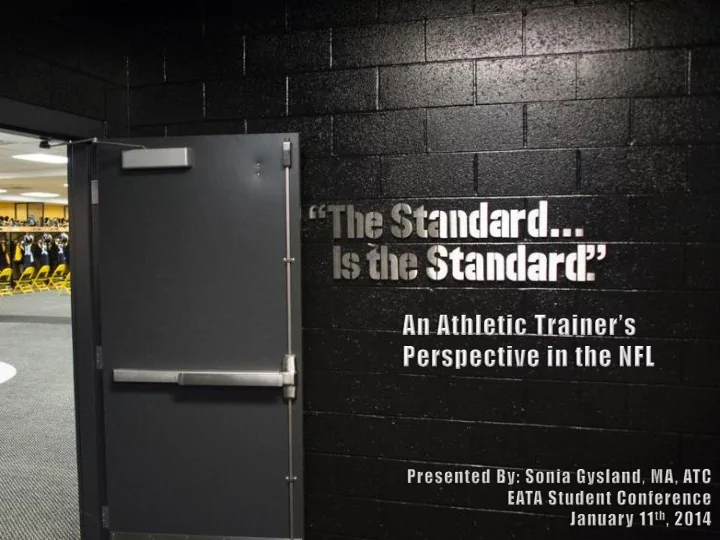
SLIDE 1
An Athletic Trainer’s Perspective in the NFL
SLIDE 2 In Football Terms: In Athletic Training Terms:
- Certified Athletic Trainers (ATCs) are held
to a standard of providing high quality healthcare to the physically active
- ATEP’s must be approved by the
Commission on Accreditation of Athletic Training Education (CAATE)
- ATC’s must pass the Board of
Certification (BOC) Exam
- BOC, Inc. conducts the role delineation
study to determine the standards of the profession and the minimal competencies needed to practice as an ATC
- The Standard = Winning Football
- Injuries are no excuse
- Play above the line
- Play winning football
- “We're here to win, we're here to be
- professionals. We're here to be
champions.” ~Steelers Wide Receiver
What does “The Standard” mean?
SLIDE 3 Preview
- Introduction
- My Journey
- How To Meet The
Standard
- Tolerance
- Mental Toughness
- Physical Fitness
- Professionalism
- Closing Remarks
SLIDE 4 Notable Sports Medicine Leaders
Ronnie Barnes, ATC
- Current Head Athletic Trainer
- f the New York Giants
- First African American ATC in
the NFL (1980-Present)
SLIDE 5 Robin West, MD
- Assistant Team Orthopedic
Physician for Pittsburgh Steelers
Surgeon in NFL (2002-Present)
Leigh Ann Curl, MD
Surgeon for Baltimore Ravens
Orthopedic Surgeon in NFL
(1998-Present)
Notable Sports Medicine Leaders
SLIDE 6 Notable Sports Medicine Leaders
Ariko Iso, ATC
- Current Head Athletic Trainer at
Oregon State University
- First Female ATC in the NFL (2002-
2011)
SLIDE 7 Notable Sports Medicine Leaders
Sue Falsone, PT, ATC
- Former Head Athletic Trainer of
the Los Angeles Dodgers
- First Female HAT in Professional
Sports (2011-Present)
SLIDE 8 Who Am I?
Sonia Gysland, MA, ATC
- Assistant Athletic Trainer for
Pittsburgh Steelers
- 2nd Full Time Female Athletic
Trainer in the NFL (2011-
Present)
SLIDE 9 My Journey
- Hometown: Minneapolis, MN
- B.S. in Kinesiology-Athletic Training
- University of Wisconsin – Madison
- M.A. in Athletic Training
- University of North Carolina at Chapel Hill
- NFL Summer Internship – Pittsburgh Steelers
- Intern Athletic Trainer – Ohio State University
- Assistant Athletic Trainer – Duke Football
SLIDE 10 Undergrad Experience
- UW ATEP Program
- Dr. Andy Winterstein
- Preceptors (ACI’s)
- Michael Moll, ATC
- Jan Helwig, ATC
- Henry Perez-Guerra, ATC
- John McKinley, ATC
- Kristi Walker, ATC
SLIDE 11 Grad School Experience
Graduate Athletic Training Program
- Graduate Assistantship
- UNC Football and Men’s and Women’s Tennis
- Teaching Assistantship
- Research Assistantship
- PT Clinic
- Intramural/Club Sport Coverage
- Masters Thesis
- Comprehensive Exams
- Steelers Summer Internship
SLIDE 12 Intern Experience
- Intern Athletic Trainer
- Men’s Gymnastics
- Multi-Sport Event
Coverage
- Concussion Research
- Intern Handbook
SLIDE 13 Duke Football
- Assistant Athletic Trainer
- 2 Athletic Trainers
- 3 PT-ATC’s Assisted
- Responsible for Work
Study Program
SLIDE 14 Steelers Experience
- 3 Full-Time Athletic Trainers
- 1 Physical Therapy Fellow
- 1 Year-Long Intern
- 2 Season Student Interns
- 3 Summer Interns
SLIDE 15 Day in the Life
- Treatments
- Org/Admin/Field Set-Up
- Taping/Treatments
- Practice Coverage
- Post Practice Treatments
- Organization/Administration
SLIDE 16
Weekly Schedule
Monday: Injury Check/Team Meeting Tuesday: Rehab Day/Players’ Day Off Wednesday – Friday: Practice Saturday: Walk Through Sunday: Game Day
SLIDE 17 Year Round Schedule
Preseason (July-Sept)
- Training Camp
- 4 Preseason Games
Regular Season (Sept-Jan)
Postseason (Jan-Feb)
Offseason (Feb-July)
- Postseason Surgeries/Rehab
- Free Agent Physicals
- NFL Combine
- NFL Draft
- Offseason Conditioning
- Team Physicals
- Rookie Mini Camp
- Organized Team Activities
- Team Mini Camp
- Training Camp Preparation
SLIDE 18
How To Meet The Standard
Tolerance Mental Toughness Physical Fitness Work Ethic Professionalism
SLIDE 19 Tolerance
Webster Definition:
differing views of other people and fairness toward the people who hold these different views”
- “The capacity to endure pain
- r hardship”
SLIDE 20
Tolerance
Focus on the Pillars of Excellence
Affability Availability Ability Adaptability Accountability
SLIDE 21
Tolerance
Affability
Characterized by ease and
friendliness, i.e. gracious
Be communicative, approachable, and
easily engaged
Be emotionally consistent, especially in
times of stress
SLIDE 22
Tolerance
Availability
Present or ready for use, accessible
Answer phone calls, emails, texts in a timely fashion Let co-workers know best way to reach you Arrange coverage when you are unavailable Schedule your time off so that it is mutually
beneficial to you and your colleagues
SLIDE 23 Tolerance
Ability
Competence in doing,
i.e. skill
Maintain and maximize
clinical knowledge, proficiency, and expertise
Be forthcoming when trying a
new or unproven technique
SLIDE 24
Tolerance
Adaptability
Capable of being made to fit by modification
Accept the changes as the regulations of providing high value healthcare continue to evolve
SLIDE 25 Tolerance
Accountability
Subject to explaining
i.e. answerable
Trust is reciprocal and
achieved by universal agreement to generally accepted standards of behavior and conduct
SLIDE 26 Mental Toughness
“Having the natural or developed psychological edge that enables you to be more consistent and better than your opponents in remaining determined, focused, confident, resilient and in control under pressure” “It is the constant and determined effort that breaks down all resistance; sweeps away all obstacles” “Describes a collection of attributes that allow a person to persevere through difficult circumstances and emerge without losing confidence” “The ability to consistently perform towards the upper range of your talent and skill regardless of competitive circumstances”
“The psychological attribute that separates greatness from mediocrity”
“Ability to persevere in pursuit of a goal, no matter how long it takes or how much pain is involved, regardless of
SLIDE 27 Mental Toughness
Sport Specific?
Traditional basis in sports Applicable to all areas of life Helps to:
- Excel during high stress and pressure situations
- Bounce back quickly after setbacks
- Produce results even when likelihood for success is low
- Be unshakable through most any circumstance
SLIDE 28
Mental Toughness
Key Psychological Components Confidence Focus Motivation Courage Composure Resiliency
SLIDE 29 Mental Toughness
Confidence
- Having an unshakable belief in
yourself and your ability to achieve goals
Focus
- Able to concentrate on the task
at hand in the face of distractions (external or internal) and in high pressure situations
SLIDE 30 Mental Toughness
Motivation
- Having an insatiable desire and
internalized motivation to succeed
Courage
- Having fear but acting as if you
don’t
- Accept that anxiety is inevitable
and know you can cope with it
SLIDE 31 Mental Toughness
Composure
- Regain control following unexpected
events or distractions
- Thriving off the pressure of
competition
- Not allowing frustration to
undermine your confidence or focus
Resiliency
- Bounce back from performance
setbacks with increased determination to succeed
SLIDE 32 Mental Toughness Nature vs. Nurture?
Debate whether mental toughness is a developed characteristic vs. genetic Two studies suggest foundational processes occur during development
- Allows a person to build mental
toughness throughout life
SLIDE 33 Mental Toughness 4 Major Influences
1) Early Life Experiences
- Links between exposure to stressors in early life and reduced fear or
emotionality when exposed to threats in adulthood
2) Passive Toughening
- Intermittent exposure to stress makes people less sensitive and more
tolerant to stress
3) Active Toughening
- Physical fitness gained through aerobic conditioning is thought to be
important means of self-toughening
4) Ageing
- Opposite effect; tends to make people more sensitive and less tolerant
- f stress
SLIDE 34
Physical Fitness
What Is It?
General Fitness
State of health and well-being
Specific Fitness
Task-oriented definition based on
ability to perform specific aspects of sports or occupations
SLIDE 35
Physical Fitness
Physically demanding jobs Long work hours consisting of
standing, walking, examining patients, carrying equipment
Need physical fitness to maintain and
advance in our careers
SLIDE 36
Physical Fitness
Journal of Occupational and
Environmental Medicine (2004)
Workers who engage in moderate exercise have
better work-quality and job performance
Physically fit employees get along better with
co-workers and take fewer sick days
Subjects with high levels of CV fitness perform
more work, using less effort
SLIDE 37 Work Ethic
Work Ethic is a set of values based on hard work and diligence
- Belief in the moral benefit of work and its
ability to enhance character
- May include being reliable, having initiative,
- r pursuing new skills
- Reliable, diligent and professional
SLIDE 38 Work Ethic
The true test of a man’s character is what he does when no one is watching ~John Wooden
SLIDE 39 Professionalism
Professionalism
- “The conduct, aims, or qualities that
characterize or mark a profession or a professional person”
- “A high standard of professional
ethics, behavior and work activities while carrying out one’s profession”
SLIDE 40 Professionalism in Medicine
Altruism Accountability Competency Pursuit of Excellence Duty/Responsibility Honor and Integrity Respect Image
“Being good healers is not enough. Athletic trainers, like physicians, will be ‘judged both as healers and as professionals, and when they do not fulfill their obligations in either role, both they and the profession suffer.’”
SLIDE 41 Professionalism Altruism
Obligation to attend to the best interest of patients, rather than self-interest Advocate for patients Respects patient privacy and cultural values
“Our prime purpose in this life is to help others. And if you can’t help them, at least don’t hurt them.” ~ The Dalai Lama
SLIDE 42
Professionalism Accountability
Accountable to patients, to society on issues of public health, and to their profession Accepts personal responsibility for mistakes
SLIDE 43
Competent and reliable Don’t make excuses; focus on finding solutions
Professionalism Competency
SLIDE 44
Professionalism Pursuit of Excellence
Commitment to life-long learning Attends meetings; seeks additional knowledge and skills Self-aware of areas of improvement; seeks feedback
SLIDE 45
Professionalism Duty/Responsibility
Follow policies Detail-oriented Available and responsive Commitment to service within the profession and the community
SLIDE 46 Professionalism Honor and Integrity
Committed to being fair, truthful and straightforward Maintain confidentiality Adhere to ethical standards
Humility
- Ask for help when needed
- Willing to learn from others
SLIDE 47
Professionalism Respect
Respect for all athletes, coaches, medical staff, and students regardless of the situation Empathy; considers the emotions and needs of others Respectful of different socioeconomic backgrounds and cultural traditions
SLIDE 48
Professionalism Image
Perception is everything Reflection of your work Appropriate attire for the situation “Don’t dress for the job you currently have – dress for your next job”
SLIDE 49
Professionalism NATA Mission Statement
“The mission of the National Athletic Trainers’ Association is to enhance the quality of healthcare provided by certified athletic trainers and to advance the athletic training profession.”
SLIDE 50 Professionalism
NATA Code of Ethics
Purpose: To establish and maintain high standards and professionalism for the athletic training profession
Principle 1: Members shall respect the rights, welfare and dignity of all. Principle 2: Members shall comply with the laws and regulations governing the practice of athletic training. Principle 3: Members shall maintain and promote high standards in their provision of services. Principle 4: Members shall not engage in conduct that could be construed as a conflict
- f interest or that reflects negatively on the
profession.
SLIDE 51 Importance of Professionalism
“Athletic trainers must participate in shaping the profession’s future and understand the principles and
- bligations associated with
being a member of a profession.”
Professional Level
- Credibility as healthcare
professionals
Personal Level
SLIDE 52 Closing Remarks
Tolerance
- Understand the environment
- Put yourself in their shoes
Mental Toughness
- Have a short-term memory
- Bounce back after setbacks
Physical Fitness
- Take care of yourself to sustain endurance for your
job
SLIDE 53 Closing Remarks
Work Ethic
- Hard work pays off in the long run
- Recognize your weaknesses and work at
them
Professionalism
- Do your job to the best of your ability
- Set a good example; someone is always
watching
SLIDE 54
- “A Survey of Athletic Trainer Employers’ Hiring Criteria”
(Kahanov and Andrews 2011)
- Most Important Criteria: Personal Characteristics
- Followed by Educational Experience, Professional
Experience, and Work-Related Attributes
- “Desirable Qualities, Attributes, and Characteristics of
Successful Athletic Trainers – A National Study” (Henry et.
- al. 2009)
- 6 Essential Personal Attributes:
- Trustworthiness, Honesty, High Ethical Standard,
Dependable, Adaptable, Communication
Setting doesn’t matter…The Standard is The Standard.
Closing Remarks
SLIDE 55
"Never let the odds keep you from doing what you know in your heart you were meant to do.” ~ H. Jackson Brown, Jr.
SLIDE 56