
SLIDE 1
RE-ALIGN: Preparing tomorrow’s workforce for the Fourth Industrial Revolution
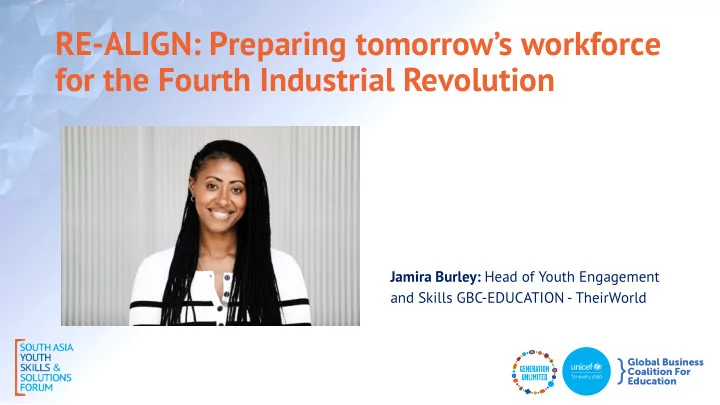
Jamira Burley: Head of Youth Engagement and Skills GBC-EDUCATION - TheirWorld
Global Business Coalition For Education
RE-ALIGN: Preparing tomorrows workforce for the Fourth Industrial - - PowerPoint PPT Presentation
RE-ALIGN: Preparing tomorrows workforce for the Fourth Industrial Revolution Jamira Burley: Head of Youth Engagement and Skills GBC-EDUCATION - TheirWorld } Global Business Coalition For Education A frame work for action: Timeline 2018
Jamira Burley: Head of Youth Engagement and Skills GBC-EDUCATION - TheirWorld
Global Business Coalition For Education
Global Business Coalition For Education
2017 launched the Youth Skills and Innovation Initiative 2018 Report released “ Preparing tomorrow’s workforce for the 4ir” Regionalize –Localize impact
Global Business Coalition For Education
Global Business Coalition For Education
coming into the workforce between now and 2030??
What new models are emerging?
What are the opportunities for business to make an impact while engaging youth? What is the challenge? What skills are needed in the new world of work? What current models are working? How does 4IR change the game?
Innovators, Global Leaders, Researchers, Non-profits, and Youth
countries
Limitations: limited sample size, self-reported nature of information, challenges reaching the “most marginalized populations”
Global Business Coalition For Education
The report identifies four primary challenges that business leaders and other stakeholders should address within the larger context of youth workforce development: Reposition discrete and disconnected programs as a systemwide, unified set of approaches Realign toward achieving both scale and impact, rather than framing solutions as scale versus impact Reframe the possibilities for marginalized youth, including those who historically have been difficult to reach, with particular attention to women and girls Reimagine 4IR as a unique opportunity to be welcomed, not a problem to be confronted
Global Business Coalition For Education
Sk Skill categories Pu Purpose Te Teaching and training me methodolo logy Wo Workforce readiness To support youth in finding and securing employment, and succeeding within the workplace
So Soft skills To support youth as they integrate and collaborate with internal and external workplace stakeholders, such as customers, co- workers, and management Te Technical skills To give youth technical or domain expertise to perform job- specific tasks En Entrepr prene neur urshi ship To support youth in establishing their own business, supporting entry into freelance, contract work, or gig work, and/or developing as a self-starter within a work environment Li Lifelong learning: A continuous process of gaining new knowledge and skills as individuals progress through their professional and personal careers
The report makes fo four key recommendations to drive change, as business accelerates its role:
Global Business Coalition For Education
Engage in public policy Strategically engage in public policy through dialogue, advocacy, collaboration, and influence. Develop strong talent strategies Analyze current talent strategies—particularly those focused on youth or under-represented populations—and implement best practices to promote inclusivity and innovation, and drive economic return through differentiation. Invest in workforce skilling Evaluate, invest, and promote workforce training programs that align with your corporate social responsibility goals, talent practices, skill needs, and corporate culture. Align stakeholders’ objectives and approaches Work with the broader ecosystem to align goals and outcomes for impact.
Global Business Coalition For Education
Global Business Coalition For Education
Jamira Burley: Head of Youth Engagement and Skills GBC-EDUCATION – TheirWorld Jamira@gbc-education.org
Global Business Coalition For Education