SLIDE 1
RAMP A P A TM IC C ODE DES O VER TMOSP SPHER ERIC VERVIE IEW - - PowerPoint PPT Presentation
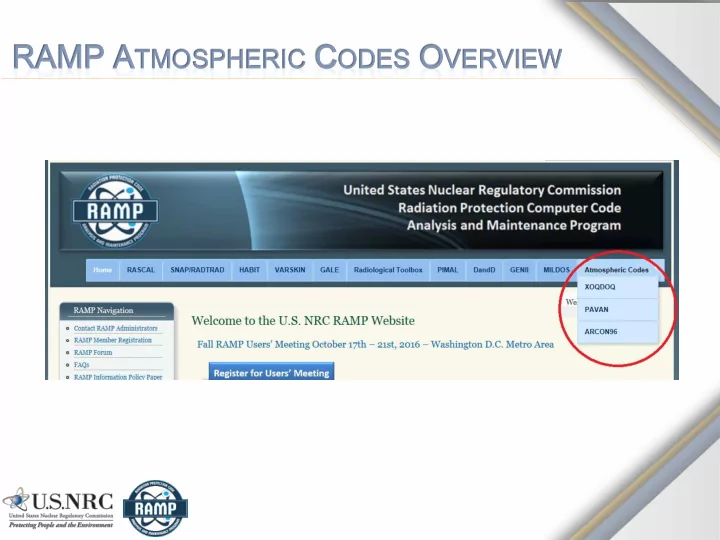
RAMP A P A TM IC C ODE DES O VER TMOSP SPHER ERIC VERVIE IEW ARCON9 CON96 ARCON9 CON96: O O VER VERVI VIEW EW ARCON96 is a Gaussian dispersion model for calculating short-term relative concentrations (/Qs ) at nuclear power
SLIDE 2
SLIDE 3
ARCON9 CON96: O OVER
VERVI VIEW EW
- ARCON96 is a Gaussian dispersion
model for calculating short-term relative concentrations (χ/Q’s) at nuclear power plant control room air intakes that would be exceeded no more than 5% of the time.
- Dispersion is near-field, in the vicinity
- f buildings.
- ARCON96 includes enhanced diffusion
coefficients for low wind speed conditions and building wake.
SLIDE 4
ARCON9 CON96: U USE
SE
- Used by the NRC for New Reactor Safety
Reviews for design-basis accidents
- 10 CFR Part 50, Appendix A, General Design
Criterion 19 (GDC 19), Control Room
- Adequate radiation protection shall be
provided to permit access and occupancy of the control room under accident conditions without personnel receiving radiation exposures in excess of 5 rem (0.05 Sv) whole body, or its equivalent to any part of the body, for the duration of the accident
SLIDE 5
PAVA PAVAN
SLIDE 6
PAVA PAVAN: O OVER
VERVI VIEW EW
- PAVAN is a Gaussian dispersion model
for calculating short-term relative concentrations (χ/Q’s) at offsite locations, including the:
- Exclusion Area Boundary (EAB)
- Low Population Zone (LPZ)
- PAVAN uses Pasquill-Gifford (PG)
diffusion coefficients with simple modifications to account for low wind speed conditions and building wake for ground-level releases.
SLIDE 7
PAVA PAVAN: U USE
SE
- Used by the NRC for New Reactor
Environmental Impact Statements and Safety Reviews for design-basis accidents
- 10 CFR 52.79(a)(1)(vi), Contents of applications;
technical information in final safety analysis report
- Perform an assessment assuming a fission product
release from the core into the containment
- An individual located at any point on the boundary of
the EAB for any 2-hour period would not receive a dose in excess of 25 rem (0.25 Sv) TEDE
- An individual located at any point on the outer
boundary of the LPZ would not receive a dose in excess of 25 rem (0.25 Sv) TEDE during the entire period of the passage of the radioactive cloud
SLIDE 8
XOQD QDOQ OQ
SLIDE 9
XOQDO DOQ: Q: O OVER
VERVI VIEW EW
- XOQDOQ is a Gaussian dispersion model
for calculating long-term relative concentrations (χ/Q’s) and deposition (D/Q’s) at user-specified locations and standard radial distances/segments out to 50 miles
- XOQDOQ plume horizontal distribution is
assumed to be evenly distributed within the 22.5 degree downwind sector (sector- averaging)
- For ground-level releases, plume vertical
diffusion coefficient modified to account for building wake
SLIDE 10
XOQDO DOQ: Q: U USE
SE
- Used by the NRC for New Reactor Environmental Impact Statements and
Safety Reviews to access impacts from routine releases
- 10 CFR Part 20, Subpart D, Radiation Dose Limits for Individual Members
- f the Public
- The annual average concentrations of radioactive material released in
gaseous effluents at the boundary of the unrestricted area do not exceed the values specified in Table 2 of Appendix B to Part 20
- Intended to result in doses below 0.05 rem (0.5 mSv)
- Appendix I of 10 CFR Part 50, Numerical Guides for Design
Objectives and Limiting Conditions for Operation to Meet ALARA Criterion for Radioactive Material in Reactor Effluents
- Section II.B: Unrestricted annual air dose < 10 mrad (0.1 mGy)
gamma or 20 mrad (0.2 mGy) beta
- Section II.C: Unrestricted annual individual organ dose from all
pathways of exposure < 15 mrem (0.15 mSv)
- Section II.D: radwaste system cost-benefit analysis based on
population dose out to 50 miles
SLIDE 11
- Jeremy Rishel
- Mr. Rishel support the RAMP
Atmospheric Codes, including ARCON96, PAVAN, and
- XOQDOQ. In addition, Mr. Rishel
supports the development of the NRC’s RASCAL emergency response code.
- jeremy.rishel@pnnl.gov
- 509-375-6974