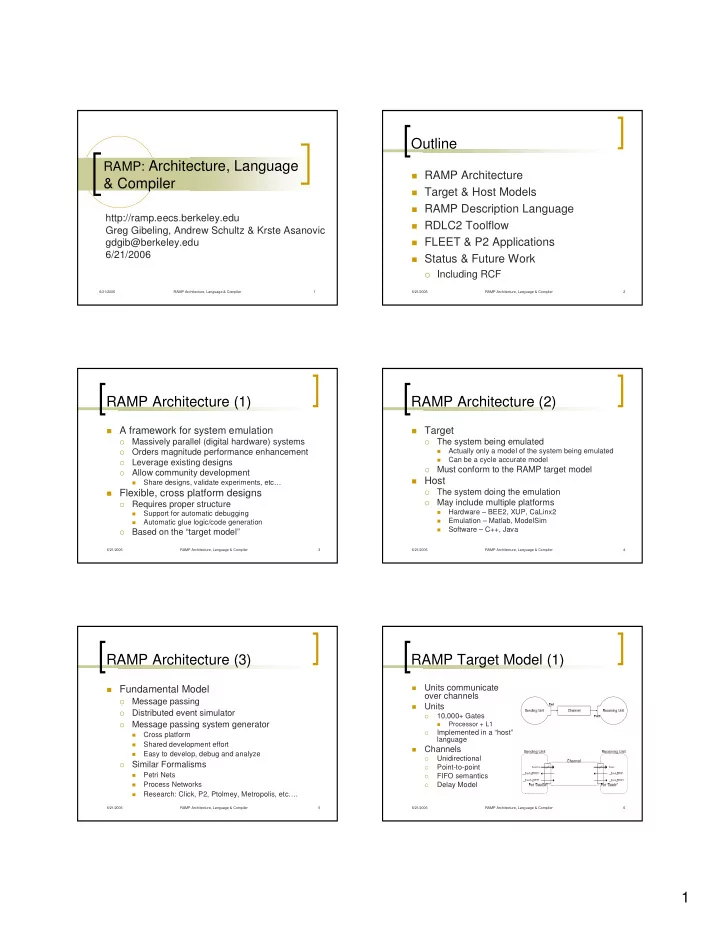
1 Target Model - Units Target Model Channel (1) Inside edge - - PDF document

1
SMART_READER_LITE
LIVE PREVIEW

1 Target Model - Units Target Model Channel (1) Inside edge - - PDF document

Outline RAMP: Architecture, Language RAMP Architecture & Compiler Target & Host Models RAMP Description Language http://ramp.eecs.berkeley.edu RDLC2 Toolflow Greg Gibeling, Andrew Schultz & Krste Asanovic FLEET


slide-1
SLIDE 1

1

6/21/2006 RAMP Architecture, Language & Compiler 1

RAMP: Architecture, Language

& Compiler

http://ramp.eecs.berkeley.edu Greg Gibeling, Andrew Schultz & Krste Asanovic gdgib@berkeley.edu 6/21/2006

6/21/2006 RAMP Architecture, Language & Compiler 2

Outline

RAMP Architecture Target & Host Models RAMP Description Language RDLC2 Toolflow FLEET & P2 Applications Status & Future Work

Including RCF

6/21/2006 RAMP Architecture, Language & Compiler 3

RAMP Architecture (1)

A framework for system emulation

  • Massively parallel (digital hardware) systems
  • Orders magnitude performance enhancement
  • Leverage existing designs
  • Allow community development
  • Share designs, validate experiments, etc…

Flexible, cross platform designs

  • Requires proper structure
  • Support for automatic debugging
  • Automatic glue logic/code generation
  • Based on the “target model”

6/21/2006 RAMP Architecture, Language & Compiler 4

RAMP Architecture (2)

Target

  • The system being emulated
  • Actually only a model of the system being emulated
  • Can be a cycle accurate model
  • Must conform to the RAMP target model

Host

  • The system doing the emulation
  • May include multiple platforms
  • Hardware – BEE2, XUP, CaLinx2
  • Emulation – Matlab, ModelSim
  • Software – C++, Java

6/21/2006 RAMP Architecture, Language & Compiler 5

RAMP Architecture (3)

Fundamental Model

  • Message passing
  • Distributed event simulator
  • Message passing system generator
  • Cross platform
  • Shared development effort
  • Easy to develop, debug and analyze
  • Similar Formalisms
  • Petri Nets
  • Process Networks
  • Research: Click, P2, Ptolmey, Metropolis, etc….

6/21/2006 RAMP Architecture, Language & Compiler 6

RAMP Target Model (1)

  • Units communicate
  • ver channels
  • Units
  • 10,000+ Gates
  • Processor + L1
  • Implemented in a “host”

language

  • Channels
  • Unidirectional
  • Point-to-point
  • FIFO semantics
  • Delay Model
slide-2
SLIDE 2

2

6/21/2006 RAMP Architecture, Language & Compiler 7

Target Model - Units

Inside edge

  • Ports connect units

to channels

  • FIFO signaling
  • Hardware or

Software

  • Target cycle control
  • __Start
  • __Done
  • Allows for variable

timing, and timing accurate simulation

6/21/2006 RAMP Architecture, Language & Compiler 8

Target Model – Channel (1)

Channel semantics

Arbitrary message size The messages are statically typed Ordered delivery Debugging through monitoring & injection Provides for cross-platform simulations

6/21/2006 RAMP Architecture, Language & Compiler 9

Target Model – Channel (2)

  • Channel Params
  • Only used for timing

accurate simulations

  • Bitwidth
  • Latency
  • Buffering
  • Fragments
  • Smaller than messages
  • Convey the simulation

time through idles

  • 6/21/2006

RAMP Architecture, Language & Compiler 10

Host Model

  • !
  • !

"

  • #$% #&'

#$( )*+',$-

#

  • .

/01

#$2$$ 1 1 !

3

  • 4
  • #

"

  • .

5'&"'

Cross platform

  • Units implemented

in many languages

  • Library units for I/O
  • Links implement

channels

Links

  • Any communication
  • Less defined

6/21/2006 RAMP Architecture, Language & Compiler 11

Host Model – Wrapper

  • '$

'$

660 66$

'$ '$

,,7 '*. 5- ,,7 '*. 5- 5-7 *. ,, 5-7 *. ,,

0.$$

$$.0

  • "
  • "
  • 6/21/2006

RAMP Architecture, Language & Compiler 12

Host Model - Link

  • Typically Three Components
  • Packing & Unpacking
  • Timing Model
  • Physical Transport
  • Generated by RDLC2 plugins
slide-3
SLIDE 3

3

6/21/2006 RAMP Architecture, Language & Compiler 13

RDL (1)

“RAMP Description Language”

  • General message passing system description

language

  • “Netlisting” language
  • Does NOT include leaf unit behavior

Compiler is highly extensible

  • Links
  • Other toolflows
  • External signals
  • Memories, etc…

6/21/2006 RAMP Architecture, Language & Compiler 14

RDL (2)

Why RDL?

Allows specification of partitioning Regular communication Enables cross platform system design RDL is a research enabler Ties together EXISTING designs Allows sharing of work & results Saves a lot of work Complex interconnect is painful in HDLs

6/21/2006 RAMP Architecture, Language & Compiler 15

RDLC2 Toolflow (1)

$$.
  • 6/21/2006

RAMP Architecture, Language & Compiler 16

RDLC2 Toolflow (2)

  • Help
  • rdlc2 –help
  • Explains

commands

  • Includes all

the options

  • GUI
  • rdlc2 –gui
  • Easy to use
  • Includes error

message display

6/21/2006 RAMP Architecture, Language & Compiler 17

FLEET Builder Application (1)

FLEET

  • A one instruction

computer (Move)

  • Highly concurrent
  • Location and
  • peration are tied
  • Includes network

builder

  • Includes assembler

generator

initial codebag Accumulate { move (0) -> Adder.Adder; move [] IntegerInput.Output

  • > Adder.Addend;

move [] Adder.Sum -> Display.Input, Adder.Adder; };

6/21/2006 RAMP Architecture, Language & Compiler 18

P2/Overlog Application

0- $ /$/$ 0*5$ $ )8 0* $

Overlay Networks

  • Overlog (datalog)

spec is compiled as in a DB query planner

  • Creates distributed

tuple processors

  • We did a hardware

implementation

  • Includes an ASIP
slide-4
SLIDE 4

4

6/21/2006 RAMP Architecture, Language & Compiler 19

State of the Project (1)

  • Working hardware
  • Compiled RDL to Verilog
  • FLEET Processor & Assembler Builder
  • Implementation of P2 overlay network platform in hardware
  • Tested on CaLinx2, XUP, Digilent S3 and ModelSim SE
  • RDL Changes
  • Added RDL Features
  • Added higher order ports: struct, union and arrays
  • Added compile time unit parameters
  • Implemented hardware generators
  • Similar in concept to Xilinx CoreGen
  • Trivial lexical changes
  • Required to support higher order ports and parameters

6/21/2006 RAMP Architecture, Language & Compiler 20

State of the Project (2)

  • RDLC2
  • Higher quality code base
  • Automated Unit Testing
  • Includes support for integrated tools (FLEET & P2)
  • Production Ready
  • Relatively narrow feature list (still a research project)
  • Documentation is limited
  • Languages
  • Hardware – Verilog, VHDL on demand
  • Software - Java & C++ waiting on RDLC3
  • Back End Plugins
  • XFlow, Impact, ModelSim
  • Not XPS until RDLC3
  • Include

6/21/2006 RAMP Architecture, Language & Compiler 21

Future Work (1)

  • RDL & RDLC3 Features
  • Parameter Inference Problems
  • The algorithm isn’t always (easily) predictable
  • Flesh out back end features
  • More languages, platforms, links
  • Debugging automation
  • Automated test code generation for links and units
  • Documentation
  • Architecture, Language & Compiler Technical Report
  • Complete compiler Javadocs
  • Example and Tutorials

6/21/2006 RAMP Architecture, Language & Compiler 22

Future Work (2)

ModelSim & XST workarounds

  • HDL Subsets
  • High level simulator

Block Generators/Library

  • Memories/FIFOs
  • Easily extendible
  • Not vendor specific

Debugging Framework

  • Integration with SW tools
  • Injection & monitoring framework

6/21/2006 RAMP Architecture, Language & Compiler 23

RCF (1)

RCF – RAMP Compiler Framework Motivation

  • Current parser & lexers are limited/buggy
  • Application Specific Compilers
  • FLEET & P2 required compilers
  • Need to integrate these with RDLC
  • RDLC2 still includes a lot of copy & paste
  • 150,000 lines of java code!
  • Bad for maintenance and upgrades
  • Hard (almost impossible) to fix parameter inference

without changing the core algorithms

6/21/2006 RAMP Architecture, Language & Compiler 24

RCF (2)

  • Compiler Compiler Interfaces
  • Lex, Parse, Syntax Directed Translation and BURS tools
  • High level specs -> Java based compilers
  • Slow, reliable implementations (for now)
  • OSGi – Like Framework
  • Eases integration of application specific tools
  • This is the basis of Eclipse (Don’t want to require Eclipse)
  • RDLC3
  • Final major version
  • Will be based on RCF, reduces code size
  • Should allow debugging, XPS and Eclipse integration
  • Planned for release 10/2006 with full docs