Purpose QCI-DL SHAH National Award on Economics of Quality 2010 - - PDF document

purpose
SMART_READER_LITE
LIVE PREVIEW

Purpose QCI-DL SHAH National Award on Economics of Quality 2010 - - PDF document

Basics 2 Operational Excellence through Intuition application of pattern recognition, artificial intelligence, positioning and branding theories to back office operations Purpose QCI-DL SHAH National Award on Economics of Quality 2010


slide-1
SLIDE 1

1

1

2

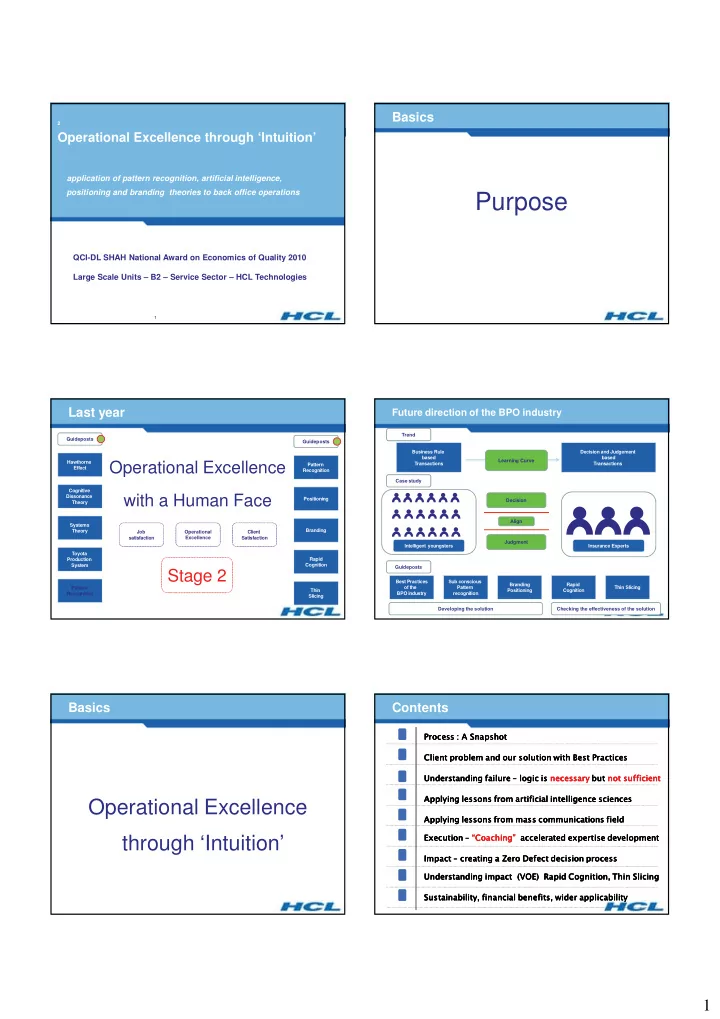
Operational Excellence through ‘Intuition’

application of pattern recognition, artificial intelligence, positioning and branding theories to back office operations QCI-DL SHAH National Award on Economics of Quality 2010 Large Scale Units – B2 – Service Sector – HCL Technologies

Basics

Purpose

Last year

Operational Excellence with a Human Face

Toyota Production System Hawthorne Effect Cognitive Dissonance Theory Systems Theory Pattern Recognition Guideposts Rapid Cognition Pattern Recognition Positioning Branding Thin Slicing Guideposts Operational Excellence Client Satisfaction Job satisfaction

Stage 2

Thin Slicing Sub conscious Pattern recognition Branding Positioning Rapid Cognition Best Practices

  • f the

BPO industry

Future direction of the BPO industry

Guideposts Business Rule based Transactions Decision and Judgement based Transactions Learning Curve Decision Judgment Intelligent youngsters Insurance Experts Align Case study Trend Developing the solution Checking the effectiveness of the solution

Basics

Operational Excellence through ‘Intuition’

  • Contents
slide-2
SLIDE 2

2

Basics

Process

Background information

On shore At Chennai Normal

Occasional

Stage 1 - Decision based on facts Stage – 2 Judgment based on Benefit of Doubt Complexity Multiple LOB Multiple disputes Task Gather data Reason the decision Judge the situation A C B D

  • 1

2 3 4 SLA 96% sync with experts AHT 48 minutes per case TASK 9 executives, 10 cases a day = 90 cases a day

“Clean Room”

5 6 7

  • Process – Success Glide Path

MANAGED OPTIMISED ADHOC CCT Experts researched, made decisions and judgments Pre off-shoring – 95%, 48 minutes Pre

  • ff

shori ng

POST OFF SHORING

2010 – May 2010 – June through December 2010 March - April 2009

Decision Judgment At Chennai A B C D

Basics

Customer’s problem with our Quality

Process – Success Glide Path

CCT Quality Check Executives research, decide, judge Onshore Experts check Quality Basic process - 92%, 1 -2 hours

Challenges Legacy system No GUI

MANAGED OPTIMISED ADHOC Pre

  • ff

shori ng

POST OFF SHORING

2010 – May 2010 – June through December 2010 March - April 2009

Decision Judgment At Chennai A B C D

CCT Experts researched, made decisions and judgments Pre off-shoring – 95%, 48 minutes

NEUTRAL

Quality – measured as incorrect decisions every week

  • Customer Satisfaction Level – Mar 2010 – Neutral

Define ,Measure , Analyse

slide-3
SLIDE 3

3

NEUTRAL DISSATISFIED

Quality – measured as incorrect decisions every week

  • Customer Satisfaction Level – Apr 2010 – Dissatisfied

Define ,Measure , Analyse 92%

Customer Remarks Less than satisfactory performance Unable to manage complexity

Basics

Diagnostic approach

Process People Attitude

Stage 1 - Decision based on facts Stage – 2 Judgment based on Benefit of Doubt A C B D 4 Computer Monitors for 4 databases NO STRAIN A C B D E G F H E G F H Glean Memorise Recall Mentally debate, Decide Refer multiple docs simultaneously, Discuss, Decide One person Single screen “Clean Room” Good in both Good In Auto Good In Home Should improve in both sequential branching Pay No Pay Correct Benefit of Doubt Error

70%

No Factual Error

30%

Correct HCL decision Correct Decision 24% Benefit of Doubt Error

70%

Factual Error

30%

Correct Decision 68%

6%

Benefit of Doubt Error

2%

Factual Error

8% 92%

Attitudinal weakness

Cannot judge Benefit of Doubt Not willing to ‘give’ more But clinical and fact based Toyota Production System Cognitive Dissonance Theory Systems Theory “Operational Excellence with a Human Face” Role Factual Evaluator Role Benefit of Doubt Explorer Role Balancer Quality officer A Toyota Production System’s Cell

Diagnostic approach

Challenges (Standard ones) Clean Room Multiple Databases Glean, Memorize, Recall Mentally debate and decide STRENUOUS

Process People Attitude

Solutions (Best Practices) Multiple monitors to view simultaneously “Two in a box” Refer to all data simultaneously Discuss and Decide – NO STRAIN Segment tasks, segment people Align people to tasks Roles to change behaviour, attitude Linked into a cell to balance the act Encourage discussions

Facts Mailbox Decide Quality Case

?

Decide BOD

Performance varies across tasks Dilutes the overall scores Strong on Clinical and factual decision Benefit of doubt and judgment missing Unwilling to GIVE more Discuss

Decide Quality Balance

slide-4
SLIDE 4

4

Basics

Phase I “Managed” Solution with “Best Practices”

Process – Success Glide Path

MANAGED OPTIMISED ADHOC Pre

  • ff

shori ng

POST OFF SHORING

2008 – II Half 2009 full year 2008 – I Half 2007 CCT Quality Check Executives research, decide, judge Onshore Experts check Quality Basic process - 92%, 1 -2 hours CCT Experts researched, made decisions and judgments Pre off-shoring – 95%, 48 minutes

Decision Judgment At Chennai A B C D

CCT Onshore Experts check Quality Discuss Quality BOD Fact Toyota Production System, Best Practices into the process – 94% - 96%, but slow

NEUTRAL DISSATISFIED

Quality – measured as incorrect decisions every week

  • Customer Satisfaction Level – Apr 2010 – Dissatisfied

Define ,Measure , Analyse 92%

Multiple Monitors Segment tasks, people Align people to task Two in a box Encourage discussions Fact Evaluator Role

Team Excellence Team Excellence

e Benefit of Doubt Explorer role Balancer Role Roles into a TPS Cell Remove Strain

Phased implementation

  • f 10 initiatives

Improve

Customer Remarks Less than satisfactory performance Unable to manage complexity

95% NEUTRAL Define ,Measure , Analyse Improve 92%

Quality – measured as incorrect decisions every week

DISSATISFIED

Customer Satisfaction Level – Apr 2010 – Dissatisfied

Multiple Monitors Segment tasks, people Align people to task Two in a box Encourage discussions Fact Evaluator Role

Team Excellence Team Excellence

e Benefit of Doubt Explorer role Balancer Role Roles into a TPS Cell Remove Strain

Phased implementation

  • f 10 initiatives

95% 98% NEUTRAL Define ,Measure , Analyse Improve 92%

Quality – measured as incorrect decisions every week

“Good Improvement seen” - May 2010, client call SATISFIED

Client on Quality Good improvement seen

DISSATISFIED

Multiple Monitors Segment tasks, people Align people to task Two in a box Encourage discussions Fact Evaluator Role

Team Excellence Team Excellence

e Benefit of Doubt Explorer role Balancer Role Roles into a TPS Cell Remove Strain

Phased implementation

  • f 10 initiatives

Basics

However the process time lengthened

slide-5
SLIDE 5

5

Basics

Soon the defects also increased..

95% 98% NEUTRAL Define ,Measure , Analyse Improve 92%

Quality – measured as incorrect decisions every week

“Good Improvement seen” - May 2010, client call SATISFIED

Client on Quality Good improvement seen

DISSATISFIED 95% 98% NEUTRAL Define ,Measure , Analyse Improve Control 94% 92%

Quality – measured as incorrect decisions every week

? “Good Improvement seen” - May 2010, client call SATISFIED

Client on Quality Good improvement seen

DISSATISFIED

Basics

We realised our solutions were not sustainable

Basics

We tried to understand our Failure

Cannot Judge Lengthy documentation Too long Cannot Decide Too many parameters

Understanding Failure

Feedback 1 … 2 … 3 … 4 … 5 … 6 … 7 … 8 … 9 … 10 … . . 25 … Xxxxxx Xxxxxxx Xxxxxxxxxx Xxxxxxxxx Xxxxxxxxx Xxxxxxxxx Xxxxxxxxx Xxxxxxxx Xxxxxxxx Xxxxxxxxxx Xxxxxxxxxx Xxxxxxxx xxxxxxxxx

We needed a certain level of “expertise”

Analytical thinking (Basic logic Business Rules) are necessary but not sufficient

slide-6
SLIDE 6

6

Basics

What is “expertise” in practical terms

1027

Why a computer cannot beat a Grand Master in a game of chess in the 1980s? Grand Master

50,000

patterns State level players

2,000 patterns Chunks of knowledge (patterns)

in the subconscious mind cross referenced becomes the vocabulary

Intuition

How does a Grand Master think?

Experts have numerous cross referenced patterns in their sub conscious Mind, which are recalled spontaneously for every requirement

Pattern + My action + My Feeling = My Chunk of knowledge

1 2 3 4 5 6

Not Logic but Patterns with feelings

Complements analysis

Step 3: Pattern Recognition - Artificial Intelligence, Hebert Simon

Pattern Recognition with feelings (and not logic!)

In our case Our team still relies on simple logic for every case

Patterns forms their ‘vocabulary’

Can we graduate them to visualize patterns in the case

20th Century IT experiment on HOW EXPERTS THINK

Goal – Understand how chess players decide ‘winning moves’ Result – Not logically but by ‘recognising patterns’

“Have patterns in the sub conscious mind” How do we execute this?

compliments

Basics

Analytical thinking Intuition

Basics Experts build patterns

  • ver 5-10 years or more,

with 10,000 hours of practice. How do we accelerate this artificially? Basics

How do we develop “expertise” and graduate to start “visualizing patterns” in addition to logical thinking

slide-7
SLIDE 7

7

Basics Even before that How do put patterns into the sub conscious mind and enable them to make decisions and judgments Basics

We listened to the experts in advertising for an answer

  • Grand Master

Positioning is the NAIL . Branding is the PICTURE

Branding Hangs as a picture in the mind space created by positioning Positioning Create an image or an identity in the mind of the prospect, by clearing some space

Basics

Coaching exercise Positioning Pattern recognition

  • 200 past defective

judgments Analyse each in depth List of factors in the case Decision given Why was it wrong Pattern + My action + My Feeling = My Chunk of knowledge

Give each pattern a ‘catchy’ name

Positioning Create an image or an identity in the mind of the prospect, by clearing some space Branding Hangs as a picture in the mind space created by positioning Coaching exercise

1 2 3 4 5 6

50 hours 10 people Pattern + Position Brand

Basics We created patterns in the conscious mind Gave them names for memorising And then (hoped to) pushed them into the sub conscious mind

slide-8
SLIDE 8

8

Basics

Phase II Optimized Solution Operational Excellence through ‘Intuition’

Basics

Making patterns a habit

Priming the young minds with a small list of “branded” patterns

  • Analyzed 200+ cases of wrong decisions, one by one
  • Root caused the reasons for our wrong judgments
  • Probed on what if we had considered, would we have avoided the error
  • Named each case in a way to remember – “Lincoln vs. Lincoln” –

Branded each mistake to help instant recall

  • Did all these in a group of quality experts – three hours a day for 15

days – totally 50 hours

  • Consciously made each member of the team to think in one way –

either from facts or from the benefit of doubt way.

  • Lincoln vs. Lincoln
  • Coaching session

200 errors analysed 50 hours for the team

Basics

Creating the holistic “Pattern Landscape” for bringing in the perspective

Coverage not applicable on the DOL BASIC FACTS Query Party Dispute Loss Policy Driver In scope Special Time DOL Policy ends Policy Begins SCENARIOS Policy Change Non Pay Vehicle People issues Link cover Form Prev Loss Res chan New Store Transfer Subst Wife Son 1 2 3 4 5 6 7 8 9 10 11 12 Coverage Member Coverage Time - Date Active Exclusions In scope Tenure Request Lein Deduction Vehicle Out of sco Sp hand Confirmation Claims Similar vehicle Warm note Web Active BOS Web cover Prem estate T-L CSF Yes Ask 10 day 30 day deploy Adjus Comp NCCTR Same Hi Cost 60 day cover Told All cov

Pattern Landscape - Decision Support System

Combination SCENARIOS to be managed through Gestalt Psychology Binder Binder

slide-9
SLIDE 9

9

  • GOAL - Accelerated Expertise Development

Positioning Branding Pattern Recognition

Best Practices

Two in a box – Four monitors , Refer and Discuss Segment task and people on skills – Align Toyota Cell and “Benefit of Doubt” as a ‘role’

Best Practices

Pattern Recognition

Coaching on defective orders, identifying patterns Converting patterns in ‘chunks of knowledge’ Creating the ‘pattern landscape’

Branding

Naming the ‘chunks of knowledge’ Patterns becomes a ‘vocabulary’ Pattern Recognition becomes a habit

Basics

Impact

  • f these initiatives

95% 98% NEUTRAL Define ,Measure , Analyse Improve Control 94% 92%

Quality – measured as incorrect decisions every week

? “Good Improvement seen” - May 2010, client call SATISFIED DISSATISFIED 95% 98%

Customer Satisfaction – Sep 2010 – Excellent – sustained improvement

NEUTRAL Define ,Measure , Analyse Improve Control 98% 94% 92%

Quality – measured as incorrect decisions every week

Client on Quality in September 2010 Sustained improvement beyond the SLA of 96%

95% 98%

Customer Satisfaction Survey – Feb 2008 – NEUTRAL

NEUTRAL Define ,Measure , Analyse Improve Control 98% 94% 92%

100% defect free

Quality – measured as incorrect decisions every week

95% 98%

Customer Satisfaction Survey – Feb 2008 – NEUTRAL

NEUTRAL Define ,Measure , Analyse Improve Control 98% 94% 92%

100% defect free continues

Quality – measured as incorrect decisions every week

Quality Demember 2010 Zero defect process

slide-10
SLIDE 10

10

Basics

The last key question: But, how do we say “Pattern Recognition Works”

We did three “voice of the employee” experiments

  • Rapid Cognition

Experts make faster decisions

  • Scientists took 14 months to establish it as ORIGINAL
  • Post which, the experts found it to be a FAKE in a “blink”

Thin Slicing Experts consider lesser number of factors

  • Success in marriage predicted by observing just four parameters
  • And within a short exchange of 2 minutes

Experts have numerous chunks of knowledge

  • 1

1 3 5 7 9 11 13 15 1 4 7 10 13 16 19 22 25 28 31 34 37 40 43 46 49 52

Decisions are faster and better – Thin slicing at work

  • 171

consecutive cases

Beginning

March- Apr 2010

Now

December 2010 36 min 11 min 25 min 92% 100% Minutes taken to decide the case while processing the decision and the documentation

Voice of employee Experiment 1

Earlier After pattern recognition exercises 1 … 2 … 3 … 4 … 5 … 6 … 7 … 8 … 9 … 10 … . . 25 …

Scenario Decision

Stage 1 Stage 2 Stage 3 1 … 2 … 3 … 4 … 5 …

Scenario Decision

Stage 1 Stage 2 Stage 4

Pattern

Stage 3 20 – 25 parameters 2 – 5 parameters 36th minute 11th minute

Quality – 92% Quality – 100% Voice of employee Experiment 2

  • Grand Master

50,000

patterns State level players

2,000 patterns

Benchmarks

Role Factual Evaluator Role Benefit of Doubt Explorer Role Balancer Quality officer

300

patterns

300

patterns

500

patterns

15,000

cases

2,250

patterns today

3,000

Patterns (long run) Client’s Insurance Experts

2,000

patterns Each of them HCL’s back office team

2,250 patterns

collectively

Our situation Aided and unaided recall Voice of employee Experiment 3

  • Vocabulary of patterns

Team – 2,250 patterns Each role – 300 to 500 patterns

  • Lesser parameters to decide

Earlier 25 parameters – then Scenario – then decision Now : Scenario – 5 parameters – Pattern – Decision

  • Faster decisions

Earlier – 36 minutes Now – 11 minutes

We can “Thin Slice” and “Think without Thinking”

slide-11
SLIDE 11

11

GOAL - Accelerated Expertise Development Positioning Branding Pattern Recognition

Best Practices

Two in a box – Four monitors , Refer and Discuss Segment task and people on skills – Align Toyota Cell and “Benefit of Doubt” as a ‘role’

Best Practices

Pattern Recognition

Coaching on defective orders Identifying patterns Converting patterns in ‘chunks of knowledge’

Branding

Naming the ‘chunks of knowledge’ Patterns becomes a ‘vocabulary’ Pattern Recognition becomes a habit

Rapid cognition

11 min average for deciding a case

Thin slicing

2-5 parameters to decide

Chunks of information

Team - 2,250 Individual - 300-500

“Pattern recognition is my HABIT”

Process – Success Glide Path

MANAGED OPTIMISED ADHOC Pre

  • ff

shori ng

POST OFF SHORING

2008 – II Half 2009 full year 2008 – I Half 2007 CCT Quality Check Executives research, decide, judge Onshore Experts check Quality Basic process - 92%, 1 -2 hours CCT Experts researched, made decisions and judgments Pre off-shoring – 95%, 48 minutes CCT Onshore Experts check Quality

Decision Judgment At Chennai A B C D

Pattern Recognition Coaching and the TPS cell system CAA MFG Discuss Quality BOD Fact Discuss Quality BOD Fact Scenario Pattern Toyota Production System, Very fast and 100% Quality

Basics

Sustainable results

95% 98%

Customer Satisfaction Survey – Feb 2008 – NEUTRAL

NEUTRAL Define ,Measure , Analyse Improve Control 98% 94% 92%

100% defect free continues

Quality – measured as incorrect decisions every week

Quality Demember 2010 Zero defect process

Basics

Client saving : $13 m per annum

Total outsourcing cost < $0.5 m per annum Annualised benefits from the project

By avoiding costs USD $ Cost of 100% quality check and rework 400,000 Cost of paying disputes cases where payment is not warranted 1,500,000 Litigation costs of denying payments in genuine cases 1,125,000 Customer loyalty and business erosion through non payment 4,500,000 Total savings

7,525,000

By increasing revenue Growth from quicker and accurate TAT 4,500,000 Total earnings

4,500,000

Total savings plus earnings

13,025,000 Savings and earnings from the project - USD 13.03 million At Rs 46.76 to a dollar the Economic value of the Quality initiatives Rs 60 crores
slide-12
SLIDE 12

12

Wider applicability

Literally in any process

Where expertise is a necessity or an advantage

69

Education – 18 years

1979 NCERT - NTSU National Talent Search Examination Scholarship holder 1983 B.Sc.(Agriculture Sciences) Tamil Nadu Agricultural University, Coimbatore Topper OGPA :4/4 1986 PGDM – SPA (IIM – A) I Schol 12th rank 1997 Certificate Course on Excise, Customs, Imports, Exports, Foreign Exchange Indian School of Materials Management Stood 2nd with Distinction 2009 Six Sigma – Black Belt, from HCL-BPO

Employment experience – 23 years

1986 Godrej and Enfield Management Trainee 1 year 1987 Syngenta Area Sales Manager 5 years 1993 Sales Manager - 2 years 1995 Product Manager - 1 year 1996 Supply Chain Manager 4 years 1999 Business Development Manager 1 year 2000 Marketing Manager 5 years 2005 Mahindra & Mahindra Senior General Manager 1 year 2006 Reliance Retail Associate Vice President; 2 years Head of Operations; Head of Strategy and Planning 2008 HCL - BPO General Manager Supply Chain Practice 1 year

Profile : Balasubramanian Viswanathan