Single purpose- Early efforts were mainly single-purpose: flood - - PowerPoint PPT Presentation

single purpose early efforts were mainly single purpose
SMART_READER_LITE
LIVE PREVIEW

Single purpose- Early efforts were mainly single-purpose: flood - - PowerPoint PPT Presentation

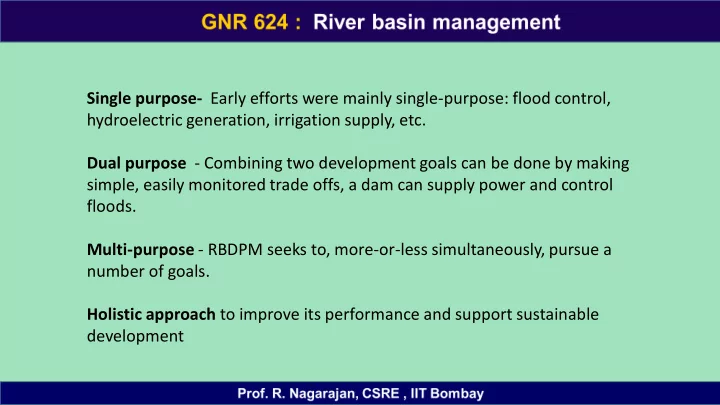
Single purpose- Early efforts were mainly single-purpose: flood control, hydroelectric generation, irrigation supply, etc. Dual purpose - Combining two development goals can be done by making simple, easily monitored trade offs, a dam can supply


slide-1
SLIDE 1

Single purpose- Early efforts were mainly single-purpose: flood control, hydroelectric generation, irrigation supply, etc. Dual purpose - Combining two development goals can be done by making simple, easily monitored trade offs, a dam can supply power and control floods. Multi-purpose - RBDPM seeks to, more-or-less simultaneously, pursue a number of goals. Holistic approach to improve its performance and support sustainable development

slide-2
SLIDE 2

GNR 639

  • Prof. R. Nagarajan, CSRE , IIT Bombay

GNR 624 : River basin management

0.05

Source courtesy: slideshare.net

slide-3
SLIDE 3

GNR 639

  • Prof. R. Nagarajan, CSRE , IIT Bombay

GNR 624 : River basin management

2.06

Source courtesy: linkedin.com

slide-4
SLIDE 4
slide-5
SLIDE 5
slide-6
SLIDE 6
slide-7
SLIDE 7
slide-8
SLIDE 8
slide-9
SLIDE 9
  • Prof. R. Nagarajan, CSRE , IIT Bombay

GNR 624 : Water Resources and River basin management

10.1

Problems for global freshwater situation

  • <1% of the world's water is available for agriculture and industry, drinking and

domestic purposes, and energy generation and transport. Increasing competition for water among such uses is degrades the natural resources.

  • One-third of the world's population live in countries that are experiencing moderate

to high water stress and death due to water-borne diseases.

  • Pollution from towns and cities, industry and agriculture directly affect water supplies

for people and freshwater ecosystems

  • Diversion of water for agriculture and industry is destroying freshwater lakes and

rivers

  • Currently, 54% of accessible runoff is appropriated by humans. By the year 2025, two-

thirds of the world's population could be facing serious problems with water availability.

slide-10
SLIDE 10
  • Prof. R. Nagarajan, CSRE , IIT Bombay

GNR 624 : Water Resources and River basin management

  • Freshwater ecosystems are the rivers, streams, lakes, ponds, groundwater, cave

water, springs, floodplains, and wetlands (bogs, marshes, and swamps) that provide water for drinking, sanitation, agriculture, transport, electricity generation and recreation.

  • Physical

alteration, habitat loss and degradation, water extraction,

  • ver-

exploitation, pollution and the introduction of invasive species threaten the planet’s freshwater ecosystems and their associated biological resources.

  • The most threatened rivers. Instead, it captures the diverse social, hydrological,

climatic and biological factors which threaten the integrity of major watersheds

  • Rivers suffering from existing threats and those which are relatively intact but under

imminent danger from emerging threats. It is important to note that most river basins suffer from multiple threats that often compound each other.

slide-11
SLIDE 11
  • Prof. R. Nagarajan, CSRE , IIT Bombay

GNR 624 : Water Resources and River basin management

  • Dams and other infrastructure have caused the fragmentation of 60% of the large river

systems in the world.

  • Only 64 of the world’s 177 large rivers (1,000 km and longer) remain free-flowing, unimpeded

by dams or other barriers.

  • There are more than 45,000 large dams in over 150 countries.
  • About 1,500 are currently under construction.
  • Some 40 to 80 million people have been displaced by dams worldwide.
  • But not all dams are bad, it depends how and where they are built.
slide-12
SLIDE 12
  • Prof. R. Nagarajan, CSRE , IIT Bombay

GNR 624 : Water Resources and River basin management

The world’s Longest rivers River name Continent Total length Nile Africa 6695 Km Amazon South America 6400 Km Yangtze Asia 6300 Km Mississippi-Missouri-Red Rock North America 5970 Km Yeisey-Angara Asia 5550 Km Yellow River Asia 5464 Km Ob’-Irtysh Asia 5410 Km Rio Parana-ril grande South America 4500 Km Amur-shilka Asia 4416 Km Lena Asia 4400 Km Congo Africa 4374 Km Mackenzie-Peace-Finlay North America 4241 Km Mekong Asia 4200 Km Niger Africa 4180 Km

Melt waters of glaciers - Rhone (France), lakes, e.g. Nile (Africa), springs, e.g. Thames (England) Regions of steady rainfall - Zaire (Africa). End at in the sea Amazon (Atlantic), the Niger (Gulf of Guinea) and the Indus, (Arabian Sea). Sometimes the mouth could be in a lake, e.g. Volga (Caspian), or in a swamp, e.g. Chari River (Lake Chad).

slide-13
SLIDE 13
  • Prof. R. Nagarajan, CSRE , IIT Bombay

GNR 624 : Water Resources and River basin management

slide-14
SLIDE 14

River impacts assessed by

  • dams and infrastructure,
  • excessive water extraction
  • climate change,
  • invasive species,
  • ver-fishing,
  • pollution.

Most endangered rivers that affects human population are:

  • Salween
  • La Plata
  • Danube
  • Rio Grande
  • Ganges
  • Murray-Darling
  • Indus
  • Nile
  • Yangtze
  • Mekong
slide-15
SLIDE 15
  • Prof. R. Nagarajan, CSRE , IIT Bombay

GNR 624 : Water Resources and River basin management

Global Water Challenges

Ratio of maximum annual flow to minimum annual flow for selected rivers 15.5 MURRAY AUSTRALIA 4705.2 DARLING AUSTRALIA 54.3 HUNTER AUSTRALIA 16.9 ORANGE SOUTH AFRICA 3.9 POTOMAC USA 2.4 WHITE NILE SUDAN 2.0 YANGTZE CHINA 1.9 RHINE SWITZERLAND 1.3 AMAZON BRAZIL

slide-16
SLIDE 16
  • Prof. R. Nagarajan, CSRE , IIT Bombay

GNR 624 : Water Resources and River basin management

Rivers are managed or controlled to be useful and less disruptive to human activity.

  • Dams or weirs may be built to control the flow, store water, or extract energy.
  • Levees may be built to prevent run-off of excess river water in times of flood.
  • Canals connect rivers to one another for water transfer or navigation.
  • River courses may be modified for navigation, or straightened to increase the

flow rate.

  • Rivers have played an important and life-sustaining role in human societies for

thousands of years. World's great cities sit on the bank of a great river.

  • It is used them as a source of water, for food, for transport, for recreation, as a

source of power to drive machinery, and as a means of disposing of waste.