Publications on science mapping Brner, K., Chen, C., & Boyack, K. - - PowerPoint PPT Presentation

publications on science mapping
SMART_READER_LITE
LIVE PREVIEW

Publications on science mapping Brner, K., Chen, C., & Boyack, K. - - PowerPoint PPT Presentation

Publications on science mapping Brner, K., Chen, C., & Boyack, K. W. (2003). Visualizing knowledge domains. Annual Review of Information Science and Technology 37, 179-255. Boyack, K. W. (2004). Mapping knowledge domains: Characterizing PNAS.


slide-1
SLIDE 1

Publications on science mapping

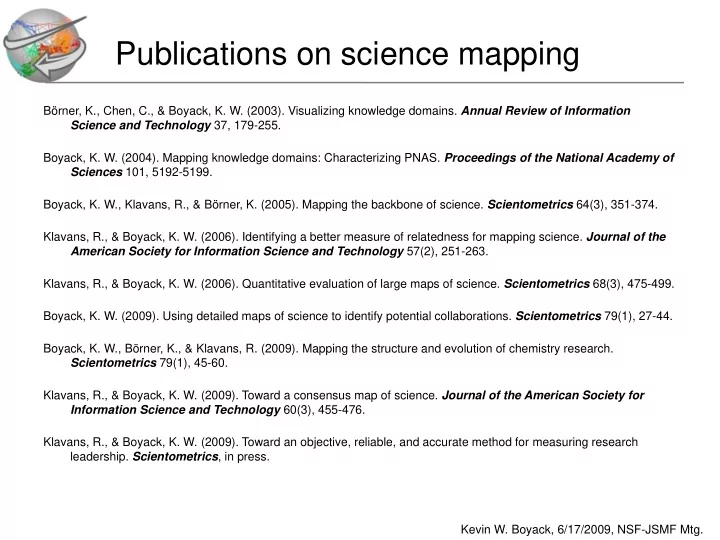
Börner, K., Chen, C., & Boyack, K. W. (2003). Visualizing knowledge domains. Annual Review of Information Science and Technology 37, 179-255. Boyack, K. W. (2004). Mapping knowledge domains: Characterizing PNAS. Proceedings of the National Academy of Sciences 101, 5192-5199. Boyack, K. W., Klavans, R., & Börner, K. (2005). Mapping the backbone of science. Scientometrics 64(3), 351-374. Klavans, R., & Boyack, K. W. (2006). Identifying a better measure of relatedness for mapping science. Journal of the American Society for Information Science and Technology 57(2), 251-263. Klavans, R., & Boyack, K. W. (2006). Quantitative evaluation of large maps of science. Scientometrics 68(3), 475-499. Boyack, K. W. (2009). Using detailed maps of science to identify potential collaborations. Scientometrics 79(1), 27-44. Boyack, K. W., Börner, K., & Klavans, R. (2009). Mapping the structure and evolution of chemistry research. Scientometrics 79(1), 45-60. Klavans, R., & Boyack, K. W. (2009). Toward a consensus map of science. Journal of the American Society for Information Science and Technology 60(3), 455-476. Klavans, R., & Boyack, K. W. (2009). Toward an objective, reliable, and accurate method for measuring research

  • leadership. Scientometrics, in press.

Kevin W. Boyack, 6/17/2009, NSF-JSMF Mtg.

slide-2
SLIDE 2

Nature Vol. 444, 21/28 December 2006

slide-3
SLIDE 3

Journal mapping

  • 16,000+ journals clustered

using bib coupling of references and keywords

  • 554 clusters formed, cluster

layout out on a sphere

  • Mercator projection of the

spherical solution

  • There is one rotation of the

spherical solution (i.e. from near the “South Pole”) that gives a near circle

Kevin W. Boyack, 6/17/2009, NSF-JSMF Mtg.

slide-4
SLIDE 4

Consensus among experts

Klavans, R., & Boyack, K. W. (2009). Toward a consensus map of science. Journal of the American Society for Information Science and Technology 60(3), 455-476.

slide-5
SLIDE 5

The circle of science

Scopus data – single year (2007) 2.1 M highly cited references

Count references & apply threshold

84,000 clusters (paradigms)

Cluster references using co-citation

5.6M current papers (2003-2007)

Fractionally assign current papers to paradigms For visualization purposes

Order 80,000 paradigms around perimeter of a circle

Kevin W. Boyack, 6/17/2009, NSF-JSMF Mtg.

slide-6
SLIDE 6

Calculating research leadership / IDR

Identify university strengths

Cluster paradigms using university papers

Identify distinctive competencies

Calculate leadership quantities, sizes

Start with 84,000 paradigms High market share paradigms

Threshold using market share For visualization purposes

Locate distinctive competencies within the circle

Kevin W. Boyack, 6/17/2009, NSF-JSMF Mtg.

slide-7
SLIDE 7

Individual researchers

Kevin W. Boyack, 6/17/2009, NSF-JSMF Mtg.

slide-8
SLIDE 8

University departments

Kevin W. Boyack, 6/17/2009, NSF-JSMF Mtg.

slide-9
SLIDE 9

National competency networks

Traditional Method New Method

Klavans, R., & Boyack, K. W. (2009). Toward an objective, reliable, and accurate method for measuring research leadership. Scientometrics, in press..

slide-10
SLIDE 10

Dynamics is next

Kevin W. Boyack, 6/17/2009, NSF-JSMF Mtg.