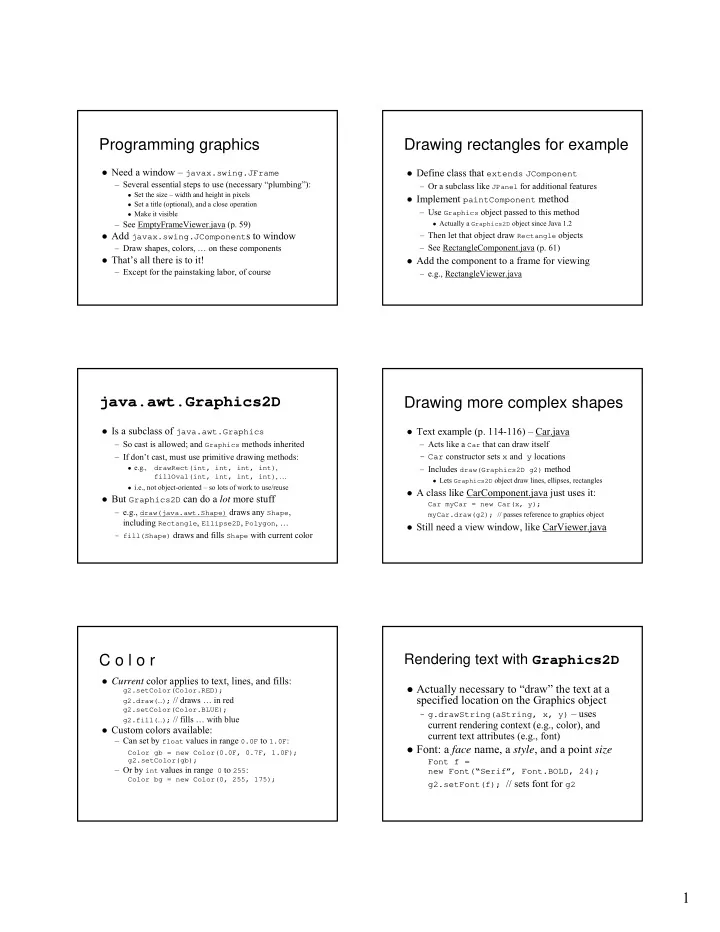
Programming graphics Drawing rectangles for example Need a window - - PDF document

programming graphics drawing rectangles for example
SMART_READER_LITE
LIVE PREVIEW

Programming graphics Drawing rectangles for example Need a window - - PDF document

Programming graphics Drawing rectangles for example Need a window javax.swing.JFrame Define class that extends JComponent Several essential steps to use (necessary plumbing): Or a subclass like JPanel for additional


slide-1
SLIDE 1

1

Programming graphics

Need a window – javax.swing.JFrame

– Several essential steps to use (necessary “plumbing”):

Set the size – width and height in pixels Set a title (optional), and a close operation Make it visible

– See EmptyFrameViewer.java (p. 59)

Add javax.swing.JComponents to window

– Draw shapes, colors, … on these components

That’s all there is to it!

– Except for the painstaking labor, of course

Drawing rectangles for example

Define class that extends JComponent

– Or a subclass like JPanel for additional features

Implement paintComponent method

– Use Graphics object passed to this method

Actually a Graphics2D object since Java 1.2

– Then let that object draw Rectangle objects – See RectangleComponent.java (p. 61)

Add the component to a frame for viewing

– e.g., RectangleViewer.java

java.awt.Graphics2D

Is a subclass of java.awt.Graphics

– So cast is allowed; and Graphics methods inherited – If don’t cast, must use primitive drawing methods:

e.g., drawRect(int, int, int, int),

fillOval(int, int, int, int), …

i.e., not object-oriented – so lots of work to use/reuse

But Graphics2D can do a lot more stuff

– e.g., draw(java.awt.Shape) draws any Shape, including Rectangle, Ellipse2D, Polygon, …

– fill(Shape) draws and fills Shape with current color

Drawing more complex shapes

Text example (p. 114-116) – Car.java

– Acts like a Car that can draw itself – Car constructor sets x and y locations – Includes draw(Graphics2D g2) method

Lets Graphics2D object draw lines, ellipses, rectangles

A class like CarComponent.java just uses it: Car myCar = new Car(x, y); myCar.draw(g2); // passes reference to graphics object Still need a view window, like CarViewer.java

C o l o r

Current color applies to text, lines, and fills: g2.setColor(Color.RED); g2.draw(…); // draws … in red g2.setColor(Color.BLUE); g2.fill(…); // fills … with blue Custom colors available:

– Can set by float values in range 0.0F to 1.0F:

Color gb = new Color(0.0F, 0.7F, 1.0F); g2.setColor(gb);

– Or by int values in range 0 to 255:

Color bg = new Color(0, 255, 175);

Rendering text with Graphics2D

Actually necessary to “draw” the text at a

specified location on the Graphics object

– g.drawString(aString, x, y) – uses

current rendering context (e.g., color), and current text attributes (e.g., font)

Font: a face name, a style, and a point size Font f = new Font(“Serif”, Font.BOLD, 24); g2.setFont(f); // sets font for g2

slide-2
SLIDE 2

2

Applets – an alternate approach

A way to run a program – but not an application

– No main method necessary

Need a subclass of Applet (or JApplet)

– So: class __ extends Applet (or extends JApplet)

Most web browsers know how to create a new

applet, and how to use certain Applet methods

– So, applets must be embedded in an html page – And, to be useful, they must include at least one of the methods the browser invokes (e.g., paint)

“Running” an Applet

The applet is started by the web browser as soon as the

web page (html file) is visited

The html file (stands for hypertext markup language) — must have

an applet tag in it:

<applet code=AppletClassName.class width=### height=###> </applet> <!-- needs a closing tag too --> The browser works in a certain order: – Creates a new applet object – includes a window, a Graphics object, lots

  • f class Applet methods

– Invokes (1) init – once, (2) start – first & return visits, (3) paint – first & every need to paint (also stop, destroy)

Implementing a “simple” applet

import javax.swing.JApplet; // mandatory

– Also usually Graphics and Graphics2D and others

Declare a class that extends JApplet:

public class RectangleApplet extends JApplet

Implement paint method (at least)

– Same procedures as paintComponent for components

Create an html file to load the applet in a web

browser or the appletviewer (provided with JDK)

See RectangleApplet.java (p. 63) and related html

files (p. 64)

Images

Images are not drawings

– You don’t draw them, you show them – But Graphics method is called drawImage anyway

Image is an abstract class

– Generally, create instance by loading from file or URL – Can also create/edit by classes in java.awt.image

Applets know how to get images (ImageApplet)

– Applications use Toolkit to get (demo)

Toolkit.getDefaultToolkit().getImage("javacup.gif");

Events

Signals from the outside

– Usually user initiates:

Mouse click, button push,

menu-select, enter text, …

– Not always: TimerTester.java

Each event has a type – a

class in java.awt.event

– So each event is an object – Created almost constantly

(by Java window manager)

Event sources

Technically: can be any external signal

– Including from a different program or system

e.g., a “client” applet contacting a web “server”

– In a GUI, focus is on user signals

Java Components generate the events

– Each component generates different event types, e.g.:

Panels (inc. Applets) MouseEvents Textfields and buttons ActionEvents Windows WindowEvents Keyboard KeyEvents

– Components inform a list of Listeners about events

slide-3
SLIDE 3

3

Listeners

Objects that components tell about events

– Must have methods a component can invoke

i.e., implements one of the Listener interfaces

– Must be added to a component’s listener list

Different listeners apply to different messages – ActionListener – actionPerformed

e.g., ClickListener (with ButtonTester.java)

– MouseListener – mouseClicked, mouseEntered, …

e.g., MouseSpy demo (from 1st edition of textbook)

Note: also can extend Adapter class instead of

implement listeners directly – saves busywork ☺

Inner class listeners

Can access private instance variables of outer class

– Stores implicit reference to outer class object – So can often “handle” events more easily

e.g., RectangleComponentViewer.java

Notice they can access final local variables too

– Another example: TimerTester2.java

– Must be final so no ambiguity about value

– For example, no opportunity for variable to go out of scope while object exists

Laying out GUI components

Depends on layout

manager

– Defaults:

JFrame:

BorderLayout

JPanel:

FlowLayout

– Others:

GridLayout GridBagLayout

Can set new, and

even make custom

Choosing a layout manager

e.g., a grid layout for

calculator buttons:

panel.setLayout( new GridLayout(4,3) ); panel.add(button7); panel.add(button8); panel.add(button9); panel.add(button4); ...

e.g., CS10Display.java

Text components

JLabel – not for user input, just display JTextField – for one row of text

– new JTextField(), or (int columns) – getText(), setText(String), setFont(Font), setEditable(boolean), … (mostly inherited) – ActionEvent on <enter>

JTextArea – for multiple rows of text

– new JTextArea(), or (int rows, int columns) – Same methods inherited from JTextComponent – Generates no events, so usually use with a button

Choices

Choice objects generate ActionEvents Handlers for JCheckBox and JRadioButton: use

boolean method isSelected() – Note: put radio buttons in a ButtonGroup – so just

  • ne can be selected at a time

– For same reason – should visually group them in a panel with a border, like EtchedBorder

For JComboBox: use getSelectedItem()

– Note: returns Object – usually cast to String

e.g., ChoiceFrame.java (see FontViewer.java, pp. 794-798)

slide-4
SLIDE 4

4

Menus

Steps to implement swing menus:

– 1. Add a menu bar to a JFrame

JMenuBar bar = new JMenuBar(); setJMenuBar(bar);

– 2. Add menus to the menu bar

JMenu fileMenu = new JMenu(“File”); bar.add(fileMenu);

– 3. Add menu items to the menus, & listeners to items

JMenuItem openItem = new JMenuItem(“Open”); fileMenu.add(openItem);

  • penItem.addActionListener(listener);

e.g., MenuFrame.java (see FontViewer2.java, pp. 803-7)

Sliders, and more swinging

Note - good text section 18.4, pp. 808-814:

should read while browsing API on web

– About how to “discover” swing features/usage

Focuses on JSlider – generates ChangeEvents, so

addChangeListener(listener), where listener

implements stateChanged method

Requires javax.swing.event for “change” events

– e.g., SliderFrame.java (see ColorViewerFrame.java, pp. 812-814)

Explore swing as needed, or even just for fun

– Buy a book, or look at API classes starting with “J” – Or just run the SwingSet demo from the JDK