
SLIDE 1
{
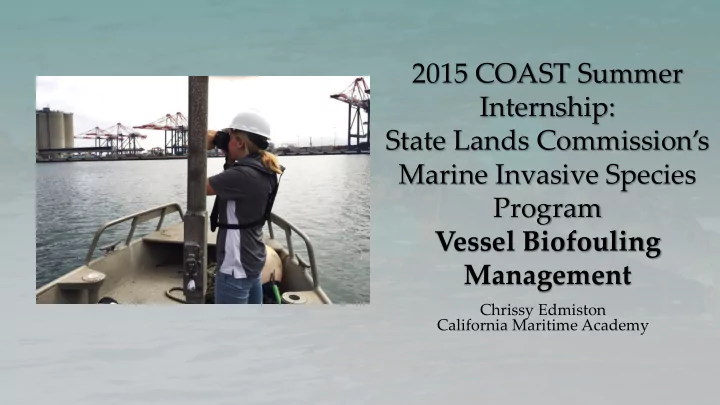
2015 COAST Summer Internship: State Lands Commission’s Marine Invasive Species Program Vessel Biofouling Management
Chrissy Edmiston California Maritime Academy
{ Program Vessel Biofouling Management Chrissy Edmiston - - PowerPoint PPT Presentation
2015 COAST Summer Internship: State Lands Commissions Marine Invasive Species { Program Vessel Biofouling Management Chrissy Edmiston California Maritime Academy Chrissy Edmiston Senior at California Maritime Academy { Major:
2015 COAST Summer Internship: State Lands Commission’s Marine Invasive Species Program Vessel Biofouling Management
Chrissy Edmiston California Maritime Academy
Maritime Academy
and Maritime Affairs
Science
Summer Intern
Ocean Affairs, Science and Technology for CSU Students
Project 1: Database Improvement
GOALS
Biocides
database, researching
A. Biocide delivery method B. Expected coating lifespan C. Speed intended for use D. Biocide contents
Project 2: Waterline Evaluation
GOAL
To determine which maintenance and operational practices are associated with the extent of fouling on waterlines of commercial vessels.
“The attachment or association of marine
portions of a vessel”
Leads to Invasive species, $ impact, Regulatory Agency impact..
Are there key elements and indicators that could be used to
commercial vessels?
Why do we look at FOULING in marine environments? What
Example of Economic Impact of Biofilm [algae and bacteria] Alone
Additional minimal $800,000 addition to fuel costs/year for ships with minimal consumption..
A company with a fleet of 18 Panamax container ships would lose
$14,400,000 a year (not to mention, environmental impacts from drag on
the ship, invasive species introduced..)
Panamax Container annual fuel consumption= $10 million. Estimates of increases in fuel consumption from biofilm ALONE range from 8-12%.
Database Improvement
1.
Identify and begin research on all 420+ coatings, looking for 4 main factors
A.Biocide delivery mechanism
B.Expected coating lifespan
C.Speed intended for use
D.
Biocide contents
2.
Identify and separate unusable coatings and clusters
3.
If Unable to find on website, conduct outreach
1.Email Companies
2.Call Companies, if email reply unsuccessful or unavailable
4.
Manually input all data into coatings database
+ Observations
Larger companies
were fairly easy to contact and were happy to assist in our project
Help from Raya,
Chris, and Chris’ contacts helped facilitate direct communication with company representatives
Smaller companies were
hesitant to be open about coating information
Time change/ language
barriers created communication issues
Companies often
remove all/any information about
coatings
What SLC’s MISP Gains
Updated coating data, allowing for more thorough analysis Cohesive and accurate biocide information inputted by a single source, rather
than multiple over a span of time.
What I Gain
Experience communicating with domestic and international companies Connections and knowledge for obtaining coating data for future research Basic knowledge of biocides, appropriate coatings for commercial vessels
# Found out of 343 Delivery Months Speed (qualitative and quantitative) Biocides 292 242 215 331 # Found out of 343 (as a %) Delivery Months Speed (qualitative and quantitative) Biocides 85% 71% 63% 97% Total Data Collected 1080 78.72% of total
Waterline Evaluation
1.
Opportunistic Stratified Sampling
A.
Available ships
B.
Targeted matrix of variables
A.
Vessel type
B.
Coating age
C.
Vessel speed
D.
# transits through tropical waters
E.
# transits through fresh water
A.
If unavailable, contact Jackie in Long Beach for assistance
B.
OR request form when aboard vessel
document level of fouling* and at least 5 pictures of
B.
Mid-ship
C.
Stern
*level of fouling: categorical ranking based on percent cover of the waterline covered in macrofouling
4.
Use iPad app (Collector) to input GPS location, HHRF data, and record level of fouling.
5.
Input data into computer
A.Verify and submit data to ARCGIS
B.Upload photos
C.Use photoQuad software to determine accuracy of LOF’s.
D.Analyze data for association- Are there
relationships between the variables and the levels of fouling?
Northern California Carquinez Conoco-Phillips/Rodeo Oakland Redwood City Richmond San Francisco Southern California Port of LA/ Long Beach
Bay Area
LA/Long Beach
Timeline: Distribution of ships by years since new coating applied
Data Trends
2 4 6 8 10 12 14 Bulker Bulker Bulker Bulker Bulker Bulker Bulker Bulker Bulker Container Container Container Container Container Container Container Container Container Container Container Container Passenger Passenger Passenger Ro-Ro Ro-Ro Ro-Ro Tank Tank Tank Tank Tank Tank Tank Tank Tank Tank Tank Unmanned Barge Unmanned Barge Unmanned Barge Cumulative Level of Fouling Ship Type Stern MS Bow
+ Observations
There are data trends and
association between several factors and levels of fouling
Use of technology (iPad app,
better camera lenses) created efficiency for data collection
All offices were more than
happy to help with the project, including advice, trips out to ports, and valuable learning
possible
There are so many factors
attributing to fouling, it would be difficult to develop an accurate, precise method to predict it;
however, anything that gives a hint can be useful
Sampling was often
difficult to hit targets
BUT we still exceeded # of
Future improvements:
More ships = more powerful data
What SLC’s MISP Gains
Hints that can determine which maintenance and operational practices are associated with the extent of fouling on vessel waterlines
Basis for improving/developing upon data and methods that I used
What I Gained
Hands-on experience navigating and working in a port environment, working with port and ship personnel, and port safety and operational practices that I would not otherwise have
Opportunity to work with professionals in the maritime industry and State Lands Commission
Broadened understanding of ballast water and biofouling, as well as in the Marine Science field in general
Legislative and public policy experience
Confidence in Excel, data collection, and presentation of results in PowerPoint and research paper format
Public speaking experience
Photography experience
Opportunity to express creativity through initiative in an applied project
Any questions?
Chrissy Edmiston (916) 208-3788 cedmiston@csum.edu