Production issues of THGEMS at ELTOS Fulvio Tessarotto ( I.N.F.N. - - PowerPoint PPT Presentation

production issues of thgems at
SMART_READER_LITE
LIVE PREVIEW

Production issues of THGEMS at ELTOS Fulvio Tessarotto ( I.N.F.N. - - PowerPoint PPT Presentation

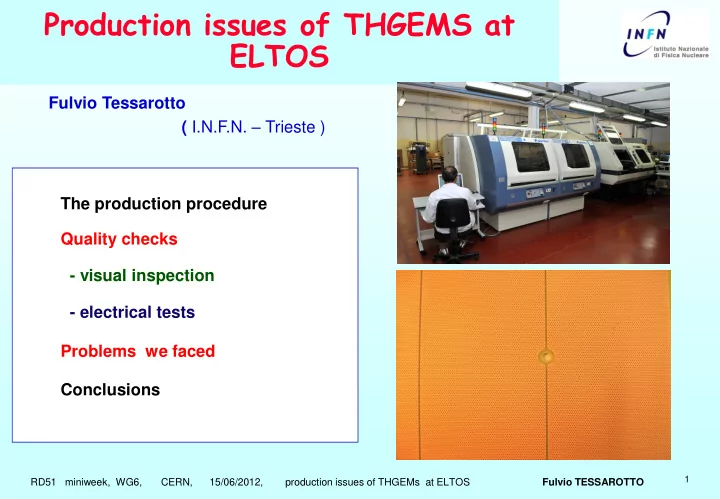
Production issues of THGEMS at ELTOS Fulvio Tessarotto ( I.N.F.N. Trieste ) The production procedure Quality checks - visual inspection - electrical tests Problems we faced Conclusions 1 RD51 miniweek, WG6, CERN,


slide-1
SLIDE 1

1

Production issues of THGEMS at ELTOS

The production procedure Quality checks

  • visual inspection
  • electrical tests

Problems we faced Conclusions Fulvio Tessarotto ( I.N.F.N. – Trieste )

RD51 miniweek, WG6, CERN, 15/06/2012, production issues of THGEMs at ELTOS Fulvio TESSAROTTO

slide-2
SLIDE 2

2

THGEM production

20 μm rim, typical Example of THGEM with 100 x 100 mm2 with 20 μm rim expected, 40 μm

  • btained

Easy to get THGEM produced by industry: provide a Gerber file and a procedure to the pcb producer and place the order. High quality can be obtained, however that is not always straightforward. the most effective

Four etching techniques:

“no” rim, typical holes, “n o” rim, bad hole

slide-3
SLIDE 3

3

THGEM PRODUCTION, materials

The large majority of our test using:

  • Halogenfree FR4, type R-1566(W) by Panasonic
  • DE-156 Halogen free, type DE-156 by Isola
  • A single test using Kapton, APICAL AV Kaneka Corporation
  • Not really stiff even if self-supporting
  • Exotic substrates not explored by us

RD51 miniweek, WG6, CERN, 15/06/2012, production issues of THGEMs at ELTOS Fulvio TESSAROTTO

slide-4
SLIDE 4

4

Material

  • Panasonic 1566 or other

fiberglass is a category

  • f fiberglass materials:

the fiber size can change

  • for small holes (200, 300

microns) it is better to select the one with the smallest fiber diameter

  • During the drilling

procedure some fiber remnants can stick out the hole, some mechanical process is needed to remove them (not trivial)

RD51 miniweek, WG6, CERN, 15/06/2012, production issues of THGEMs at ELTOS Fulvio TESSAROTTO

We tried two producers: Isola and Panasonic: no major difference seen

slide-5
SLIDE 5

5

Production: techniques

Example of ELTOS specified production cycle

The selected technique for our application is based on the global micro-etching process with a well defined procedure (we tried many of them)

RD51 miniweek, WG6, CERN, 15/06/2012, production issues of THGEMs at ELTOS Fulvio TESSAROTTO

slide-6
SLIDE 6

6

Pluritec Multistation Evolution (ELTOS)

180,000 turns/min 20,000 holes/hour Storage: 840 tools Controlled diam., depth and run-out

working area: 630 x 765 mm2

RD51 miniweek, WG6, CERN, 15/06/2012, production issues of THGEMs at ELTOS Fulvio TESSAROTTO

slide-7
SLIDE 7

7

Etching and Final THGEM stabilization

  • Micro etching
  • Smoothens the sharp edges and the copper

residuals inside the hole, that usually ultrasonic bath can not remove

  • The epoxy glue polymerization is usually

incomplete for the standard fiberglass pieces

  • Eltos is applying a 4 hours baking procedure at

140 C, but it is insufficient

  • Full polymerization is obtained with 4 hours at

180 C

  • To be performed at the end of the production

allowing moisture/gases to be outgassed

RD51 miniweek, WG6, CERN, 15/06/2012, production issues of THGEMs at ELTOS Fulvio TESSAROTTO

slide-8
SLIDE 8

8

THGEM RIM PRODUCTION

1)traditional 2) large rim 3) Global microetching

etching before drilling

  • ff-centered rims

uniform and smooth

  • ur choice:

global micro-etching

100 μm rim metallographic section CERN approaches

  • R. De OLIVEIRA

RD51 miniweek, WG6, CERN, 15/06/2012, production issues of THGEMs at ELTOS Fulvio TESSAROTTO

slide-9
SLIDE 9

9

Irregular rim

During the drilling of the holes part of the epoxy glue used for the fiberglass lamination is deposited onto the copper layer The chemical bath is not effective on the area with deposited epoxy glue The only way to avoid is to apply a desmearing: chemical attack to the epoxy glue, process to be applied before etching

RD51 miniweek, WG6, CERN, 15/06/2012, production issues of THGEMs at ELTOS Fulvio TESSAROTTO

Flash removals procedure is applied using abrasive material (pomice stone) in a polishing cylinder machine.

  • The procedure can be applied more than once if

needed (after visual inspection)

Protection and cleaning

Copper protection

To avoid copper oxidation a passivation process can be applied using Chromic acid: same protection as gold coating but less expensive, suite for those layers which are not used as photocathode

Washing

High pressure demineralized water to remove the dust residual.
slide-10
SLIDE 10

10

removed by ultrasonic bath

THGEM quality test

Defects are detected by a quality check procedure when THGEMs are received

local defect from Ni-Au coating: refused piece

II Seminario Nazionale Rivelatori Innovativi, Trieste 18-22/10/2010 THGEMs Fulvio Tessarotto

slide-11
SLIDE 11

11

Quality check

  • Visual inspection
  • Microscope inspection to check the effect of the

treatments

  • Electrical tests

Max biasing voltage: HV tester with nA current limit (N471A) Must respect the Paschen curve expected value. 40% Air humidity 3kV on 0.7mm

RD51 miniweek, WG6, CERN, 15/06/2012, production issues of THGEMs at ELTOS Fulvio TESSAROTTO

slide-12
SLIDE 12

12

MEASUREMENT OF THE RIM SIZE

Trieste 10/5/2012 THGEM-based photon detectors

RIM measurement, method:

  • Microscope Image
  • imported in AutoCad
  • fit of the circles
  • scale calibration using the

radius of the hole (mechanics, i.e. good precision)

Microscope with direct USB interface to any PC: Dino-Lite AM7013 MZT (x 250, 5 Mpixels)

slide-13
SLIDE 13

13

Important tool: Picoammeters

1) Commercial, 1 ch.

  • Keithley 6517A (current res. down to 0.1 pA)

2) Home-made, battery powered (fully floating) (current res. down to 0.1 pA)

  • Read-out by imaging acquisition, by a Lumenera photocamera type Lu275 [100]

reading the picoammeters and a clock; off-line data processing via a MATLAB- based application performing pattern recognition

Trieste 10/5/2012 THGEM-based photon detectors

Voltmeter : OEM44 by Anders

slide-14
SLIDE 14

14

various problems we faced

  • Quality of the raw fiberglass: thickness uniformity, glass fibre quality
  • Drilling uniformity (decision: change tool every 1000 holes)
  • Hole edge quality: Cu detachment, badly cut fibres
  • Remnants from production phases: photoresist or other products
  • Spikes or sharp edges (decision: microetching)
  • Rim defects: non uniformity, incorrect rim size, incorrect centering
  • Isolated holes with rim in a no-rim THGEM (decision: external printing

first)

RD51 miniweek, WG1, CERN, 14/06/2012, IBF studies with THGEMs Fulvio TESSAROTTO

slide-15
SLIDE 15

15

Problem: control of rim quality and size

expected rim: 20 μm measured rim: 40 μm 100 x 100 mm2 prototipes

RD51 miniweek, WG6, CERN, 15/06/2012, production issues of THGEMs at ELTOS Fulvio TESSAROTTO

now we use very small rim

slide-16
SLIDE 16

16

large THGEM production

Test production of 600 x 600 mm2 “Standard” THGEMs 300 x 300 mm2

slide-17
SLIDE 17

17

300 x 300 mm2 THGEMs planarity

300 x 300 mm2 PROTOTYPE, 1/5

central holders border holders new solution

slide-18
SLIDE 18

18

Summary of ELTOS THGEM production

  • About 60 different type of THGEMs produced for our R&D by ELTOS

(~500 pieces in total) 30x30, 100x100, 300x300

  • Most of the production has very good quality drilling
  • Many small problems have been faced and solutions found
  • Converging toward a standard production procedure
  • Small area THGEMS well understood
  • Mastering of large area production is progressing

RD51 miniweek, WG1, CERN, 14/06/2012, IBF studies with THGEMs Fulvio TESSAROTTO