Principal Professional Practice Measures School Year 2014 15 Name: - - PDF document

principal professional practice measures school year 2014
SMART_READER_LITE
LIVE PREVIEW

Principal Professional Practice Measures School Year 2014 15 Name: - - PDF document

Principal Professional Practice Measures School Year 2014 15 Name: Michael Meiser School: Thomas Stone High School Outcome Evidence/Explanation 1.0 Facilitate the development of a school vision. 1.1 There is a written school vision that


slide-1
SLIDE 1

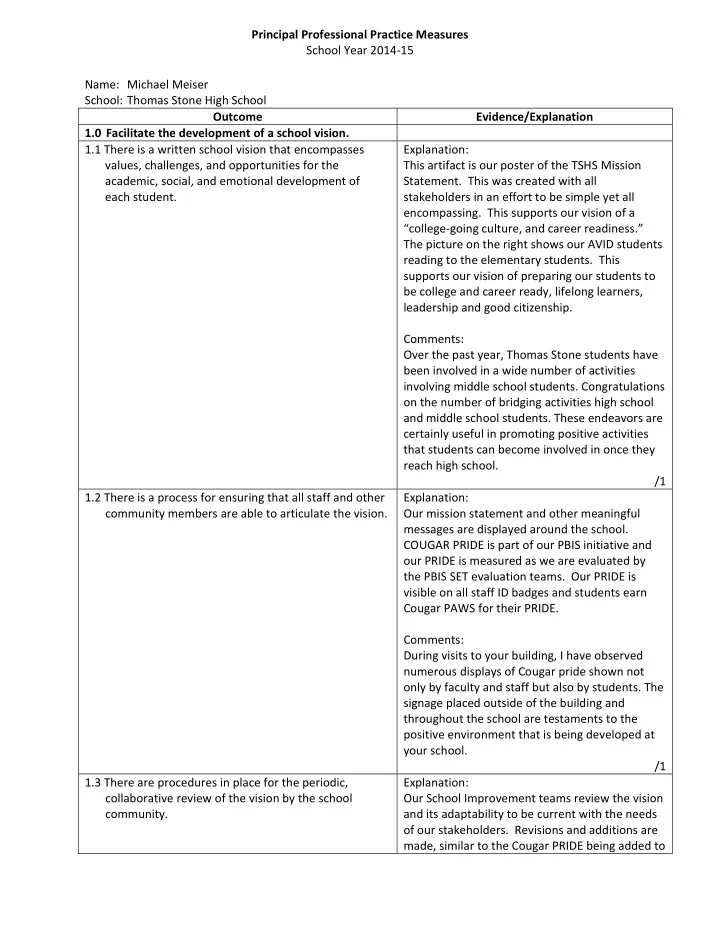
Principal Professional Practice Measures School Year 2014‐15 Name: Michael Meiser School: Thomas Stone High School Outcome Evidence/Explanation 1.0 Facilitate the development of a school vision. 1.1 There is a written school vision that encompasses values, challenges, and opportunities for the academic, social, and emotional development of each student. Explanation: This artifact is our poster of the TSHS Mission

  • Statement. This was created with all

stakeholders in an effort to be simple yet all

  • encompassing. This supports our vision of a

“college‐going culture, and career readiness.” The picture on the right shows our AVID students reading to the elementary students. This supports our vision of preparing our students to be college and career ready, lifelong learners, leadership and good citizenship. Comments: Over the past year, Thomas Stone students have been involved in a wide number of activities involving middle school students. Congratulations

  • n the number of bridging activities high school

and middle school students. These endeavors are certainly useful in promoting positive activities that students can become involved in once they reach high school. /1 1.2 There is a process for ensuring that all staff and other community members are able to articulate the vision. Explanation: Our mission statement and other meaningful messages are displayed around the school. COUGAR PRIDE is part of our PBIS initiative and

  • ur PRIDE is measured as we are evaluated by

the PBIS SET evaluation teams. Our PRIDE is visible on all staff ID badges and students earn Cougar PAWS for their PRIDE. Comments: During visits to your building, I have observed numerous displays of Cougar pride shown not

  • nly by faculty and staff but also by students. The

signage placed outside of the building and throughout the school are testaments to the positive environment that is being developed at your school. /1 1.3 There are procedures in place for the periodic, collaborative review of the vision by the school community. Explanation: Our School Improvement teams review the vision and its adaptability to be current with the needs

  • f our stakeholders. Revisions and additions are

made, similar to the Cougar PRIDE being added to

slide-2
SLIDE 2

Principal Professional Practice Measures School Year 2014‐15 support our PBIS initiative. Our stakeholders review the vision throughout the year as they meet once a month in their SIT meetings on Professional Tuesdays. The Third Tuesday of every month in designated as SIT meeting dates. Comment: It is always important to involve stakeholders and community members in efforts to adapt and share the vision of the school. Question: How many revisions of the school vision have been made this year? /1 1.4 Resources are in place or have been requested to support the vision. Our AVID Site Team helps to support our vision. Our AVID team is a diverse group of stakeholders that impacts and drives the educational focus of the school. Team members are trained to help prepare students for college success and works to be sure our students are college and career

  • ready. AVID promotes leadership, citizenship,

lifelong learning and college readiness; it also provides resources for staff via training and

  • ngoing PD. AVID teaching and learning

strategies are pushed out at all faculty meetings and department chair meetings. Comments: AVID training also provides staff with many essential classroom management strategies. Hopefully those skills are being shared through the AVID team as well. /1 Total Points Outcome #1 4/4 Outcome Evidence 2.0 Align all aspects of a school culture to student and adult learning. 2.1 There is respect, teamwork, and trust in dealings with students, staff, and parents. Explanation: The two documents selected are ways we show respect for our stakeholders and their involvement in our school. The article on the left is a poster for nominating our SUPER STONE STAFF that we recognize at every faculty meeting. The document on the right is a student selected by his teacher as a Cougar Of Courage; each day in April we highlighted a student nominated by a

  • teacher. Both these allow our staff and students

to be recognized for their good doings in and out

slide-3
SLIDE 3

Principal Professional Practice Measures School Year 2014‐15

  • f the classroom.

Comments: Both of the artifacts you shared are excellent examples of how staff and students receive positive recognition. Over the past several weeks, your efforts to recognize vice principals and other administrative personnel have been noted. /1 2.2 There are high expectations for all students and teachers in a culture of continuous learning. Explanation: This artifact is a Twitter feed that shows our staff taking place in staff led professional development

  • n the practical usage of technology in the
  • classroom. Our teachers had the choice of what

PD they wanted to attend and how they wanted to implement in their instruction. Many of our teachers are interested in the benefits of technology to enhance instruction. Comments: In my opinion, technology usage has quickly become one of the most significant instructional tools of the 21st century. You have proven through your leadership that you embrace the transformation, which has been created by technology usage in the classroom. /1 2.3 There is a school improvement plan, focused on results, and characterized by collective responsibility for instructional planning and student learning. Explanation: Department Chairs have common planning time and meet during 7th period every day. This time is utilized to collaboratively drive our instructional focus and plan how it will be developed and delivered to departments and

  • staff. Meetings consists of all core content Dept.

Chairs, High School Resource Teacher, and

  • Administration. This time allows for grass roots

leadership and buy‐in to the programs that are being developed to support our school vision. Comments: I noticed that you have on an orange key clip. I think orange is a great color as well. /1 2.4 There is a school improvement plan, focused on results, and characterized by collective responsibility for instructional planning and student learning. Explanation: We developed the School Improvement Plan and Teams to engage the entire staff in the school improvement plan. The SIP is a process of having stakeholders take part in developing our SIP based on data analysis and incorporate the plan into action. By looking at the needs unique to

slide-4
SLIDE 4

Principal Professional Practice Measures School Year 2014‐15 TSHS, the teams have been developed and adjusted as needed. Our core team, which developed our plan, includes a variety of stakeholders – such as dept. chairs and a parent. Our School Improvement Teams include all members, divided into groups based on interest. Comments: I never had the entire faculty involved in the development of the School Improvement Plan. I think the strategy of obtaining input from all staff members by dividing the staff into groups based

  • n interests is an excellent idea.

/1 2.5 There are opportunities for leadership and collaborative decision‐making distributed among stakeholders, especially teachers. Explanation: Along with our Common Planning period with Department Chairs every day during 7th period, which allows for collaborative decision making and leadership, this year our administrative interns have been a part of the collaborative approach in developing our future leaders of the

  • school. From helping to lead our Cougar Time

SIP, running our CPR (Credit Progress Recovery), and coordinating survey’s and bus referrals, our interns have been instrumental in our inner workings this year. Comment: Assisting administrative interns in enhancing their knowledge of instruction, programs, policies and procedures is extremely crucial. Dr. Hill is dedicated to the concept of “growing your own” in relation to administrative leadership. /1 Total Points Outcome #2 5/5 Outcome Evidence 3.0 Monitor the alignment of curriculum, instruction, and assessment. 3.1 There are ongoing conversations with teachers as to how the Maryland State Common Core Curriculum and/or local curriculum and research‐based instructional strategies that are integrated into daily classroom instruction. Explanation: Our departmental Lesson Sharing and Formative Assessment sharing allowed for departments to showcase their researched‐based instructional

  • programs. Administration and HSRT observed

the Lesson Sharing activities once a marking period, making our way around to all

  • departments. This is a great way to insure that
  • ur instructional focus is being implemented

throughout the departments and school wide. It also allows the staff to showcase their craft with

slide-5
SLIDE 5

Principal Professional Practice Measures School Year 2014‐15

  • ther staff and take back what works to their

classrooms. /1 3.2 There is student work that is appropriately challenging. Explanation: Many of our students take part in rigorous work

  • daily. Our teachers create hands on inquiry‐

based learning activities that allow the students to create original learning assessments. From the use of data analysis activities in Algebra I to BYOD activities used in the Biology Labs, to the AP World History class playing twister as a review to show how Entangling Alliances led to WWI, our teachers provide students with original and alternative assessments, to keep learning fun. Comment: Please discuss minority enrollment in honor and AP classes and efforts to increase the overall number of students of all subgroups enrolled in advanced level classes. /1 3.3 There are assessments that regularly measure student mastery of the content standards. Explanation: As Assessments are regularly given, our data reports are housed in the “School 56 Reports Folder”. We use this information to analyze our data to determine our students’ progress, strengths and challenges as a school. We use this data to drive instruction and to develop our SLO. Comment: You shared many assessments and report folders. Please go into detail and explain additional assessments that are used to measure student mastery of content standards. /1 Total Points Outcome #3 3/3 Outcome Evidence 4.0 Improve instructional practices through

  • bservation and evaluation of teachers.

4.1 There is a process to determine what students are reading, writing, producing, and learning. Explanation: Above is a sample of notes taken when visiting a teacher’s classroom and the Individualized PD plan from this school year? The notes were taken during a class that a teacher requested the HSRT come see in order to find better ways to engage her students. The HSRT then met with the teacher to discuss possible adjustments to her routine in order to promote critical thinking and streamlining lesson plans based on notes. The PD plan is a tool we designed to help teachers plan

slide-6
SLIDE 6

Principal Professional Practice Measures School Year 2014‐15 what PD they wanted to engage in this year. We use our classroom visits, notes and PD plans to determine what students are learning. Comment: Continual discussion of the professional development plan is evident. Questions: How is the plan devised? Along with the AVID team, who is involved in the development of the plan? /1 4.2 There is use of student data and data collected during the observation process to make recommendations for improvement in classroom instruction. Explanation: Student Data was collected to determine the need to create an in‐school Credit Recovery Explanation:

  • Program. As we viewed our graduation rate, we

noticed many were failing and falling out of their

  • cohort. We saw that many students failed Earth

and Space Science in 9th grade, as well as other courses, but then they fell out of their cohort. We created a Credit Progress Recovery to allow students to utilize Cougar Time to regain their Earth and Space Science credit to remain on time to graduate. We had 37 students qualify and 24 students take the program and pass successfully. Comments: The pass rate of students enrolled in Credit Recovery is evidence that the initiative was a

  • success. Thank you for agreeing to pilot this

program. /1 4.3 There is formal feedback during the observation conferences as well as ongoing informal visits, meetings, and conversations with teachers regarding classroom instruction. Explanation: The Insystech platform has been used to plan pre‐conferences, teacher observations, and post‐ conferences, as well as SLO review and SIP. We provide all teachers with detailed feedback. In some cases, action plans were drafted and several follow‐ups were made. Questions: Do all administrators use the same walk‐through

  • bservation sheet? Are there a set number of

weekly “walk‐throughs” required for administrators? /1 4.4 There is regular and effective evaluation of teacher performance based on continuous student progress. Explanation: The two artifacts attached are the e‐mail to

slide-7
SLIDE 7

Principal Professional Practice Measures School Year 2014‐15 teachers going over the Mid‐Year SLO review

  • process. The second artifact is the SLO Mid‐Year

Evaluation Questionnaire. This form was used to ask teachers reflective questions regarding their first part of the year instruction. It was used to determine what ‐ if any ‐ changes would need to be made to their SLO. All teachers had to fill this

  • ut and submit to me prior to meeting to discuss

their progress. /1 4.5 There is identification and development of potential school leaders. Explanation: This artifact shows one of our Admin Interns, a PLTW Biological Medical Teacher, leading the Parent Advisory Committee for the PLTW Bio‐ Med Program. This meeting was conducted at Central Office after school hours, and consisted

  • f students, parents, teachers, administrators,

business owners, health professionals, and Central Office Staff. This teacher runs this meeting and is actively involved in the growth of PLTW Bio Med and developing parent/business partnerships. Question: Are there other parent advisory committees in addition to the Parent Advisory Committee for the PLTW Bio‐Med Program? /1 Total Points Outcome # 4 5/5 Outcome Evidence 5.0 Ensure the regular integration of appropriate assessments into classroom instruction. 5.1 There are multiple and varied assessments. Explanation: The three artifacts shown above address student

  • assessments. Two of them are e‐mails from our

Testing Coordinator to our staff regarding AP testing and PARCC testing schedules and lists of

  • students. The other is the testing calendar of AP
  • testing. These artifacts show only a glimpse of

the varied forms of assessment our students take to show their mastery of content. /1 5.2 There are formative and summative assessments that are a regular part of the ongoing evaluation of student performance and that serve as the basis for adjustments to instruction. Explanation: The above artifact is an e‐mail from our HSRT to Department Chairs giving them the agenda of our Formative Assessment sharing sessions. Our Instructional Focus for second quarter was Formative Assessments. The picture is of the day

slide-8
SLIDE 8

Principal Professional Practice Measures School Year 2014‐15 at the end of the quarter where Administration and HSRT went to various departments, and the teachers shared Formative Assessments they were using to enhance instruction. The share session allowed staff to have takeaways they too could use in their classrooms. These formative assessments allowed administration to see how teachers were evaluating students’ mastery of content and how teachers were adjusting their instruction/planning to meet the needs of their students. Comments: The artifacts for 3.1 and 5.2 are the same picture illustrating the sharing of formative assessment by department members. Information shared by you states, “These formative assessments allowed administrators to see how teachers were evaluating student’s mastery of content and how teachers were adjusting their instruction/planning to meet the needs of their students.” Question: How do administrators use formative assessments to determine whether or not teachers are evaluating student mastery of content and if adjustments are needed to meet the instructional needs of all students in their classrooms? /1 5.3 There are appropriate interventions for individual students based on results of assessments. Explanation: The three artifacts are attributed to our Cougar Time Credit Recovery Program, and our Saturday Grade Recovery Program. The CPR program allowed 24 students to obtain their Earth Science

  • Credit. After we looked at data we saw, Earth

Science was a place where a lot of our students were falling behind. As a result, students signed a contract for success in this program and worked for three months to obtain their credit. Our Saturday Grade recovery program is an

  • pportunity for students to stay up to speed in

their current classes so they don’t fail it for

  • riginal credit. Both programs help us to keep

students on track to graduate and require us to evaluate the data regularly. Comments:

slide-9
SLIDE 9

Principal Professional Practice Measures School Year 2014‐15 Providing students with opportunities for Credit Recovery and Grade Recovery is a significant step in reducing the overall failure rate of students. The contract for Cougar Progress Recovery Time also provides a way that the school can obtain cooperation from students and involve parents/guardians. /1 Total Points Outcome # 5 3/3 6.0 Use technology and multiple sources of data to improve instruction. 6.1 There is effective use of appropriate instructional technology by students, staff, and administration. Explanation: Part of using technology to improve instruction is to provide available technology to teachers that use it to its fullest potential. We have managed who has smart boards over the years at TSHS. Further, we have sought internal and outside sources to provide training to interested

  • teachers. In addition, our utilization of BYOD

pilot school has enhanced our instructional engagement and allowed our teachers to use technology in the classroom daily. Comments: You are the technological guru. Thank you for sharing your technical expertise with other principles in the county chairing the BYOD committee and piloting BYOD initiatives at your school. /1 6.2 There is review of disaggregated data by subgroups. Explanation: We took a hit this past year when we were given

  • ur graduation data for the class of 2013. We fell

way behind and were not keeping pace with where we wanted to be and where the county

  • was. After getting this data we looked at ways

we could improve. We already had grade recovery programs and then looked at the creation of our CRP program. We then later received the information from Dr. Hill releasing

  • ur 2014 graduation rate, and we went up
  • 7percent. This was the largest growth in the

county, and we celebrated by giving every staff member a “7‐up”. We invited Ms. Hollstein over to celebrate in our announcement.

slide-10
SLIDE 10

Principal Professional Practice Measures School Year 2014‐15 Comments: Congratulations on your 2014 graduation data. Increasing by 7 percent this year is a tremendous

  • accomplishment. I am not surprised that you

received the good news from Dr. Hill. She is an advocate of setting high standards in regards to student achievement and models those expectations through her own professional goals. /1 6.3 There is ongoing root cause analysis of student performance that drives instructional decision‐ making. Explanation: At the beginning of the year we looked at our achievement gap as a whole staff. We looked at the data, and analyzed why we have scored the way we had scored. Our staff was asked to determine the root cause of some of these low SPED scores and ways to overcome this gap. We emphasized “Grit”, and hoped that teachers would model Grit as a way of showing the students the mindset needed to overcome challenges. Comments: I appreciate the fact that by emphasizing “Grit” to analyze root cause analysis data, you remembered information shared by Dr. Hill during the Administrative Leadership Institute. Grit and determination will always be important factors in developing the tenacity needed to consistently increase the academic achievement

  • f our neediest students.

/1 6.4 There is regular collaboration among teachers on analyzing student work. Explanation: Our departmental Lesson Sharing, allowed for departments to showcase their researched based instructional programs and the student work

  • created. Administration and HSRT observe the

Lesson Sharing activities once a marking period and make our way around to all departments. This is a great way to insure that our areas of instructional focus are being implemented throughout the departments and school wide. It also allows the staff to reflect on students work and make suggestions on what is working and what may need to be improved. /1 Total Points Outcome #6 4/4

slide-11
SLIDE 11

Principal Professional Practice Measures School Year 2014‐15 Outcome Evidence 7.0 Aligns professional development with identified curricular, instructional, and assessment needs connected to school improvement goals. 7.1 There are opportunities for teachers to engage in collaborative planning and critical reflection wherever possible within the regular school day. Explanation: The artifact at the top shows our Departmental Planning agenda for our Content Planning period. It maps out the instructional focus for Third Marking Period and gives them a baseline of what will be covered as we progress through the Third MP and the Instructional Focus. These are then discussed and adjusted as needed to meet the needs of the teachers and department and

  • students. Department chairs are expected to

discuss the instructional focus at each monthly department meeting. This collaboration allows for input from all departments as we develop and push out our instructional focus. /1 7.2 There is differentiated professional development according to career stages, needs of staff, and student performance. Explanation: These three artifacts show our differentiation of Professional Development. One is an e‐mail from me, with staff being able to select a free webinar

  • f their choice. The other is an e‐mail thanking

staff for their participation in the AVID Mini Training session we went to in Alexandria. As we have more staff growing an interest in wanting to be in AVID, we offer various opportunities to get them trained. The webinars allowed teachers to choose which one of the webinar’s fit their need

  • area. Many of the staff thanked me for these, as

it allowed them flexibility in obtaining needed and wanted PD. Additionally, we have differentiated, either by interest or ability level, PD sessions throughout the school year. Comments: The three artifacts presented provide evidence that there is differentiated professional development according to the needs of staff in relation to their individual professional

  • development. Some principals utilize a

professional development needs assessment survey which is completed by each staff member. I think that the survey is also a good way to determine professional development activities that should be considered by the administrative team. /1

slide-12
SLIDE 12

Principal Professional Practice Measures School Year 2014‐15 7.3 Faculty will be provided an opportunity for input on professional development activities. Explanation: The two documents show our ability to survey

  • ur staff to produce staff development that is of

interest to them. The form on the left is a Google Doc form that was a survey of our offered staff

  • development. It allowed staff to have feedback

and input on the given staff development of the

  • day. The form on the right is the raw feedback on

the PD of the day. We used this to guide us as to what PD we would do as a follow up. These surveys are given out to staff after every large PD activity in order to inform how we create the next PD event. Comments: The Google Docs survey form is a great way to allow staff to have input concerning professional development activities. Analyzing feedback from staff and using that information as a guide in determining follow up to professional development activities is an excellent way to involve staff in the decision‐making process involving their own professional growth and development. /1 Total Points Outcome #7 3/3 Outcome Evidence 8.0 Engage school community members in a shared responsibility for student and school success. 8.1 There are parents and guardians welcomed in the school, encouraged to participate, and given information and materials to help their children learn. Explanation: As can be seen from the artifacts, we offer our stakeholders an opportunity to meet with any and all staff during our Open Parent Conference without an appointment. Staff meets in the cafeteria and sits according to their department. Parents enter the building around 2:30 and begin meeting with teachers of their choice. This was scheduled around the time of 1st MP report cards and allowed teachers and parents to have deep genuine conferences. Comments: Placing all teachers in the cafeteria and having

  • pen parent conferences without an

appointment is certainly a unique concept. I am curious about whether or not parents are able to meet with all of their children’s teachers during this timeframe. /1

slide-13
SLIDE 13

Principal Professional Practice Measures School Year 2014‐15 8.2 There are school community members and school partners who readily participate in school life. Explanation: As a show of support for our student leaders, we had a Student Leadership Week at TSHS sponsored by NHS and one of our administrative

  • interns. We had the student panel speak to our

students, and then we also invited community leaders into the forum to discuss leadership with

  • ur teacher identified leaders. Our very own Dr.

Hill and Chairwoman McGraw attended and provided insight to the students on leadership. Comments:

  • Mr. Meiser you certainly know how to provide

artifacts that would gain you credit for the

  • component. Including a picture of Dr. Hill and
  • Mrs. McGraw will result in credit every time.

/1 Total Points Outcome #8 2/2 Outcome Evidence 9.0 Prioritize, manage, and administer resources in an effective and efficient manner. 9.1 Creates processes and a schedule that maximizes time for instruction and collaboration. Explanation: Our implementation of Cougar Time, or Hour Lunch, allowed us to maximize our instructional time and time for planning and collaboration. This time in our schedule was new for this school

  • year. Our students were given the time to eat

lunch and meet with teachers for club and activities, but also for extra academic supports. Students were able to utilize this time for their benefits, but in addition, staff used this time to collaboratively plan and have meetings to review content and students’ successes and challenges. Comments: It is imperative that students, faculty, and staff realized that the lunch hour was not created to provide students with 60 minutes to eat. The entire concept is built upon the premise that students will be given time during the regular school day to participate in clubs and activities,

  • btain academic support, make up missed

assignments, and participate in grade recovery

  • initiatives. The additional time also provides staff

with time for collaborative planning and time to review the academic achievement of selected students. /1

slide-14
SLIDE 14

Principal Professional Practice Measures School Year 2014‐15 9.2 Facilitates hiring, assigning, and supervising of all personnel employed at the school. Explanation: Attached are two artifacts and/or e‐mails to Dean Brooks in HR, in which we offered employment positions to candidates that we interviewed here at TSHS. We work with HR to get our candidates and staffing to see what works best with TSHS. Comment: Please explain the process of interviewing, hiring, and determining who is on the interview panel at your school. /1 9.3 Uses a variety of performance data to recommend personnel action. Explanation: Here is a copy of our grade distribution sheets that we use to look at teachers’ grades. We utilize this data to determine staff success with various levels of students. We are using this data to move forward in our discussion of a change in

  • ur Grading Policy at TSHS. If teachers’ scores

are not matching expectations for levels of rigor, we look for PD and/or the possibility of changing the students’ level of rigor or content. Comment: Please explain the process of changing a student’s level of rigor or placing students in more rigorous academic classes. /1 9.4 Uses public resources and funds appropriately Explanation: Attached are two artifacts that show our Verification for Monthly School Allotment and Monthly Checklist for Financial Statements. We verify all spending every month to insure that our spending is accurate, that we don’t have bills that are overdue, and that accounts are within the limits required by guidelines. /1 9.5 Manages financial, material, and technology resources in an effective and equitable manner. Explanation: This year we converted to use the P‐card. Our spending had to be monitored in a different way, but technology allowed for us to track our spending and use of the P‐card. Question: Has converting to use of a P‐card improved the monitoring of monthly school expenditures? /1

slide-15
SLIDE 15

Principal Professional Practice Measures School Year 2014‐15 9.6 Coordinates the management of the school plant. Explanation: We made a big push this year to upgrade our physical plant. We had our facilities panted, new and updated signage, including our banners that are hung from our light poles. The banners highlight our accomplishments and programs of study we have here at TSHS. Comments: Your idea of hanging banners on the light poles has become very popular. Other schools are using your idea to market their schools. Throughout the school year, it has been noted that you have been a leader in that area. You do a great job of marketing your school in a very positive manner. /1 9.7 Ensures the maintenance and accuracy of all school records. Explanation: This year our system switched to the Insystech as a way to manage all teachers SLO’s, SIP, and

  • Observations. As we got near the end and

teachers were coming in for their Evaluations, I had to monitor the accuracy of the data that Insystech accurately/inaccurately had entered. Above are e‐mails to Insystech and R&A asking for help in the fixing of inaccurate data? /1 Total Points Outcome #9 7/7 Outcome Evidence 10.0 Communicate effectively in a variety of situations and circumstances with diverse audiences. 10.1 Strives to keep the community aware of school programs and shares important data and information with the school community. Explanation: By writing monthly newsletters for seniors, parents and students are provided with up‐to‐ date graduation information. Aside from the newsletter, a “senior corner” is kept updated on the website. Emails and phone calls take place regularly throughout the day to keep parents informed on their students’ progress and

  • behavior. In addition, Twitter has been used as

a vehicle to push information out to the masses. We have over 850 followers which allows for us to make contact with a large group of stakeholders in one message. Comments: Congratulations on having over 850 followers for your Twitter account. Hopefully that number will continue to grow. /1

slide-16
SLIDE 16

Principal Professional Practice Measures School Year 2014‐15 10.2 Facilitates the continuous safety of the school. Explanation: We conduct our monthly severe weather drills and keep our kids prepared in case of emergency. The letter on the right went home to all households regarding an incident that occurred

  • n one of our school busses. This information

shows the stakeholders our concern for the safety for all, but also that action has been taken to keep them informed and safe and secure in

  • ur duties.

/1 10.3 Responds appropriately and in a timely manner to members of the school community. Explanation: This e‐mail from a parent thanks me for keeping them informed of all on goings in the schools, “good or bad.” This shows our open lines of communications with stakeholders and their involvement in the school. This timely information allowed the parents the ability to address the situation with their child and help to counsel their child at home. Comments: Transparency is an important factor in providing information to our school communities. Transparency builds trust and confidence from parents concerning actions of the administrative team. /1 10.4 Communicates and interacts professionally and positively with members of the internal and external school communities. Explanation: This year I was invited to speak to a local Lions Club in Waldorf. After treating me to a great meal, they then had me talk about TSHS and asked me pointed questions about the school and school system. This gave me an opportunity to sell what was happening at TSHS as well as build a bridge with community members. The pictures are of one of 5 community‐related speakers who we invited to our school and of one of our AVID students reading at one of our feeder elementary

  • school. We have found that opening the lines of

communication with internal and external school communities starts with an invitation or an offer to help. Comment: It is always exciting to read about how principals share information with our stakeholders and to view bridging activities with your feeder schools. /1

slide-17
SLIDE 17

Principal Professional Practice Measures School Year 2014‐15 10.5 Demonstrates appreciation of diversity and promotes sensitivity to student and staff needs. Explanation: Our ties to the Korean Culture here at TSHS have allowed us to make a worldwide connection with this culture. They come to our school twice a year, from Korea, to perform and share their culture with our kids. These are professional singers, dancers and artists share with TSHS students to help promote their culture, as Waldorf has a Korean Culture within our school. Comment: Please make sure you invite me the next time a group from Korea visits your school. The pictures are inspiring. I am sorry that I missed the program this year, but I certainly look forward to that opportunity on their next visit. /1 10.6 Utilizes effective problem solving strategies for resolving conflict and building consensus. Here is a picture of our Department Chairs and me talking about how we can solve the problem

  • f our graduation rate, inequities in our grading,

and development of a more cohesive grading

  • policy. Members of the group all have differing

ideas of how this should be implemented and what they want. I facilitate, but looked for teachers to drive the discussion and find the answers, as they will have to be the ones living by the new policy. Comment: You already know what I am thinking about this

  • picture. I have previously shared my thoughts

about the orange key clip from my comments in 2.3. I really do think that you should have also left the lettering in orange but I do understand that blue is also a great color. /1 Total Points Outcome #10 6/6 Outcome Evidence 11.0 Understand and respond to the cultural context of the school community. 11.1 Models the core beliefs of the system and the school. Explanation: Our core beliefs of college and career readiness, leadership and citizenship are highlighted every year at the Military Ball. Our JROTC program, the

  • ldest in the county, is a program with great

pride as these young men and women prepare to join the real world. /1

slide-18
SLIDE 18

Principal Professional Practice Measures School Year 2014‐15 11.2 Aligns actions to the vision of the school. Explanation: Our Bridging the Gap College and Career Fair allowed us to have employers and colleges on site, accepting applications and hiring on the

  • spot. Students were offered on site acceptance

to colleges and were able to compare schools and

  • professions. Our Environmental club is active in

citizenship projects in beautifying the school and the grounds. Our courtyard projects are mostly student led and student created. /1 11.3 Develops positive relationships with community leaders and fosters a climate that invites community members to donate time, expertise, and resources. Explanation: Our annual Fall Festival allows for us to build positive relationship with our community and share with our community all the good things our students produce. Our AVID students had a bake sale at the Fall Fest and showed leadership and civic mindedness as they interacted with our

  • stakeholders. The hallways are decorated by our

class leaders, aided by class sponsors, in order to provide our community members with a safe place for kids to “trick or treat.” Comments: You have done an outstanding job of creating partnerships with the business community. Please continue your efforts in regard to this

  • initiative. Contributions from business partners

go a long way in assisting marketing your school initiatives. /1 11.4 Recognizes and celebrates the contributions of all school community members. Explanation: We updated our Wall of Fame and brought back 5 historically impactful people to be recognized and placed into our Wall of Fame. We recognized Nancy Jeffrey as an Exceptional Teacher at this year’s board meeting. She was overwhelmed and pleased be part of the recognition. Comments: I always enjoy looking at the wall of fame when I visit Thomas Stone High School. Recognizing

  • utstanding employees is always a highlight of

Board meetings. Board members and the Superintendent appreciate having an opportunity to hear about the outstanding contributions of students and county employees. /1 Total Points Outcome #11 4/4

slide-19
SLIDE 19

Principal Professional Practice Measures School Year 2014‐15 Outcome Evidence 12.0 Promote the success of every student and teacher by acting within a framework of integrity, fairness, and ethics. 12.1 Fosters, models, and supports a high level of professional performance and growth for administrative, instructional, and support staff. Explanation: This year I presented to the Board Members and to the Principals at our monthly Principals

  • meeting. Presentations included BYOD and

Marketing Your School. Currently I am on the PASS committee, the Grading Policy Committee, and BYOD Pilot school committee. I try to foster, model, and supports a high level of professional performance and growth for all of my stakeholders in the attempt to model what is right. Comments: The professional support that you provide has been well documented throughout the entire

  • portfolio. It is evident that you model a high level
  • f professionalism and support for faculty and

staff that has a direct impact on the positive school environment, instructional activities, and student achievement. Thank you for your participation on Board level committees and pilot programs within the county. /1 12.2 Maintains confidentiality when dealing with staff, students, services, and records. Explanation: Attached are an action plan and a letter of

  • reprimand. Both were created and sent to HR to

follow proper procedures. Only those directly a part of the letter and the action plan are privy to the information. All files are kept confidential and shared with no one. Comments: During several principals meetings, discussions were conducted involving the need for courageous conversations involving staff. Maintaining confidentiality in reference to such conversation is extremely important. Your statement that all files are kept confidential and shared with no one is noted and appreciated. /1 12.3 Follows established legal practices, Board policy, negotiated agreements, and system procedures. Explanation: At the beginning of the school year, a systematic plan is put into place to ensure we have all student Code of Conduct pages signed. This is partly in effort to follow the required steps in preparing for a suspension to the superintendent.

slide-20
SLIDE 20

Principal Professional Practice Measures School Year 2014‐15 Great measures are taken to be sure that each suspension packet is completed promptly and professionally. /1 12.4 Exercises appropriate judgment when making decisions. Explanation: Above are a copy of the E‐mail from a parent who was happy with the way we handled a situation and the letter of the incident that went home to

  • everyone. Using proper judgment, I sent this

letter home to all to keep them informed, and not to cause a panic. In this case, I used proper judgment, as we received no complaints or concerns, only praise for the way the incident was dealt with. Comments: The same email was used in component 10.3. It is always good practice to keep copies of a variety

  • f different emails which can be included within

your portfolio. /1 Total Points Outcome #12 4/4 Total Points 50/50