Principal Professional Practice Measures School Year 2014 2015 Name: - - PDF document

principal professional practice measures school year 2014
SMART_READER_LITE
LIVE PREVIEW

Principal Professional Practice Measures School Year 2014 2015 Name: - - PDF document

Principal Professional Practice Measures School Year 2014 2015 Name: Kathy Perriello School: General Smallwood Middle School Outcome Evidence 1.0 Facilitate the development of a school vision. 1.1 There is a written school vision that


slide-1
SLIDE 1

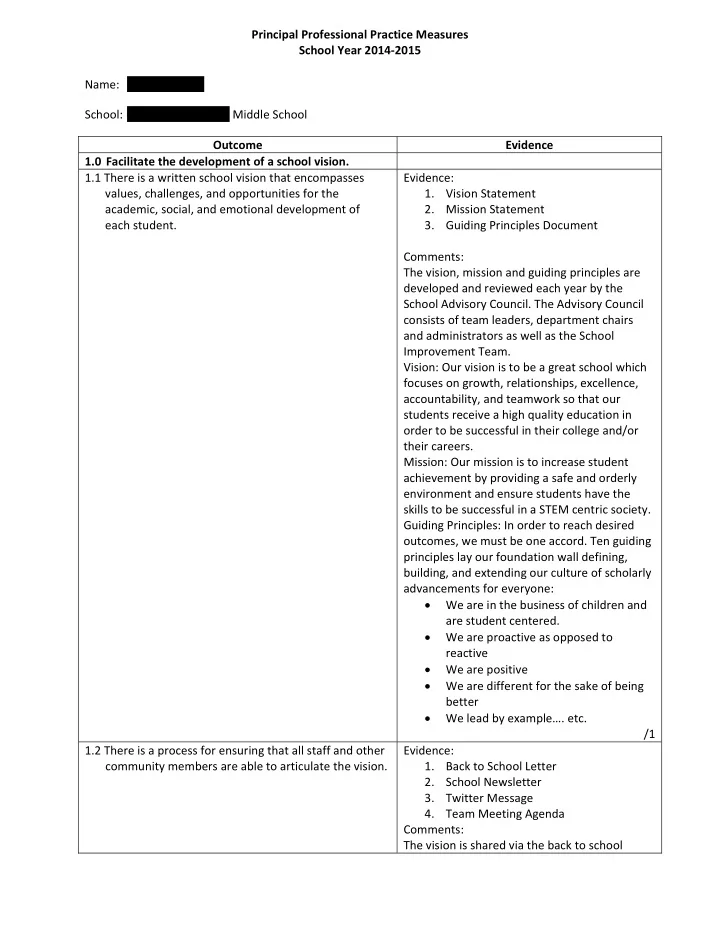
Principal Professional Practice Measures School Year 2014‐2015 Name: Kathy Perriello School: General Smallwood Middle School Outcome Evidence 1.0 Facilitate the development of a school vision. 1.1 There is a written school vision that encompasses values, challenges, and opportunities for the academic, social, and emotional development of each student. Evidence:

  • 1. Vision Statement
  • 2. Mission Statement
  • 3. Guiding Principles Document

Comments: The vision, mission and guiding principles are developed and reviewed each year by the School Advisory Council. The Advisory Council consists of team leaders, department chairs and administrators as well as the School Improvement Team. Vision: Our vision is to be a great school which focuses on growth, relationships, excellence, accountability, and teamwork so that our students receive a high quality education in

  • rder to be successful in their college and/or

their careers. Mission: Our mission is to increase student achievement by providing a safe and orderly environment and ensure students have the skills to be successful in a STEM centric society. Guiding Principles: In order to reach desired

  • utcomes, we must be one accord. Ten guiding

principles lay our foundation wall defining, building, and extending our culture of scholarly advancements for everyone:

  • We are in the business of children and

are student centered.

  • We are proactive as opposed to

reactive

  • We are positive
  • We are different for the sake of being

better

  • We lead by example…. etc.

/1 1.2 There is a process for ensuring that all staff and other community members are able to articulate the vision. Evidence:

  • 1. Back to School Letter
  • 2. School Newsletter
  • 3. Twitter Message
  • 4. Team Meeting Agenda

Comments: The vision is shared via the back to school

slide-2
SLIDE 2

Principal Professional Practice Measures School Year 2014‐2015 newsletter to parents and staff, school newsletter, Edline messages, and social media such as Twitter. The morning and afternoon announcements also incorporate the school’s vision as does the weekly Friday Focus. Team leaders review the vision with their respective team members after meeting with the principal. Information contained within the school newsletter carefully exemplify your efforts to create a positive and welcoming educational environment for students and staff. In addition, the sixth grade team meeting agenda for November 7, 2014, incorporated many activities to help students become accountable for their own academic status. /1 1.3 There are procedures in place for the periodic, collaborative review of the vision by the school community. Evidence:

  • 1. PTO Principal’s Report
  • 2. Team Leader/Department Chair

Agenda

  • 3. Friday Focus

Comments: The vision of the school is reviewed and discussed by the PTO and the School Advisory Council consisting of team leaders, department chairs, and the School Improvement Team. Parents are members of all three of these

  • rganizations. Reminders are also sent in the

form of written communication in the Friday Focus, a communication tool sent to all staff members every Friday before the end of the school day. /1 1.4 Resources are in place or have been requested to support the vision. Evidence:

  • 1. Requests for Substitute
  • 2. Email
  • 3. Top 5 Priorities
  • 4. Emails Regarding Positions

Comments: A variety of resources have been requested to support the vision of the school. Substitute requests have been made to support teaching and learning. Requests have been made for special educators for the purpose of case

  • management. Other requests have included

support for post‐assessment testing and

slide-3
SLIDE 3

Principal Professional Practice Measures School Year 2014‐2015 transitions for staff members who go out on Family Medical Leave Act (FMLA). Additional priorities have been submitted to the Office of School Administration. /1 Total Points Outcome #1 4/4 Outcome Evidence 2.0 Align all aspects of a school culture to student and adult learning. /1 2.1 There is respect, teamwork, and trust in dealings with students, staff, and parents. Evidence:

  • 1. Parent Letter
  • 2. IEP Meeting Email of Support
  • 3. Parent Email
  • 4. Parent Email

Comments: The vision of the school is reflective of the fact that there is respect, teamwork, and trust in dealings with students, staff, parents, and the school community. The vision focuses on developing relationships between individuals, excellence, accountability, and teamwork. According to Ms. Perriello, it is expected that all staff members treat each other respectfully and forge positive relationships with students and their families. The motto is to treat others as you would want to be treated. This message is conveyed daily during the morning and afternoon announcements. /1 2.2 There are high expectations for all students and teachers in a culture of continuous learning. Evidence:

  • 1. Organizational Chart
  • 2. Administrative Meeting Agenda
  • 3. Team Leader/Department Chair

Meeting Agenda Comments: Staff always begins the start of each new year with a review of the vision, mission, and guiding principles. Reminders and expectations regarding school protocol and expectations are conveyed periodically through the Friday Focus, staff meetings, team meetings, department chair and team leader meetings, and general emails sent to staff. Programs are in place to help promote and cultivate a climate conducive to learning for all. Students are invited to participate in accelerated and AVID meetings. Each day, expectations are reviewed through

  • announcements. Other reminders about
slide-4
SLIDE 4

Principal Professional Practice Measures School Year 2014‐2015 positive behavior are also reinforced daily with students. /1 2.3 There is a school improvement plan, focused on results, and characterized by collective responsibility for instructional planning and student learning. Evidence:

  • 1. Organizational Chart
  • 2. Administrative Meeting Agenda
  • 3. Team Leader/Department Chair

Meeting Agenda Comments: The School Leadership Team consists of administrators, team leaders, department chairs, school improvement team members, counselors, the PPW, and the Instructional Leadership Team (ILT). Administrators, counselors, the Instructional Leadership Team, and the PPW meet every Monday morning with the principal to discuss instructional programs, safety and security, and student services. Team leaders and department chairs meet the first Monday of the month with the principal after school. /1 2.4 There is a school improvement plan, focused on results, and characterized by collective responsibility for instructional planning and student learning. Evidence:

  • 1. School Improvement Plan
  • 2. SLO #1
  • 3. SLO#2
  • 4. SLO Gap Reduction

Comments: The School Improvement Plan is developed by the school leadership team and includes parental input. The School Improvement Plan is based on pre‐/post data and science MSA

  • scores. The School Improvement Plan guides

the development of the school’s SLOs and Gap Reduction initiatives. Questions that guide pre/post data analysis include:

  • 1. Describe the challenges in

reading/language arts, math, and science. In your response identify subgroup information and gap data.

  • 2. Describe the changes or adjustments that

will be made to ensure progress in closing the achievement gap.

  • 3. Describe the actions that will be made to

prepare students and staff for the implementation of selected instructional strategies. /1

slide-5
SLIDE 5

Principal Professional Practice Measures School Year 2014‐2015 2.5 There are opportunities for leadership and collaborative decision‐making distributed among stakeholders, especially teachers. Evidence:

  • 1. Calendar of Meetings
  • 2. Agenda Team Meeting

Comments: Teachers, team leaders, department chairs, and school activities sponsors meet according to a systematic schedule that allows an opportunity for discussion and review. Mondays are designated team leader/department chair

  • meetings. Professional learning communities

take place on Tuesday during the school day. Teachers meet with the ILT for the purpose of content plantings on Mondays, and grade level teams meet during the school day on Fridays. After school conferences take place on Tuesdays, Wednesdays, and Thursdays. Daily and weekly planning times are incorporated into the master schedule by grade level. /1 Total Points Outcome #2 5/5 Outcome Evidence 3.0 Monitor the alignment of curriculum, instruction, and assessment. 3.1 There are ongoing conversations with teachers as to how the Maryland State Common Core Curriculum and/or local curriculum and research‐based instructional strategies that are integrated into daily classroom instruction. Evidence:

  • 1. Friday Focus (2)
  • 2. ILT Assignments (3)
  • 3. Email of Instruction Newsletter
  • 4. Newsletter
  • 5. Instructional Reminders Email

Comments: Teachers at General middle school meet with members of the ILT on Mondays during half of their planning time for the purposes of content

  • planning. Teachers submit two lesson plans on

Thursday afternoons. Lesson plans and the Maryland Standards for College and Career Readiness drive short ‐and long‐term planning. ILT members are assigned to teachers’ classrooms to provide additional support through co‐teaching and small group pull‐out so that best practices are aligned with the

  • content. Based upon informal classroom visits,

discussions with staff members and follow up with written forms of communication. /1

slide-6
SLIDE 6

Principal Professional Practice Measures School Year 2014‐2015 3.2 There is student work that is appropriately challenging. Evidence:

  • 1. School Lesson Plan
  • 2. Twitter Messages: Website Domain
  • 3. Text Dependent Questions
  • 4. Class Essay

Comments: Student work is monitored and celebrated through informal classroom visits in addition to the formal observation process to ensure alignment and appropriateness of work. Lessons are generated for the entire school based upon the Maryland Standards for College and Career Readiness. Teachers, administrators, and the ILT members discuss student work samples in team meetings, department meetings, and through informal sharing. /1 3.3 There are assessments that regularly measure student Mastery of the content standards. Evidence:

  • 1. Pre Assessment Data Sheet
  • 2. Mock Science
  • 3. Reading Benchmark
  • 4. Spanish I

Comments: Students are administered pre‐assessments in September, and the post‐assessment is given in

  • February. These assessments are based on the

content standards. An eighth‐grade Mock Science Assessment is given to help identify areas of need in preparation for the Science

  • MSA. The focus of the school continues to be

reading comprehension. Benchmark assessments are given to monitor struggling

  • readers. Teachers use a variety of formative

and summative assessments to measure student learning and mastery of content. /1 Total Points Outcome #3 3/3 Outcome Evidence 4.0 Improve instructional practices through

  • bservation and evaluation of teachers.

4.1 There is a process to determine what students are reading, writing, producing, and learning. Evidence:

  • 1. Email of Observation Process
  • 2. Vice Principal Email
  • 3. Observation Checklist
slide-7
SLIDE 7

Principal Professional Practice Measures School Year 2014‐2015

  • 4. Insystech Email
  • 5. Maryland Independent Resource
  • 6. Guided Reading Document

Comments: Formal observations and informal classroom visits are conducted to determine what students are learning and producing. The ILT meets with administrators on a weekly basis to discuss classroom instruction. ILT members are assigned to classrooms four out of five days. The sum plans are submitted to the administration and reviewed by the ILT to monitor student work. Guided/strategic reading groups are essential to the overall success of every student preforming at or below grade level. The goal is to build reading comprehension skills to enhance student access to the curriculum. /1 4.2 There is use of student data and data collected during the observation process to make recommendations for improvement in classroom instruction. Evidence:

  • 1. Observation Profile
  • 2. Three Observations From

Administrative Team Comments:

  • Ms. Perriello conducts formal observations of

all non‐tenured and cohort 2 teachers. Vice principals are assigned to observations based upon content. Observations are conducted based upon The Danielson Framework of Classroom Environment and Instruction in

  • rder to make recommendations for

improvement in instructional activities within the classrooms. /1 4.3 There is formal feedback during the observation conferences as well as ongoing informal visits, meetings, and conversations with teachers regarding classroom instruction. Evidence:

  • 1. Principal Summary Observation
  • 2. Friday Focus
  • 3. Instructional Reminders
  • 4. Grading Practices
  • 5. Grade Distributions

Comments: Classroom instruction is the continuous conversation at the school. Formal and informal dialogue occurs during the

slide-8
SLIDE 8

Principal Professional Practice Measures School Year 2014‐2015

  • bservation process, staff meetings, team

meetings, department meetings, in professional weekly Friday Focus discussions, and through emails. A major focus this year has been an effective grading practices and the use

  • f formative and summative assessments to

drive classroom instruction. The School Leadership Team decided to change the school‐ wide grading policy to 55 percent summative assessments and 45 percent formative

  • assessments. Failure conferences are held

throughout the year to better communicate with parents and assist students with reaching grade specific content levels. All Core Six strategies have been implemented as a means to help advance instructional delivery in the classrooms. /1 4.4 There is regular and effective evaluation of teacher performance based on continuous student progress. Evidence:

  • 1. Principal Summary Observation
  • 2. Friday Focus
  • 3. Instructional Reminders
  • 4. Grading Practices
  • 5. Grade Distributions

Comments: Mid‐year conferences are held in January with teachers to discuss the progress and attainment of their Student Learning

  • Objectives. Dialogue includes conversations

about specific reading targets, instructional strategies to support student growth, supports for struggling learners, professional development, exclusion rule, and interventions. Dialogue during these conferences includes discussions about formal and informal

  • bservations that have been conducted by
  • administrators. Department meetings are also

held and include discussions about student performance data. /1 4.5 There is identification and development of potential school leaders. Evidence:

  • 1. Organizational Chart
  • 2. Internship Confirmation
  • 3. Vice Principal Applications
  • 4. Principal Application

Comments: The principal believes in building leadership

slide-9
SLIDE 9

Principal Professional Practice Measures School Year 2014‐2015 capacity at the school. An organizational chart has been developed that highlights leadership activities of administrators, counselors, team leaders, and department chair members. Teachers have been identified and targeted for leadership development based upon their roles within the school. The administrative assistant and the Instructional Resource teacher

  • btained their Administrative I endorsement.

/1 Total Points Outcome # 4 5/5 Outcome Evidence 5.0 Ensure the regular integration of appropriate assessments into classroom instruction. 5.1 There are multiple and varied assessments. Evidence:

  • 1. Professional Development on

Grading Performance Series Testing

  • 2. History Fair Winners

Comments: Professional development is held throughout the year and focuses on grading and infusion of formative and summative assessments into classroom instruction. Benchmark assessments are given students to measure their reading

  • comprehension. In addition to general

classroom assessments, students in enrichment science and social studies classes participate in both the school and county History Day, and the Science Fair. /1 5.2 There are formative and summative assessments that are a regular part of the ongoing evaluation of student performance and that serve as the basis for adjustments to instruction. Evidence:

  • 1. Summary of Data Analysis
  • 2. Professional Development Log
  • 3. Science Formative Assessment
  • 4. Email on Running Records
  • 5. Email Regarding Mock Data

Comments: Samples of student work are reviewed at grade level team meetings and at professional learning community meetings. Work is reviewed to determine patterns and trends as a means to identify best practices in classroom

  • instruction. Teachers, administrators,

counselors, and ILT members have daily conversations about student progress. Department meetings are held monthly to discuss student performance. /1

slide-10
SLIDE 10

Principal Professional Practice Measures School Year 2014‐2015 5.3 There are appropriate interventions for individual students based on results of assessments. Evidence:

  • 1. ELO Student Information Sheet
  • 2. 7th Grade Guided Reading, SWAG

(Students With A Goal) Assignments

  • 3. Science MSA Initiatives

Comments: Academic interventions are conducted within the regular classroom setting. Students are identified through post‐assessment data from 2014, MSA data, and recommendations from elementary feeder schools. Reading support classes have been added for sixth grade

  • students. Guided reading groups have been

established based on running record levels in sixth and seventh grade inclusion classes. Math support is provided as an intervention in the regular classroom setting. The school also utilizes extended learning opportunities as a means to work with targeted students. Targeted interventions for specific students in science were developed through an analysis of the mock MSA Science test. /1 Total Points Outcome # 5 3/3 6.0 Use technology and multiple sources of data to improve instruction. 6.1 There is effective use of appropriate instructional technology by students, staff, and administration. Evidence:

  • 1. BYOD Overview
  • 2. BYOD Programs and Applications
  • 3. Six Twitter Messages of Technology

Use by Students Comments: Students utilize technology in the classroom on a daily basis. Staff members have received professional development training on various programs and applications. Training is based upon staff interests and professional development needs. Devices such as laptops, tablets, and iPads are provided for students. /1 6.2 There is review of disaggregated data by subgroups. Evidence:

  • 1. ELO Information Sheet
  • 2. Targeted Students, Math ELO
  • 3. Reading ELO
  • 4. Gap Reduction

Comments: Student performance is analyzed by grade

slide-11
SLIDE 11

Principal Professional Practice Measures School Year 2014‐2015 level, content, and other demographic information such as FARMS, special education, ethnicity, and gender. Subgroup data is also considered as a criteria for student enrollment into extending learning opportunities. /1 6.3 There is ongoing root cause analysis of student performance that drives instructional decision‐ making. Evidence:

  • 1. Administrative Meeting Agenda
  • 2. Email Regarding SSTs
  • 3. SST Schedule
  • 4. Email of Grading and Formative

Assessments Comments: Review of student performance and root cause analyses is an ongoing process. Students are referred to the Student Support Team for academic concerns during weekly team

  • meetings. Teachers complete referral forms for

consideration during the Student Support Team (SST) meetings. Student performance, pacing, and academic progress is also discussed during department meetings. /1 6.4 There is regular collaboration among teachers on analyzing student work. Evidence: Drop‐In Schedule Friday Focus on Gifted Friday Focus on Failure Conferences Friday Focus on Data Analysis Comments: Teachers participate in a “Drop‐In” program during which they elect to spend one half of their planning, once a week, in a classroom with teachers that teach similar or the same content as they do. Teachers utilize this time to assist students individually with their work, conduct small group instruction, or provide makeup assistance for students due to

  • absences. Drop‐in partners are a creative way

to enhance student/teacher relationships and promote comprehension of content by all students. /1 Total Points Outcome #6 4/4

slide-12
SLIDE 12

Principal Professional Practice Measures School Year 2014‐2015 Outcome Evidence 7.0 Aligns professional development with identified curricular, instructional, and assessment needs connected to school improvement goals. 7.1 There are opportunities for teachers to engage in collaborative planning and critical reflection wherever possible within the regular school day. Evidence:

  • 1. Calendar of Meetings
  • 2. Friday Focus on Content Planning with

ILT

  • 3. Data Analysis Logs
  • 4. Short Term Planning
  • 5. Classroom Support

Comments: Teacher planning time is strategically scheduled to maximize professional discourse, reflection

  • n instructional activities, and collaboration

between and among grade levels. Teachers are given an opportunity to analyze student work and record their analysis of student progress which is uploaded into Insystec. Teacher weekly calendar:

  • Mondays ‐ Content Planning With ILT
  • Tuesdays ‐ Professional Development
  • Wednesdays ‐ Professional Drop‐Ins
  • Thursdays ‐ Edline Updates
  • Fridays ‐ Team Meetings

/1 7.2 There is differentiated professional development according to career stages, needs of staff, and student performance.

  • 1. Evidence:
  • 2. Exit Slip
  • 3. Email on Core 6
  • 4. Commendation from Dawn Schaeffer
  • 5. Non‐Tenured Email
  • 6. Four Twitter Messages on Professional

Development Comments: Overall professional development goal is to develop, build, and enhance teacher capacity. Professional development occurs with the intern staff during the school day or during staff

  • meetings. Differentiated professional

development occurs during content and/or grade level professional learning communities. Examples of professional development which has occurred this year include:

  • Core Six Strategies
  • Text Dependent Questions
  • Equation Editor for Math PARCC
slide-13
SLIDE 13

Principal Professional Practice Measures School Year 2014‐2015

  • Formative and Summative Assessments
  • Student Engagement
  • Professional Responsibilities for Non‐

tenured Staff

  • AVID Strategies
  • Mentoring and School Visits for First‐

Year Teachers /1 7.3 Faculty will be provided an opportunity for input on professional development activities. Evidence:

  • 1. BYOD Sign‐up
  • 2. Mid‐Year Professional Development

Needs Mentoring Email

  • 3. Nearpod Request
  • 4. Teacher Thank‐You About Social

Studies Request Comments: At General Smallwood Middle school, the goal is to be inclusive as opposed to exclusive. Staff members actively participate in the selection of professional development activities. The teachers begin discussing anticipated professional development needs on their first day of work. Additional opportunities are

  • ffered throughout the year for staff to have

input into staff development activities. Requests can be made during staff meetings, team meetings, department meetings, through emails, and through personal communication with administrators. /1 Total Points Outcome #7 3/3 Outcome Evidence 8.0 Engage school community members in a shared responsibility for student and school success. 8.1 There are parents and guardians welcomed in the school, encouraged to participate, and given information and materials to help their children learn. Evidence :

  • 1. Twitter Message About AVID Parent

Night Awards Program

  • 2. Two Documents on American

Education Week

  • 3. Parent Email for Supplies

Comments: Parent nights are conducted quarterly throughout the year. The goal of parent nights is to inform parents about instructional strategies, scope and sequence of each curriculum, and instructional strategies that can be used to assist their children at home.

slide-14
SLIDE 14

Principal Professional Practice Measures School Year 2014‐2015 Parents are always welcome at the school. Parent volunteers chaperone field trips, assist with extracurricular activities, volunteer in the media center, assist with the book fair, assist with the science fair, and assist with quarterly awards assemblies. Parents always have the

  • ption of having lunch with their children in the

cafeteria during respective grade level lunches. During American Education Week, parents are invited to visit classrooms. /1 8.2 There are school community members and school partners who readily participate in school life. Evidence:

  • 1. Twitter Message about College Day
  • 2. Career Day Schedule
  • 3. Three Pictures of Church Donation
  • 4. PAC (Principal’s Advisory Council) and

Life Skills Comments: Partnerships have been established and forge with members of the school community. Each year, college day and career days are hosted at the school. Numerous college students and career professionals dedicate their time to come out and meet with students. Many businesses also support programs within the school. /1 Total Points Outcome #8 2/2 Outcome Evidence 9.0 Prioritize, manage, and administer resources in an effective and efficient manner. 9.1 Creates processes and a schedule that maximizes time for instruction and collaboration. Evidence:

  • 1. Schedules of Language Arts, Math,

Science, Social Studies, Related Arts and Special Education Comments: Teaching and learning is always the focus of the

  • school. The schedule is based on a modified

block schedule. All teachers are assigned to planning based on grade level. Teachers have a school, collaborative planning period by grade and content every day. /1 9.2 Facilitates hiring, assigning, and supervising of all personnel employed at the school. Evidence:

  • 2. Four Emails on Secretary Position
  • 3. Interview Days
  • 4. Teacher Request
slide-15
SLIDE 15

Principal Professional Practice Measures School Year 2014‐2015

  • 5. Special Education Request

Comments:

  • Ms. Perriello supervises the hiring of all staff
  • members. Whenever a vacancy occurs, there is

always a diverse interview panel. /1 9.3 Uses a variety of performance data to recommend personnel action. Evidence:

  • 1. Two Emails
  • 2. Reprimand
  • 3. Substitute Teacher
  • 4. Plan for Improvement
  • 5. Reprimand

Comments: Data is always a key factor in the decision‐ making process in regards to personnel actions. School‐based personnel files are kept in the principal’s office. The location of the files ensures that confidential documentation and records are maintained in a safe place. Performance data for certificated staff members include indicators of qualitative and quantitative measures. Performance data includes such information as attendance, initiative, quality of work, job completions, etc. Performance data is also used as indicators of evaluation for support staff. Evaluation rubrics for student support personnel such as PPWs, the IEP facilitator, and the school psychologists are completed and shared with respective supervisors. /1 9.4 Uses public resources and funds appropriately Evidence:

  • 1. Xerox Limits
  • 2. Books are Fun
  • 3. Student Gift Certificate for Book Fair

Comments: The management of financial resources is always handled with the upmost integrity. Board and student activity funds are managed by the principal with checks and balances from the financial secretary. The goal is to always be competent stewards of public funds. A concerted effort has also been made to reduce the number of copies made at the school and increase usage of the print shop. All staff members have been given a code with monthly

slide-16
SLIDE 16

Principal Professional Practice Measures School Year 2014‐2015 copier allotments. As a result, there has been a reduction in copier use by more than 75

  • percent. More than 70 percent of the school

budget is allotted to students. /1 9.5 Manages financial, material, and technology resources in an effective and equitable manner. Evidence:

  • 1. Monthly Checklist
  • 2. Monthly Verification
  • 3. P‐Card Request
  • 4. P‐Card Form

Comments: A system of checks and balances has been implemented with respect to fiscal management of school funds. Monthly checklists are prepared as a means to summarize all accounts and financial

  • transactions. Monthly bank statements are

checked by the principal. To date, no discrepancies in the expenditure of funds have been noted. All purchasing cards for the student activity fund and Board funds are strictly monitored. Approval must be given for purchases made. Staff members must complete a form before purchasing materials for the departments, classrooms, and school sponsored activities. Sign‐out sheets are required for checking out laptops, tablets, iPads, and all electronic devices. The Sensitive Inventory sign‐out sheets assist in monitoring all physical resources in the school. /1 9.6 Coordinates the management of the school plant. Evidence:

  • 1. Painting of School
  • 2. Cafeteria Inspection
  • 3. Email Regarding Carpet in Life Skills

Comments: All capital improvements and physical aspects

  • f the school are managed in conjunction with

the building service manager. A vice principal has been assigned to directly oversee the building service staff. The principal, along with the administrative team and building service manager, created an overall improvement plan that focuses on the anesthetic, structural, and repair needs of the school. /1

slide-17
SLIDE 17

Principal Professional Practice Measures School Year 2014‐2015 9.7 Ensures the maintenance and accuracy of all school records. Evidence:

  • 1. Six Emails: Records Withdraw,

Interims, Custody, North Point, Attendance, Domicile Comments: General Smallwood middle school has been in 100 percent compliance in the maintenance and accuracy of all school records including: attendance records, cumulative files, discipline files, IEPs, 504s, federal impact aid forms, eighth grade proof of residency forms, and recommendation forms for elementary feeder and high schools. Attendance records are maintained in the main office. Cumulative student records are maintained in the counseling center. A room has been established to maintain IEP records. Student health records are stored in the nurse’s office. Meetings are held throughout the school year with the main

  • ffice secretarial staff and the counseling

center secretary to ensure the accuracy of all

  • records. Attendance is also monitored by grade

level administrators. /1 Total Points Outcome #9 7/7 Outcome Evidence 10.0 Communicate effectively in a variety of situations and circumstances with diverse audiences. 10.1 Strives to keep the community aware of school programs and shares important data and information with the school community. Evidence:

  • 2. Immunization Letter
  • 3. Twitter Messages about Dental and

Flu Clinics Marketing Your School

  • 4. Edline Messages to Families

Comments: The school community receives information concerning school events through written communication and social media. A back to school newsletter is sent in August which contains important information about the upcoming school year in addition to highlights regarding various student achievements and school progress. Twitter message are sent at least four times a week and an Edline message is sent weekly. Important information is shared with families during grade level awards

  • assemblies. Students are provided with

information during morning and afternoon

slide-18
SLIDE 18

Principal Professional Practice Measures School Year 2014‐2015

  • announcements. A written principal’s report is

shared at the quarterly PTO meetings. The Maryland Independent is also used to feature the quarterly honor roll and other accomplishments. /1 10.2 Facilitates the continuous safety of the school. Evidence:

  • 1. Four Twitter Messages on Hands

are Helping not for Hurting

  • 2. Anti‐Bullying
  • 3. Emergency Drills
  • 4. Hazard Communications

Comments: The administration considers a safe and orderly environment as a key in an environment that is designed for teaching and learning. School rules are enforced in a firm, fair, and consistent

  • manner. The school motto is “Our hands are
  • nly for helping, not for hurting.” All students

cut out a replica of their hand and sign their names as a pledge they will only use their hands for helpful activities. In addition, efforts are made throughout the year to be proactive about bullying. Several interventions have been utilized to correct inappropriate student behavior and focus on restorative relationships. All emergency drills are conducted in science. All emergency drills were completed for both semesters and a fire drill has been conducted each month. All staff members successfully completed the required online training for risk management. /1 10.3 Responds appropriately and in a timely manner to members of the school community. Evidence:

  • 1. Parent Email Regarding National

Junior Honor Society

  • 2. Parent Email Regarding Care and

Concern in Emergency Situation

  • 3. Email from Community Member

Regarding Community Service Comments: All emails and phone calls are returned within 24 hours. The same expectation applies for staff members. Teachers are allotted one planning period a week to update their Edline pages and upload grades accordingly. Making

slide-19
SLIDE 19

Principal Professional Practice Measures School Year 2014‐2015 sure that communication is conducted in a positive and respectful manner is also a priority

  • f the principal.

/1 10.4 Communicates and interacts professionally and positively with members of the internal and external school communities. Evidence:

  • 1. Friday Focus Message
  • 2. Parent Email
  • 3. Communication from Plum Point Middle

School

  • 4. Email from Indian Head Senior Center
  • 5. Parent Thank You

Comments: All written and verbal communication is professional and positive in nature. The importance of communicating with staff on a weekly basis has been noted in shared through artifacts such as the Friday Focus. The Friday Focus is electronically each week. The expectation of the principal is that all electronic communications, parent conferences, phone calls, etc. are handled with the upmost professionalism. /1 10.5 Demonstrates appreciation of diversity and promotes sensitivity to student and staff needs. Evidence:

  • 1. Three Emails: Teacher Time, Safe

Travels, Relationship Building

  • 2. Honor Roll Document
  • 3. Diversity Awareness

Comments: Administrative team and teaching staff are cognizant of the diverse population of the

  • school. Students and staff are featured monthly

for their accomplishments and special talents. The ideas and suggestions of staff members are welcomed and considered by the principal. /1 10.6 Utilizes effective problem solving strategies for resolving conflict and building consensus. Evidence:

  • 1. Effective Problem Solving

Team Building

  • 2. Twitter Message about School

Resource Officer’s Lesson on Gangs and Peer Pressure Comments: A variety of meetings are utilized as a way for staff members to engage in problem solving

slide-20
SLIDE 20

Principal Professional Practice Measures School Year 2014‐2015 discourse and conversations. According to the principal, it is important to be a part of the solution, not the problem. Formal and informal dialogue is an ongoing process among staff members by grade level and content. All conflict is considered at the lowest possible level in order to allow for an appeal if

  • necessary. The School Resource Officer has

been instrumental in resolving conflicts among students as well as the administrative team. The School Resource Officer conducted lessons for seventh‐ grade students about the dangers

  • f peer pressure.

/1 Total Points Outcome #10 6/6 Outcome Evidence 11.0 Understand and respond to the cultural context of the school community. 11.1 Models the core beliefs of the system and the school. Evidence:

  • 1. Twitter Messages from Dr. Hill
  • 2. Staff Email
  • 3. Years of Service Recognition

Comments: The principal understands the importance of being the instructional leader of the school. Emphasis is focused on building relationships and promoting a positive culture within the

  • school. Comments from Dr. Hill’s Tweets

demonstrate that the principal has established and embraced a philosophy of excellence within the school. /1 11.2 Aligns actions to the vision of the school. Evidence:

  • 1. Coverage of Events
  • 2. Articulation Meetings
  • 3. School Counseling Week
  • 4. Parent Email
  • 5. Friday Focus

Comments:

  • Ms. Perriello models the expectations and leads

by example. The administrative team engages students, parents, and staff in a positive and respectful manner. Administrators are present at all weeknight and weekend events. Instructional leadership is a focus of the administrative team. The principal models and

slide-21
SLIDE 21

Principal Professional Practice Measures School Year 2014‐2015 facilitates professional development activities. Administrators are also present at team meetings and department meetings. The administrative format allows interaction with building service staff, food service staff, instructional assistants, technology assistance, and counselors. The principal also visits elementary feeder schools and actively participates in articulation meetings. /1 11.3 Develops positive relationships with community leaders and fosters a climate that invites community members to donate time, expertise, and resources. Evidence:

  • 1. Edline Message
  • 2. Thank You Letter Philanthropist
  • 3. Twitter Messages of Chick‐fil‐A
  • 4. Mr. Short Volunteer Hours

Comments: Business partnerships have been established. Business partnerships include:

  • Chick‐fil‐A of LaPlata
  • Chipotle
  • Ledos
  • Roy Rogers

The school also gives back to the community through food baskets, coat drives, and food

  • drives. Throughout the year the Boy Scouts of

America, church leaders, and parent volunteers donate their time and talents to assist school‐ based sponsors of student clubs and

  • rganizations during activities such as MESA,

Destination Imagination, VEX Robotics, Builder’s Club, and Career Day. /1 11.4 Recognizes and celebrates the contributions of all school community members. Evidence:

  • Picture of 6th Graders
  • Bulletin Board of Student and Staff

Recognition Tweets about Math Team

  • Parents and Grandparents Day
  • Thank ‐You for Awards Assembly
  • School News Mr. Sokoloski Gifted

Education

  • SMECO Letter for Ms. Fallica, Staff Shout

Out Comments: The principal recognizes that all stakeholders are important and contribute greatly to the success of the school. The school recognizes

slide-22
SLIDE 22

Principal Professional Practice Measures School Year 2014‐2015 and celebrates the efforts and contributions of parent volunteers. Contributions of parent volunteers are recognized via Edline and Twitter messages. /1 Total Points Outcome #11 4/4 Outcome Evidence 12.0 Promote the success of every student and teacher by acting within a framework of integrity, fairness, and ethics. 12.1 Fosters, models, and supports a high level of professional performance and growth for administrative, instructional, and support staff. Evidence:

  • 1. Administrative Duties
  • 2. Vice Principal Evaluations
  • 3. Instructional Assistant In‐Service
  • 4. Guided Reading Email

Comments: The principal provides the administrative team with a list of their professional responsibilities. The principal reviews expectations of each responsibility and sets goals with the administrative team. In regard to the teaching staff, lesson plans are collected throughout the year as a means to monitor content and instructional pacing. Attendance and participation of staff members are monitored at in‐service meetings, staff meetings, professional learning community meetings, and team meetings. A rubric has been established for instructional assistants and building service workers for their midyear and end of the year evaluation. /1 12.2 Maintains confidentiality when dealing with staff, students, services, and records. Evidence:

  • 1. Confidential Email
  • 2. Psychologist Email
  • 3. Statement on Student

Comments: All records are secured and held with the upmost confidentiality. Discipline of students is

  • nly shared with their parents/guardians. The

administrative team continually reminds staff about the need to remain confidential in regard to student data, discipline issues, and school

  • records. SST data and conversations regarding

the programming for students are held in private sessions. /1

slide-23
SLIDE 23

Principal Professional Practice Measures School Year 2014‐2015 12.3 Follows established legal practices, Board policy, negotiated agreements, and system procedures. Evidence:

  • 1. Four Emails: Negotiated Agreement,

Parent Contact, Gift Cards, Leave

  • 2. Financial Disclosure
  • 3. School Procedures

Comments:

  • Ms. Perriello adheres to Board policies,

stipulations of the negotiated agreement, and system procedures. She continuously strives to work closely with Human Resources, Office of School Administration, special education staff, the system’s attorney, and student services to ensure compliance of rules and regulations, practices, and established protocols. /1 12.4 Exercises appropriate judgment when making decisions. Evidence:

  • 1. Communication Regarding Testing
  • 2. Email with IEP Facilitator
  • 3. Staff Absences
  • 4. Schedule
  • 5. No Trespass

Comments: Decisions are made based upon what is in the best interests of students. The principal seeks clarification on situations if needed and guidance is obtained from other individuals and

  • ffices when necessary. Many decisions are

made in collaboration with the administrative

  • team. It has been noted that the administrative

team conducts thorough investigations in regard to staff and student issues. /1 Total Points Outcome #12 4/4 Total Points 50/50