Principal Professional Practice Measures School Year 2014 15 Name: - - PDF document

principal professional practice measures school year 2014
SMART_READER_LITE
LIVE PREVIEW

Principal Professional Practice Measures School Year 2014 15 Name: - - PDF document

Principal Professional Practice Measures School Year 2014 15 Name: Melissa Logan School: Berry Elementary School Outcome Evidence 1.0 Facilitate the development of a school vision. 1.1 There is a written school vision that encompasses Evidence:


slide-1
SLIDE 1

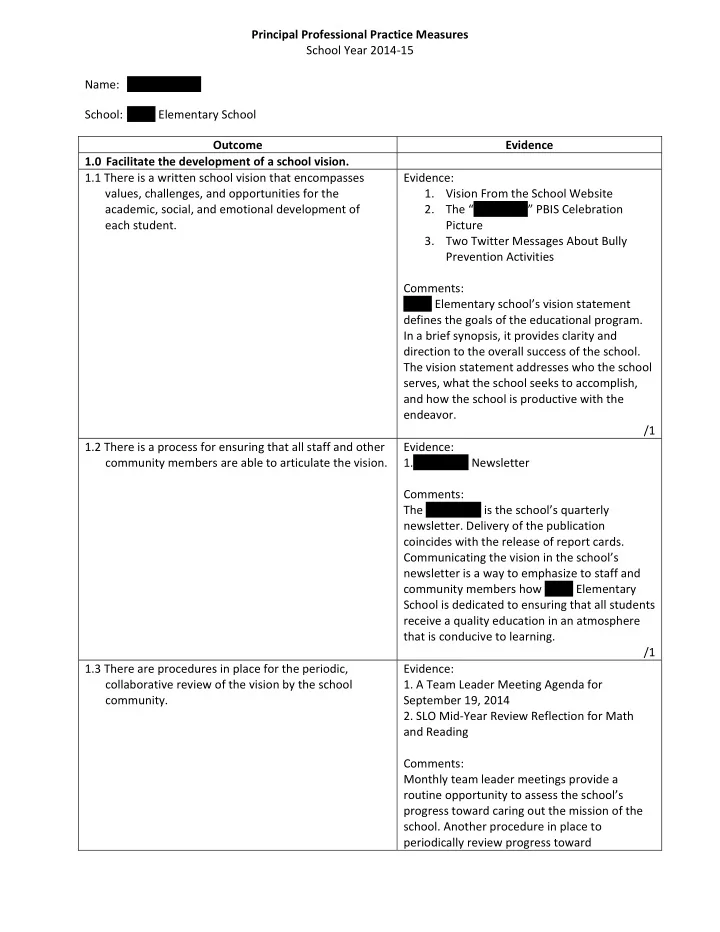
Principal Professional Practice Measures School Year 2014‐15 Name: Melissa Logan School: Berry Elementary School Outcome Evidence 1.0 Facilitate the development of a school vision. 1.1 There is a written school vision that encompasses values, challenges, and opportunities for the academic, social, and emotional development of each student. Evidence:

  • 1. Vision From the School Website
  • 2. The “Berry Best” PBIS Celebration

Picture

  • 3. Two Twitter Messages About Bully

Prevention Activities Comments: Berry Elementary school’s vision statement defines the goals of the educational program. In a brief synopsis, it provides clarity and direction to the overall success of the school. The vision statement addresses who the school serves, what the school seeks to accomplish, and how the school is productive with the endeavor. /1 1.2 There is a process for ensuring that all staff and other community members are able to articulate the vision. Evidence: 1.Berry Beat Newsletter Comments: The Berry Beat is the school’s quarterly

  • newsletter. Delivery of the publication

coincides with the release of report cards. Communicating the vision in the school’s newsletter is a way to emphasize to staff and community members how Berry Elementary School is dedicated to ensuring that all students receive a quality education in an atmosphere that is conducive to learning. /1 1.3 There are procedures in place for the periodic, collaborative review of the vision by the school community. Evidence:

  • 1. A Team Leader Meeting Agenda for

September 19, 2014

  • 2. SLO Mid‐Year Review Reflection for Math

and Reading Comments: Monthly team leader meetings provide a routine opportunity to assess the school’s progress toward caring out the mission of the

  • school. Another procedure in place to

periodically review progress toward

slide-2
SLIDE 2

Principal Professional Practice Measures School Year 2014‐15 accomplishing the vision is mid‐year SLOs. The review process includes collaboration of the Office of School Administration, the school‐ based administrative team, and the Instructional Leadership Team (ILT). /1 1.4 Resources are in place or have been requested to support the vision. Evidence:

  • 1. Extending Learning Opportunity

Proposal for Reading, Math, and Science: the proposal included SIP

  • bjectives, program duration, student

and teacher ratio, needs, and root causes to be addressed Comments: In order to support the attainment of the vision

  • f the school, the extended learning
  • pportunity program was revamped. The

purpose of the strategy was to increase the amount of time students were learning in the classroom, to avoid pulling students out of their regular classrooms, and to improve academic achievement and assessment scores. Having the program before school allowed for instruction by certified teachers. This process benefited students because teachers are familiar with expectations associated with College and Career Ready Standards. /1 Total Points Outcome #1 4/4 Outcome Evidence 2.0 Align all aspects of a school culture to student and adult learning. /1 2.1 There is respect, teamwork, and trust in dealings with students, staff, and parents. Evidence:

  • 1. Letters to Sylvia Lawson, Amy Hollstein

and Ms. Peter

  • 2. Emails to Staff and Parents

Comments: Modeling of the PBIS expectation of respect toward students, staff, and parents contributes to establishing a positive school culture. During the course of a school year there are many situations in which courageous conversations must take place. It is evident through the letters and emails exhibited, that Ms. Logan has established procedures and policies that encourage teamwork among all stakeholders. /1

slide-3
SLIDE 3

Principal Professional Practice Measures School Year 2014‐15 2.2 There are high expectations for all students and teachers in a culture of continuous learning. Evidence:

  • 1. Professional Development Calendar

and Sign in Sheets for Core Six Professional Development (Circle of Knowledge, Compare and Contrast, Inductive Reasoning, Vocabulary’s CODE, Write to Learn, and Read to Learn)

  • 2. Two pictures of Staff Development

Activities (Fair Day and Core Six strategy in the classroom with students) Comments:

  • Ms. Logan has made professional development

priority by facilitating a learning community in which teachers are active participants. Teachers and staff are provided with up‐to‐ date educational strategies and trends. Staff development is also based on the book, The Core Six: Essential Strategies for Achieving Excellence With the Common Core. The goal is to provide teachers with exposure to classroom proven strategies to support the instruction demands of the College and Career Ready Standards. /1 2.3 There is a school improvement plan, focused on results, and characterized by collective responsibility for instructional planning and student learning. Evidence: School Improvement Team:

  • 1. The school improvement team consists
  • f the principal, vice Principal,

administrative assistant, reading resource teacher, instructional specialists, learning resource teacher, nine classroom teachers, and two guidance counselors Comments: The purpose of the school improvement team is to collaborate on the development of the school improvement plan to ensure that the design addresses student achievement, methods to monitor the implementation of the plan, and to increase the staff involvement in executing the plan. The strategies support attainment of the school vision. /1 2.4 There is a school improvement plan, focused on results, and characterized by collective responsibility for instructional planning and student learning. Evidence:

  • 1. The School Improvement Plan
slide-4
SLIDE 4

Principal Professional Practice Measures School Year 2014‐15 Comments: The School Improvement Plan included pre‐and post‐test data analysis for math and science, adjustments that would be made to ensure progress in closing the achievement gap between students in reading and math, actions that would be made to prepare students and staff for implementation of PARCC, and a plan

  • f action for improving scores in math, science,

and reading/Language Arts. The development of the School Improvement Plan was a collective effort. The purpose of the plan is to support the Superintendent’s motto which is to improve the quality of “teaching and learning.” The School Improvement Plan includes an action plan that is designed to increase student achievement. It also includes an analysis of data and challenges which need to be address in order to move toward making progress in the overall academic performance

  • f students.

/1 2.5 There are opportunities for leadership and collaborative decision‐making distributed among stakeholders, especially teachers. Evidence:

  • 1. Staff Interest Survey and School

Committees Responsibility Directory (American Indian Think Tank, Art Contests, Berry Jaguar Leadership, Bus Coordinator, Course Activities, Code.Org, Computer Bowl, County Fair Representative, Crisis Team, Crochet Club, etc.) Comments: The staff interest survey is designed to identify teachers and staff interests of the upcoming school year. It also provides teachers with an

  • pportunity to express an interest in leadership
  • pportunities. The information is also helpful in

signing committee chairpersons to assist with carrying out the goals of the School Improvement. /1 Total Points Outcome #2 5/5 Outcome Evidence 3.0 Monitor the alignment of curriculum, instruction, and assessment.

slide-5
SLIDE 5

Principal Professional Practice Measures School Year 2014‐15 3.1 There are ongoing conversations with teachers as to how the Maryland State Common Core Curriculum and/or local curriculum and research‐based instructional strategies that are integrated into daily classroom instruction. Evidence:

  • 1. Email to Amy Hollstein regarding usage
  • f substitutes for formative

assessments

  • 2. Long‐Range Planning For Reading and

Math During the First Quarter: Reading (Map Updates on Pacing Calendar, Formative Assessments, Running Records Training, Reading Updates, Questions/Needs/Comments) Math (Unpacking the Standards, Map Of Dates On Pacing Calendar, Formative Assessments, Print Pre/Post Test Items for Teams, Review Resource Folders on the V Drive, Questions/Needs/ Comments) Gifted Testing (Harrison Observation Form, Gifted Cluster Curriculum, Questions/Needs/ Comments)

  • 3. Berry Elementary Quarterly Planning:

Maryland College and Career Readiness Standards‐Long Range Planning Comments: Each quarter Ms. Logan designates time for the instructional leadership team and grade level teachers to engage in long‐range planning. The purpose of these sessions is to develop a quarterly long‐term plan that will prioritize instruction, support the school improvement plan, and lead to increased student

  • achievement. Teachers are guided to develop

lesson plans which focus on achievement in targeted areas. /1 3.2 There is student work that is appropriately challenging. Evidence:

  • 1. ILT Collaboration Planning Agenda for

November 24, 2014

  • 2. Formative Assessment Pinch Cards
  • 3. Independent Research Project About

Spiders: A sample of the project by Noah W.

  • 4. Six Pictures (a tweet about

kindergarten students using a sensory box to find objects that began with the letter “S”, two tweets about second graders doing a project involving wax exhibits, Ms. Thompson’s third grade class learning about static electricity by

slide-6
SLIDE 6

Principal Professional Practice Measures School Year 2014‐15 making tissue paper dance with a balloon, a tweet third grade class visit to the zoo, a tweet about Mrs. Ross’s third grade class trading math strategies) Comments: Research has proven that meaningful schoolwork promotes student’s learning of academic content. The school work which was exhibited was an example of meaningful and thoughtful instructional activities. According to

  • Ms. Logan, during biweekly ILT and grade level

planning meetings the leadership team provide support to teachers to ensure there is student work that is appropriately challenging. Challenging work is also differentiated to meet the needs of highly capable students. The ILT and teachers also design and present learning tasks in ways that lead to not just short‐term achievement but also long‐term success. /1 3.3 There are assessments that regularly measure student Mastery of the content standards. Evidence:

  • 1. Pre‐tests Data Results
  • 2. Post‐tests Data Results

Comments: Teachers in kindergarten through fifth grade administer and report on post‐test data for each math unit. Information collected provides teachers with an opportunity to determine what students have learned, identify next steps for instruction, and resources that may be necessary to plan instruction. Identifying information from data ensures that all students’ academic needs are being met. /1 Total Points Outcome #3 3/3 Outcome Evidence 4.0 Improve instructional practices through

  • bservation and evaluation of teachers.

4.1 There is a process to determine what students are reading, writing, producing, and learning. Evidence:

  • 1. PowerPoint presentation on

Expectation for Walk‐throughs: expectations include portion of the lesson being observed, grouping format, availability of lesson plans, respectful and actions, monitoring of student behavior, communication with

slide-7
SLIDE 7

Principal Professional Practice Measures School Year 2014‐15 students, student engagement, and different annotation Comments: Instructional walk‐throughs are an essential component of instructional activities at Berry Elementary School. Walk‐throughs enhance the quality of teaching and student performance. At Berry Elementary School walk‐throughs for all staff are an important measure of qualitative

  • performance. Walk‐throughs are an important

way to communicate expectations of instructional activities. The PowerPoint provided staff with expectations of walk‐ throughs and observations. /1 4.2 There is use of student data and data collected during the observation process to make recommendations for improvement in classroom instruction. Evidence:

  • 1. Post Observation Conference

Reflection Form

  • 2. Four Examples of Student Math Work

Comments:

  • Ms. Logan conducts post observation

conferences as a component of the formal

  • bservation process. During the conferences,
  • Ms. Logan and the teachers discuss and reflect
  • n processes that were observed during the
  • bservation and review students’ progress with

the lesson objectives. The goal of the post conference is to provide teachers with specific next steps to integrate into his or her instructional practices to improve the quality of teaching and learning. /1 4.3 There is formal feedback during the observation conferences as well as ongoing informal visits, meetings, and conversations with teachers regarding classroom instruction. Evidence:

  • 1. Observation Report From InSystech

Dated January 22, 2015: The

  • bservation included comments from

domains one, two, and three, of Charlotte Danielson framework Comments: The observation provided evidence that the principal is skilled in observation and evaluation

  • f classroom instruction. Observation and

evaluation of teachers is an essential component of instructional an instructional

  • leader. Ms. Logan has provided evidence that

she is skilled in providing specific feedback

slide-8
SLIDE 8

Principal Professional Practice Measures School Year 2014‐15 during the formal observation process. Specific feedback is vital because observations influence teaching and learning and the attainment of school improvement goals. /1 4.4 There is regular and effective evaluation of teacher performance based on continuous student progress. Evidence:

  • 1. SLO and Mid‐Year Progress Reflection:

Progress Reflection included: information about SLO goals, percentage of students demonstrating progress toward obtaining the goal, percentage of students not demonstrating progress, data to support progress or lack of progress, instructional strategies implemented to support students, professional development opportunities used to assist during classroom instruction, additional resources that may be helpful, student attendance issues, and any adjustments to the SLO that may be needed.

  • 2. SLO Mid‐Year Review Conference

Schedule

  • 3. Email to teachers outlining topics that

would be discussed during Mid‐year Evaluation Conferences Comments:

  • Ms. Logan’s evaluation conferences with staff

were used as a quantitative measure of student

  • achievement. Student learning objectives were

also utilized as a measure of the teachers’ impact on student learning. The purpose of the conferences was to access the teacher’s instructional progress toward meeting their

  • SLOs. Each conference provides teachers with

an opportunity to reflect on steps necessary to increase student achievement. /1 4.5 There is identification and development of potential school leaders. Evidence:

  • 1. Rise In Roar Extended Learning

Opportunity Proposal: the proposal included SIP objectives, program duration, student and teacher ratio, needs, root causes to be addressed, students targeted for the program, and teachers involved in the extended

slide-9
SLIDE 9

Principal Professional Practice Measures School Year 2014‐15 learning opportunity

  • 2. List of Extra Duty Positions and

Teacher Assignments Comments:

  • Ms. Logan has established procedures that

identify and develop potential school leaders. These individuals are trusted to manage and facilitate a variety of different grade/team level activities, coordinate after school activities, serve as a liaison to the administration, and collaborate with other faculty and staff. According to Ms. Logan, the ultimate goal in the development of school leaders will be the enhancement of collaboration among staff, providing opportunities for mentorship by the school administration, and enhancement of public relation and human relation skills of potential school leaders. /1 Total Points Outcome # 4 5/5 Outcome Evidence 5.0 Ensure the regular integration of appropriate assessments into classroom instruction. 5.1 There are multiple and varied assessments. Evidence:

  • 1. Emails To Teachers Concerning

Expectations for Long Range Planning: Reading: map out dates on pacing calendar, formative assessments, reading updates, questions/needs/comments Math: student work analysis, front load upcoming topics, map out dates on pacing calendar, developed formative assessments, questions/needs/comments Gifted/Testing: gifted cluster curriculum, questions/needs/comments

  • 2. Sample Of Fifth‐Grade Math Unit Tests
  • 3. Long‐Range Planning Meeting Notes for

the Fourth Quarter for March and April: Planning included: evaluating student work flowcharts, math skills sheets, six samples of fifth‐grade student math worksheets Comments: During long‐range planning meetings the ILT

slide-10
SLIDE 10

Principal Professional Practice Measures School Year 2014‐15 and teachers analyze student assessments to identify next steps in instruction. Previous assessments are reviewed and samples are used to assist and specifically identify skills which require re‐teaching or extension in learning opportunities. Analyses of assessments assist the ILT and teachers in determining if students need enrichment or intervention

  • activities. In addition, conducting analysis

during long range planning meetings allows an

  • pportunity for teachers and the ILT team to

ensure that assessments are multiple and varied. /1 5.2 There are formative and summative assessments that are a regular part of the ongoing evaluation of student performance and that serve as the basis for adjustments to instruction. Evidence:

  • 1. Information Concerning Assessments

for First, Second, Third, and Fourth

  • Quarters. Information included all

assessments that would be provided for all grades from August through

  • May. Information included how

computer labs would be used to enhance instructional activities.

  • 2. List of PARCC Assess Ability Features

and Accommodations for Students

  • 3. Second‐quarter Math Mapping

Standards, Content, and Suggested Resource Activities for Second Grade Students

  • 4. ILT Collaborative Planning Guide and

Agenda for November 24, 2014: Agenda items: staff development debriefing, book room housekeeping, review of posttest feedback sheets from the Central Office, frontloading of upcoming curriculum’s for grades two through four, formative assessment Pinch cards, CogAT screener discussion, gifted curriculum updates, and questions Comments: The testing at a glance calendar provides evidence of how summative assessments are administered throughout the school year. Summative assessments are used to provide teachers with information pertaining to the attainment of student knowledge over a period

  • f time. During long range planning, formative
slide-11
SLIDE 11

Principal Professional Practice Measures School Year 2014‐15 assessment tools are used by teachers to determine what students have learned. The purpose of Pinch cards is to quickly gather data whether students comprehend appropriate

  • perations used when solving math equations.

The goal of quarterly long‐range planning sessions is to build teacher strategies and ways

  • f using assessments into daily instruction.

/1 5.3 There are appropriate interventions for individual students based on results of assessments. Evidence:

  • 1. Academic and Behavior Intervention

Descriptions: Academic Interventions: Wilson Reading, Fundations, Soar to Success, extra guided reading, small group instruction in math, strategic reading instruction, Just Words, Wozers, Rise and Roar Behavior Interventions: check‐ in/check‐out, behavior charts, visual reminders, schedule with breaks, break pass, incentives, social stories, and Lunch Bunch

  • 2. Bully Prevention Initiatives: anti‐

bullying campaign, “Be a Buddy Not a Bully”, classroom guidance lessons, small group instruction by counselors, Just Say No club initiatives, bully free pledge, and bully free always Comments: Interventions are developed for individual students based on data collection from assessments and observations. Academic interventions provide instructional supports for students who are preforming below grade level in reading, writing, or math. Behavioral interventions are designed to prevent student behavior from interfering with their learning or academic progress of other students. Academic and behavioral interventions are designed to address individual student instructional and or social needs. /1 Total Points Outcome # 5 3/3 6.0 Use technology and multiple sources of data to improve instruction.

slide-12
SLIDE 12

Principal Professional Practice Measures School Year 2014‐15 6.1 There is effective use of appropriate instructional technology by students, staff, and administration. Evidence:

  • 1. Summary of Technology Instruction
  • 2. PARCC Computer Practice Plan
  • 3. Completed Observation Schedule for

Teachers Comments: Teachers are encouraged to identify ways that technology can be infused into classroom

  • practices. A summary of how technology is

used during classroom instruction at each grade level was provided as proof. The PARCC practice plan was designed to offer teachers instructional strategies and designate

  • pportunities for the third, fourth, and fifth

grade teachers to practice using the PARCC

  • nline tools. The use of technology in the

school has made the process of teaching and learning enjoyable and engaging for students. The administration had completed 48 teacher

  • bservations.

/1 6.2 There is review of disaggregated data by subgroups. Evidence:

  • 1. Reading and Math SLOs
  • 2. County Pretests Data Analysis Sheets
  • 3. School Case Summaries by Teacher and

Grade

  • 4. Executive Summary of the School

Improvement Plan Comments:

  • Ms. Logan used disaggregated data in the

School Improvement Plan to identify which students were achieving, which students needed additional assistance, and how to target resources to meet the needs of all

  • students. After review of school data, individual

teacher data was reviewed and included input from the ILT members. /1 6.3 There is ongoing root cause analysis of student performance that drives instructional decision‐ making. Evidence:

  • 1. Kindergarten Teaching Planning Notes
  • 2. Pre‐/Post Data Analysis of Math and

Reading

  • 3. Plan for Science Improvement Which

Included Improvement Action Steps, Individuals Responsible for Implementation, and a Timeline

slide-13
SLIDE 13

Principal Professional Practice Measures School Year 2014‐15 Comments: Pre‐and post‐assessment data was analyzed as a means to make informed instructional decisions based on evidence and to monitor student learning and progress. /1 6.4 There is regular collaboration among teachers on analyzing student work. Evidence:

  • 1. ILT Collaborative Planning for

September 25, 2014: Planning included: reading updates, Kagan activities to review math concepts, posttest data collection, first‐grade curriculum updates, and gifted updates

  • 2. Evaluating Student Work Flowcharts:

Information on the flowchart included essential questions: Is enrichment needed, What is the next steps toward efficiency, What instruction is needed to correct errors, Is the error computational or conceptual, Is the strategies used efficient, etc.

  • 3. Email From the Instructional Specialist

Concerning Information Needed for Long Range Planning and Analysis of Student Work Comments: The evaluating student work flowcharts allow teachers to analyze students’ mistakes and determine whether errors are computational or

  • conceptual. It also provides teachers with

useful information to make groups and determine next steps for instruction. /1 Total Points Outcome #6 4/4 Outcome Evidence 7.0 Aligns professional development with identified curricular, instructional, and assessment needs connected to school improvement goals. 7.1 There are opportunities for teachers to engage in collaborative planning and critical reflection wherever possible within the regular school day. Evidence:

  • 1. Team Planning Sheets: Information on

each sheet included: math indicators, reading indicators, writing indicators, activities planned for social studies, and activities planned for science Comments: Collaborative planning occurs once a week for

slide-14
SLIDE 14

Principal Professional Practice Measures School Year 2014‐15 each grade level team. The purpose of collaborative planning is to give teachers the

  • pportunity to work and learn together in

relation to planning for unit tests, classroom based assessments, and to ensure compliance with College and Career Readiness Standards. Another benefit of collaborative planning is to provide opportunities for teachers to work together during the school day to ensure connections among each team in examining professional practice, allowance of team consultation, and the development of instructional strategies. /1 7.2 There is differentiated professional development according to career stages, needs of staff, and student performance. Evidence:

  • 1. Core Six Vocabulary Code Lesson Plan
  • 2. Professional Development Needs

Assessment

  • 3. Pre‐Assessment for Critical Verbs
  • 4. Pre‐Assessment For Critical Nouns
  • 5. Survey of Professional Development

Comments: Teachers are engaged in professional development during weekly staff meetings. A professional development needs assessment survey is completed by each teacher as a means to meet the individualized needs of each staff member. The purpose of the professional development session is to keep teachers up to date on relevant research‐based strategies and trends in education related to how children learn, emerging technologies, and instructional resources. /1 7.3 Faculty will be provided an opportunity for input on professional development activities. Evidence:

  • 1. Professional development needs

assessment survey: Examples of surveys from seven teachers was provided as evidence. Teachers were asked to respond to 10 questions:

  • 1. Which of the following best describes

your certification area?

  • 2. I can benefit from additional staff

development opportunities addressing effective instructional strategies and teaching methods in the following areas:

slide-15
SLIDE 15

Principal Professional Practice Measures School Year 2014‐15

  • 3. I can benefit from additional staff

development opportunities in the following areas:

  • 4. I can benefit from the effective use of

learning centers/stations for differentiated centers in the following areas.

  • 5. Of the following areas of professional

development, which are your top three personal priorities for improvement for next school year? Please rank in order from 1 to 3.

  • 6. I can benefit from additional contents

specific staff development in reading, please check all that applies.

  • 7. I can benefit from additional contents

the civic staff development in mathematics, please check all that applies.

  • 8. I would describe my skill level in

integrating technology in the classroom as:

  • 9. What interactive tools have you used in

your classroom the school year? Please check all that apply.

  • 10. Other topics/thoughts you wish to be

considered. Comments: Teachers are engaged in professional development during weekly staff meetings. A professional development needs assessment survey is completed by each teacher as a means to meet the individualized needs of each staff member. The purpose of the professional development session is to keep teachers up‐to‐ date on relevant research‐based strategies and trends in education related to how children learn, emerging technologies, and instructional resources. /1 Total Points Outcome #7 3/3 Outcome Evidence 8.0 Engage school community members in a shared responsibility for student and school success. 8.1 There are parents and guardians welcomed in the school, encouraged to participate, and given information and materials to help their children learn. Evidence:

  • 1. Evening of Learning Activity
  • 2. Tweet about Science Fair
  • 3. Tweet about Kindergarten Thanksgiving
slide-16
SLIDE 16

Principal Professional Practice Measures School Year 2014‐15 Feast

  • 4. Brochure on the Parent Guide to Fifth‐

Grade Math

  • 5. Brochure on the school’s educational

showcase Comments: The school hosted an educational showcase as a means to reach out and connect with community members. The event provided helpful resources and strategies to complement the academic achievement of students. Complimentary childcare was offered in the cafeteria and parents had the opportunity to attend three different sessions of their choice

  • n many different educational topics.

Information was shared with parents through the school’s newsletter. /1 8.2 There are school community members and school partners who readily participate in school life. Evidence:

  • 1. PTO Minutes for February 5, 2014
  • 2. Tweet about recognition of student

artwork

  • 3. Tweet about the Community Carnival

Comments: The PTO are members of the school community who are invested in the overall success of the

  • school. The PTO encourages parents to actively

contribute to the success of the school. During the meetings the president promotes open communication and understanding between parents, staff, and the school administration. The principal uses Twitter to share good news about individual student and school success. /1 Total Points Outcome #8 2/2 Outcome Evidence 9.0 Prioritize, manage, and administer resources in an effective and efficient manner. 9.1 Creates processes and a schedule that maximizes time for instruction and collaboration. Evidence:

  • 1. Master Schedule
  • 2. Yearly Meeting Scheduled: Schedules

included: staff meetings, team leader meetings, staff development meetings, PBI S meetings, administrative meetings, ILT meetings, SST meetings, collaborative meetings, and faculty

slide-17
SLIDE 17

Principal Professional Practice Measures School Year 2014‐15 meetings

  • 3. Daily Schedules of Teachers and Staff

for All Teachers and All Grade Levels Comments: The master schedule was designed to maximize

  • pportunities for teaching and learning. The

calendar also provided an opportunity for special education teachers and instructional assistants to support co‐teaching in general education classrooms in pre‐kindergarten through fifth grades. The yearly meeting was designed to establish routine times for collaboration on a bi‐weekly basis. /1 9.2 Facilitates hiring, assigning, and supervising of all personnel employed at the school. Evidence:

  • 1. Kindergarten Instructional Assistant

Interview Questions

  • 2. Email Requesting Additional Staff

Comments: Questions asked during the interview were designed to gain knowledge and information about individuals applying for the instructional assistant position. Interview questions demonstrated awareness by the principal of skills that would be needed by the individual selected for the position. /1 9.3 Uses a variety of performance data to recommend personnel action. Evidence:

  • 1. Eleven Month Secretary Support Staff

Evaluation Comments: The evaluation of the secretary was

  • unsatisfactory. Evidence provided within the

evaluation demonstrated that the principal had documented deficiencies of the secretary. The evaluation also illustrated that the principal was cognizant of the necessity for maintaining high expectations for all staff. Only factual information was presented as evidence. The rotation included suggestions about how the secretary could improve her job performance. /1 9.4 Uses public resources and funds appropriately Evidence:

  • 1. Monthly Financial Reports
  • 2. Request for Materials of Instruction
slide-18
SLIDE 18

Principal Professional Practice Measures School Year 2014‐15 Comments: The monthly financial report demonstrated that the principal effectively manages the school budget. Monthly meetings are conducted to ensure that the school finances are managed efficiently and within state and county guidelines. A meeting is held with the financial secretary every third Friday of the month to reconcile and evaluate the school budget. /1 9.5 Manages financial, material, and technology resources in an effective and equitable manner. Evidence:

  • 1. Summary of Financial Activities

Comments: A review of the summary of activity reports produced by the finance secretary of the school demonstrated efficient management of the school budget. /1 9.6 Coordinates the management of the school plant. Evidence:

  • 1. Fire Protection Inspection Report
  • 2. Fuel or Inventory Worksheet
  • 3. Pre‐Opening Inspection Report

Comments: All three reports demonstrated that the principal maintains an active role in making sure that the building is well‐maintained and inspection reports are completed in a timely

  • manner. The overall rating from the summer
  • pening inspection of the school was a 99 per
  • cent. Personal visits to the school have

demonstrated that the school is well‐ maintained and conducive to instructional

  • activities. According to the principal, the

building service staff is proactive in making sure that the building is well maintained and report problems or discrepancies in a timely manner. /1 9.7 Ensures the maintenance and accuracy of all school records. Evidence:

  • 1. Monthly Checklist for Financial

Statements

  • 2. Bank Statements
  • 3. Bank Reconciliation Details

Comments: The monthly checklist for financial statements

slide-19
SLIDE 19

Principal Professional Practice Measures School Year 2014‐15 report is produced by the financial secretary and reviewed with the principal before sending the documentation to the Board’s financial department. /1 Total Points Outcome #9 7/7 Outcome Evidence 10.0 Communicate effectively in a variety of situations and circumstances with diverse audiences. 10.1 Strives to keep the community aware of school programs and shares important data and information with the school community. Evidence:

  • 1. The Berry Beat
  • 2. The Berry Bulls‐Eye (Two Copies)

Comments: The Berry Beat is a quarterly newsletter and distributed to the school community. The initiative of the newspaper is to keep all school stakeholders informed about school events and

  • activities. The publication provides the school

community with important information about all areas of educational program. Information within the newsletter includes information from the principal, information from the vice principal, information from the administrative assistant, information from the nurse, formation from the reading resource teacher, information from the learning resource teacher, information from the STEM resource teacher, information from the counselors, information from the technology facilitator, and information from all grade levels. Please explain how the Berry Bulls‐Eye is produced and who is responsible for its production. /1 10.2 Facilitates the continuous safety of the school. Evidence:

  • 1. Emergency Drill Quick Reference Guide:

Information included: post incident procedures, training schedule, and a schedule of all drills

  • 2. New Year Letter For Teachers And Staff
  • 3. Tweet About Stop, Drop and Roll

Activity

  • 4. Email Regarding Suggestions For

Lockdown Drills

slide-20
SLIDE 20

Principal Professional Practice Measures School Year 2014‐15 Comments: The emergency drill quick reference guide provides a summary of the procedures in place for the five required drills for the Maryland State Department of Education. The purpose of the guide is to promote safety in the event of a true emergency. All drills are practiced and evaluated to determine if improvements are needed and to provide feedback to students, faculty, and staff. /1 10.3 Responds appropriately and in a timely manner to members of the school community. Evidence:

  • 1. Email From Parent Requesting Excused

Absences Comments: The response to the parent from the principal was professional and personable. However, the principal followed Board policy in denying the parental request. /1 10.4 Communicates and interacts professionally and positively with members of the internal and external school communities. Evidence:

  • 1. Picture of Principal Interacting with

Staff and Students

  • 2. New Year Letter for Teachers and Staff

Comments: Evidence presented demonstrated positive interaction between the principal with members of the school community, students, and staff. The new year letter for teachers and staff demonstrated administrative understanding of the value of the positive

  • communication. The letter is sent to staff at the

beginning of each school year as a means to welcome them back and set the stage for a positive school year. /1 10.5 Demonstrates appreciation of diversity and promotes sensitivity to student and staff needs. Evidence:

  • 1. Burning Questions
  • 2. Online Computer Testing Plan
  • 3. Computer Lab Setup

Comments: Burning questions were utilized to gain information about testing sessions and utilization of computer labs. The online computer testing plan demonstrated the

  • rganizational skills of the principal in relation
slide-21
SLIDE 21

Principal Professional Practice Measures School Year 2014‐15 to scheduling and management of the computer labs. /1 10.6 Utilizes effective problem solving strategies for resolving conflict and building consensus. Evidence:

  • 1. Email Concerning Online Testing Plan
  • 2. Resolution of Possible Problems of the

Online Testing Plan Comments: Several issues were presented to the principal as possible problems associated with the online testing plan. Solutions were provided by the principal that adequately addressed teacher

  • concerns. Information provided demonstrated

that the principal effectively addressed issues and came up with reasonable and efficient room resolutions to each problem presented by the staff. /1 Total Points Outcome #10 6/6 Outcome Evidence 11.0 Understand and respond to the cultural context of the school community. 11.1 Models the core beliefs of the system and the school. Evidence:

  • 1. Two Tweets Showing the Science

Olympic Games and Opening Ceremonies for the Science Olympic Games

  • 2. Science Olympics Planning Agenda
  • 3. Science Olympic Schedule
  • 4. Plan for Science Improvement
  • 5. Brochure for MSA Science Olympics
  • 6. Three Mini Science Lesson Plans

Comments: The school selected science as an area in need

  • f improvement. A science improvement plan

was developed to strategically align actions to areas of need. Activities were developed by the ILT in conjunction with special education teachers and general education teachers that would support increased achievement in science classrooms. /1 11.2 Aligns actions to the vision of the school. Evidence:

  • 1. Action Plans for Reading, Math and

Science

  • 2. School Climate Action Plan
slide-22
SLIDE 22

Principal Professional Practice Measures School Year 2014‐15 Comments: The school improvement team collaboratively developed an action plan for reading, math, science, and the overall school climate. The action plans supports the vision of the school and is a key element in the overall decision‐ making process that is utilized to ensure steps are taken to increase student achievement. The action plan includes goals, justification/data analysis, action steps, and has a measuring tool. The action plan is formally evaluated twice during the school year. /1 11.3 Develops positive relationships with community leaders and fosters a climate that invites community members to donate time, expertise, and resources. Evidence:

  • 1. A Tweet from Berry Best Military

Veterans Day Activities

  • 2. Pictures from Veterans Day Activities
  • 3. Information from American Freedom

Day Celebration Activities From Monday, November 10, 2014

  • 4. A thank‐you letter from the principal to

a parent for assistance with the unified basketball team. Comments: The American Freedom Day celebration was an excellent way for the school to participate in meaningful programs and established positive relationships with the community. The pictures were evidence that students, community members, faculty and staff enjoyed the celebration and planned activities. /1 11.4 Recognizes and celebrates the contributions of all school community members. Evidence:

  • 1. Jaguar Journal

Comments: The Jaguar Journal is a weekly publication produced by the principal. The publication is a newsletter to staff which recognizes contributions of all staff members and is designed to show appreciation to staff members who have made positive contributions at school during the week. /1 Total Points Outcome #11 4/4

slide-23
SLIDE 23

Principal Professional Practice Measures School Year 2014‐15 Outcome Evidence 12.0 Promote the success of every student and teacher by acting within a framework of integrity, fairness, and ethics. 12.1 Fosters, models, and supports a high level of professional performance and growth for administrative, instructional, and support staff. Evidence:

  • 1. Domain Four PowerPoint Training and

Evaluation

  • 2. Portfolio Guidelines and Criteria

Comments: The PowerPoint presentation was utilized to provide teachers with training and examples of expectations during classroom observations. Portfolio guidelines were shared with staff to demonstrate areas of professional responsibility and required components of their portfolios. /1 12.2 Maintains confidentiality when dealing with staff, students, services, and records. Evidence:

  • 1. Examples of Formal Letters of

Reprimand

  • 2. Correspondence With the Office of

Human Resources Comments: The letter of reprimand demonstrated the principal’s ability to involve individuals at the Board level when needed to address staff issues or concerns. Counsel for developing the letter of reprimand was obtained from the Staff Attorney and a Human Resource specialist. /1 12.3 Follows established legal practices, Board policy, negotiated agreements, and system procedures. Evidence:

  • 1. School Emergency Plan: The emergency plan

included information about the chain of command, the emergency response team, the crisis response team, emergency operations and controls, the command posts, and emergency checklists, emergency procedures for specific incidents, hazardous material, bus accidents, etc. Comments: The emergency plan is an example of procedures put into place for use during emergency situations. It outlines the principal’s ability and compliance with maintaining a safe and orderly school environment. /1

slide-24
SLIDE 24

Principal Professional Practice Measures School Year 2014‐15 12.4 Exercises appropriate judgment when making decisions. Evidence:

  • 1. Emails Communications With Teachers

Comment: Email communications with teachers demonstrated the principal’s ability to make sound and appropriate decisions in relation to staff concerns. /1 Total Points Outcome #12 4/4 Total Points 50/50