Previous Lecture Introduction to SMIL 2 Introduction to W3C and - - PowerPoint PPT Presentation

previous lecture introduction to smil 2
SMART_READER_LITE
LIVE PREVIEW

Previous Lecture Introduction to SMIL 2 Introduction to W3C and - - PowerPoint PPT Presentation

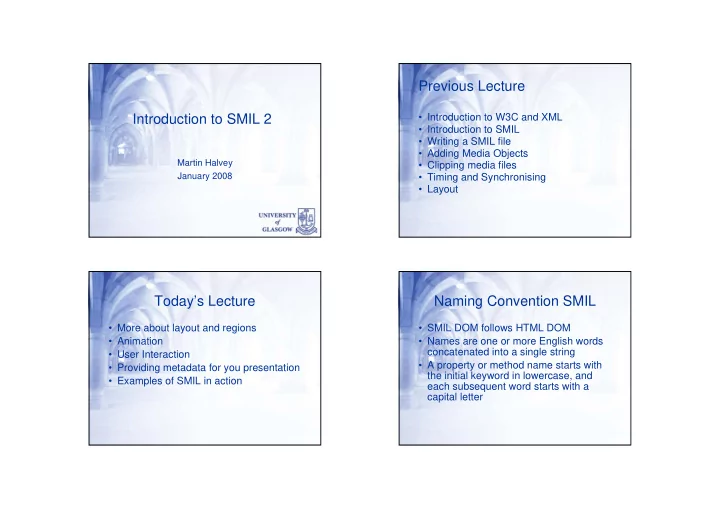
Previous Lecture Introduction to SMIL 2 Introduction to W3C and XML Introduction to SMIL Writing a SMIL file Adding Media Objects Martin Halvey Clipping media files January 2008 Timing and Synchronising Layout


slide-1
SLIDE 1

Introduction to SMIL 2

Martin Halvey January 2008

Previous Lecture

  • Introduction to W3C and XML
  • Introduction to SMIL
  • Writing a SMIL file
  • Adding Media Objects
  • Clipping media files
  • Timing and Synchronising
  • Layout

Today’s Lecture

  • More about layout and regions
  • Animation
  • User Interaction
  • Providing metadata for you presentation
  • Examples of SMIL in action

Naming Convention SMIL

  • SMIL DOM follows HTML DOM
  • Names are one or more English words

concatenated into a single string

  • A property or method name starts with

the initial keyword in lowercase, and each subsequent word starts with a capital letter

slide-2
SLIDE 2

Region and Layout

  • We have seen how to declare regions

and a layout

  • Region describes a rectangular area of

your SMIL file

  • Layout groups a number of regions

together

  • But how do we use them?

Region and Layout

<head> <layout> <region id="half-center" left="25%“ top="25%" width="50%" height="50%"/> </layout> </head> <body> <img src="photo.jpg" alt="picture of a snowman in a blizzard" region="half center"/> </body>

Region and Layout

  • What happens if size of region and

media do not match

  • By default media is starts in top left

corner, remaining space is in background colour

  • If object doesn’t fit it isn’t rendered
  • There are a number of fit values that

can be used to ensure that an object fits a region

Region and Layout

Fit values van be used to ensure that a media object fits into a region, these include –Slice –Scroll –Fill –Meet

slide-3
SLIDE 3

Region and Layout

As we have seen with other attributes it is possible to nest regions in SMIL

<region id="two-column" width="100%“ height="100%"> <region id="column1" left="0%" top="0%“ width="50%" height="100%"/> <region id="column2" left="50%" top="0%" width="50%" height="100%"/> </region>

Region and Layout

  • Other than 3-D media objects SMIL

does not have many 3-D capabilities

  • Child regions are rendered on top of

ancestor regions

  • It is possible to override this using z-

index

  • If object have the same z-index, the
  • bject created later will have a higher

position

Region and Layout Example

  • Going to create a presentation which

looks like picture-in-picture television

  • Going to use two video sources
  • One will occupy the entire screen
  • The other will be displayed in the

bottom right corner

Region and Layout Example

<layout> <topLayout width=“400px" height=“300px"> <region id="main-video" left="0%" top="0% width="100%" height="100%"> <region id="corner-video" left="75%" top="75%” width=“25%" height=“25%" fit="scale“ soundLevel="0%" /> </region> </topLayout> </layout>

slide-4
SLIDE 4

Region and Layout Example

<par> <video id=“big-video" src=“big.mpg“ alt=“our big video" region="main-video"/> <video id=“small-video" src=“small.mpg“ alt=“our small video" region="corner- video" end=“big-video.end"/> </par>

Region and Layout Example

  • Didn’t need any special software
  • We can easily change the layout, i.e.

size and position

  • Don’t need to know the size or duration
  • f the files
  • The files don’t have to be on our server
  • r machines

User Interaction

  • SMIL provides a number of different

methods for interacting with users

  • We will cover basics of hyper linking

and click events

  • Most of this uses the anchor elements

that are available

User Interaction

  • Can use the <a> element just like in

HTML

  • As in html it has the attribute href which

contains the target URI of the link

  • SMIL contains <a> by adding a number
  • f attributes that are unique to SMIL
  • Can also add alt information to <a>
slide-5
SLIDE 5

User Interaction

The unique attributes include:

– Show – Target – External – destinationPlaystate – sourcePlaystate

  • Play
  • Stop
  • pause

User Interaction

The unique attributes include:

– accesskey – tabindex – sourceLevel – destinationLevel – actuate

User Interaction

<a href="http://www.w3.org/" alt="the World Wide Web Consortium"> <text src="w3.txt" alt="a brief of the W3C"/> </a> <a href="second.smil" alt="the next presentation in the series" show="replace"> <animation src="credits.svg" alt="the names of the makers of this presentation"/> </a>

User Interaction

<a href="pause.smil" alt="simple animated pause loop" show="new" sourcePlaystate="pause" accesskey="p"> <img src="pause.png" alt="two vertical bars"/> </a>

slide-6
SLIDE 6

User Interaction

  • Possible to divide up media objects to

link to more than one target

  • You can divide the object spatially or

temporally

  • To divide the object spatially user the

<area> element

  • <area> takes the same attributes as

<a>, plus shape and coords

User Interaction

<video src="ads.mpg" alt="a series of ads" dur="01:30"> <area href=http://ad1.com/ begin="00:00" end="00:30"/> <area href=http://ad2.com/ begin="00:30" end="01:00"/> <area href=http://ad3.com/ begin="01:00" end="01:30"/> </video>

User Interaction

  • SMIL presentations can behave like

GUIs if the appropriate events are handled

  • SMIL only specifies three events
  • It is not mandatory for players to handle

these events

  • The events are

– .beginEvent – .endEvent – .repeat

User Interaction

  • Mainly use the <a> element just like in

HTML

  • However SMIL provides some

additional attributes

  • It is possible to divide a media object

into more than one target link

  • SMIL can handle some user click

events

slide-7
SLIDE 7

Animation

  • It is possible to animate media objects

in SMIL

  • Animation in SMIL requires a lot of

maths

  • Using a dedicated editor can alleviate

this problem

  • Animation elements are nested within

the media object they are animating

  • We are going to use the BasicAnimation

module

Animation

The four animation elements in SMIL are:

– <animate> – <animateMotion> – <animateColor> – <set>

Each element animates it’s parent

  • bject by manipulating the parent
  • bjects attributes

Animation

In addition to the timing attributes, animations have a number of other attributes

– attributeName – targetElement – from,to and by – values – calcMode

Animation

Animation for pot falling from window sill <video src=“pot.mpg" alt=“flower pot"> <animateMotion values="0,0; 0,9; 0,27; 0,54" calcMode="linear“ dur="4s"/> </video>

slide-8
SLIDE 8

Animation

TV set turning off straight away <video src="television.mpg" alt=“television"> <set attributeName="width" to="0“ begin="5s" dur="indefinite"/> <set attributeName="height" to="0“ begin="5s" dur="indefinite"/> </video>

Animation

Can use more than one animation on single object

<video src="television.mpg" alt="the news"> <animateMotion values="0,0; 0,3; 0,0; 0,7; 0,0" dur="1s" repeatDur="indefinite"/> <animateMotion values="0,0; 4,0; 0,0“ dur="2s" repeatDur="indefinite"/> </video>

Animation

Animation for a TV screen fading to black <video src="television.mpg" alt="bright television"> <animateColor to="#000000“ dur="10s"/> </video>

Animation

  • It is possible to animate media objects

in SMIL

  • Animation elements are nested within

the media object they are animating

  • The change the value of attributes to

cause the animation

  • This can happen over a duration of time

and/or a set of values