Intro duc tio n to JEM/ SMIL ES K. Kikuchi and JEM/SMILES Mission - - PowerPoint PPT Presentation

intro duc tio n to jem smil es
SMART_READER_LITE
LIVE PREVIEW

Intro duc tio n to JEM/ SMIL ES K. Kikuchi and JEM/SMILES Mission - - PowerPoint PPT Presentation

Intro duc tio n to JEM/ SMIL ES K. Kikuchi and JEM/SMILES Mission Team (JAXA & NiCT) JEM/SMILES Atmospheric Submillimeter Observation from Space 640- GHz SIS Receiver with 4- K Mechanical Cooler Contents Overview of J


slide-1
SLIDE 1

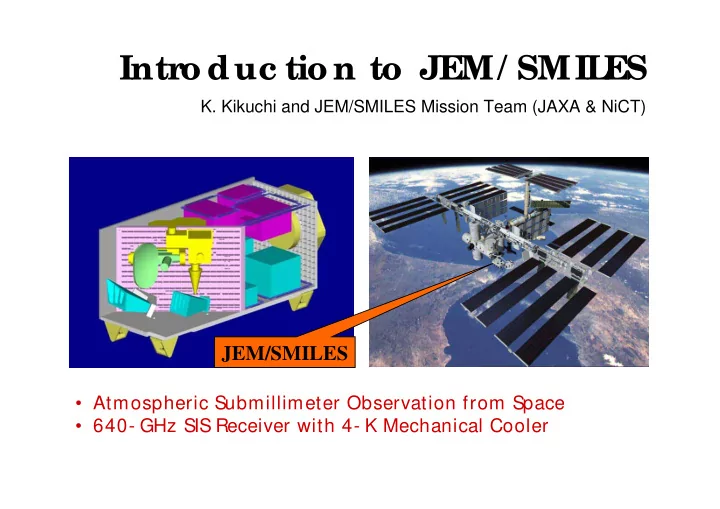
Intro duc tio n to JEM/ SMIL ES

  • K. Kikuchi and JEM/SMILES Mission Team (JAXA & NiCT)
  • Atmospheric Submillimeter Observation from Space
  • 640- GHz SIS Receiver with 4- K Mechanical Cooler

JEM/SMILES

slide-2
SLIDE 2

Overview of J EM/ SMILES Overview of J EM/ SMILES

  • Mission Objectives

Results from Receiver System (EM) Test Results from Receiver System (EM) Test

  • System Noise Temperature and Gain
  • Sideband Separation
  • Linearity Test
  • Beam Test
  • Gas Cell Measurement

Contents

slide-3
SLIDE 3

Overview of J EM/ SMILES Overview of J EM/ SMILES

slide-4
SLIDE 4

Superconductive Submillimeter- Wave Limb- Superconductive Submillimeter- Wave Limb- Emission Sounder designed to be aboard the Emission Sounder designed to be aboard the J apanese Experiment Module (J EM) on ISS J apanese Experiment Module (J EM) on ISS Collaboration project of J AXA and NiCT Collaboration project of J AXA and NiCT

JEM/SMILES Mission Objectives

Space Demonstration of Superconductive Mixer Space Demonstration of Superconductive Mixer and 4- K Mechanical Cooler for Submillimeter and 4- K Mechanical Cooler for Submillimeter Limb- Emission Sounding Limb- Emission Sounding Global Observations of Atmospheric Trace Gases Global Observations of Atmospheric Trace Gases in the Stratosphere in the Stratosphere

slide-5
SLIDE 5

Structure Model

JEM/SMILES Payload

  • RF : 640 GHz band
  • Spectral Coverage:

1200 MHz x 2

  • Antenna:

40 cm x 20 cm

  • Weight: < 500 kg
  • Mission Life: 1 year

Majo Major De r Design Paramete sign Parameters rs

slide-6
SLIDE 6

4 K 20 K 100 K

Mechanical Cooler and SIS Mixer

Mechanical Cooler Mechanical Cooler

Two- stage Stirling and J

  • T

・ Cooling Capacity: 20mW @ 4K, 200mW @ 20K, 1000mW @ 100K ・ Power Consumption: < 300 W ・ Mass: 90 kg

SIS Mixer SIS Mixer

・ RF: 640 GHz ・ IF: 11- 13 GHz ・ J unction: Nb/ AlOx/ Nb, ~7 kA/ cm 2 ・ RF Matching: PCTJ with Integrated Circuit ・ Fabricated at Nobeyama IF port GND 500 µm

slide-7
SLIDE 7

Submillimeter Limb-Emission Sounding and Global Observation

  • look in “limb” directions of

various tangent heights

  • cover latitudes of 65 N to 38 S

T r a j e c t

  • r

y i n 2 4 H

  • u

r s

slide-8
SLIDE 8

Multi-species, High-sensitive Observation

  • f Trace Gases

J EM/ SMILES outputs the altitude distribution and its variation for trace gases. Simulated spectra at different tangent heights (LSB)

”Retrieval”

slide-9
SLIDE 9

Development Schedule

slide-10
SLIDE 10

Results from Receiver System Results from Receiver System (EM) Test (EM) Test

slide-11
SLIDE 11

SRX: Submillimeter Receiver

Block Diagram of JEM/SMILES

slide-12
SLIDE 12

Major Specification of Receiver System (SRX)

RF Frequency: RF Frequency: 624.32- 626.32 GHz (LSB) 624.32- 626.32 GHz (LSB) 649.12- 650.32 GHz (USB) 649.12- 650.32 GHz (USB) IF Frequency: IF Frequency: 11.0- 13.0 GHz (LSB) 11.0- 13.0 GHz (LSB) 11.8- 13.0 GHz (USB) 11.8- 13.0 GHz (USB) Noise Temperature: Noise Temperature: < 500 K (Goal) < 500 K (Goal) Image Rejection Ratio: Image Rejection Ratio: > 15 dB > 15 dB Gain: Gain: Overall: verall: 65.6 65.6±2 dB 2 dB Deviation:< 2.5 dB Deviation:< 2.5 dBp- p

p- p (Goal)

(Goal) Linearity: Linearity: < < ±1 % 1 % Stability: Stability: < ±1 % (in 1 min.) 1 % (in 1 min.)

slide-13
SLIDE 13

EM Test of Receiver System

SRX (EM) test has been completed in J uly 2005

Optical Jig Plate RF Input IF output

slide-14
SLIDE 14

Noise Temperature and Gain (1/2)

Noise Temperature Gain 2.3 62.1 mean 477 mean / 519 max. LSB-ch 3.0 62.6 mean 447 mean / 498 max. USB-ch < 2.5 goal 65.6±2 < 500 goal Specification Gain Dev. [dBp-p] Gain [dB] Noise Temp. [K]

  • Gain level is adjustable
  • Measured at 4.11 K (4-K stage temperature)
slide-15
SLIDE 15

Noise Temperature and Gain (2/2)

Achieve a better matching between SIS mixer and HEMT amp. to reduce noise temperature and gain ripple.

SIS Device Impedance Transformer HEMT Amp. SIS Device HEMT Amp. SIS Mixer (EM) SIS Mixer (FM)

With Transformer Without Transformer

Gain char. of SIS Mixer

IN (SIS) OUT

slide-16
SLIDE 16

FSP: Frequency- Selective Polarizer: FSP: Frequency- Selective Polarizer:

・ Extremely low reflection - - - Low standing waves ・ Suitable for a fixed- frequency application

Sideband Separation

WG A WG B WG (RG1) Wire-Grid(CG1) FSP Flat Mirror Flat Mirror SIS Mixer(T) SIS Mixer(R) absorber LO WG (LG1) Cold Sky Antenna

slide-17
SLIDE 17

Linearity Test

∆T T

Lock-in Amp.

Cryo- stat AOPT

SRX (Gain G ) ∆V(T) = G(T) ∆T

Reference ATT r ~ 0.1

C H

) ( ) ( 1 C V H V NL − ≡

case linear for = NL case saturated for > NL

slide-18
SLIDE 18

Beam Test (1/2)

SLO RM5a RM5b A B SMI LG1 B B H ( C S T ) B B H ( T R N ) RG 1 RM5d CM2t RM6 CM1 CG1 RM5c CM2r SMXt Horn R M 5 e SMXr Horn

A L P

COPT: Cooled Optics AOPT:

  • Amb. Temp.

Optics

S i g n a l P

  • r

t I m a g e P

  • r

t

CW Source ±0.64 max ±1.51 max.

AOPT – COPT

Beam axis

±0.28 max. ±0.28 max.

COPT

Mechanical – Beam axis

±0.36 max. ±1.23 max.

AOPT

Mechanical – Beam axis

Tilt Err. [deg] Position Err. [mm]

slide-19
SLIDE 19

Beam Test (2/2)

  • Mechanical alignment alone is not enough. Adjustment
  • f beam axis between AOPT and COPT is essential.
  • Beam efficiency of ~90 %

will be achievable in FM.

First Result “Beam Shift” between AOPT and COPT by 1 mm ~5 % increase of beam efficiency

slide-20
SLIDE 20

x0 x1

Cold Termination

Gas Cell

k SRX Gas Cell Measurement (1/2)

) ' ) ' ( exp( ) (

1

− =

x x

dx x k x T Transmittance : T(x)

slide-21
SLIDE 21
  • CH2F2, H37Cl, and CH3CN
  • Measured with AOS(BBM)

LSB LSB USB

Gas Cell Measurement (2/2)

slide-22
SLIDE 22

Conclusion

J EM/ SMILES mission is overviewed. The performance of SRX (EM) almost meets the requirements of J EM/ SMILES specification.

http:/ / smiles.tksc.jaxa.jp