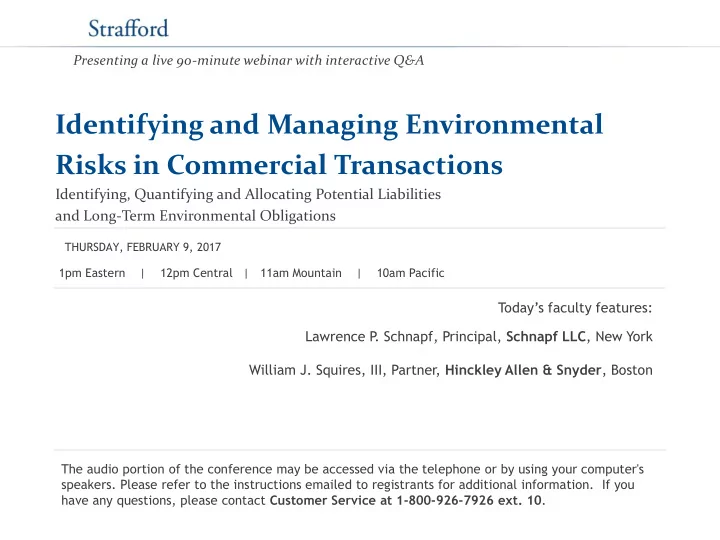
Presenting a live 90-minute webinar with interactive Q&A - - PowerPoint PPT Presentation

presenting a live 90 minute webinar with interactive q a
SMART_READER_LITE
LIVE PREVIEW

Presenting a live 90-minute webinar with interactive Q&A - - PowerPoint PPT Presentation

Presenting a live 90-minute webinar with interactive Q&A Identifying and Managing Environmental Risks in Commercial Transactions Identifying, Quantifying and Allocating Potential Liabilities and Long-Term Environmental Obligations THURSDAY,


slide-1
SLIDE 1

The audio portion of the conference may be accessed via the telephone or by using your computer's

  • speakers. Please refer to the instructions emailed to registrants for additional information. If you

have any questions, please contact Customer Service at 1-800-926-7926 ext. 10.

Presenting a live 90-minute webinar with interactive Q&A

Identifying and Managing Environmental Risks in Commercial Transactions

Identifying, Quantifying and Allocating Potential Liabilities and Long-Term Environmental Obligations

Today’s faculty features:

1pm Eastern | 12pm Central | 11am Mountain | 10am Pacific THURSDAY, FEBRUARY 9, 2017

Lawrence P . Schnapf, Principal, Schnapf LLC, New York William J. Squires, III, Partner, Hinckley Allen & Snyder, Boston

slide-2
SLIDE 2

Tips for Optimal Quality

Sound Quality If you are listening via your computer speakers, please note that the quality

  • f your sound will vary depending on the speed and quality of your internet

connection. If the sound quality is not satisfactory, you may listen via the phone: dial 1-866-961-9091 and enter your PIN when prompted. Otherwise, please send us a chat or e-mail sound@straffordpub.com immediately so we can address the problem. If you dialed in and have any difficulties during the call, press *0 for assistance. Viewing Quality To maximize your screen, press the F11 key on your keyboard. To exit full screen, press the F11 key again.

FOR LIVE EVENT ONLY

slide-3
SLIDE 3

Continuing Education Credits

In order for us to process your continuing education credit, you must confirm your participation in this webinar by completing and submitting the Attendance Affirmation/Evaluation after the webinar. A link to the Attendance Affirmation/Evaluation will be in the thank you email that you will receive immediately following the program. For additional information about continuing education, call us at 1-800-926-7926

  • ext. 35.

FOR LIVE EVENT ONLY

slide-4
SLIDE 4

Program Materials

If you have not printed the conference materials for this program, please complete the following steps:

  • Click on the ^ symbol next to “Conference Materials” in the middle of the left-

hand column on your screen.

  • Click on the tab labeled “Handouts” that appears, and there you will see a

PDF of the slides for today's program.

  • Double click on the PDF and a separate page will open.
  • Print the slides by clicking on the printer icon.

FOR LIVE EVENT ONLY

slide-5
SLIDE 5

LAWRENCE P . SCHNAPF SCHNAPF LLC WILLIAM J. SQUIRES, III HINCKLEY, ALLEN & SNYDER LLP

IDENTIFYING AND MANAGING ENVIRONMENTAL RISKS IN COMMERCIAL TRANSACTIONS

STRAFFORD PUBLICATIONS FEBRUARY 9, 2017

slide-6
SLIDE 6

AGENDA

  • Purpose of Environmental Due Diligence
  • Conducting Environmental Due Diligence
  • Allocating and Mitigating Environmental Risks

6

slide-7
SLIDE 7

7

Purpose of Environmental Due Diligence

slide-8
SLIDE 8

IDENT

NTIFYI FYING NG ENVIRONMEN ENTAL RISKS

8

slide-9
SLIDE 9

WHY

HY ENVI VIRON ONMEN MENTAL DUE UE DILI LIGENC ENCE?

  • Qualify for Defenses Under Environmental Laws Imposing Strict and Joint Liability For Cleanups

Government Cost Recovery and Unilateral Administrative Orders

Third Party Cost Recovery or Contribution Claims

  • Quantify Material Environmental Liabilities Under Federal and State Laws Imposing Compliance

Obligations

Change in Business Operations

Construction Delays or Overruns

  • Comply With State and Local Transactional Laws

NJ ISRA; CT Transfer Act

NYC e-designation

  • Satisfy Lender Requirements

9

slide-10
SLIDE 10

WHY

HY ENVI VIRON ONMEN MENTAL DUE UE DILI LIGENC ENCE?

  • Evaluate Common Law Liabilities

 Successor, Parent, Affiliate Liability  Property Damage Claims  Personal Injury

  • Evaluate Contractual/Lease Obligations

 CERCLA 107(e)-parties may not contract away liability  “As Is” only applies to reps and warranties  Release Should refer to “CERCLA-like” liabilities

10

slide-11
SLIDE 11

GOAL OF DUE

UE DILI LIGENC ENCE

  • Not To Eliminate ALL Risk but Understand Material Risks
  • Cleanup
  • Compliance
  • Permits for Business Plans
  • Culture
  • Identify and Allocate (Manage) Risk Based on Nature of Transaction
  • Stage of Deal (pre-bid, exclusivity period)
  • Time, cost, data room vs site assessments
  • Deal Killers
  • Purchaser Tolerance
  • Bid Pricing
  • Markup Purchase Agreement
  • Identify Potential Mitigation Tools

11

slide-12
SLIDE 12

KEY

EY ENVIRONMEN ENTAL LAWS WS

  • Principal Sources of Cleanup Liability

 CERCLA, 42 U.S.C. 9601 et seq.  RCRA, 42 U.S.C. 6901 et seq.  TSCA (PCBs)  State Versions of CERCLA/RCRA  State Transaction Statues  State Superlien Statutes

12

slide-13
SLIDE 13

PRINCIP

IPAL SOURCES OF OF REGUL ULATORY COMPLIAN LIANCE

  • Clean Air Act (CAA), 42 U.S.C. 7401 et. seq.
  • Clean Water Act (CWA), 33 U.S.C. 1251 et seq.
  • Resource Conservation and Recovery Act (RCRA), 42 U.S.C. 6901
  • et. Seq.
  • Toxic Substances Control Act (TSCA), 15 U.S.C. 2601 et seq.
  • Emergency Planning and Community Right to Know (EPCRA), 42

U.S.C. 11001 et seq.

  • Comparable State Laws

13

slide-14
SLIDE 14

CER ERCLA CLA AUTHOR

ORIT ITY

  • Established “Superfund” to finance cleanups
  • Authorizes list of most heavily- contaminated sites.
  • Gov’t May perform cleanups.
  • Unilateral Administrative Orders to address sites posing substantial

and imminent endangerment.

  • Recover response costs from PRPs.
  • Permits PRPs to seek reimbursement of response costs from other

PRPs.

14

slide-15
SLIDE 15

UNILA

LATER ERAL AL ADMINIS ISTRA RATIVE IVE ORDERS

42 2 USC 960 606

  • EPA may issue UAO when it determines

 Release or threatened Release  May pose imminent and substantial endangerment to public health or the

environment

  • Failure to comply without sufficient cause may result in fines and

treble damages

15

slide-16
SLIDE 16

STANDARD

RD OF OF LIABILIT LITY

  • STRICT LIABILITY
  • RETROACTIVE LIABILITY
  • Joint (107 actions only)

16

slide-17
SLIDE 17

ELE

LEMEN MENTS OF OF CER

ERCLA CLA LIABILIT

LITY

  • Release

 Includes “disposal”  Passive migration vs active disposal

  • Hazardous Substance
  • Facility
  • Response Costs

 Remedial or Removal  Consistency with NCP

17

slide-18
SLIDE 18

CER ERCLA CLA LIABLE

LE PARTI RTIES

  • Current and Former Owners
  • Current and Past Operators
  • Generators
  • Transporters

18

slide-19
SLIDE 19

CER ERCLA CLA OWNER

  • Current Owner
  • Past Owner “at time of disposal”

 Passive vs. active disposal

  • Title Holders
  • Easement Holders
  • Long-Term Tenants
  • Parent Corporations

19

slide-20
SLIDE 20

CER ERCLA CLA OPERATOR

  • Based on Control

 Actual vs ability to control

  • Past Operator “at time of disposal”

 Active vs passive disposal

20

slide-21
SLIDE 21

CER ERCLA CLA ARRANGER

ER

  • Intent to Arrange for Disposal of Hazardous Substance

 Sale of raw materials/useful product  Liable if transported to non-approved site

21

slide-22
SLIDE 22

TRANSP

SPOR ORTER ER

  • Must make decision where to dispose hazardous substances

22

slide-23
SLIDE 23

CER ERCLA CLA AFFIRMA

MATIVE IVE DEFENS NSES ES

  • Act of God
  • Act of War
  • Third Party
  • Innocent Landowner (ILO)
  • Bona Fide Prospective Purchaser (BFPP)
  • Contiguous Property Owner (CPO)

23

slide-24
SLIDE 24

THIRD

RD PART RTY TRANSFER ERS

  • Release Solely Caused by TP
  • No direct and indirect contractual relationship

 ILO Exception to this element

  • Due care
  • Precaution against foreseeable acts or omissions

24

slide-25
SLIDE 25

INNOCEN

ENT LANDOWNER DEFEN ENSE SE (ILO)

O) 42 2 U.S.C .C. . 9601(35 1(35)(A (A) ) AND (B) (B)

  • Did Not Know or Had No Reason to Know of Release
  • Perform Pre-Acquisition AAI
  • Comply with Post-Acquisition Continuing Obligations

 Cooperate and Provide Access for Persons Performing Response Actions  Comply With Land Use Controls (LUCs)  Provide Access to Persons Maintaining LUCs

25

slide-26
SLIDE 26

BFPP P - 42 42 U.S.C. .C. 960 601(40 1(40)

  • Applies to transactions after January 11,2002
  • Applies to Purchasers and Tenants
  • Applies to brownfield and NPL sites

26

slide-27
SLIDE 27

ELE

LEMEN MENTS OF OF BF

BFPP PP DEFENSE

SE

  • Threshold Criteria

 Conducted AAI  Not PRP or affiliated with PRP by:

 direct or indirect familial relationship  contractual or corporate relationship  Corporate Reorganization

 Disposal took place prior to acquisition

27

slide-28
SLIDE 28

BFPP P DEFENSE

SE ELEMEN ENTS CONT’D

  • Continuing Obligations

 Complied with All Applicable Reporting Requirements  Undertake “Appropriate Care”  Cooperate and Provide Access to Persons Performing Response Actions  Comply With LUCs Provide Access for Persons Maintaining LUCs  Comply with EPA CERCLA Information Requests or Subpoenas

28

slide-29
SLIDE 29

CPO PO DEFEN

ENSE SE

42 2 U.S.C. .C. 9607( 7(Q)

  • Owner did not cause, contribute, or consent to release
  • Conduct “Appropriate Inquiry”
  • Exercise “Appropriate Care”
  • Cooperate and Provide Access To Persons Performing Cleanups
  • Comply With LUCs
  • Provide Access To Persons Maintaining LUCs
  • Comply with all release reporting requirements
  • Comply with EPA CERCLA Information Requests and Subpoenas
  • Owner not a PRP or affiliated with PRP

29

slide-30
SLIDE 30

SECURE

RED CREDIT ITOR OR EXEMPTION ION

  • Holder of Security Interest Not Owner if

 Holds “indicia of ownership” primarily to protect security interest  Did Not “Participate in Management” of facility

  • Post-Foreclosure Immunity if:

 Takes commercially reasonable steps to sale property  Does not Cause or Exacerbate Release

  • Beware of:

 RCRA UST Secured Creditor Exemption  RCRA 7002 actions  Common Law Failure to Disclose

30

slide-31
SLIDE 31

TYPICA

ICAL BANK CON ONCERN RNS

  • Credit Risk

 Borrower Ability to Pay Loan  Value of Collateral

  • Direct Liability

 Cleanup costs  Toxic Torts

  • Reputational Risk

31

slide-32
SLIDE 32

TYPE OF LENDER MAY INFLUENCE DILIGENCE

  • Community Bank

 Small borrowers with limited resources for environmental risks  Frequently little or no environmental diligence

  • SBA 7(a) and 504 programs Loan (SOP 50 10 5(G))

 < $150K and not on NAICS list, Environmental Questionnaire  >$150K and on NAICS, perform Records Search with Risk Assessment

(RSRA) report.

 “High Risk” proceeds to Phase 1

  • Traditional Balance Sheet/Life Insurance

 Borrower financial strength can influence diligence

32

slide-33
SLIDE 33

TYPES

ES OF OF LENDER ERS

  • Loan Syndication

 Piggy-back on lead lender

  • Construction Loan

 Environmental overruns  Ability to be taken out

  • Mezzanine Lender

 Usually piggy-backs on senior lender  Steps in shows of borrower on default

  • CMBS Lender

 Sells loan to trust  Makes reps about diligence  B-Piece Buyers key role

33

slide-34
SLIDE 34

TYPES OF LENDERS CONT’D

  • Private Equity

 Revolving/term loan often with warrants or board seats  Qualify for secured creditor?

34

slide-35
SLIDE 35

RCR CRA A GENERATORS

RS

  • Three types

 Large Quantity Generator  Small Quantity Generator

 100-1000 kg (220 to 2200 lbs)

 Conditionally Exempt Small Quantity Generator

 < 100 kg (220 lbs)

  • Closure Obligations

 Run with land

35

slide-36
SLIDE 36

RCR CRA A TREATMEN

ENT,

, STORAGE AND DISPOSAL FACILIT

ITIES IES

(TSDF SDF)

  • Permitted or Interim Status
  • Design and Operating Standards
  • Preparedness and Recordkeeping
  • Ground water monitoring
  • Land disposal restrictions
  • Closure/Post Closure
  • Corrective Action
  • Financial Assurance

36

slide-37
SLIDE 37

RCRA CRA COR

ORREC ECTIVE IVE ACTION CTION

  • Permit Authority- HMWUs and SWMUs

 3004 (u) (onsite)  3004 (v) (offsite)

  • Interim Status and Generators

 3008 (h)

  • Procedure

 RCRA Facility Assessment (“RFA”)  RCRA Facility Investigation (“RFI”)  Corrective Measures Study (“CMS”)  Corrective Measure Implementation (“CMI”)  Corrective Action Management Unit Rule (“CAMU”)

37

slide-38
SLIDE 38

700 002 2 AND 7003 03 INJUNCTIVE

IVE RELIEF IEF

  • 7002- Private Parties

 Any person “contributing to”  Past or present handling…disposal of solid or hazardous waste  May present imminent and substantial endangerment

  • 7003 Govt. Only

38

slide-39
SLIDE 39

UNDER

ERGROUN UND STORAGE TANKS

42 2 U.S.C .C. . 6991-699 6991M

  • Regulated tanks

 Applies to storage of petroleum or hazardous substance  Not apply to heating oil tanks used for on-site consumption  Not apply to tanks storing HW are subject to Subtitle C  Not apply to motor fuel tanks less than 1100 gallons at farms and homes

39

slide-40
SLIDE 40

USTS CONT’D

  • UST Design Standards
  • Release Reporting

 Report spills or overflow of 25 gallons or more  Reportable quantity of hazardous substance  Suspected releases

  • Corrective Action
  • UST Closure
  • Financial Assurance
  • Secured Creditor Exemption for USTs

40

slide-41
SLIDE 41

CLE

LEAN AIR IR ACT CT

  • Permit Programs

 NSR (PSD and Non-Attainment)  Title V

  • New Source Performance Standards (NSPS)
  • Hazardous Air Pollutants (HAPs)
  • Risk Management Plans
  • Asbestos-Containing Programs
  • GHG Regulation
  • Title IV Acid Rain and Title VI Ozone-Depleting Substances

41

slide-42
SLIDE 42

NEW

EW SOURCE PERFORM ORMANCE CE STANDARDS (NS

NSPS)

  • When construction commences- actual physical work or contract has

been signed

 Any physical change or change in method of operation which

increases the amount of any air pollutant regulated under CAA that was not previously emitted.

 expressed in hourly emissions rate at maximum physical capacity before and

after change

 Hourly emission rate is after controls installed

  • Reconstruction: at least 50% of total cost of a comparable new facility

even if no increase in emissions

  • Minor NSPS exempt from Title V

 Purchase Emission Reduction Credits (ERCs)

  • Best Demonstrated Technology (BDAT)

42

slide-43
SLIDE 43

CLE

LEAN AIR IR ACT CT

 New Source Review (NSR)

 Construction of new major sources or modification of existing

major stationary sources

  • physical change
  • change in the operation of a major source that results in

 Significant net increase in emissions that impacts air quality

 PSD vs. Non-Attainment

43

slide-44
SLIDE 44

NS NSR- PSD (ATTAINMEN

ENT AREAS)

  • Major source

any source that belongs to a list of 28 categories

emits or PTE emit 100 tpy of air pollutants regulated by the CAA (except HAPs or any type of source that has the PTE 250 tpy

  • Significant Net emissions

CO (100 tpy)

NOx, SO2 and VOCs(40 tpy)

PM (25 tpy)

  • Best available control technology ("BACT")

44

slide-45
SLIDE 45

NS NSR NON

ON-ATTAINMEN INMENT(§173

73)

  • Only covers six criteria pollutants
  • LAER (more stringent that BACT)
  • Major Source- depends on pollutant and classification

 Marginal and Moderate Non-Attainment areas: 100 tpy NOx/VOC  Serious Non-Attainment: 50 tpy NOx/VOC.  Severe Non-Attainment: 25 tpy NOx/VOC  Extreme Non-Attainment areas: 10 tpy  CO (100 to 50 tpy);  PM (100-70 tpy)

  • Offsets- Range from 1:1 to 1:5 depending on the air quality

classification

45

slide-46
SLIDE 46

CWA A PERMIT

IT PROG OGRAMS MS

  • NPDES Permit Program (§402)

 Industrial Dischargers  Municipal (POTWs) (§301)  SSO/CSO (§402(q))  Indirect Dischargers (pretreatment-§317)  Stormwater (§ 402(p))  Sludge Disposal (§405)  CAFOs

  • Wetlands (§404)

46

slide-47
SLIDE 47

NP NPDES ES

  • Discharge

 Addition of pollutant

  • Pollutants

 Not include fluids to promote oil/gas production

  • Point Source
  • Waters of United States

47

slide-48
SLIDE 48

NP NPDES ES PERMITS

ITS

  • Individual vs General Permits
  • Duty to Apply
  • Effluent Limits

 Technology (BCT, BPT, BAT, NSPS)  water quality-based standards

  • Discharge Monitoring Reports
  • Standard Conditions
  • Special Conditions

48

slide-49
SLIDE 49

COM

OMMO MON LAW AW

  • Negligence
  • Trespass
  • Nuisance
  • Strict Liability for Abnormally Dangerous Activity

49

slide-50
SLIDE 50

COM

OMMO MON CHALLEN LLENGES GES

  • Historic Contamination
  • Lack of Awareness (not intentional)
  • Evolving Standards of Care
  • Acceptable Practices At Time of Release or Disposal
  • Lack of Statutory or Regulatory Programs
  • Truly responsible parties unavailable
  • Statute of Limitations (SOL)

50

slide-51
SLIDE 51

SUCCESSOR

OR LIABILIT LITY OVERVI RVIEW EW

  • Asset Purchase

 Generally no successor liability unless four exceptions (express/implied

assumption, fraud, de facto merger or continuity)

  • Stock Purchase- liabilities follow purchaser unless excluded
  • Merger- acquirer assumes liabilities
  • Bankruptcy (§363 or §1141)

 Order may provide for “free and clear” and no successor liability

51

slide-52
SLIDE 52

VEIL PIERCING

NG

  • Parent Corporation Liability for Subsidiary

 State Law Predominates  Owner Liability

 Direct liability of facility

 Operator Liability

 Control over operation  Corporate officers may wear “dual hats”

52

slide-53
SLIDE 53

53

Conducting Environmental Due Diligence

slide-54
SLIDE 54

CONDUC

UCTIN ING ENVIRONM NMEN ENTAL DUE UE DILIGE GENCE

GETTING STARTE

RTED

  • Assemble Experienced Team:

 Environmental legal counsel  Environmental consulting team  Knowledgeable EH&S staff

  • Consider Big Picture
  • Customize Environmental Due Diligence Request List
  • Consider Timing
  • Determine Appropriate Scope and Methods

54

slide-55
SLIDE 55

CONDUC

UCTIN ING ENVIRONM NMEN ENTAL DUE UE DILIGE GENCE

COMMON METHODS

  • Phase I Environmental Site Assessments
  • Phase II Subsurface Investigations
  • Permitting and Regulatory Compliance Review/Audit
  • Desktop Reviews
  • Gather and Review:

 Environmental reports, audits and data  Permits, registrations and agency correspondence  General notice letters, 104(e) requests and NFAs  Notices of violation and administrative/judicial pleadings  Agreements relating to previous acquisitions and dispositions of

businesses and real property

 Environmental insurance

55

slide-56
SLIDE 56

CONDUC

UCTIN ING ENVIRONM NMEN ENTAL DUE UE DILIGE GENCE

PHASE I E ENVIRONM

NMEN ENTAL SITE ASSESSMEN ENT

  • An inquiry by an environmental professional to ascertain

whether there is reason to believe the property is contaminated.

  • Elements of Phase I ESA (ASTM E1527-13):

 Interviews with current and former owners, operators and others  Review of historical sources  Review of public records  Site inspection  Review of information provided by seller

56

slide-57
SLIDE 57

CONDUC

UCTIN ING ENVIRONM NMEN ENTAL DUE UE DILIGE GENCE

PHASE I E ENVIRONM

NMEN ENTAL SITE ASSESSMEN ENT

  • Standard of Care – Must identify:

 Recognized Environmental Conditions (RECs)  Historical Recognized Environmental Conditions (HRECs)  Controlled Recognized Environmental Conditions (CRECs)  Potential for Vapor Intrusion  User Provided Information (i.e., User Questionnaire)  Data Gaps

57

slide-58
SLIDE 58

CONDUC

UCTIN ING ENVIRONM NMEN ENTAL DUE UE DILIGE GENCE

PHASE II SUBSURFACE

CE INVESTIG IGATION ION

  • Is there contamination?

 Nature, extent and source of contamination?  Estimated time and cost to remediate?  Risk to current building occupants?  Impacts to on-going operations?  Impacts to proposed development?

  • Timing
  • Relevant Contractual Concepts

 Real Estate Purchase Agreement  Site Access Agreement

58

slide-59
SLIDE 59

CONDUC

UCTIN ING ENVIRONM NMEN ENTAL DUE UE DILIGE GENCE

PERMIT

ITTIN ING AND REGULA LATOR ORY COMPLIAN LIANCE CE

  • Do the business operations comply with environmental laws?

 Does the business have all permits?  Are there pending violations or enforcement actions?  Are major expenditures required to achieve compliance?  Any pending changes in law that will make compliance

difficult or expensive?

 Is there a risk of citizen suits?

59

slide-60
SLIDE 60

CON

ONDUCT UCTIN ING ENVI VIRON ONME MENTAL DUE UE DILI LIGEN GENCE

IDENT

NTIFYI FYING NG PRE RE- AND POS OST-CLOSI OSING NG OBLI LIGATION ONS

  • Permit transfer requirements

 Must permits be transferred? (equity vs. asset)

 How and when?  Transfer vs. cancellation & reissuance

 Transfer of consent decrees, orders, settlement agreements  May need to assure compliance prior to transfer

  • Property transfer disclosure requirements

 NJ ISRA  CT Property Transfer Act  Other

60

slide-61
SLIDE 61

CONDUC

UCTIN ING ENVIRONM NMEN ENTAL DUE UE DILIGE GENCE

TO EVALUATE AND STRU

RUCTURE THE DEAL

  • Allocation of environmental liabilities between buyer & seller
  • Choice of acquisition type (e.g., asset purchase vs. merger)
  • Assessment of potential current/future remediation & compliance

costs in pricing deal or obtaining concessions

 Including discovered or planned capital expenditures

  • Properly value property to be transferred
  • Structure deal to ensure application of landowner and/or lender

liability protections

  • Anticipate potential issues with timing of closing
  • Evaluate need to acquire/supplement environmental insurance
  • Determine whether to proceed with transaction

61

slide-62
SLIDE 62

62

Allocating and Mitigating Environmental Risks

slide-63
SLIDE 63

ALLOC

OCATING ING AND MITIGATING ENVIRONM NMEN ENTAL RISKS

RELEV

LEVAN ANT COMMER ERCIAL IAL TRANSACTION IONS

63

  • Purchase and Sale of Business

 Stock Purchase Agreements  Asset Purchase Agreements  Merger Agreements

  • Purchase and Sale of Real Property

 Real Estate Purchase and Sale Agreements  Lease Agreements

  • Acquisition and Construction Financing

 Various Loan Agreements

slide-64
SLIDE 64

ALLOC

OCATING ING AND MITIGATING ENVIRONM NMEN ENTAL RISKS

GENER

ERAL CONSIDE DERA RATION ONS

64

  • In General:

 One cannot contract away statutory environmental liabilities  Contracts bind the parties to the contract and do not bind third parties  A contractual protection is only as good as the parties’ balance sheet

  • Consider Purpose, Nature and Structure of Each Transaction
  • Determine Risk Tolerance of Client(s)
  • Assess Applicable Legal Requirements

 May not be limited to jurisdiction of real property/facility

slide-65
SLIDE 65

ALLOC

OCATING ING AND MITIGATING ENVIRONM NMEN ENTAL RISKS

CONSIDER

IDERATION IONS SPECIFIC IC TO TO DEAL STRU RUCTURE

65

  • For Equity Deals:

 Successor liability concerns regarding:

 Off-site disposal of hazardous waste  Pre-closing violations of environmental laws  Formerly owned, leased or operated real property  Legacy businesses

 Merger Agreements

 Environmental provisions typically reciprocal  Who are the indemnitors?

  • For Asset and Real Estate Deals:

 Consider likelihood of successor liability exposure  Permit transfers and potential need for new permits

slide-66
SLIDE 66

ALLOC

OCATING ING AND MITIGATING ENVIRONM NMEN ENTAL RISKS

KEY

EY CONTRACTUAL CONCEP EPTS AND PROVISION IONS

66

  • Contract Concepts and Provisions for Allocating Liability and

Responsibility

 Definitions  Representation and Warranties  Covenants and Conditions Precedent  Indemnities and Escrows  Releases & Covenants Not to Sue  Purchase Price

slide-67
SLIDE 67

ALLOC

OCATING ING AND MITIGATING ENVIRONM NMEN ENTAL RISKS

KEY

EY DEFINIT ITION ONAL AL TERMS

  • Environmental Terms:

 Environmental Laws  Hazardous Materials  Environmental Liabilities  Existing Environmental Conditions  Response Actions/Response Costs

  • General Terms:

 MAE  Permits  Real Property  Excluded Assets  Knowledge

67

slide-68
SLIDE 68

ALLOC

OCATING ING AND MITIGATING ENVIRONM NMEN ENTAL RISKS

COMMON REPRES

ESEN ENTATION IONS AND WARRANTIES IES

  • Compliance with environmental laws
  • Have, maintain and comply with environmental permits
  • Handling, storage, transportation, disposal and treatment of

hazardous materials and wastes in compliance with law

  • No receipt of notices alleging:

 Violations of any environmental requirements;  Third-party liability related to environmental requirements

  • r conditions
  • No on- or off-site releases of any hazardous substances
  • Disclosure of all environmental reports, data and documents

68

slide-69
SLIDE 69

KEY

EY CONTRACTUAL CONCEP EPTS AND PROVISION IONS

REPRE

RESEN SENTATION IONS AND WARRANTIES IES

  • Potential Limitations

 Materiality Qualifiers  Knowledge Qualifiers  Duration & Survival Period  Disclosure Schedules

  • Remedies for Breaches
  • Potential Overlap/Conflict with Other R&Ws
  • Careful Coordination with Client when Giving R&Ws

69

slide-70
SLIDE 70

ALLOC

OCATING ING AND MITIGATING ENVIRONM NMEN ENTAL RISKS

COVEN

VENAN ANTS AND CONDITION IONS

  • Pre-Closing Covenants (Examples)

 Seller shall operate and maintain all facilities in compliance with all

applicable environmental laws

 Seller shall immediately notify purchaser of any notices received by

seller alleging violations of environmental laws

 Seller shall ensure compliance with all permit transfer requirements

(or warrant no such requirements)

  • Post-Closing Covenants

 Example - Covenant to complete existing cleanup, post-closing

compliance plan, agreement on cleanup standards

  • Remedies for Breach of Covenants

 Example - For seller material breach, purchaser right to terminate with

no liability

  • Conditions to Closing

70

slide-71
SLIDE 71

ALLOC

OCATING ING AND MITIGATING ENVIRONM NMEN ENTAL RISKS

INDEM

EMNIT ITIES IES

  • Allocate remediation and other liabilities, including:

 Fines, penalties, capital expenditures for violations of law  Tort claims  Natural resource damage claims

  • Potential Scope of Indemnity - Indemnification for:

 Breaches of representations and warranties  Excluded environmental liabilities  Other excluded liabilities (e.g., seller-retained assets)  Known/unknown environmental conditions

71

slide-72
SLIDE 72

ALLOC

OCATING ING AND MITIGATING ENVIRONM NMEN ENTAL RISKS

INDEM

EMNIT ITIES IES

72

  • Limitations on Indemnity:

 Deductibles  Caps  Thresholds/Deductibles  Survival Periods

  • For what?

 Pre-closing vs. post-closing?  Only what is required by government or anything required by laws?  Voluntary cleanup?  Cleanup of soil and groundwater only?

slide-73
SLIDE 73

ALLOC

OCATING ING AND MITIGATING ENVIRONM NMEN ENTAL RISKS

INDEM

EMNIT ITIES IES

73

  • Other Considerations:

 What kind of cleanup?

 Industrial/commercial versus residential?  Are institutional controls permitted?

 Third party claims (e.g., diminished value, toxic tort, business loss)  Who controls relationship with government and decisions

regarding cleanup?

 Right to comment on reports and attend meetings?  Voluntary testing provision

slide-74
SLIDE 74

ALLOC

OCATING ING AND MITIGATING ENVIRONM NMEN ENTAL RISKS

OTHER ALLOCATION

ION TECHNI NIQUES QUES

  • Purchase Price Adjustments
  • Releases and Covenants Not To Sue
  • Cost Sharing
  • Escrows To Fund Cleanup
  • Deal Structure (e.g., Equity vs. Asset)
  • Use of Deed Restrictions
  • Potential Statutory Limitations on Liability

74

slide-75
SLIDE 75

ALLOC

OCATING ING AND MITIGATING ENVIRONM NMEN ENTAL RISKS

USE

SE OF OF FEDER ERAL AL AND STATE MITIGATION TOOLS OOLS

  • Covenants Not to Sue
  • Contribution Protection
  • Brownfields Programs:

 Grants and Loans  Tax Incentives  Liability Protections

  • State UST Financial Assurance Funds
  • EPA Comfort Letters
  • Voluntary Cleanup Programs
  • ILOD/BFPP/Eligible Person/Eligible Tenant

75

slide-76
SLIDE 76

CON

ONTACT INFOR ORMA MATIO ION

Lawrence P Schnapf Schnapf LLC 55 East 87th Street #8B New York, NY 10128 212.876.3189 larry@schnapflaw.com www.SchnapfLaw.com William J. Squires, III Hinckley, Allen & Snyder LLP 28 State Street Boston, MA 02109 617.378.4212 wsquires@hinckleyallen.com www.hinckleyallen.com

76