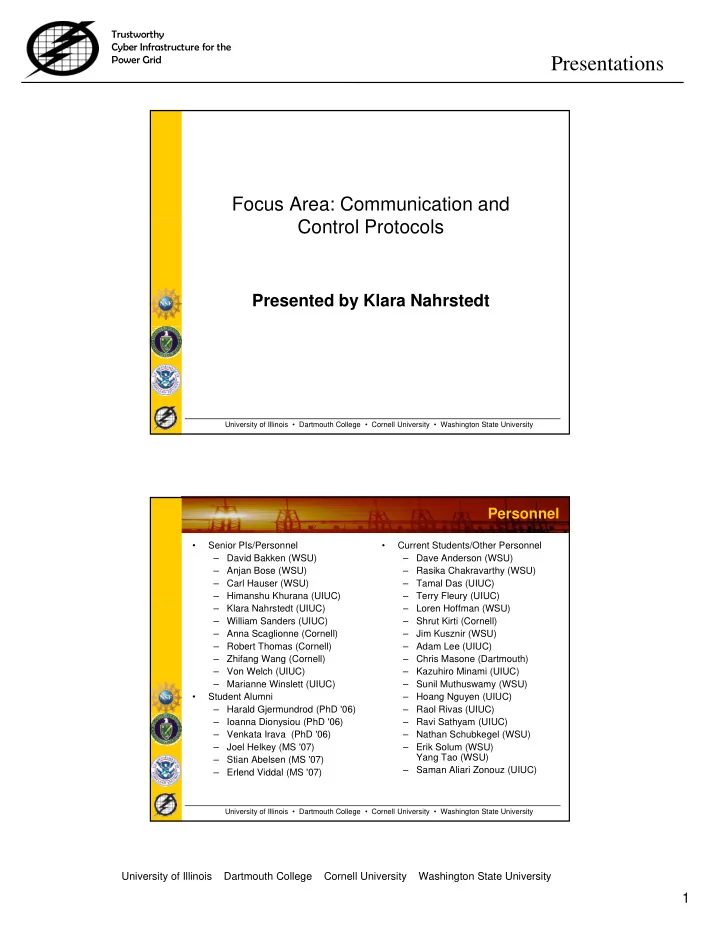
Presentations Focus Area: Communication and Control Protocols - - PDF document

presentations
SMART_READER_LITE
LIVE PREVIEW

Presentations Focus Area: Communication and Control Protocols - - PDF document

Trustworthy Cyber Infrastructure for the Power Grid Presentations Focus Area: Communication and Control Protocols Presented by Klara Nahrstedt University of Illinois Dartmouth College Cornell University Washington State


slide-1
SLIDE 1

Trustworthy Cyber Infrastructure for the Power Grid

Presentations

1

University of Illinois Dartmouth College Cornell University Washington State University

Focus Area: Communication and Control Protocols

Presented by Klara Nahrstedt

University of Illinois • Dartmouth College • Cornell University • Washington State University

Personnel

  • Senior PIs/Personnel

– David Bakken (WSU) – Anjan Bose (WSU) – Carl Hauser (WSU) – Himanshu Khurana (UIUC) Kl N h t dt (UIUC)

  • Current Students/Other Personnel

– Dave Anderson (WSU) – Rasika Chakravarthy (WSU) – Tamal Das (UIUC) – Terry Fleury (UIUC) L H ff (WSU) – Klara Nahrstedt (UIUC) – William Sanders (UIUC) – Anna Scaglionne (Cornell) – Robert Thomas (Cornell) – Zhifang Wang (Cornell) – Von Welch (UIUC) – Marianne Winslett (UIUC)

  • Student Alumni

– Harald Gjermundrod (PhD '06) – Loren Hoffman (WSU) – Shrut Kirti (Cornell) – Jim Kusznir (WSU) – Adam Lee (UIUC) – Chris Masone (Dartmouth) – Kazuhiro Minami (UIUC) – Sunil Muthuswamy (WSU) – Hoang Nguyen (UIUC) – Raol Rivas (UIUC)

University of Illinois • Dartmouth College • Cornell University • Washington State University

j ( ) – Ioanna Dionysiou (PhD '06) – Venkata Irava (PhD '06) – Joel Helkey (MS '07) – Stian Abelsen (MS '07) – Erlend Viddal (MS '07) ( ) – Ravi Sathyam (UIUC) – Nathan Schubkegel (WSU) – Erik Solum (WSU) Yang Tao (WSU) – Saman Aliari Zonouz (UIUC)

slide-2
SLIDE 2

Trustworthy Cyber Infrastructure for the Power Grid

Presentations

2

University of Illinois Dartmouth College Cornell University Washington State University

Problem Space

Trend/Premise: Next Generation Power Grid Infrastructures will deploy COTS Computing and Communication Refined Protocol/Service Challenges:

  • End-to-end key management
  • End-to-end authentication, access

Computing and Communication components for their process control SCADA cyber-infrastructure Needs: Cyber-infrastructure for PowerGrid needs holistic end-to-end protocol and service solutions with respect to , control and trust negotiation

  • End-to-end real-time/QoS

guarantees

  • Provision of real-time and reliable

monitoring, detection, alert, containment and recovery solutions in case of perturbations, vulnerabilities and attacks

University of Illinois • Dartmouth College • Cornell University • Washington State University

performance and trust issues

Vision: End-to-End Trust Provisioning for Power Grid Monitoring and Control

Control Center Level

ISO

Ethernet / IP-Network (Secure, Real-time, Monitored)

Backup

Ethernet / IP-Network (Secure, Real-time, Monitored)

Coordinator Level

Private IP-Based Network (Secure, Real-time, Monitored) Private IP-Based Network (Secure, Real-time, Monitored)

Data “Smart” Gateway/Hub

Private IP-Based Network (Secure, Real-time, Monitored)

Network Level

University of Illinois • Dartmouth College • Cornell University • Washington State University

Substation Level Sensor/Actuator Level

IED IED IED Local HMI IED DFR IED IED IED “Smart” Gateway/Hub Ethernet / IP-Network (Secure, Real-time, Monitored)

slide-3
SLIDE 3

Trustworthy Cyber Infrastructure for the Power Grid

Presentations

3

University of Illinois Dartmouth College Cornell University Washington State University

Threat Modeling

  • Problem: Assess cyber threats

to Power Grid to

– Aid in defining the scope of security problems – Allow for assessment of efficacy

  • f security solutions
  • Example Cyber Attacks
  • f security solutions

– Enable development of a taxonomy

  • Approach: Develop modeling

framework

– Emphasize vulnerabilities and potential damage – Survey known attacks to build and populate framework

Attack Vulnerability Damage Name/ Origin Action Target Vulnerability State Effect Perf. Effect Severity Data Storm/ Local Flood Network Specification Avail. Precision Medium Slamm- er/ Remote Copy Process Implementation Integrity Accuracy Low XA21/ Local Terminate Process Implementation Integrity Timeliness Medium NMAP S / Probe, S Network Specification Conf. None Low

University of Illinois • Dartmouth College • Cornell University • Washington State University

and populate framework

  • Results

– Attack-Vulnerability-Damage framework – Surveyed >50 known attacks

Scan/ Remote Scan TCP Reset/ Remote Terminate Network Specification Avail. Timeliness High

End-to-End Trust Provisioning for Power Grid Monitoring and Control

Control Center Level

ISO

Ethernet / IP-Network (Secure, Real-time, Monitored)

Ethernet / IP-Network (Secure, Real-time, Monitored)

Coordinator Level

(1) End-to-End Key Management

Private IP-Based Network (Secure, Real-time, Monitored)

Data “Smart” Gateway/Hub

Private IP-Based Network (Secure, Real-time, Monitored)

Network Level

Management (2) Authorization, Authentication And Access Control (AAA) (3) Secure and Real-Time Transmission

University of Illinois • Dartmouth College • Cornell University • Washington State University

Substation Level Sensor/Actuator Level

IED IED IED Local HMI IED DFR IED IED IED “Smart” Gateway/Hub Ethernet / IP-Network (Secure, Real-time, Monitored)

(4) Vulnerabilities/Attacks Monitoring, Detection, Containment, Recovery

slide-4
SLIDE 4

Trustworthy Cyber Infrastructure for the Power Grid

Presentations

4

University of Illinois Dartmouth College Cornell University Washington State University

Protocol/Service Functions

Power Grid SCADA Application Data Generation, Processing And Communication

Data Plane Setup Plane

Application Setup Application Control & Man. Control & Management Plane .

Public Key and Symmetric Key Setup Real-Time Encryption/ Decryption

Re-keying Protocols

Trust Negotiation & Authorization Authentication & Access Control Per-Packet Authentication & Access Control

Key Man. AAA

University of Illinois • Dartmouth College • Cornell University • Washington State University

Real-time Delivery/Scheduling

QoS Setup Admission Control QoS Management/ Topology Man./ Monitoring/ Adaptation Vulnerabilities/Attack Analysis, Monitoring, Detection, Containment and Recovery

RT Man. Attack Man.

(1) End-to-End Key Management

Control Center

Engineering Division DNSSEC Other Divisions SCADA

DomainCert:

  • Trust Establishment
  • Certificate Entry/Deletion
  • Certificate Usage

Gateway DNSSEC C h

DomainCert:

  • Certificate access
  • Certificate usage

Gateway

DomainCert SMOCK:

  • Combinatorial Key Management

For Resource Constraint/Legacy Devices

  • Resilient to Compromised Nodes/

Sybil Attack

University of Illinois • Dartmouth College • Cornell University • Washington State University

Cache

Substation

New IED Devices Legacy IED Devices

Substation

  • A. SMOCK
  • B. DomainCert

Wireless

slide-5
SLIDE 5

Trustworthy Cyber Infrastructure for the Power Grid

Presentations

5

University of Illinois Dartmouth College Cornell University Washington State University

(2) End-to-End AAA – Trusted Authorization of GridStat Secure Status Dissemination

  • Problem
  • Approach

Achieve confidentiality, integrity and availability (CIA) for GridStat’s status dissemination in a dynamic way that can evolve with changes in the security field during the long lifecycle of information systems for the power grid.

  • Design and implement proof of concept modules

es g a d p e e p oo o co cep

  • du es

with different functional and performance attributes such as bandwidth, latency and throughput attributes.

  • Evaluate the Data Plane Security Architecture

together with developed modules in terms of their dynamics and performance and gained confidentiality, integrity and accessibility

  • Authorization via trust negotiation; Policy compiler,

high-performance runtime policy; compliance checker; Resilience to attack via careful replication

Primary Replica A subset of the data plane Leaf-SMS Leaf-SMS Leaf-SMS Root Security Management Servers without any publication data Request Request Request Request Answer Answer Answer Answer Pub-1 P b Sub-1 Publisher Subscriber . . . . . .

A N Security Management Plane

Status Router Second Backup

Legend

First Backup

University of Illinois • Dartmouth College • Cornell University • Washington State University

  • Results
  • Replaced modules and keys over the wire at

runtime without relying on root keys/certificates

  • Implemented encryption, authentication, etc
  • TrustBuilder2 framework for experimenting with

trust negotiation (SourceForge); Fastest policy compliance checker for Datalog-style policy languages

publication data Pub-n Sub-n

Data Plane

F e t c h M
  • d
u l e R e t r i e v e Cache Module Update Pub/Sub Policies

(3) End-to-end Real-Time Data Delivery

Middleware Power App

DSRT Distributed Scheduling/ Coordination SCADA Data Processing/Aggregation IEC 61850

Gateway Device

Private IP-Based Network (Secure, Real-time, Monitored)

D

Middleware Power App

DSRT Distributed Scheduling/ SCADA Data/Alarm Generation IEC 61850

Middleware Power App

DSRT Distributed SCADA Data/Alarm Generation IEC 61850 Dynamic Soft-Real-Time CPU

PHY/MAC N/T

WTP/EED Network Scheduling/FEC/TS Consensus-based Distributed control

IP/

RT Alarm

C

University of Illinois • Dartmouth College • Cornell University • Washington State University

PHY/MAC N/T

WTP Network Scheduling/FEC/TS Consensus-based Distributed control Scheduling/ Coordination

PHY/MAC N/T

WTP Network Scheduling/FEC/TS Consensus-based Distributed control Scheduling/ Coordination

IED Device

  • 1. Gossiping for distributed

fusion of net. Information

  • 2. Design distributed control

Real-time Network Packet Scheduling Using Waiting Time Priority (WTP) Policy, Forward Error Correction, Traffic Shaping Using EDF and Distributed EDF Coordination Function

IP/ IP/ IED Device B C A
slide-6
SLIDE 6

Trustworthy Cyber Infrastructure for the Power Grid

Presentations

6

University of Illinois Dartmouth College Cornell University Washington State University

Project 3.A: Random Topology Power Grids

  • Problem:

– Develop a methodology to produce a large number of test power grids with appropriate topologies and scalable network size, in order to design, examine or verify any proposed

  • Results

Model proposed is able to generate random-topology power grids which effectively approximate the topological and electrical characteristics of real power system grids. Ei l di t ib ti f th t d

y y p p

  • implementation. One example is to

answer how much communication flow do I need between different parts

  • f the network in order to manage it

and control it.

  • Approach:

– Formation of random topologies

  • Nodal locations
  • Link selection

C ti it Ch k

Eigenvalues distribution of the generated power grids is very similar to that of IEEE standard system. Between the two varieties of the model, Poisson-RT works better than Uniform-RT to approximate the selected standard model systems.

University of Illinois • Dartmouth College • Cornell University • Washington State University

  • Connectivity Check

– Assignments of power grid parameters

  • Impedance of transmission lines
  • Loads and generation settings
  • Initial operating equilibrium

Project 3.B: Scalable Communication Protocols for Real- Time State Estimation in Power Networks

  • Project Problem

1. How to achieve decentralized state estimation (DSE)? 2. How to design communication architecture that enables DSE directly at all of the PMU’s?

  • Approach

1. DSE  distributed Kalman Filter 2. Message structure - Extend the use of “average consensus” protocols to extended Kalman filters

[Olfati-Saber CDC05]

3. Media Access Control (MAC) Coding - Data driven channel access protocols for fast average consensus

[Kirti and Scaglione CDC07]

  • Results

1. Designed data driven communication protocol – Scalable physical layer gossiping protocol for quantized average consensus – Uses node data to drive the transmission scheduling and modulation

Example of data driven channel

University of Illinois • Dartmouth College • Cornell University • Washington State University scheduling and modulation – Opportunistically exploits broadcast wireless channel to perform desired computations 2. Implemented distributed Kalman filter using data driven communication  figure shows distributed tracking of object’s position

Quantized state values

access

|Q| = no. of slots allowed

slide-7
SLIDE 7

Trustworthy Cyber Infrastructure for the Power Grid

Presentations

7

University of Illinois Dartmouth College Cornell University Washington State University

Project 3.C/D – Integrated CPU and Network Scheduling in 802.11 Wireless Networks and QoS Routers

  • Problem:

– Provide end-to-end real-time delivery

  • ver wireless and wide area networks
  • Approach:

– Dynamic Soft Real-time Scheduling (DSRT) ith EDF li CPU

WTP/ RT-App BE-App SMOCK/QoS/ ACF Management DSRT Distributed Coordination User Space BITW IED IED

(DSRT) with EDF policy as CPU scheduling at IEDs & gateway – Waiting Time Priority (WTP) as intra- network scheduling on IEDs & Gateway – End-to-end Earliest Deadline Network Scheduling Policy at Gateways, Routers & Control Center – Coordination Protocol among DSRT(s) for allowing Distributed Scheduling

WTP/ EED

802.11

Kernel Space

University of Illinois • Dartmouth College • Cornell University • Washington State University

  • Results

– End-to-end delay is in the

  • rder of milliseconds (< 10ms)

– Smaller jitter – QoS Routers in Gridstat – C/C++ implementation for faster, more predictable performance

(4) Vulnerabilities/Attacks Monitoring, Detection, Containment, Recovery

Recovery and Response Framework at Control Center Control

The image cannot be displayed. Your computer may not have enough memory to open the image, or the image may have been corrupted. Restart your computer, and then open the file again. If the red x still appears, you may have to delete the image and then insert it again.

Cyber

  • side

(SCADA ) Monitoring Sensors

The image cannot be displayed. Your computer may not have enough memory to open the image, or the image may have been corrupted. Restart your computer, and then open the file again. If the red x still appears, you may have to delete the image and then insert it again.

Power

  • side

Monitoring Sensors

The image cannot be displayed. Your computer may not have enough memory to open the image, or the image may have been corrupted. Restart your computer, and then open the file again. If the red x still appears, you may have to delete the image and then insert it again.

Recovery and Response Engine

The image cannot be displayed. Your computer may not have enough memory to open the image,
  • r the image may have been corrupted. Restart your computer, and then open the file again. If the
red x still appears, you may have to delete the image and then insert it again.

Aggregation

The image cannot be displayed. Your computer may not have enough memory to open the image,
  • r the image may have been corrupted. Restart your computer, and then open the file again. If the
red x still appears, you may have to delete the image and then insert it again.

Correlation

The image cannot be displayed. Your computer may not have enough memory to open the image, or the image may have been corrupted. Restart your computer, and then open the file again. If the red x still appears, you may have to delete the image and then insert it again.

Bad Data Detection

The image cannot be displayed. Your computer may not have enough memory to open the image,
  • r the image may have been corrupted. Restart your computer, and then open the file again. If the
red x still appears, you may have to delete the image and then insert it again.

RRE DB

The image cannot be displayed. Your computer may not have enough memory to open the image, or the image may have been corrupted. Restart your computer, and then open the file again. If the red x still appears, you may have to delete the image and then insert it again.

Alerting to System Operator

The image cannot be displayed. Your computer may not have enough memory to open the image, or the image may have been corrupted. Restart your computer, and then open the file again. If the red x still appears, you may have to delete the image and then insert it again.

RRE Central Unit : Decision Making on Recovery Actions

Substations

Data/Control Info. Monitor

Vulnerabilities/Attack Detection Attack Containment/ Cooperative Response

Vulnerabilities Attack Info. Logs (AID)

Attack Containment Framework at Substation Substation Gateway Center

Processing/ egation

The image cannot be displayed. Your computer may not have enough memory to open the image, or the image may have been corrupted. Restart your computer, and then open the file again. If the red x still appears, you may have to delete the image and then insert it again.

Supervisory Control and Data Acquisition Networks

Alerts Data/Control

ATTACKS ATTACKS

University of Illinois • Dartmouth College • Cornell University • Washington State University Attack Monitoring/ OS/Net Containment

Cooperative Response

Log Summarization

Gateway Device IED Devices

Attack Monitoring/ OS/Net Containment Attack Monitoring/ OS/Net Containment Data Aggre

ATTACKS ATTACKS ATTACKS ATTACKS

slide-8
SLIDE 8

Trustworthy Cyber Infrastructure for the Power Grid

Presentations

8

University of Illinois Dartmouth College Cornell University Washington State University

Accomplishments

  • Theory

– Exploration of mathematical models for scalable channel coding to achieve consensus among nodes – Random Topology Power Grids – Modeling of end-to-end attack monitoring, detection and containment/ recovery (Probabilistic Real-Time Intrusion Detection & Attack Containment and Attack Degree Modeling) – Compliance checker – Trust negotiation state consistency enforcement algorithms

  • Software

– Secure Real-time End-to-end Delivery Protocol for Wireless Networks in Substations (DSRT CPU RT Scheduler & WTP Network RT Scheduler & SMOCK) – Optimized TrustBuilder2 framework for trust negotiation – Compliance Checker – GridStat –based Real-time Command Control (RT and Reliable Router & RPC for

University of Illinois • Dartmouth College • Cornell University • Washington State University

Actuator Control) – DomainCert Prototype

  • Evaluation

– Evaluation of secure real-time protocols over 802.11b and 802.11a wireless technologies (see Demo) – Evaluation of Integrated TrustBuilder2 and GridStat (see Demo) – Evaluation of other theoretical distributed algorithms and protocols via simulations (see Posters)

Future Work

  • Integration of research results within Protocols Group

– Gridstat AAA and End-to-End Key Management – End-to-End Key Management with DomainCert and SMOCK – End-to-End Attack Monitoring/Detection with RRE and ACF Integration of Attack Protection Management with Attack Characterization – Integration of Attack Protection Management with Attack Characterization – Integration of End-to-End Secure Real-Time Delivery from Substation to Control Center with DSRT/SMOCK/ACF/WiFi and GridStat – Collaboration on state estimator problem

  • Integration of research results with Evaluation Group

– Considerations of Wireless Channels in RINSE –802.11i, 802.11e, Zigbee, Bluetooth,… – Use of RINSE for Scalable Wireless/IP/Transport/Overlay Protocols Validation

University of Illinois • Dartmouth College • Cornell University • Washington State University

Validation

  • Integration of research results with Device Group

– DomainCert/SMOCK Key Management Integration with Secure IEDs – Usage of Trusted Hardware for Secure Real-time End-to-End Protocols to Protect SCADA data and Commands within Substation and between Substations and Control Centers