
SLIDE 1
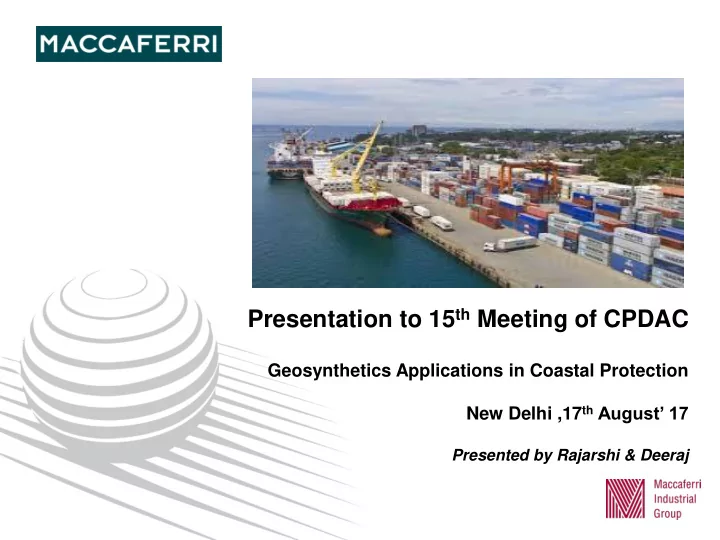
Presentation to 15th Meeting of CPDAC
Geosynthetics Applications in Coastal Protection New Delhi ,17th August’ 17
Presented by Rajarshi & Deeraj
Presentation to 15 th Meeting of CPDAC Geosynthetics Applications in - - PowerPoint PPT Presentation
Presentation to 15 th Meeting of CPDAC Geosynthetics Applications in Coastal Protection New Delhi ,17 th August 17 Presented by Rajarshi & Deeraj Agenda About Maccaferri Applications for Coastal protection and Ports Products &
Presentation to 15th Meeting of CPDAC
Geosynthetics Applications in Coastal Protection New Delhi ,17th August’ 17
Presented by Rajarshi & Deeraj
Agenda Applications for Coastal protection and Ports Products & Proposed Solutions Project References International Case studies About Maccaferri
used in 1894 for the first time; …the structure is still working today...
worldwide, 1 billion USD of yearly turnover, and an industrial group working on all five continents
area has a yearly turnover of 200 million USD
About us
GEOSYNTHETICS IN BEACH EROSION MITIGATION
The key physical parameters to identify coastal erosion as a problem are: Coastal Geomorphology: Coastline type and sensitivity to coastal processes. Wind: Wind may transfer sediment from the beach environment landward on all open coastlines. Waves: They introduce energy to the coast and also a series of currents that move sediment along the shore (longshore drift) and normal to the shore (cross-shore transport). Tides: They modulate wave action, controlling energy arriving on the coast and drive groundwater fluctuation and tidal currents. Vegetation: Important for improving slope stability, consolidating sediments and providing some shoreline protection.
Coastal Erosion Parameters
Human activities that must be considered over the range of spatial and time scales are: Activities along the coast: land reclamation, port/ harbour development, Removal of dune vegetation and mangroves, other structures such as groynes and jetties typically cause erosion down-drift of the structure. Activities within river catchments/watersheds: Dam construction and river diversion cause reduction of sediment supply to the coast that contributes to coastal erosion. Onshore and offshore activities: Sand and coral mining and dredging may affect coasts. The impact of these activities will be obvious within a short period of time (one to ten years).
Coastal Erosion Parameters
Geosynthetics
Containment: Majorly Geotextile tubes(Geosystems) used for erosion protection, Flood prevention works.
Geosynthetics in Beach Erosion Mitigation - Historical Background
Protection Bund Breakwater Groin Structure Beach Formation
Applications on the Coast
Pic taken at : LNG Petronet Kochi
Replacing Inner core Layer of Groynes with Geo textile bags / tubes Applications on the Coast
Pic Courtesy: PILOT PROJECT IN ARATTUPUZHA ,KERALA
Recommendation of IIT Madras, Ocean Engineering Department
13
Installation Methodology - Material Storage and Handling
3. Installation Methodology Material unloading using Cranes Geotextile tube stacking and storing
14
Installation Methodology - Preparation of Tubes at Land
3. Installation Methodology Rolling out of Geotextile tubes Lifting of Tubes folded in Concertina style
15
Installation Methodology
3. Installation Methodology Transport of Empty Tubes into the Sea Pipeline arrangement from slurry pump to filling area
16
Installation Methodology
3. Installation Methodology Spreading of Empty Tube Underwater Hydraulic Filling of Geotextile Tube (Underwater)
Marine mattresses are rock-filled containers constructed of high-strength geogrid
Applications on the Port
Mattress lengths vary up to a recommended maximum of 35 ft. Mattress thickness is usually between 8 and 12 in. for revetment applications, but thicknesses can vary between 4 in. for bedding layers up to 24 in. for heavy- duty applications exposed to waves and
volumetric weight of about 110 lb/cu ft, a 35- ft-long, 5-ft-wide, 1-ft-thick mattress weighs approximately 9.6 tons
Shore protection mattress revetment , Cape May State Park Philadelphia Scour apron at Seabrook, New England
Applications: 1. Under layer for Rubble-Mound Structures 2. Toe Protection. 3. Pipeline and Outfall Protection. 4. Revetment Units for Low to Moderate Wave Exposure. 5. Scour Mats at Inlets 6. Scour Prevention Mats in Advance of Construction
7. Structure Foundation Mats and Bedding Layers Where Erosion Is Problematic or Foundation Soil Strength Is Poor
Construction of Dykes using Gabions Applications on the Port
Pic Courtesy: Proposed Solution at Nayachara Island
Tail end portion on the Nayachara Island. A Dyke structure is to be constructed with stacked Geotextile Tubes and covered with Gabion Mattress filled with Geotextile Bags towards the Estuary side. Length: 6.9 Km Gabion walls to retain the dredged material. Front Height : 6m Wall at the back:2m Material: Zinc+PVC coated Gabions lined with geotextile and filled with dewatered non- cohesive dredged material
Quay wall using Gabions for mooring and berthing of vessels Applications on the Port
a)A schematic sketch of Gabion block quay wall ( 1.5m-3.0m Height) b) Reinforced gabion walls for greater heights
Prefilled Gabions are placed under
the berthing platform replacing piles Quays with an open construction, where the deck is supported on piles
Pic Courtesy: International container Trans-shipment Terminal, Cochin Port trust. (Maccaferi- India 2009-2010)
Anchorage/ protection of pipelines using ACBM Applications for Pipeline Protection
Rectangular unit made up of concrete blocks which can be manufactured in different thickness, joined by means of polypropylene ropes.
Articulated Concrete Block Mattress
Uses:
Advantages:
Anchorage/ protection of pipelines using SARMAC Applications for Pipeline Protection
The Sarmac mattress is a rectangular unit made of an external geotextile covering, filled with stones and sand asphalt mastic, internally reinforced with a steel woven wire mesh.
Articulated Concrete Block Mattress
Advantages:
facilitate positioning
Solutions using Geosynthetics
Basal reinforcement PVDs Basal reinforcement for Piled Embankments Geosynthetic Encased Stone Column/Stone Column
Applications on the Port Roads
BREAKWATER
Potential Applications
Basal Reinforcement PVDs Piled Embankment Stone Column
Other Applications
RE Wall : Design Completed Structure
PROJECTS
Project No -1
Project : Using Geo-Textile Tubes:
Client : LNG PETRO NET LTD. Construction Start Date : April 2014 Construction Completion date : January 2015 Project Brief : To provide long term solution for achieving required tranquility at the LNG Jetty, reduce siltation and protect beach from erosion.
Geotextile Tubes
water
contain inlets on the top for attachment of pipe to allow hydraulic fill
between 2m to 6m
Main Applications of Geotextile Tubes Prot
ctio ion n Bund nd / Sea Wall
Seawall / Protection bund using Geotextile Tubes
Main Applications of Geotextile Tubes Groyne Structu ture re
Effects of Geotextile Tubes
Main Applications of Geotextile Tubes Breakw akwat ater
tranquility.
and vessels during high tides when it is fully submerged.
conventional rubble mound breakwaters
Geotextile Tubes : Breakwater Structure
Beach nourished due to Groin Structure Protection Bund
Effects of Geotextile Tubes
Project No -2
Project : Construction of Artificial Submerged Reef Using Geo-synthetic Tubes Client : Maharashtra Maritime Board (MMB) Construction Start Date : February 2015 Construction Completion date : Going On Project Brief : Mirya Bay, located on the West Coast in Ratnagiri District, Maharashtra had been subjected to severe erosion and consequently accretion. In order to mitigate the problem of erosion, Maharashtra Maritime Board (MMB) has proposed the construction of a Multipurpose Submerged Geotextile Reef at the Northern shoreline of Mirya Bay by installing sand filled Geotextile containers
Submerged Reefs
the shoreline
Submerged Reefs using Geotextile Tubes
38
Protection from Erosion using Geotextile Tube at Ambalapuzha - Irrigation Department Kerala Pilot Project for 100m in Kerala Constructed in continuation of a reformed Sea wall before the erosion season Work Commenced in April 2016 Local sand was made into a slurry and pumped into the tubes In last January, Sea wall structure made of Armour stones have collapsed completely in the southern side, but Geo systems are still intact
39
Protection from Erosion using Geotextile Tube at Ambalapuzha - Irrigation Department Kerala
40
Protection from Erosion using Geotextile Tube at Ambalapuzha - Irrigation Department Kerala
41
Protection from Erosion using Geotextile Tube at Ambalapuzha - Irrigation Department Kerala
42
Protection from Erosion using Geotextile Tube at Ambalapuzha - Irrigation Department Kerala
43
Protection from Erosion using Geotextile Tube at Ambalapuzha - Irrigation Department Kerala
44
Protection from Erosion using Geotextile Tube at Ambalapuzha - Irrigation Department Kerala
45
Protection from Erosion using Geotextile Tube at Ambalapuzha - Irrigation Department Kerala
46
Protection from Erosion using Geotextile Tube at Ambalapuzha - Irrigation Department Kerala
Reclamation Bunds at Ponnani Fishery Harbour – Coastal Protection Work – Kerala (India)
Reclamation Bunds at Ponnani Fishery Harbor (India)
Project No -4
Beach Erosion Control Sea Isle City, New Jersey
Project No - 5
Beach Erosion – before Application After Construction
Geotextile Tube Installation (Italy)
Project No- 6
Problems The proposed road is to be constructed between the Creeks. Ground water table is high and flood level is also high during the monsoon. Also sub grade strength was found to be CBR<2% with poor soil properties.
Pavement Stabilization - Creek Kalatalav Sanesh Road, Bhavnagar.
Project No- 7
Solution
Pavement Stabilization - Creek Kalatalav Sanesh Road, Bhavnagar.
Solution
Pavement Stabilization - Creek Kalatalav Sanesh Road, Bhavnagar.
Solution
Pavement Stabilization - Creek Kalatalav Sanesh Road, Bhavnagar.
Solution
Pavement Stabilization - Creek Kalatalav Sanesh Road, Bhavnagar.
Solution
Pavement Stabilization - Creek Kalatalav Sanesh Road, Bhavnagar.
Solution
Pavement Stabilization - Creek Kalatalav Sanesh Road, Bhavnagar.
CONCLUSIONS
considerations with a SCIENTIFIC AND PRACTICAL APPROACH.
engineering problems in coastal environment.
assures minimal disturbance to the coastal environment or aquatic life.
WORK VOLUME AND EXECUTION TIME which will contribute to overall economy compared to conventional solutions.