SLIDE 1
1
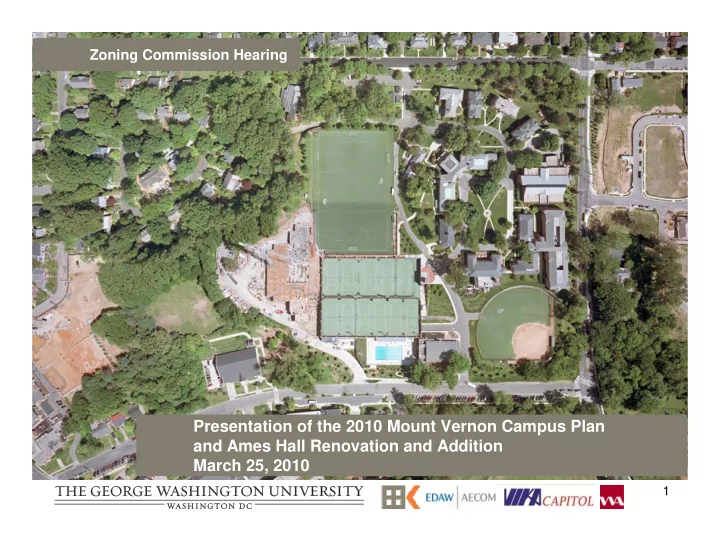
Presentation of the 2010 Mount Vernon Campus Plan and Ames Hall Renovation and Addition March 25, 2010
Zoning Commission Hearing
SLIDE 2 2
Overview of the 2010 Mount Vernon Campus Plan
- Comprehensive Community-Based Planning Process
- No Objectionable Impact on Surrounding Neighborhood
- Proposed Conditions of Approval and Implementation Schedule
SLIDE 3 3
The 2010 Mount Vernon Campus Plan
Ames Hall Renovation & Addition – Further Processing
- No Objectionable Impact
- Roof Structure Relief
SLIDE 4
4
The George Washington University Mount Vernon Campus
– The campus was originally home to the Mount Vernon Seminary and later Mount Vernon College – Mount Vernon College transitioned to The George Washington University Mount Vernon Campus under the 2000 Mount Vernon Campus Plan – The 23-acre campus is now a fully integrated co-educational “Academic Village” that complements GW’s Foggy Bottom Campus – The campus is home to undergraduate students -- largely freshmen and sophomores -- and offers a wide variety of academic and student life opportunities
SLIDE 5 5
Community Based Planning Process for the 2010 Mount Vernon Campus Plan The Planning Process for the 2010 Mount Vernon Campus Plan included:
– Eight monthly community meetings from April thru November 2009 – Multiple additional informational meetings and conversations with community members
– Four ANC 3D meetings to share information on the Plan, including three meetings from January to March 2010 to review and respond to questions about the filed Campus Plan – Meetings with Saint Patrick’s Episcopal Day School regarding the development of the Campus Plan – Meetings and conversations with Office of Planning, Department of Transportation, Historic Preservation Office, Department of the Environment and Fire and Emergency Management Services regarding the proposed Campus Plan – Utilization of an Issues Exhibit to document and respond to all community concerns raised during the process
SLIDE 6 6
Community Based Planning Process for the 2010 Mount Vernon Campus Plan The Planning Process for the 2010 Mount Vernon Campus Plan included:
– Internal GW dialogue regarding community concerns and how the University could meet
- ur academic and operational goals while addressing community issues
– Additional Consultant Work
- Updated Campus Survey
- Audit of gross floor area of existing campus development
- Acoustical studies regarding perimeter noise concerns
- Investigation of lighting mitigation strategies for tennis court lights
- Infiltration studies regarding removal of W Street parking lot
- Phase 1A assessment of archaeological potential of development sites
- Research and assessment of history and development on the Mount Vernon Campus
SLIDE 7 7
University Goals/Objectives 2010 Mount Vernon Campus Plan GW’s Key Goals and Objectives for the 2010 Mount Vernon Campus Plan included:
– Develop a plan that accommodates the University’s space needs with limited, if any, additional new development over what was approved in the 2000 Campus Plan
- Additional academic space to balance the living-learning community on the campus (estimated
at approximately 100,000 net new square feet of academic space)
- Approximately 100 net new student beds on the campus
– Enhance the Campus Environment
- Additional streetscape elements, including plantings, pedestrian-ways, sculpture locations
- Preserve and enhance open space and landscaping
- Develop a plan for appropriate campus lighting (pedestrian & athletic fields)
– Demonstrate Commitment to Sustainability
- Demonstrate GW’s commitment to sustainability through stormwater management, building
standards and enhancement of campus eco-system
SLIDE 8 8
University Goals/Objectives 2010 Mount Vernon Campus Plan GW’s Key Goals and Objectives for the 2010 Mount Vernon Campus Plan included:
– Address key campus plan measures
- Campus population counts
- Re-verification of metrics of the existing campus
– Honor existing agreements with neighbors that carry forward
SLIDE 9
9
Key Features of the 2010 Mount Vernon Campus Plan Campus Development
– Same amount of new construction as was approved in the existing campus plan – Focus on achieving a balance of uses on the campus – Site-specific guidelines for development, including height, bulk and location of development – Development located to the center of the campus, away from residential neighborhoods – Campus design guidelines for future campus buildings
Transportation and Circulation
– Closure of the W Street entrance and removal of the W Street parking lot – Continued use of the Vern Express shuttle to transport students, faculty and staff between the Mount Vernon and Foggy Bottom campuses
SLIDE 10
10
Key Features of the 2010 Mount Vernon Campus Plan
Campus Perimeter Improvements – Foxhall Road: Landscaping and fencing improvements – Whitehaven Parkway: New sidewalks, landscaping, signage and campus entrance improvements – W Street: Closure of the W Street entrance of the campus with enhanced plantings and continued maintenance of existing landscaping – Berkeley Terrace: Continued maintenance of existing landscaping Sustainability and Environmental Impacts – Commitment to a minimum of the equivalent of LEED Certification for all new construction – Comprehensive stormwater management system to be implemented with new construction – No lighting of soccer field and enhanced controls on tennis court lighting – Mitigation of noise from soccer field and mechanical equipment along Foxhall Road
SLIDE 11
11
Key Features of the 2010 Mount Vernon Campus Plan
Campus Population – Increase in number of students on a daily basis to 1,725 on a headcount basis and 1,100 on a full-time equivalent basis – Continue to expect not more than 150 faculty/staff on a daily basis 5 Year Historical Data on Student Enrollment Counts (fall semester, as of census) 741 1,419
Fall 2005
1,000 1,500
CURRENT PLAN CAPS
623 615 645 778
Maximum Daily Student Enrollment (FTE)
1,148 1,190 1,241 1,471
Maximum Daily Student Enrollment (Headcount) Fall 2009 Fall 2008 Fall 2007 Fall 2006
SLIDE 12
12
Commitments and Implementation of 2010 Mount Vernon Campus Plan Conditions of Approval to Mitigate any potential objectionable impacts
– Limitations on the location, use, height, density and lot coverage of proposed new campus development – Cap on student enrollment – Vehicular circulation and parking restrictions – Limitations that will mitigate potential noise and lighting impacts – Continued quarterly community meetings
SLIDE 13
13
Commitments and Implementation of 2010 Mount Vernon Campus Plan Implementation Schedule to ensure that improvements will be provided
– Noise improvement measures already underway – Automatic timers on tennis court lights underway by November 2010 – Perimeter fence improvement along Foxhall underway within six months of approval – Closure of W Street and removal of parking lot underway after the completion of Ames Hall (or first development under the 2010 Plan, if a building other than Ames Hall) – Sidewalk and other Whitehaven entrance improvements underway within 1 year of approval
SLIDE 14
14
Snapshot of Existing Conditions and 2000 Campus Plan Development Sites
SLIDE 15
15
Snapshot of Existing Conditions Existing Building Uses
SLIDE 16
16
Proposed Campus Development Sites 2010 Mount Vernon Campus Plan
SLIDE 17 17 15,000 18,000 S1 170,886 193,000 Total New GFA (20,387) (26,000) Demo’d GFA 150,499 167,000 NET NEW GFA Current Plan
October 2009
Original Proposal
Summer 2009
Site 50,000 30,000 25,000 25,000 45,000 50,000 R1 26,886 A4 24,000 A3 20,000 A2 35,000 A1
Proposed Campus Development - Sites and Uses 2010 Mount Vernon Campus Plan
SLIDE 18 18
3.1’ ’
Proposed Development Sites with Roof Heights 2010 Mount Vernon Campus Plan
+1.4 +1.4’ ’
8.4’ ’
2.8’ ’
R1 R1
Entrance Elevation = 235’ Roof Elevation = 295’ Total Height = 60’
- Elev. Delta= +1.4’ (Academic Bldg)
A3 A3
Entrance Elevation = 268’ Roof Elevation = 307’ Total Height = 39’
- Elev. Delta= -2.8’ (Ames)
A2 A2
Entrance Elevation = 228’ Roof Elevation = 267’ Total Height = 39’
- Elev. Delta= -8.4’ (Merriweather)
A1 A1
Entrance Elevation = 263’ Roof Elevation = 320’ Total Height = 57’
- Elev. Delta= -3.1’ (Eckles Library)
SLIDE 19 19
Proposed Campus Development – Design Standards 2010 Mount Vernon Campus Plan Design Guidelines
– Materials:
- Predominantly brick with cast stone or pre-cast details, glass and metal
features – Design Features:
- Due to adjacencies to residential streets sites A1 and A2 will develop street
façades consistent with, and at the same level of design detail as campus core façades
- Due to the various campus frontages sites A3 and R1 will develop three
façades consistent with, and at the same level of design detail as campus core façades
SLIDE 20 20
Proposed Campus Development – Design Standards 2010 Mount Vernon Campus Plan Design Guidelines
– Primary roof design will be hip or gabled style and may contain occupied space and integrate dormers or other windows as appropriate – Secondary areas of the roof may be flat – The mechanical penthouse for A1 will be set back a minimum of 40 feet from the northeast (street-facing) façade – The top story and mechanical penthouse for A2 will be set back a minimum
- f 20 feet from the north (street-facing) façade
– The design of mechanical penthouses will be integrated into the building’s design with a hip and gable roof in an architectural style consistent with existing Mount Vernon Campus buildings. Where development site constraints do not permit such integration, GW will meet with the Office of Planning and Historic Preservation Office to discuss penthouse design solutions
SLIDE 21
21
Campus Circulation - Vehicular 2010 Mount Vernon Campus Plan
SLIDE 22
22
Campus Circulation - Pedestrian 2010 Mount Vernon Campus Plan
SLIDE 23
23
Perimeter Treatment - W Street 2010 Mount Vernon Campus Plan
SLIDE 24
24
Perimeter Treatment - W Street 2010 Mount Vernon Campus Plan
SLIDE 25
25
Perimeter Treatment - Foxhall Road 2010 Mount Vernon Campus Plan
SLIDE 26
26
Perimeter Treatment - Whitehaven Entrance 2010 Mount Vernon Campus Plan
SLIDE 27
27
Perimeter Treatment - Landscaping 2010 Mount Vernon Campus Plan
SLIDE 28
28
Stormwater Management 2010 Mount Vernon Campus Plan
SLIDE 29 29
Study Area
9
10
8 5 6 7 4 3 2 1
W Street F
h a l l R
d B
l e v a r d Reservoir Road M a c A r t h u r
W h i t e h a v e n P a r k w a y Deerfield Road
SLIDE 30
30
Transportation Summary
– The increase in enrollment associated with the Campus Plan will generate 58 AM peak hour vehicle trips and 37 PM peak hour vehicle trips – Traffic associated with the increased enrollment will account for less than one percent of traffic at the study intersections – This increase in traffic will be virtually imperceptible at the study intersections – The shuttle between the Mount Vernon and Foggy Bottom Campuses is widely used by both staff/faculty and students – The number of shuttle buses will be expanded as necessary during peak periods – The University will expand its existing TDM and Parking Management programs to ensure that traffic impacts on the neighborhood are minimized
Summary of Findings:
SLIDE 31 31
Existing Transportation Demand Management Existing TDM Measures:
- The Vern Express
- Zipcar
- NuRide
- Reduced parking rates for carpools
- Significant bicycle parking
- Bicycle loan program
- Shopping cart loan program
SLIDE 32 32
Proposed Transportation Demand Management TDM Recommendations:
- Continue existing TDM strategies
- Maintain shuttle bus service with commitment to expand number of
buses as necessary during peak periods
- Provide preferential parking in garage for carpools
- Provide preferential parking for hybrid vehicles
SLIDE 33 33
Existing Parking Management
Existing Parking Management:
- On-Campus Parking Restrictions Policy
– All GW faculty, staff, students and visitors must park on campus – Policy is available on-line and is given to new residents of the Mount Vernon Campus
- “Help GW Be A Good Neighbor” Flyer
– Flyers are placed on vehicles affiliated with GW that are parked on neighborhood streets to remind them of the policy
SLIDE 34 34
Proposed Parking Management
Proposed Parking Management:
- Maintain ability to reclaim Lab School leased parking spaces at any time
- Monitor Parking Annually – when parking occupancy reaches 85%,
implement additional measures, such as:
– Increase number of spaces by implementing attendant parking – Restrict freshmen from bringing cars to campus
- Provide preferential parking in garage for carpools
- Continue to encourage use of car sharing service by students and
monitor potential demand of car sharing
SLIDE 35
35
Ames Hall Renovation and Addition 2010 Mount Vernon Campus Plan
SLIDE 36
36 36
Ames Hall Renovation and Addition 2010 Mount Vernon Campus Plan
SLIDE 37
37 37
Ames Hall Renovation and Addition 2010 Mount Vernon Campus Plan
SLIDE 38
38 38
Ames Hall Renovation and Addition 2010 Mount Vernon Campus Plan
Perspective View from South Entrance
SLIDE 39
39 39
Ames Hall Renovation and Addition 2010 Mount Vernon Campus Plan
SLIDE 40
40 40
Ames Hall Renovation and Addition 2010 Mount Vernon Campus Plan
Perspective View from across the Softball Field
SLIDE 41
41 41
Ames Hall Renovation and Addition 2010 Mount Vernon Campus Plan
SLIDE 42 42
Conclusion 2010 Mount Vernon Campus Plan
- ANC 3D Report
- OP Report
- DDOT Report
SLIDE 43
43
Conclusion 2010 Mount Vernon Campus Plan
SLIDE 44
44
SLIDE 45
45
SLIDE 46
46
SLIDE 47
47
Proposed Development Sites with Roof Heights 2010 Mount Vernon Campus Plan 2 2 2 2 1 1 1 1
SLIDE 48 48
Relative Heights of Development Sites Site A1 Elevation/Section
W Street W Street
Campus Fence Eckles Library Eckles Library +323.1 +323.1’ ’
A1 A1
+320.0 +320.0’ ’ +311.3 +311.3’ ’
Key Plan
190.0 190.0’ ’
+302.0 +302.0’ ’
30.0 30.0’ ’ 48.0 48.0’ ’
+272.0 +272.0’ ’ +277.0 +277.0’ ’
Somers Hall Somers Hall +320.2 +320.2’ ’
Potential Connection
SLIDE 49 49
W Street W Street
A1 A1
+320.0 +320.0’ ’ +311.3 +311.3’ ’
+302.0 +302.0’ ’ +302.0 +302.0’ ’
Relative Heights of Development Sites Site A1 Elevation/Section
30.0 30.0’ ’ 1 1 2 2 3 3 48.0 48.0’ ’ 40.0 40.0’ ’ +272.0 +272.0’ ’ +277.0 +277.0’ ’
Key Plan
Campus Fence 190.0 190.0’ ’
SLIDE 50 50
MacArthur Boulevard Intersections
2243 1808 2458 2009 2737 2023 250 344 275 384 283 312
500 1000 1500 2000 2500 3000 3500
AM PM AM PM AM PM MacArthur Boulevard/ W Street MacArthur Boulevard/ Reservoir Road MacArthur Boulevard/ Whitehaven Parkway
Volume (vph)
Existing Volumes Background Volumes Site-Generated Volumes
Proportional Impact
12 (< 1%) 8 (< 1%) 17 (< 1%) 25 (< 1%) 13 (< 1%) 9 (< 1%)
SLIDE 51 51
Foxhall Road Intersections
1816 1474 1605 1371 1794 1432 2594 2406 348 386 325 434 345 391 358 421
500 1000 1500 2000 2500 3000 3500
AM PM AM PM AM PM AM PM Foxhall Road/ W Street Foxhall Road/ Deerfield Road Foxhall Road/ Whitehaven Parkway Foxhall Road/ Reservoir Road
Volume (vph)
Existing Volumes Background Volumes Site-Generated Volumes
Proportional Impact (continued)
9 (< 1%) 6 (< 1%) 9 (< 1%) 6 (< 1%) 17 (< 1%) 12 (< 1%) 21 (< 1%) 14 (< 1%)
SLIDE 52
52
Trip Generation
21 14 22 15
10 20 30 40 50 60
AM Peak 7:45 - 8:45 PM Peak 5:15 - 6:15 Total Vehicle Trips Trips Associated with Pelham Project Additional Trips Associated with Campus Plan
SLIDE 53 53
Existing Parking Demand
48 80 101 133 133 132 131 142 123 96 89 89 82
20 40 60 80 100 120 140 160 180 200 7:00 AM 8:00 AM 9:00 AM 10:00 AM 11:00 AM 12:00 PM 1:00 PM 2:00 PM 3:00 PM 4:00 PM 5:00 PM 6:00 PM 7:00 PM Count Time Occupied Parking Spaces
Parking Capacity = 196
SLIDE 54
54
Peak Parking Demands
Existing Projected with Lab School Leased Spaces Projected without Lab School Leased Spaces
Peak GW Demand Unused Supply Lab School Leased Spaces Deficit
66% 89% 89%
SLIDE 55
55
Existing Trip Generation
10% 6% 84%
7:45 AM - 8:45 AM 5:15 PM - 6:15 PM Other Times
SLIDE 56
56 56
Ames Hall Renovation and Addition 2010 Mount Vernon Campus Plan
SLIDE 57
57 57
Ames Hall Renovation and Addition 2010 Mount Vernon Campus Plan
Perspective View from Campus
SLIDE 58
58 58
Ames Hall Renovation and Addition 2010 Mount Vernon Campus Plan
SLIDE 59
59 59
Ames Hall Renovation and Addition 2010 Mount Vernon Campus Plan
SLIDE 60
60 60
Ames Hall Renovation and Addition 2010 Mount Vernon Campus Plan
SLIDE 61
61 61
Ames Hall Renovation and Addition 2010 Mount Vernon Campus Plan