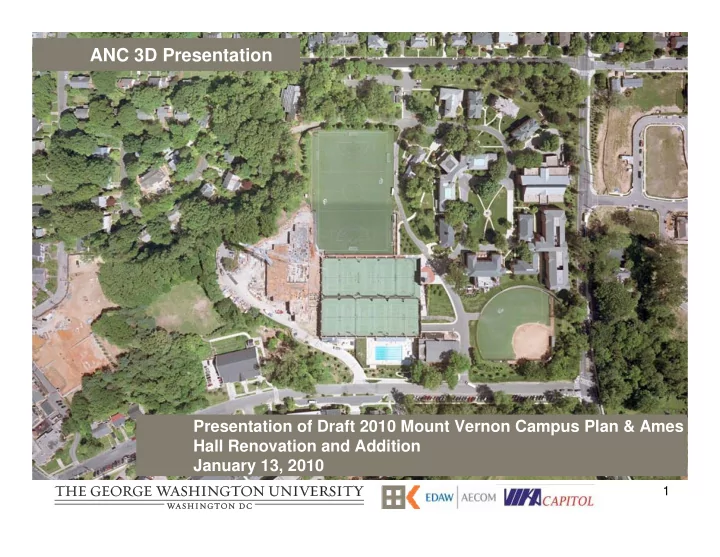
SLIDE 1
1
Presentation of Draft 2010 Mount Vernon Campus Plan & Ames Hall Renovation and Addition January 13, 2010
ANC 3D Presentation
SLIDE 2 2
Recap of Key Elements of the Draft 2010 Mount Vernon Campus Plan
- The Draft 2010 Mount Vernon Campus Plan proposes...
– Same amount of new development on campus as was approved in the existing campus plan – Locating the majority of new development focused away from the residential neighborhoods – Closing the W Street entrance except to emergency vehicles, removing the parking lot and landscaping that area – Campus perimeter to benefit from relocated fencing to limit visual impact and new plantings, specifically along Foxhall Road – No lighting of the soccer field – Enhanced controls on tennis court lighting to minimize lighting when courts not in use – Construction of 10’ wall on northern side of soccer field to assist in noise mitigation – Mitigation of noise from mechanical units along Foxhall Road
SLIDE 3 3
Recap of Key Elements of the Draft 2010 Mount Vernon Campus Plan (ctd.)
- The Draft 2010 Mount Vernon Campus Plan proposes (ctd)...
– Increase in base student enrollment of the equivalent of 15% on a headcount basis and 10% on an FTE basis, on any given day – Continued use of the Vern Express shuttle to transport students, faculty and staff between the Mount Vernon and Foggy Bottom campuses – Physical enhancements to the Whitehaven entrance to the campus and surrounding streetscape – GW commitment to achieve equivalent of certification under LEED NC for all new projects – Comprehensive stormwater management system to be implemented with new campus developments
SLIDE 4 4
Planning Process Snapshot of the process since April
- Eight community meetings to gather information and receive feedback on
design team work and proposals
- Review and responses to community issues documented in the Issues Exhibit
- Additional consultant work by GW
- Study of gross floor area of all campus buildings
- Acoustical input regarding perimeter noise concerns
- Lighting input regarding tennis court lighting
- Investigation of stormwater management options to replace existing W Street
parking lot
- Survey of the campus
- Meetings with DC Agencies, including DC Office of Planning, District Department
- f Transportation, District Department of the Environment and briefing to ANC3D
- Discussions with DC Historic Preservation Office on historic and archeological
assessments of the campus
- Internal GW discussions regarding community concerns, campus enrollment
and other internal decisions regarding academic initiatives, operational and campus plan commitments
SLIDE 5
5
Snapshot of Existing Conditions 2000 Campus Plan Development Sites
SLIDE 6
6
Snapshot of Existing Conditions Existing Building Uses
SLIDE 7 7
Snapshot of Existing Conditions Existing GFA Study
- Study of Campus Square Footages
– GW contracted with EE&K to study the campus; confirm existing gross floor area of campus buildings – Some discrepancies were found with respect to current gross floor area
- Campus buildings pre-dating GW’s involvement in the campus –
information will be updated in new plan
- Parking Garage – existing GFA calculations increased as a result of
the re-grading for the Pelham Project (as GFA is above-grade square footage and re-grading caused additional areas of the building to be “above-grade”) – As a result, the 2010 Plan will reduce GFA of new development to offset this variance » Reductions focused on development sites closest to W Street/Foxhall based on community feedback
SLIDE 8
8
Draft 2010 Mount Vernon Campus Plan Proposed Campus Development – Sites and Uses
15,000 18,000 S1 170,886 193,000 Total New GFA (20,387) (26,000) Demo’d GFA 150,499 167,000 NET NEW GFA Draft Plan (October) Original Proposal (Summer) Site 50,000 30,000 25,000 25,000 45,000 50,000 R1 26,886 A4 24,000 A3 20,000 A2 35,000 A1
SLIDE 9
9
Draft 2010 Mount Vernon Campus Plan Proposed Campus Development – Sites
SLIDE 10
10
Draft 2010 Mount Vernon Campus Plan Proposed Campus Development – Sites
SLIDE 11 11
3.1’ ’
Proposed Development Sites with Roof Heights
+9.4 +9.4’ ’ +5.6 +5.6’ ’
2.8’ ’
R1 R1
Entrance Elevation = 235’ Roof Elevation = 303’ Total Height = 68’
- Elev. Delta= +9.4’ (Academic Bldg)
A3 A3
Entrance Elevation = 268’ Roof Elevation = 307’ Total Height = 39’
- Elev. Delta= -2.8’ (Ames)
A2 A2
Entrance Elevation = 228’ Roof Elevation = 281’ Total Height = 53’
- Elev. Delta= +5.6’ (Merriweather)
A1 A1
Entrance Elevation = 263’ Roof Elevation = 320.0’ Total Height = 57.0’
- Elev. Delta= -3.1’ (Eckles Library)
SLIDE 12
12
Proposed Development Sites with Roof Heights 2 2 2 2 1 1 1 1
SLIDE 13 13
Relative Heights of Development Sites Site A1 Elevation/Section
W Street W Street
Campus Fence Eckles Library Eckles Library +323.1 +323.1’ ’
A1 A1
+320.0 +320.0’ ’ +311.3 +311.3’ ’
Key Plan
190.0 190.0’ ’
+302.0 +302.0’ ’
30.0 30.0’ ’ 48.0 48.0’ ’
+272.0 +272.0’ ’ +277.0 +277.0’ ’
Somers Hall Somers Hall +320.2 +320.2’ ’
Potential Connection
SLIDE 14 14
W Street W Street
A1 A1
+320.0 +320.0’ ’ +311.3 +311.3’ ’
+302.0 +302.0’ ’ +302.0 +302.0’ ’
Relative Heights of Development Sites Site A1 Elevation/Section
30.0 30.0’ ’ 1 1 2 2 3 3 48.0 48.0’ ’ 40.0 40.0’ ’ +272.0 +272.0’ ’ +277.0 +277.0’ ’
Key Plan
Campus Fence 190.0 190.0’ ’
SLIDE 15 15
Draft 2010 Mount Vernon Campus Plan Proposed Campus Development – Development Summary
15,000 3 63 Residential/Campus Life S1 – New Athletic 50,000 4 68 Residential/Campus Life R1 – New Residential 26,886 3 45 Academic/Admin A4 – Ames Addition 24,000 3 39 Academic/Admin A3 – Acheson Replacement 20,000 3 53 Academic/Admin A2 – W Street Central 35,000 3 57 Academic/Admin A1 – W/Foxhall Hillside Maximum GFA
Stories Max. Height* Use Site
New Development (GFA) 170,886 Demolition (GFA) ( 20,387 ) TOTAL NET NEW GFA 150,499 Remaining GFA in Approved 2000 Plan 150,499 New GFA Proposed over Approved 2000 Plan
Proposed Reallocation of Future Campus Development
*Maximum heights include architectural embellishments and mechanical equipment
SLIDE 16
16
Draft 2010 Mount Vernon Campus Plan Proposed Campus Development – Campus Development
498,057 478,928 Total Campus GFA 150,449 (169,501) 320,000 Proposed New GFA 347,558 158,928 Existing Campus GFA 2010 Campus Plan Less: New Development During 2000 Plan Approved 2000 Campus Plan
SLIDE 17 17
Draft 2010 Mount Vernon Campus Plan Proposed Campus Development – Design Standards
– Materials:
- Predominantly brick with cast stone or pre-cast details, glass and metal
features – Design Features:
- Due to adjacencies to residential streets sites A1 and A2 will develop street
facades consistent with, and at the same level of design detail as campus core façades.
- Due to the various campus frontages sites A3 and R1 will develop three
facades consistent with, and at the same level of design detail as campus core facades – Rooflines:
- Primary roof design will be hip or gabled style and may contain occupied
space and integrate dormers or other windows as appropriate
- Secondary areas of the roof may be flat
- The mechanical penthouse for A1 will be set back a minimum of 40 feet from
the northeast (street-facing) façade
- The top story and mechanical penthouse for A2 will be set back a minimum
- f 20 feet from the north (street-facing) façade.
SLIDE 18
18
Draft 2010 Mount Vernon Campus Plan Campus Circulation - Vehicular
SLIDE 19 19
Draft 2010 Mount Vernon Campus Plan Campus Circulation – Vehicular
- GW will close the W Street entrance to the campus following completion of
Ames Hall
- Whitehaven will be the primary campus entrance for students, faculty, staff
and visitors to the campus
- The Secondary Whitehaven Access Road will only be used on a limited
basis (as per existing agreements)
- Non-emergency vehicles will not use the W Street entrance to the campus,
with the exception of an emergency condition on Whitehaven Parkway rendering campus access infeasible and the continued use of the W Street entrance for move-in/move out activities (maximum 4 days/year)
SLIDE 20
20
Draft 2010 Mount Vernon Campus Plan Campus Circulation - Pedestrian
SLIDE 21
21
Draft 2010 Mount Vernon Campus Plan Perimeter Treatment - W Street
SLIDE 22
22
Draft 2010 Mount Vernon Campus Plan Perimeter Treatment - W Street
SLIDE 23
23
Draft 2010 Mount Vernon Campus Plan Perimeter Treatment - Foxhall
SLIDE 24
24
Draft 2010 Mount Vernon Campus Plan Perimeter Treatment - Whitehaven Entrance
SLIDE 25
25
Draft 2010 Mount Vernon Campus Plan Perimeter Treatment - Whitehaven Entrance
Concept Graphic
SLIDE 26
26
Draft 2010 Mount Vernon Campus Plan Perimeter Treatment - Landscaping
SLIDE 27 27
Draft 2010 Mount Vernon Campus Plan Perimeter Treatment – General
- The University will maintain the previously identified areas that are
protected from future campus development
- Existing landscape buffers will be maintained and plants and trees
that have suffered harm will be replaced on an ongoing basis throughout the duration of the Plan
- The University will maintain a fenced perimeter in areas that are not
entrances to the campus, however, the fence will be located such that it is set back in the landscape buffer to minimize visual impact
SLIDE 28 28
Draft 2010 Mount Vernon Campus Plan Perimeter Treatment – Implementation Schedule
- The University will file for permit and diligently pursue
completion of the perimeter enhancements in the following timeframes: – File for necessary permits to replace and relocate campus perimeter fencing and add landscaping to the Foxhall perimeter, as proposed, within 6 months of approval of the 2010 Mount Vernon Campus Plan by the Zoning Commission – File for necessary permits to implement the proposed W Street entrance modifications at the completion of the Ames addition (A4),
- It is specifically noted and agreed that these improvements are directly
linked to the University’s intention to develop A2 – the adjacent academic site
SLIDE 29 29
Draft 2010 Mount Vernon Campus Plan Perimeter Treatment – Implementation Schedule (ctd).
- The University will file for permit and diligently
pursue completion of the perimeter enhancements in the following timeframes:
– File for permit to demolish the campus sign at W Street and Foxhall upon closing of the W Street entrance to the campus – File for permit to add directional signage to the west side of Foxhall road to direct southbound vehicles to the Whitehaven entrance, upon closing of the W Street entrance to the campus – File for permit to make enhancements to the Whitehaven entrance to the campus, replace the signage at Whitehaven and Foxhall Road, and add a sidewalk from the Whitehaven entrance east to Foxhall within 1 year of approval of the campus plan by the Zoning Commission
SLIDE 30 30
Draft 2010 Mount Vernon Campus Plan Sustainability
- The University will design and construct all new buildings on the campus to
achieve the equivalent of certification under the LEED NC rating system
- The University will continue its practice of incorporating additional green
design practices into existing campus buildings
- The University will make efforts to maintain and enhance the tree canopy on
the campus to increase the aesthetics and environmental benefits of campus trees
- Landscaped areas will incorporate native and drought resistant plantings
that will promote biodiversity and require little irrigation
- Enhance the campus’ stormwater management infrastructure during the
course of the Plan
SLIDE 31
31
Draft 2010 Mount Vernon Campus Plan Stormwater Management
SLIDE 32 32
Draft 2010 Mount Vernon Campus Plan Stormwater Management
- The University has developed a stormwater management plan for the Mount Vernon Campus that
will be designed to have a 0% impact on overall stormwater drainage system both on a development-site basis as well as an aggregate basis. This plan will be implemented on a building-by-building basis over the course of the 2010 Plan as new buildings are developed.
- Potential stormwater management technologies (listed in order of preference by DC’s Department
- f the Environment) include:
– Green Roofs – Rain Gardens, Biowsales, Bioretention Areas – Raintank/Infiltration with Pre-Treatment Facility – Bioretention Box – Cisterns/Rain Barrels – Grasspave 2 – Sandfilters/Stormfilters
- Site-specific conditions will determine the particular technologies that are feasible on given
development sites. Therefore, specific stormwater management technologies for each development site will be selected at the time of construction based on an evaluation of multiple criteria
- In addition, retention facilities for stormwater management shall also be evaluated for each
development site.
SLIDE 33 33
Draft 2010 Mount Vernon Campus Plan Stormwater Management – Implementation Schedule
- The University will file for permit and diligently
pursue completion of stormwater management improvements in the following timeframes:
– At the completion of Ames Hall, GW will remove the W Street parking lot and replace with a combination of lawn and landscaping to improve natural stormwater infiltration. The W Street driveway will be replaced with GrassPave (or similar product) porous paving. – As part of new projects developed on the campus, the University will install a new stormwater management facilities to handle stormwater run-off. Specific technologies and implementation will be subject to approval by the District Department of the Environment
SLIDE 34 34
Draft 2010 Mount Vernon Campus Plan Traffic Study Methodology
- Met with DDOT to Scope Study
- Data Collection
– Traffic Counts – Parking Counts
- Future Conditions without Changes to Mount Vernon Campus
– Regional Growth – Nearby Planned/Approved Developments
- Future Conditions with Proposed Changes to Mount Vernon Campus
– Site Trip Generation
– Roadway and/or operational improvements – Parking – Loading – Multimodal – Transportation Demand Management
SLIDE 35 35
Study Area
9
10
8 5 6 7 4 3 2 1
W Street F
h a l l R
d
Boulevard
Reservoir Road
M a c A r t h u r W h i t e h a v e n P a r k w a y Deerfield Road
SLIDE 36 36
Transportation Summary
- Traffic associated with the increased enrollment will account for one percent or less of
traffic at the study intersections
- This increase in traffic will be virtually imperceptible at the study intersections
- The shuttle between the Mount Vernon and Foggy Bottom Campuses is widely used by
both faculty and students
- The number of shuttle buses will be expanded as necessary during peak periods
- The University will expand its existing TDM and Parking Management programs to
ensure that traffic impacts on the neighborhood are minimized
Summary of Findings:
SLIDE 37
37
Proportional Impact
MacArthur Boulevard Intersections
2243 1808 2458 2009 2737 2023 250 344 275 384 283 312
500 1000 1500 2000 2500 3000 3500
AM PM AM PM AM PM MacArthur Boulevard/ W Street MacArthur Boulevard/ Reservoir Road MacArthur Boulevard/ Whitehaven Parkway
Volume (vph)
Existing Volumes Background Volumes Site-Generated Volumes
15 (< 1%) 10 (< 1%) 22 (1%) 34 (1%) 17 (< 1%) 11 (< 1%)
SLIDE 38 38
Proportional Impact (continued)
Foxhall Road Intersections
1816 1474 1605 1371 1794 1432 2594 2406 348 386 325 434 345 391 358 421
500 1000 1500 2000 2500 3000 3500
AM PM AM PM AM PM AM PM Foxhall Road/ W Street Foxhall Road/ Deerfield Road Foxhall Road/ Whitehaven Parkway Foxhall Road/ Reservoir Road
Volume (vph)
Existing Volumes Background Volumes Site-Generated Volumes
12 (< 1%) 8 (< 1%) 12 (< 1%) 8 (< 1%) 23 (1%) 15 (< 1%) 28 (1%) 18 (< 1%)
SLIDE 39 39
Existing Transportation Demand Management
Existing TDM Measures:
- The Vern Express
- Zipcar
- NuRide
- Reduced parking rates for carpools
- Significant bicycle parking
- Shopping cart loan program
SLIDE 40
40
Trip Generation
21 14 37 23
10 20 30 40 50 60
AM Peak 7:45 - 8:45 PM Peak 5:15 - 6:15 Total Vehicle Trips Trips Associated with Pelham Project Additional Trips Associated with Campus Plan
SLIDE 41 41
Proposed Transportation Demand Management
TDM Recommendations:
- Continue existing TDM strategies
- Maintain shuttle bus service with commitment to expand number
- f buses as necessary during peak periods
- Provide preferential parking in garage for carpools
- Provide preferential parking for hybrid vehicles
SLIDE 42 42
Existing Parking Demand
48 80 101 133 133 132 131 142 123 96 89 89 82
20 40 60 80 100 120 140 160 180 200 7:00 AM 8:00 AM 9:00 AM 10:00 AM 11:00 AM 12:00 PM 1:00 PM 2:00 PM 3:00 PM 4:00 PM 5:00 PM 6:00 PM 7:00 PM Count Time Occupied Parking Spaces
Parking Capacity = 196
SLIDE 43
43
Peak Parking Demands
66% 89% 89%
Existing Projected with Lab School Leased Spaces Projected without Lab School Leased Spaces
Peak GW Demand Unused Supply Lab School Leased Spaces Deficit
66% 99.5% 99.5%
SLIDE 44 44
Existing Parking Management Existing Parking Management:
- On-Campus Parking Restrictions Policy
– All GW faculty, staff, students and visitors must park on campus – Policy is available on-line and is given to new residents of the Mount Vernon Campus
- Active enforcement of parking restrictions on adjacent streets
- “Help GW Be A Good Neighbor” Flyer
– Flyers are placed on vehicles affiliated with GW that are parked on neighborhood streets to remind them of the policy
SLIDE 45 45
Proposed Parking Management Proposed Parking Management:
- Maintain ability to reclaim Lab School leased parking spaces at
any time
- Monitor Parking Annually – when parking occupancy reaches
85%, implement additional measures, such as: – Increase number of spaces by implementing attendant parking – Restrict freshmen from bringing cars to campus
- Provide preferential parking in garage for carpools
- Continue to encourage use of car sharing service by students and
monitor potential demand for additional car sharing space
SLIDE 46 46
Draft 2010 Mount Vernon Campus Plan Vehicular Issues – Secondary Whitehaven Access Road
- The Secondary Whitehaven Access Road will be restricted to one-way
southbound from Hand Chapel to the Pelham loading dock, with the exception of special events and activities including, but not limited to, move in/move out
- Use of the Secondary Whitehaven Access Road is limited as follows:
– The one-way portion of the road will be limited to University vehicles
- nly (facilities and security vehicles and limited pickup/drop off for
disabled students who require access to Pelham Hall) – The area of the Access Road between Whitehaven and the Pelham loading dock will be two way and limited to university vehicles, subject to special circumstances for special events and activities – The Access Road will not be regularly used by the Vern Express, but shuttle service may be provided on an on-call basis for students with disabilities
- The University will monitor the use of the Secondary Whitehaven Access
Road in order to limit the impact of deliveries and other access on the
- perations of St. Patrick’s (procedures still under discussion with St.
Patrick’s)
SLIDE 47 47
Draft 2010 Mount Vernon Campus Plan Vehicular Issues - Parking
- As noted, GW will close the W Street parking lot and will then direct all
visitors (in addition to faculty, staff and students) to the parking garage accessed from Whitehaven
- GW will prohibit, to the extent possible by law, parking by students, faculty,
staff and visitors on residential streets adjacent to the campus
- The University will prohibit, by contract, its construction workers engaged in
campus development work from parking on residential streets adjacent to the campus
- Students will continue to be discouraged from bringing cars to the campus,
but if vehicles are brought, they must be parked in the GW parking garage
SLIDE 48 48
Draft 2010 Mount Vernon Campus Plan Vehicular Issues – Shuttle Routes
- The primary route for the Mount Vernon Campus shuttle (“the Vern
Express”) will be from Foggy Bottom to the Whitehurst Freeway to Canal Road to Foxhall Road to Whitehaven Parkway (and in reverse).
- In cases of emergency or extreme traffic situations, alternate routes may be
used, but in no case will include routes along W Street or 48th Street, with the exception that W Street may be used if Whitehaven is rendered impassable due to unforeseen events
- The Secondary Whitehaven Access Road will not regularly pick up at the
Pelham building, but may respond to transportation needs of disabled students requiring transportation to/from the building
SLIDE 49 49
Draft 2010 Mount Vernon Campus Plan Noise
- The University will abide by all DC noise regulations in its operations and during
construction activities
- Noise generated from amplified sound will be limited as follows:
– No amplified sound on the tennis courts after 7pm – No amplified sound on the soccer field after 7pm except for a declared overtime or in the case of a “Special Event” as described below – The University will be permitted to utilize amplified sound on the soccer field for non-athletic Special Events, which may occur a maximum of 12 times per year
- The University will construct a 10’ wall on the north side of the soccer field to assist
with reducing noise impacts. Design of the wall will commence upon filing of the 2010 Mount Vernon Campus Plan with the Zoning Commission. GW will file for permit to construct the wall within 3 months of that date and diligently pursue the project to completion.
- The University will mitigate noise generated by mechanical equipment located behind
Eckles Library by either relocation, replacement or improvement of equipment, or construction of a sound-attenuating wall. The appropriate mitigation will be determined through continued engineering and design. Design of the solution will commence upon filing of the 2010 Mount Vernon Campus Plan with the Zoning
- Commission. The University will file for permit for implementation of the solution
within 3 months of that date and diligently pursue the project to completion.
- Construction will occur only during the hours set forth in the DC regulations (currently
7am – 7pm Monday – Saturday), with an exception for emergency circumstances as permitted by DCRA
SLIDE 50 50
Draft 2010 Mount Vernon Campus Plan Lighting
- The University will not add lighting to the soccer field
- New campus lighting will be limited to that reasonably required for campus
safety and security, and will be designed in a high quality manner with the goal of limiting impact on adjacent neighborhood properties and will specifically not include flood lights angled toward the campus perimeter
- The University will add timers to the tennis court lights that turn off lights at
the 11pm shut off time. Additionally, the University will implement switching such that courts are not lit when not reasonably in use. These improvements will be made within 1 year of the approval of the 2010 Mount Vernon Campus Plan by the Zoning Commission.
SLIDE 51 51
Potential Construction Routes
- The University has not determined construction routing plans for each of the
proposed development sites, but will do so - in coordination with DDOT - in advance of commencement of new construction projects.
- Specific to the A1 site, the University may seek to work with DDOT to gain
approval for a temporary construction entrance to Foxhall to assist in managing traffic flow associated with that project. However, this or other solutions would require discussion and approval of DDOT in advance.
- The University may also seek to utilize the Perimeter Road in its one-way
southbound direction for routing of construction vehicles during future construction projects. This is also to be determined on a project basis, moving forward.
SLIDE 52 52
Further Discussion of Campus Population Counts Review of Existing Conditions
- The existing Campus Plan has multiple caps on campus populations,
including:
– Daily cap on traditional student enrollment (1,500 headcount; 1,000 FTE) – Daily cap on non-traditional, evening, weekend, continuing education students of 300 – Daily number of participants in summer campus programs, including students, shall not exceed 1500 headcount; 1,000 FTE
- Existing Campus Plan indicates that the number of faculty/staff is not
expected to exceed 150 by year 2009
- Existing Campus Plan permitted GW to seek an increase to the student
enrollment caps after 5 years, if in substantial compliance with the Plan. GW did not do so.
SLIDE 53 53
Further Discussion of Campus Population Counts Faculty/Staff Counts
- As of October 9, 2009 (fall census) there were approximately 85 GW faculty
and staff with offices on the Mount Vernon Campus
– In addition, there are a reported 27 outsourced workers on the campus that are not included in GW’s faculty/staff numbers
- The University anticipates that the number of faculty and staff with offices
located on the Mount Vernon Campus will not exceed the previously estimated 150
– The University does not believe that implementation of a faculty and staff cap is necessary
SLIDE 54 54
Draft 2010 Mount Vernon Campus Plan Population Counts
- The campus will be subject to the following population caps:
Students – Semester Basis:
- The number of students enrolled in a credit bearing course in a given semester (counted at the semester
census) will not exceed 3,000 on a headcount basis and 1,600 on a full time equivalent basis. Furthermore, not more than 800 of these students may be “Mount Vernon Residents.”
OR – Daily Basis:
- The number of students enrolled in a credit bearing course on any given day of the week as of the semester
census date will not exceed 1,725 on a headcount basis and 1,100 on a full-time equivalent basis. Furthermore, not more than 800 of these students may be “Mount Vernon Residents.”
– Additional Definitions and Clarifications:
- Mount Vernon Residents will be determined by identifying the number of students who have a housing
assignment in a residence hall on the Mount Vernon Campus, and shall not exceed 800 students.
- Student Headcount will be determined by counting each student enrolled in courses on the Mount Vernon
Campus as one
- The “Mount Vernon full-time equivalent” shall be defined as follows:
– Students who have a housing assignment at the Mount Vernon Campus or take all of their classes at Mount Vernon shall each be counted as one full-time equivalent – Full-time equivalency will be determined by counting all full time students as 1 and then adding up the total number of course credits enrolled on the campus by part time students and dividing by a full-time course load (generally 12 credits), with the exception that all “Mount Vernon Residents” will equal 1 student (on every day of the week) for both headcount and FTE counting purposes. Currently, the full- time course load for undergraduate students is 12 credits and the full-time course load for graduate students is 9 credits. Formulas for determining full-time equivalents may change over the term of the 2010 Mount Vernon Campus Plan depending on program requirements or the restructuring of the academic calendar
SLIDE 55 55
Draft 2010 Mount Vernon Campus Plan Population Counts (ctd.)
Faculty/Staff
- The University estimates a faculty/staff count of not more than 150 over the life of the
Plan
- The University does not believe that a faculty/staff cap is necessary in this Campus
Plan
- Contractors providing services on the campus will not be counted for the purposes of
faculty/staff counts
- A written report will be provided each fall on November 20th detailing the
current fall and prior spring campus population counts and will also provide faculty/staff counts
SLIDE 56 56
Draft 2010 Mount Vernon Campus Plan Use of Campus by Community Organizations
- The University will work with local community organizations to allow access
to campus facilities, including athletic fields on a space available basis. These facilities will be continue to be available on a fee basis, with fee depending upon the nature of the organization, the type of event and other related factors.
- The use of campus resources by community organizations will not be such
that it becomes objectionable with respect to noise, parking or other measures
- The University will agree to limit the timing of weekend events on the
athletic fields such that these events do not begin before 8am; however set- up may occur before this time, but in no case shall set up include use of amplified sound.
SLIDE 57 57
Draft 2010 Mount Vernon Campus Plan Community Engagement
- The University will continue to meet with members of the community on a
quarterly basis to provide updates on the campus and discuss issues of mutual interest or concern
- The University will continue to maintain a hotline for members of the
community to call with complaints about campus activities or other items
- It is the University’s expectation that GW and its neighbors will be able to
discuss and come to agreement regarding resolution of disputes that may arise during the life of the 2010 Mount Vernon Campus Plan. However, any disputes that are unable to be resolved between the parties will be submitted to the Zoning Administrator for review and action, as outlined in the DC regulations governing campus plans.
SLIDE 58 58
Draft 2010 Mount Vernon Campus Plan Additional General Campus Plan Conditions
- Lot 806 in Square 1385 (along Berkeley Terrace) will not be included in the
Campus Plan
- GW will apply for further processing of the Ames addition in conjunction with
the 2010 Mount Vernon Campus Plan filing
- In anticipation of changes to zoning regulations, GW has provided a higher
level of detail in this Plan as compared to past plans with the goal of being positioned to meet new regulations - specifically as related to changes in procedures for second stage review of projects
SLIDE 59
59
Draft 2010 Mount Vernon Campus Plan Ames Hall Renovation and Addition
SLIDE 60
60
Draft 2010 Mount Vernon Campus Plan Ames Hall Renovation and Addition
SLIDE 61
61
Draft 2010 Mount Vernon Campus Plan Ames Hall Renovation and Addition
SLIDE 62
62
Draft 2010 Mount Vernon Campus Plan Ames Hall Renovation and Addition
SLIDE 63
63
Draft 2010 Mount Vernon Campus Plan Ames Hall Renovation and Addition
SLIDE 64 64
Next Steps
- Zoning Commission hearing has been scheduled for the 2010
Mount Vernon Campus Plan on March 25, 2010
- The University will continue to engage in dialogue with interested
members of the community in advance of the hearing