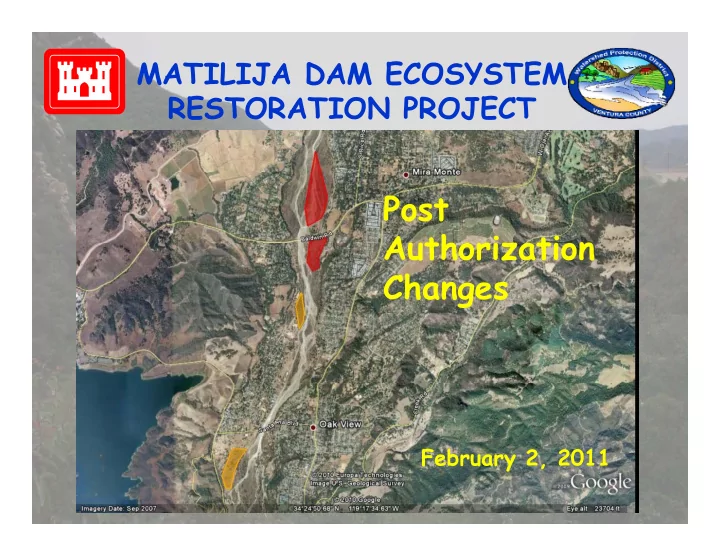
Post Auth riz ti n Authorization Changes F b February 2, 2011 2 - - PowerPoint PPT Presentation

post auth riz ti n authorization changes
SMART_READER_LITE
LIVE PREVIEW

Post Auth riz ti n Authorization Changes F b February 2, 2011 2 - - PowerPoint PPT Presentation

MATILIJA DAM ECOSYSTEM RESTORATION PROJECT RESTORATION PROJECT Post Auth riz ti n Authorization Changes F b February 2, 2011 2 2011 Common Decision Documents for P Post-Authorization Changes h i i Ch Minor Updates from


slide-1
SLIDE 1

MATILIJA DAM ECOSYSTEM RESTORATION PROJECT RESTORATION PROJECT

Post Auth riz ti n Authorization Changes

F b 2 2011 February 2, 2011

slide-2
SLIDE 2

Common Decision Documents for P h i i Ch Post-Authorization Changes

Mi U d t f F ibilit R t

  • Minor Updates from Feasibility Report
  • Economic updates, typically approved by the Corps,

District Commander

  • Limited Changes from Feasibility Report
  • Within the South Pacific Division (SPD) Commander’s

uth rit authority

  • Project Exceeds Maximum Cost Limit
  • Requires Congressional reauthorization

Requires Congressional reauthorization

  • Significant Changes from Feasibility Report
  • Post Authorization Decision Document (PADD)
  • Requires SPD or HQ/ASA/Congressional approval
slide-3
SLIDE 3

Authority for Changes h d to an authorized project

The discretionary authority to make post-authorization y y p changes without seeking further Congressional authority is restricted to circumstances where the scope, area to be served purpose function or plan of improvement of the served, purpose, function or plan of improvement of the project is not materially altered (within a specified range/scope). Changes in authorized projects may be made without Congressional permission if the changes are required either by engineering necessity or are needed to either by engineering necessity or are needed to accommodate changed economic and/or physical conditions. The approval authority depends on the type and The approval authority depends on the type and magnitude (scope/metrics) of a change….. magnitude (scope/metrics) of a change…..

slide-4
SLIDE 4

Approval Authority for Changes

The approval

Reauthorization by Congress

The approval authority is at

  • ne of five

Secretary of the Army

  • ne of five

levels:

Chief of Engineers Division Commander Division Commander District Commander

slide-5
SLIDE 5

Approval Authority of h d the District Commander

Some limited changes may be approved

D m nt ti n f D si n R fin m nts

Some limited changes may be approved by the District Commander:

  • Documentation of Design Refinements.
  • Minor cost updates and scope changes

associated with design associated with design refinements….i.e., less than 20%.

  • Insignificant changes in environmental

i t (t i ll S l t l EA)

Reauthorization by Congress

impacts (typically Supplemental EA).

Secretary of the Army Chief of Engineers Division Commander District Commander

slide-6
SLIDE 6

Approval Authority of th Di i i C d the Division Commander

Typical Criteria:

  • Within the Chief of Engineer’s delegated

th it

Typical Criteria:

authority:

  • Does not require action by Assistant

Secretary of the Army for Civil Works y y (ASA (CW)) or authorization by Congress

  • Required Documentation

Generally a Limited Reevaluation Report

Reauthorization by Congress

  • Generally, a Limited Reevaluation Report

(LRR)

  • NEPA Document is required (Likely EA)

Secretary of the Army Chief of Engineers Division Commander District Commander

slide-7
SLIDE 7

Approval Authority by d Corps Headquarters

T i l C it i

Within the Chief of Engineer’s h

Typical Criteria:

g authority Requires coordination with, but no authorization by ASA(CW) u z y ( W) Does not require authorization by Congress Required Documentation

Reauthorization by Congress

Required Documentation

  • General Reevaluation Report

(GRR)

Secretary of the Army Chief of Engineers

  • NEPA Document (SEIS)

Division Commander District Commander

slide-8
SLIDE 8

Approval Authority by h ( ) the ASA(CW)

Change does not require authorization

Typical Criteria:

Change does not require authorization by Congress. Congressional discretion: delegated g g authority to the ASA(CW) ASA(CW) does not delegate the authority to the USACE

Reauthorization by Congress

authority to the USACE NEPA Document is required

Secretary of the Army Chief of Engineers Division Commander District Commander

slide-9
SLIDE 9

Changes Requiring h b Authorization by Congress

T i l C it i

Addition or deletion of a project purpose.

Typical Criteria:

p j p p Change in local cooperation requirements specifically referenced in authorizing language. Cost increase greater than 20% (Section 902 Limit). g ( ) Significant change in project scope. Required Documentation General Reevaluation Report (GRR)

Reauthorization by Congress

  • General Reevaluation Report (GRR)
  • NEPA Document (SEIS)

Other?......

Secretary of the Army Chief of Engineers Division Commander District Commander

slide-10
SLIDE 10

Fines Disposal Options

Design Phase Decision Tree for Disposal of

Reauthor ization by Congres s Secretary of the Army Chief of Engineers

Sequester Fines

Fines

Division Commander District Commander

Prior Objective: Retain Approval Authority

Sequester Fines

pp y within the 1st Tier

BRDA O ti MODA Options: Upstream (USA) Other? Options:

  • BRDA 1-4 (136 Ac)
  • BRDA 1-2 only (89 Ac)
  • Feas (94 Ac)
  • East/West Split (72

Ac)

  • MODA East (46 Ac)

Options:

  • 2 sites (USA 1&2)

BRDA 1-4 Issues:

  • Cost Increase of approx

BRDA 1-2 Issues

  • Cost Increase of

Issues:

  • Property

Issues:

  • Approx 37 Ac of addt’l impacts
  • utside of Feas stockpile footprint

(225 Ac Feas vs 262 Ac USA & Stockpiles) Cost Increase of approx $34+ Million over Feas Cost Increase of approx $20+ Million over Feas p y Owner/Community Concerns

  • Cost Increase of approx

$14+ Million over Feas

  • Concerns regarding concept

design: little/no erosion potential

  • Cost Increase of approx

$15+Million over Feas

slide-11
SLIDE 11

Fines Disposal Options

Design Phase Fines Disposal: Cost &

Sequester Fines Natural Transport of

Schedule Impacts

BRDA Other Sites Upstream

  • f BRDA

Transport of Fines Upstream of Downstream of H 150 Sites 1-4:

  • Supplemental EA

Sites 1-2:

  • Supplemental

EA

  • At minimum,

Supplemental EA / Robles

  • Likely requires EIS

due to change in water Hwy 150

  • Likely requires EIS
  • PADD required
  • Requires 902

Congressional Reauthorization due to cost increase

  • Concurrent action

with ongoing design: 2- EA

  • Requires 902

Reauthorization

  • 2-3 month

impact for 902

  • Costs approx

Supplemental EA / Possible EIS

  • Possible PADD

Required

  • Assume no

significant change in due to change in water supply impacts

  • PADD required
  • If significant change in

timeframe for project ecorest benefits,

  • If significant change in

timeframe for project ecorest benefits, Congressional Reauthorization likely

  • 7-10 year impact due

g g g 3 months impact likely for 902 approval

  • Costs approx $150k

Costs approx $150k g g scope or timeframe for ecorest (HEP) benefits

  • 6-18 month impact
  • Costs approx

$400k $1 2M Congressional Reauthorization likely

  • 7-10 year impact due

to PADD (new Feas study) & Congress Reauth 7 10 year impact due to PADD (new Feas study) & Congress Reauth

  • Costs approx $5-7M

$400k-$1.2M

  • Costs approx $5-7M
slide-12
SLIDE 12

First Milestone Second Chief of Engineers Report

Decision Document (PADD) Tasks

Initiate PADD Milestone Review of Tentatively Recommend ed Plan

  • Hold Public

Second Milestone Review/ Public Draft

  • Detailed

Analysis of

Public Meeting p

  • Complete IEPR
  • Respond to

comments

  • Finalize Report

Documentation C l t Di t i t

Initiate PADD Study

  • Prepare PMP
  • Review &

Approval

  • Negotiate &

Hold Public Workshop

  • Analyze Alts,

Env Impacts, Costs, Real Estate Requirements Analysis of Recommende d Plan

  • Prepare

Public Draft Report (EIS/EIR)

Meeting

  • Respond to

Review Comments/ Finalize

  • Complete District

Report

  • Transmit to MSC

& Corps HQ

  • Prepare for 30-

day Washington-

Reinitiate Design

  • Administration

Review g Sign Design Agreement Mod

  • 75%/25%

Cost Share Splie Requirements (includes model cert)

  • Select

Tentative Plan

  • Prepare

Interim Draft (EIS/EIR)

  • Initiate

Independent External Peer Review (IEPR)

  • Agency

Finalize Public Draft Report

  • Complete

additional ATR & Policy Review Level State & Agency Review

  • Testify at Civil

Works Review Board

  • Initiate

Review

  • Record of

Decision

  • WRDA

Authorization p

  • Approx 6 mo-

1 yr Interim Draft Report

  • Agency

Technical Review

  • Policy Review
  • Agency

Technical Review

  • Policy

Review A 1 5 2

  • Initiate 45-day

Public Review

  • Approx 6-9

mo Washington Level Review

  • Prepare Chief Of

Engineer’s Report

  • Unknown

Timeframe

  • Approx 1.5-2

yrs

  • Approx 1.5-2

yrs

  • Approx 1 yr
slide-13
SLIDE 13

References

  • ER 200-2-2: Procedures for Implementing NEPA, March

1988

  • ER 1105-2-100: Planning Guidance Notebook, Appendix G

(PAC reports) & Appendix H (Review & Approval of Decision Documents) November 2007 Documents), November 2007

  • ER 1165-2-502: Delegation of Review and Approval

Authority for Post-Authorization Decision Documents, March 2007

  • ER 1110-2-1150: Engineering and Design for Civil Works

Projects, August 1999 Projects, August 1999

  • CESPD-ET-P Memorandum: Guidance for Post-Authorization

Decision Documents, April 1999 ER 1130 2 530 Fl d C t l O ti d M i t

  • ER 1130-2-530: Flood Control Operations and Maintenance

Policies , November 1996

slide-14
SLIDE 14

Upstream Storage of Fines p g

slide-15
SLIDE 15

Slurry Disposal Sites

MODA East MODA West BRDA 1 BRDA 2 BRDA 3 BRDA 4