Pomegranate peel and orange juice by-product as new biosorbents of - - PowerPoint PPT Presentation

pomegranate peel and orange juice by product as new
SMART_READER_LITE
LIVE PREVIEW

Pomegranate peel and orange juice by-product as new biosorbents of - - PowerPoint PPT Presentation

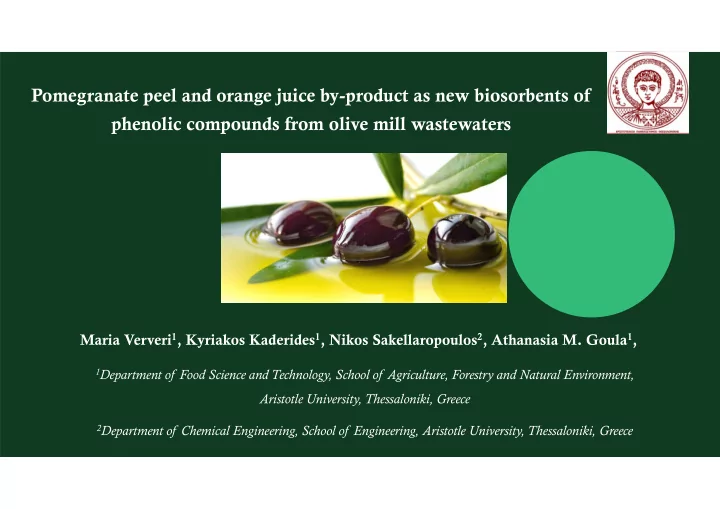
Pomegranate peel and orange juice by-product as new biosorbents of phenolic compounds from olive mill wastewaters Maria Ververi 1 , Kyriakos Kaderides 1 , Nikos Sakellaropoulos 2 , Athanasia M. Goula 1 , 1 Department of Food Science and


slide-1
SLIDE 1

1Department of Food Science and Technology, School of Agriculture, Forestry and Natural Environment,

Aristotle University, Thessaloniki, Greece

2Department of Chemical Engineering, School of Engineering, Aristotle University, Thessaloniki, Greece

Pomegranate peel and orange juice by-product as new biosorbents of phenolic compounds from olive mill wastewaters

Maria Ververi1, Kyriakos Kaderides1, Nikos Sakellaropoulos2, Athanasia M. Goula1,

slide-2
SLIDE 2

Olive oil production

 The extraction of olive oil consists of three steps:

  • 1. Olive crashing, where the fruit is broken down and the oil is exported
  • 2. Mixing, where the remaining paste is slowly mixed to increase the oil

extraction

  • 3. Oil separation from the remaining wastes

i.

Traditional pressing

ii.

3- phases centrifugal extraction system

iii.

2- phases centrifugal extraction system

(Klen & Vodopivec, 2012)

slide-3
SLIDE 3

 Traditional pressing  Obsolete technology  A solid fraction, “olive husk”, is obtained as a by- product with an emulsion containing the olive oil  The olive oil is separated from the remaining olive mill wastewater by decanting  Predominant process in modern olive mills  Two streams of waste i. a wet solid cake (~30% of raw material weight) called “orujo” or “olive cake” ii. a watery liquid (50% of raw material weight) called “alpechin” or “olive mill wastewater (OMW)  ‘‘Ecological’’ method, reduces the olive mill waste by 75%  Two fractions i. A solid called “alperujo” or “olive wet husk” or “wet pomace” or “two-phase olive mill waste” (TPOMW) ii. A liquid (olive oil) (Tsagaraki et al., 2007)

slide-4
SLIDE 4

Production system Inputs Outputs Traditional pressing Olives (1000 kg) Washing water (100-120 kg) Oil (200 kg) Solid waste (400 kg) Wastewater (600 kg) Two-phase system Olives (1000 kg) Washing water (100-120 kg) Oil (200 kg) Solid waste (800-950 kg) Three-phase system Olives (1000 kg) Washing water (100-120 kg) Mixing water (500-1000 kg) Oil (200 kg) Solid waste (500-600 kg) Wastewater (1000-1200 kg)

Olive oil extraction by- products

(Goula et al., 2016)

Three- and two-phase centrifugation systems

(Alburquerque et al., 2004)

slide-5
SLIDE 5

The management of waste from olive mills

 Olive cake

i.

Solid fuels

ii.

Animal feed supplement

  • iii. Return to the olive grove as mulch

 Olive mill wastewater (OMW)

i.

Disposal of OMW in nearby aquatic receivers

ii.

Physical and physicochemical processes

  • iii. Biological processes

iv.

Coupled physicochemical and biological treatments (Tsagaraki et al., 2007; Goula et al., 2016)

slide-6
SLIDE 6

Component Olive mill by-product Reference

OMW Olive cake TPOMW

Total carbon (%) 2.0-3.3 29.0-42.9 25.4 Vlyssides et al., 1998; Garcia-Castello et al., 2010 Total nitrogen (%) 0.63 0.2-0.3 0.25-1.85 Saviozzi et al., 2001; Di Giovacchino et al., 2006; Dermeche et al., 2013 Ash (%) 1.0 1.7-4.0 1.4-4.0 Vlyssides et al., 1998; Di Giovacchino et al., 2006; Lafka et al., 2011 Lipids (%) 0.03-4.25 3.5`0-8.72 3.76-18.00 Vlyssides et al., 1998; Paredes et al., 1999; Di Giovacchino et al., 2006; Dermeche et al., 2013 Total sugars (%) 1.50-12.22 0.99-1.38 0.83-19.30 Vlyssides et al., 1998; Caputo et al., 2003; Vlyssides et al., 2004 Total proteins (%) 3.43-7.26 2.87-7.20 Vlyssides et al., 1998; Alburquerque et al., 2004 Total phenols (%) 0.63-5.45 0.200-1.146 0.40-2.43 Vlyssides et al., 1998; Caputo et al., 2003; Dermeche et al., 2013 Cellulose (%) 17.37-24.14 14.54 Vlyssides et al., 1998 Hemicellulose (%) 7.92-11.00 6.63 Vlyssides et al., 1998 Lignin (%) 0.21-14.18 8.54 Vlyssides et al., 1998

Composition of olive mill wastewaters and solid residues
slide-7
SLIDE 7

Phenolics of OMW

Phenolic compound Content (mg/L) Reference Tyrosol 5-100 Navrozidis, 2008 Hydroxytyrosol 35-130 Caffeic acid 4-12 Elenileic acid 17-1430 Luteolin 2-623 Cinnamic acid 1-118

slide-8
SLIDE 8

Characterization of OMW

 OMWW  Aqueous, dark, foul smelling, turbid

liquid, includes emulsified grease, easily fermentable

 High organic content(57.2-62.1%)  Acidic character (pH 2.2 -5.9)  High concentrations of phenolic

compounds (up to 80 g/L)

 High content of solid matter (total

solids up to 20 g/L)

  • high phytotoxicity with strong negative impact
  • n soil quality and plant growth, due to phenolic

compounds, low pH and toxic fatty acids

  • strong discoloration and pollution of natural

waters, resulting in surface and ground water pollution

  • threatening the aquatic life
  • problems with offensive odors
slide-9
SLIDE 9

Recovery of functional components from OMW

Phenolic compounds

as food additives and/or nutraceuticals

(de Leonardis et al., 2007; Rosello-Soto et al., 2015)

 Membrane separation  Extraction  Chromatographic separation  Adsorption

slide-10
SLIDE 10

Adsorption

 Adsorption method is generally considered to be the best, effective, low-cost and most

frequently used method for the removal of phenolic compounds

 The profitability of an industrial process for the adsorptive purification and concentration of

phenolic compounds from OMW depends mainly on the adsorption efficiency and on the recovery rates during desorption

Transfer of a solute from either a gas

  • r liquid/solution to a solid.

The solute is held to the surface of the solid as a result of due to intermolecular attraction with the solid molecules.

slide-11
SLIDE 11

Stages of adsorption

Stage 1: Diffusion on the surface of sorbent Stage 2: Transfer in the pores of sorbent

Stage 3: Creation monolayer of adsorbate substance

slide-12
SLIDE 12

Mechanisms

 Exchange adsorption (ion exchange): electrostatic due to charged sites on the surface  Physical adsorption: Van der Waals attraction between adsorbate and adsorbent  Chemical adsorption: Some degree of chemical bonding between adsorbate and

adsorbent characterized by strong attractiveness. Adsorbed molecules are not free to move

  • n the surface.

Physical adsorption Chemical adsorption

slide-13
SLIDE 13

Commercial adsorbents

slide-14
SLIDE 14

Adsorbent Yield (%) Reference

Resin XAD-4 3.5- 97.5 (Kaleh et al., 2016) XAD-16 4.5- 99.0 XAD-761 2.1- 87.2 Xad-7hp 3.1- 98.0 FPX-66 4.5- 98.0 PVPP 0.9-100 AF5 31.7-91.4 AF6 90- 100 AF7 92.4- 100 GAC 71- 100 PAC 93.5- 100 Val d’ Orsia soil 27- 67 (Santi, 2007) Zeolite 37- 45 Bentonite 29-45 Banana peel 34 -66 (Achaka et al.,2009) Wheat bran 12-63 (Achak et al., 2014)

Adsorbent Recovery Yield (%) Reference

Pine wood char Pb, Cd, Ar from water 3-54 (Dinesh Mohan et al., 2007) 26-98 Oak bark char Banana peel Cd from water 77.0- 89.2 (Jamil, 2010) Pb from water 76.0 -58.3 Cr from leather tanning 99.1- 100 (Jamil et al., 2008) Coir pith carbon Congo red 30.5-66.5 (Namasivayam et al., 2002) Banana pith Direct red from water 55-80 (Namasivayam, 1998) Acid brilliant blue from water 65-95 Apple pomace Textile dye effluent 91-100 (Robinson et al., 2001)

Commercial adsorbents used for recovery of phenolics from OMW Biosorbents used for recovery of various components

slide-15
SLIDE 15

Objective

 Investigation of the efficiency of two food wastes: 

pomegranate peel

  • range juice by-product

as biosorbents for removal of phenolic compounds from OMW

 Optimization of adsorption process using biosorbents  Development of a new, low cost method for removal of phenolic compounds

from OMW

slide-16
SLIDE 16

Materials and Methods

slide-17
SLIDE 17

Integrated process for adsorption of phenolics from OMW with biosorbents

OMW

Filtration Adsorption in rotary shaker Adjustment of initial phenolic concentration and pH Ultrasound-assisted extraction

  • f phenolics from OMW

(35oC, amplitude 40%, 10 min)

Filtration Evaporation Washing of biosorbents Drying of biosorbents

(40oC, 4 h)

Desorption in rotary shaker

(90 min)

Evaporation Determination

  • f total desorbed

phenolics Determination of phenolics in OMW

(Follin-Ciocalteau method)

Biosorbent

Sampling in different times (10, 20, 30, 45, 60 min)

slide-18
SLIDE 18

Preparation of biosorbents

Pomegranate peel

Pomegranate peel Washing Drying 40oC, 48 h Grinding Ultrasound- assisted extraction Sizing Drying 40oC, 5 h

Orange waste

Orange Juice production Washing Drying 40oC, 48 h Orange wastes Grinding Sizing Orange wastes powder Pomegranate peel powder

slide-19
SLIDE 19

Component Content (%) Total solids 96.00 Moisture 4.00 Total sugars 31.38 Protein 8.72 Crude Fiber 21.06 Fat 9.40 Ash 5.00 Total phenolics 8.10

Composition of biosorbents

Component Content (g/100 g DM) Moisture 8.52 Protein 13.25 Lipid 2.12 Ash 4.25 Carbohydrate 80.38 Total dietary fiber 65.7 Insoluble dietary fiber 48.9 Soluble dietary fiber 16.8

slide-20
SLIDE 20

Factors Affecting the Adsorption Process

  • Adsorption temperature
  • pH
  • OMW/sorbent ratio
  • Initial concentration of phenolics in OMW
  • Particle size of biosorbent
slide-21
SLIDE 21

Experimental Design for Optimization of Adsorption

T (oC) pH Sorbent/OMW ratio (r) (g/mL) Initial phenolic concentration in OMW (Co) (mg/L) Sorbent particle size (d)

(mm)

Biosorbent type

20 4.00 0.010 50.0 0.149 Pomegranate peel 30 4.75 0.015 162.5 0.373 40 5.50 0.020 275.0 0.515 Orange juice wastes 50 6.25 0.025 387.5 0.847 60 7.00 0.020 500.0 1.180

Yield

  • 100

C: concentration of phenolics in OMW after adsorption Co: initial concentration of phenolics in OMW Levels of variables Lower C Lower Yield value Higher Adsorption Capacity

slide-22
SLIDE 22

Desorption

Water (pH 7) 50% acetic acid (pH 1.2) Alkaline water (pH 12)

1 2 3

C1: concentration of phenolics in OMW before adsorption C2: concentration of phenolics in OMW after adsorption C3: concentration of phenolics in solvent after desorption

Yield desorption=

slide-23
SLIDE 23

Results

slide-24
SLIDE 24

Pomegranate peel - biosorbent

Max adsorption capacity:  T : 20OC  pH : 4.75  r : 0.01 g/mL  CO : 50 mg/L  d : 0.149 mm Lower C Lower Yield value Higher Adsorption Capacity Yield

  • 100
slide-25
SLIDE 25

Pomegranate peel as biosorbent – Optimization

Statistically significant parameters p-value pH 0.034 T2 0.003 pH2 0.036 r2 0.049 Co 0.000 d2 0.033 T*r 0.047

% Y=-261.7812 The phenolics concentration reduced by 2.6 times Yield

  • 100
slide-26
SLIDE 26

Orange juice waste - biosorbent

Max adsorption capacity:  T : 30OC  pH : 7  r : 0.01 g/mL  CO :162.5 mg/L  d : 0.149 mm  t: : 20min Lower C Lower Yield value Higher Adsorption Capacity

slide-27
SLIDE 27

Orange juice wastes as biosorbent - Optimization

t 60 min T 20oC pH 4.00 r 0.03 g/mL Co 500 mg/L d 1.18 mm Statistically significant parameters p-value T 0.012 d 0.014 pH2 0.041 r2 0.001 d2 0.000 T*pH 0.000 T*r 0.043 T*d 0.020 r*d 0.012

slide-28
SLIDE 28

Max adsorption capacity: T : 20oC pH : 4.75 r : 0.01 g/mL Co : 50mg/L d: 0.149 mm

Effects of Various Parameters

Lower phenolics concentration in OMW after adsorption (C) Lower Yield (Y, %) value Higher adsorption capacity

slide-29
SLIDE 29

Adsorption - Optimization

Biosorbent (bsb) 1: pomegranate peel 2: orange juice wastes Y=-259.4129

The phenolics concentration reduced by 2.6 times Yield

  • 100
slide-30
SLIDE 30

Desorption

 Pomegranate peel powder - biosorbent

50% acetic acid Desorption efficiency: 59.34% Water Desorption Efficiency: 13.04% Alkaline water Desorption Efficiency: 67.31%

Orange juice waste powder - biosorbent

Water Desorption Efficiency: 2.17% 50% acetic acid Desorption Efficiency: 5.33% Alkaline water Desorption Efficiency: 1.33% Adsorption mechanism: ion exchange Adsorption mechanism: chemisorption

slide-31
SLIDE 31

Conclusions

Banana peel and orange juice waste have proven to be promising materials for the removal

  • f contaminants from olive mill wastewaters

The adsorption process was very fast, and it reached equilibrium in < 60 min of contact The optimum adsorption conditions were:

  • T: 20oC
  • pH: 4
  • r: 0.01 g/mL
  • Co: 50 mg/L
  • d: 0.149 mm
  • t: 5 min
  • Pomegranate peel powder as biosorbent

 All the examined factors had a statistical significant effect on the adsorption capacity  Desorption experiments showed an ion change adsorption for pomegranate peel and a

chemisorption mechanism for orange waste

 Kinetic and equilibrium studies should be accomplished

reduction of phenolics concentration = 260%

slide-32
SLIDE 32

Thank you for your attention!

Team of food engineering…