Point to a window pane. Is it made from plastic, metal or glass? - - PowerPoint PPT Presentation

point to a window pane
SMART_READER_LITE
LIVE PREVIEW

Point to a window pane. Is it made from plastic, metal or glass? - - PowerPoint PPT Presentation

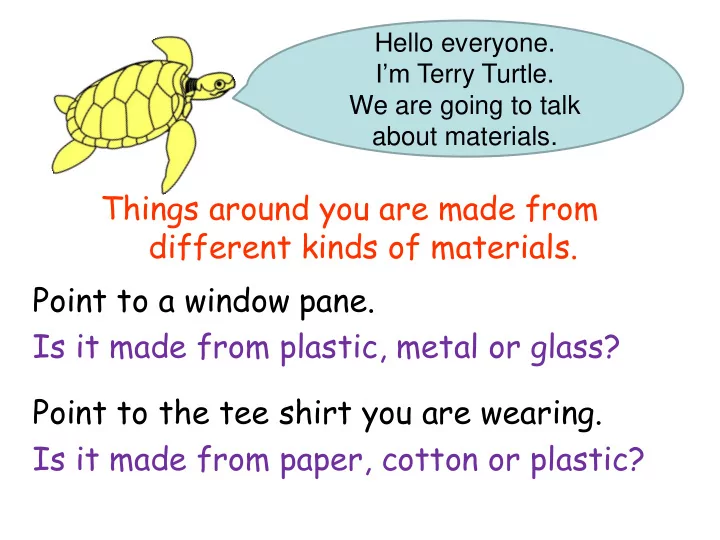
Hello everyone. Im Terry Turtle. We are going to talk about materials. Things around you are made from different kinds of materials. Point to a window pane. Is it made from plastic, metal or glass? Point to the tee shirt you are wearing.


slide-1
SLIDE 1

Things around you are made from different kinds of materials. Point to a window pane. Is it made from plastic, metal or glass? Point to the tee shirt you are wearing. Is it made from paper, cotton or plastic?

Hello everyone. I’m Terry Turtle. We are going to talk about materials.

slide-2
SLIDE 2

Look around you for these things. a wall a chair your shoes the floor Which materials are they made from?

Now let’s think of other materials.

slide-3
SLIDE 3

Natural materials, such as clay and stone, can be found in the ground, or growing out of the ground, such as wood or cotton. Can you think of any others?

There are natural materials and man-made materials.

slide-4
SLIDE 4

Clay

Clay can be dug out of the ground and is used for making cups, pots, vases etc. Why is clay a good material to make these things from? Have a think.

slide-5
SLIDE 5

Clay

When it is glazed, clay will hold hot and cold liquids and it is rigid so it will keep its shape. Imagine pouring some milk into a cotton ‘cup’!

Whoops! That’s made a mess!!

slide-6
SLIDE 6

Wood

Wood comes from trees that grow naturally out of the ground. It is used to make furniture, floors, shelves, rounders bats, wooden toys etc. Why is wood a good material for a bat? Have a think.

slide-7
SLIDE 7

Wood

Wood is rigid and strong but won’t break easily when it is hit by a ball. Imagine using a rounders or cricket bat made

  • ut of clay.

That didn’t work! It broke straight away!

slide-8
SLIDE 8

Cotton

Cotton grows. It is part of a plant. The cotton fibres surround the seed and these can be made into thread for weaving. Cotton can then be used for clothes, duvet covers, curtains etc. Why is cotton a good material for your tee shirt? Have a think.

slide-9
SLIDE 9

Cotton

Cotton is flexible and light and will keep you warm. Imagine wearing a wooden tee shirt.

Urrgghh! That’s uncomfortable and I can’t move!

slide-10
SLIDE 10

Man-made materials

So..... natural materials can be found in the ground or growing. Man-made materials cannot be just found; they have to be made, even though natural materials are often used to make them. Glass and plastic are examples of man- made materials.

slide-11
SLIDE 11

Glass

Glass is a man-made material because you can’t really find glass naturally in the ground and it doesn’t grow. Look at the windows. Why is glass such a good material for windows? Have a think.

slide-12
SLIDE 12

Glass

Glass is transparent so it lets you look

  • utside and lets light in so you can see

what you are doing. It’s also rigid and strong and keeps wind and rain out.

I wouldn’t like to live in a house with no windows!

slide-13
SLIDE 13

Plastic

Plastic is a man-made material. Have a look around you. Can you see anything made of plastic? You probably have some plastic toys at home. You probably drink water from a plastic bottle or eat yogurt from a plastic tub.

slide-14
SLIDE 14

Plastic

Plastic is a great material.

Why is it such a good material for a yogurt pot?

Have a think.

slide-15
SLIDE 15

Plastic

Plastic is light, strong, waterproof and it can be flexible or rigid. It can also be made into many different shapes and colours.

A glass water bottle is heavy to carry and easily broken.

slide-16
SLIDE 16

Plastic

So plastic is a great material……

but there is a problem.

We use too much of it, then throw it away.

Some of it ends up littering our streets and the countryside and a lot ends up in the sea.

slide-17
SLIDE 17

So what?

slide-18
SLIDE 18

Plastic

Why do you think that might be a problem?

slide-19
SLIDE 19

Is this really how we want our streets and beautiful beaches to look? A million plastic bottles are bought worldwide, every minute.

slide-20
SLIDE 20

Here are some of my

  • cean friends, the

dolphins. Hello boys and girls.

slide-21
SLIDE 21

Plastic waste

A lot of plastic waste ends up in the sea. Sea creatures can get tangled up in it and die. Some think it’s food. If they eat it, they could die too.

slide-22
SLIDE 22

Plastic waste

Plastic in the sea and in the oceans is a

HUGE

problem.

We need our seas and oceans to be clean and healthy so that sea creatures and plant life thrive. That benefits our own health and wellbeing too.

slide-23
SLIDE 23

Plastic

So, plastic is useful but we use too much of it. The good news is – YOU can help. Here are 4 challenges for you:

slide-24
SLIDE 24
  • 1. Re-use a bottle for drinking water.
  • 2. Refuse to take a plastic straw for your drinks.
  • 3. Take re-usable bags when you go shopping.

Here’s how you can help.

slide-25
SLIDE 25
  • 4. Do you really need that new plastic toy

that will end up being thrown away in a few months, weeks or even days? Perhaps you can re-use a toy by getting

  • ne from the charity shop which will be

cheaper and a charity will benefit at the same time.

The 4th challenge....

slide-26
SLIDE 26
  • Finding ways to reduce the plastic in your

lunchboxes or school dinners.

  • Making sure any plastic tubs and milk bottles are
  • recycled. Could you use a container that is not

plastic instead?

  • Did you know that you can recycle felt tip pens?

Also, when you are out, take your litter home to throw away or recycle.

As a class, could you find ways of reducing and recycling your plastic in school? Such as.... ,

slide-27
SLIDE 27

reduce, re-use, recycle.

  • 1. Buy less plastic whenever you can.
  • 2. Re-use what you already have.
  • 3. When you can’t do 1 or 2, recycle it.

Recycling plastic means that it can be made into

  • ther plastic items.

Remember the 3 rs…..

slide-28
SLIDE 28

Did you know?.... All these items can be recycled by Wycombe District Council. Put them in your blue bin at home→ But NOT these →

slide-29
SLIDE 29

Recycling

At home this is your blue bin.↴ Do you have a plastic recycling bin in your school? Don’t forget to put your waste paper in the paper recycling bin.

slide-30
SLIDE 30

Thanks very much. Thanks from all of us and, remember, it’s best for YOU too!

Wycombe Friends of the Earth Autumn 2018