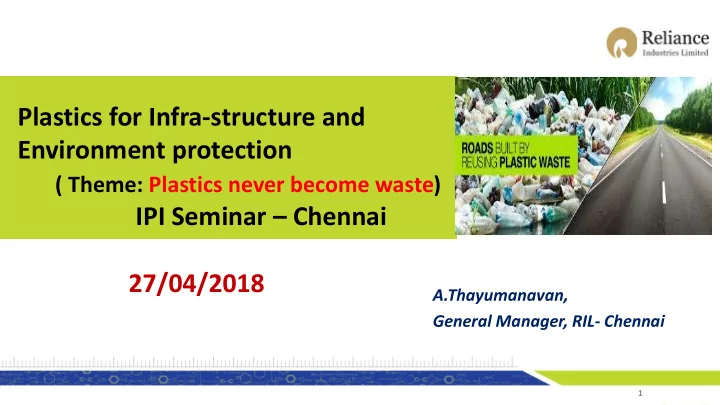
SLIDE 1 Plastics for Infra-structure and Environment protection
( Theme: Plastics never become waste)
IPI Seminar – Chennai 27/04/2018
A.Thayumanavan, General Manager, RIL- Chennai
1
SLIDE 2 Indian plastics industry:
Indian plastics industry made a promising beginning in 1957 with the production of polystyrene. A CAGR of 10% in volume terms from 8.3 MMTPA in FY10 to 13.4 MMTPA in FY15 Projected to grow at a CAGR of 10.5% from FY17 to FY20 to reach 22 MMTPA. Employs about 4 million people and comprises more than 30,000 processing units Major strengths is the local availability of raw materials Thus, plastic processors do not have to depend on imports.
2
SLIDE 3 Development activity in 2017-18
Infra structure development with Polypropylene
- Break through in using Geo - textiles with southern railway
- Drainage composite for Highways/ Railways/RE walls etc.,
- Sands in Raffia bags like cement
Environment protection with Polyethylene
- GEO membrane for River, Coastal, land fills
- Shrimp pond lining (Aqua-Culture)
3
SLIDE 4
GEO SYNTHETICS SECTOR:
SLIDE 5 5
GEO-SYNTHETICS
ENV.PROTECTION INFRASTRUCTURE LANDFILL ENGINEERING COASTAL PROTECTION SLOPE PROTECTION CANAL LINING FLOOD CONTROL ROADS RAILWAYS GROUND IMPROVEMENT
SLIDE 6 Geo Textiles: Southern railway
Breakthrough in Southern Railway for Geo synthetics ( PP Needle punched Nonwoven and PP Geo grid) Tenders were released for the supply of Geo- grid/ Geo – textile for Formation treatment -18 KM Stretch
- Chennai Central-Gudur section
- Villupuram-Tiruchchirappalli chordline
section
6
Huge potential exists for Geo Textiles
SLIDE 7
Geo-synthetics Sector: All India
Approvals/Tenders floated across 6 more new railway zones Introduced the concepts across 11 out of 17 Indian Railway Zones First Rural Road Stretch in the State of Odisha stabilized with Geotextiles @ 5 KM First Tender from the State of Bihar floated for PP Geo-bags for erosion control BIS Standard on Geotextile Bags for Flood & River Bank Protection Works Published
SLIDE 8
BULK PKG SECTOR : Sand filled in Geo bags : Packed sand for B& C
SLIDE 9 Geo ( sand)bags:
It is used with permeable fabrics have the ability to
- Separate,
- Filter
- Reinforce,
- Protect, or
- Drain.
Typically made from polypropylene or polyester, geotextile fabrics come in three basic forms:
- Woven (resembling mail bag sacking),
- Needle punched (resembling felt)
Most common one is polypropylene woven bags
9
SLIDE 10 Sand in Raffia bags:
100 square feet of built-up area requires, 33 bags
- f cement of 50kg each and 117 cubic ft of sand
Estimated sand requirement is 1.4 Billion MT of sand by 2020 in the country , compared to 700 million tonnes in 2015 . ( Cement 270 MMT) Karnataka started importing sand from Malaysia and started distributing in 50 kg PP raffia bags . Plans further to import 14 million MT in 2018-19 Tamilnadu -2 MMT , Kerala-1 MMT and Pondy- 1MMT are also planned to have imported source I- Sand, M-Sand ,P – Sand are the latest classification
10
20 MMT to be packed in 28 KT of PP Raffia bags
SLIDE 11
Development Activity with Polyethylene
SLIDE 14 14
BIO-REACTOR LANDFILL - INTRODUCTION
An innovative technology for bio- stabilisation of MSW A controlled land fill where liquid and gas are managed to enhance the process Controls , monitors and optimises the process rather than simply contain the waste Waste stabilisation process requires aerobic/ anaerobic , Temperature, PH and nutrient level
SLIDE 15 Land-fill Comparison:
15
Conventional land fill To Contain and store the waste Called as Dry Tomb Talk 30-40 years for decomposition Environment risk due to leachate and release of gases Bio reactor land fill To treat the waste for decomposition To have shorted decomposition period as early as 5-6 years Tackle some of the environment problems
SLIDE 16 Geo membrane ( HDPE Sheet) :
For waste management M/s Ramky Infra Hyderabad had used imported 9 meter HD sheet. Last year they did12 crore business in solid waste management covering area
- f 72 lakh sq meter : 50% HDPE sheet,
50% Geo filter fabric Installed India’s largest waste (solid municipal waste) to power energy plant at Narela , generating 26 KW electricity.
Friday, April 27, 2018
16
Looking for domestic suppliers & specified their requirement
SLIDE 17 HDPE GEO-MEMBRANE – SMOOTH 1.5 mm
Parameter UNIT
Specifications
Test method Value 1 Brand name HDPE Smooth Geo membrane 2 Thickness (min individual thickness value) mm ASTM D 5199 1.5 3 Width m 9.4/7.1 4 Density g/cm3 ASTM D1505 ASTM D 792 0.942 5 Tensile Strength at Yield N/mm MPA ASTM D 6693 25 16 6 Elongation at yield % ASTM D6693 12 7 Tensile strength at break N/mm MPA ASTM D 6693 45 >26 8 Elongation at break % ASTM D 6693 700 9 Carbon black content % ASTM D 1603 2 10 Carbon black dispersion Category ASTM D 5596 1-2 11 Cold bending at -200C
passed 12 NCTL-Test* Stress Crack Resistance Hours ASTM D 5397 App >400 13 OIT Min ASTM D 3895 100 14 Puncture Resistance N ASTM D 4833 EN ISO 12236 500 4000
Parameter UNIT
Specifications
Test method Value 1 Brand name HDPE Texture Geo membrane 2 Thickness (min individual thickness value) mm ASTM D 5994 1.5 3 Width m 5.1 4 Asperity height Mm ASTM D 7466 ≥0.9 5 Density g/cm3 ASTM D1505 ASTM D 792 0.942 6 Tensile Strength at Yield KN/m ASTM D 6693 23 7 Elongation at yield % ASTM D6693 12 8 Tensile strength at break KN/m ASTM D 6693 24 9 Elongation at break % ASTM D 6693 300 10 Carbon black content % ASTM D 1603 2-3 11 Carbon black dispersion Category ASTM D 5596 1-2 12 NCTL-Test* Stress Crack Resistance Hours ASTM D 5397 Appendix >400 13 Oxidation Induction Time (OIT) a)Standard OIT min ASTM D 3895 100 14 Puncture Resistance N ASTM D 4833 600
HDPE GEO-MEMBRANE – TEXTURED 1.5 mm
SLIDE 18 Pond lining: Shrimp
Total area under shrimp cultivation is 6 lakhs acre Many shrimp ponds were affected with viral that led to closure of existing ponds As per HC order it became mandatory to adopt modern technique including the use of Pond liners. HDPE sheet requirement is @ 2.5 MT/ acre (500 micron to 1mm thick sheet), New investment is 15 lakhs/ Ha. Advantages of shrimp pond liner : Reduces water seepage & the leaching of potentially stressful compounds into the ponds Helps in reducing the time and costs to clean the ponds between cycles. High intensive cultivation is possible (10 lakhs shrimp seeds/Acre ) PH level can be monitored with liner & corrected to suit the growth Almost 5-6 % shrimp mortality vs 40-50% without liner, Higher yield, Good revenues ( Per kg
- f shrimp is sold as high as Rs 300-340/kg)
18
SLIDE 19
Demolition Blast Wrap
Blast Wrap is used to achieve a satisfactory and safe end result to demolition projects. It is for safely containing the resulting debris and dust from contaminating surrounding areas and minimizing the risk of flying concrete causing damage. Blast wrap is a cost-effective, strong and durable material constructed for optimum strength and puncture resistance. Blast Wrap continues to be in regular use on demolition projects providing blast screen.
SLIDE 20 Plastics – The Environmental angle
20
SLIDE 21 World Environment Day - June 5
World Environment Day (WED) occurs on 5 June every year. India to host the World Environment Day 2018. With “Beat Plastic Pollution” as the theme for this year's edition, the world is coming together to combat single-use plastic pollution. All our efforts are required from all levels to mitigate the major issues by:
- Reusing ,
- Recycling
- Land filling along with municipal waste
- Incineration along with medical waste
- Fuel to Industries including Kiln of cement Industries
- Power generation
Friday, April 27, 2018
21
SLIDE 22 A Look at Plastics: Uses and Benefits
Plastic products improve
daily lives and have made vast improvements in areas such as:
- Transportation - Automotive, Aerospace, Space Exploration
Medicines - helping us all live longer, healthier lives Electronics - information, communication, and entertainment Building and Construction - durability, aesthetics, and high performance Personal protection - children, athletes, police and firefighters Innovative packaging - freshness, storage stability, and protection from
bacteria Recyclability and reuse
Friday, April 27, 2018
22
SLIDE 23
Plastics Recycling
SLIDE 24
Industry response
One of the key counters is the Recycling of Plastics: Industrial waste management Solid waste management Post consumer waste management
SLIDE 25 Plastics Recycling Industries:
25
Number of organised recycling units: 7000 Number of unorganised recycling units: 12000 Major types of plastics recycled: PET, HDPE, PVC, LDPE/LLDPE, PP, PS & others like ABS, PMMA etc. Manpower directly involved in plastics recycling: around 5, 00,000 Manpower indirectly involved in plastics recycling: around 12, 00,000 Quantum of plastics recycled per annum: 6 MMT. Estimation based on following facts : Almost 100% of rigid packaging products is recycled except EPS 90% of PET bottles are recycled Waste generated by plastic industry, industrial plastic waste are 100 % recycled Recycling including plastics from household, furniture etc Plastic products going into municipal solid waste Source: ICPE
SLIDE 26
Reproduction of recycled Plastics:
Virgin products Recycled items Milk Pouches Carry bags Packaging Film, Carry bags Water proof Sheets Foot wear, Bottles Foot wear Bucket, Crates, Luggage Bucket, Luggage PP Film , Thermo ware, Tooth brush, Pens Combs, Pen , Toys Cement bags Thin ropes Battery boxes, Industrial products, Thermo ware Luggage, Cups, TV cabinets, cassettes Cassettes cover , Novelty items
SLIDE 27 Numbering system for plastic recycling
Recycling No. Abbreviation Polymer Name
PETE or PET
Polyethylene Terephthalate
HDPE
High-Density Polyethylene
PVC or V
Polyvinyl Chloride
LDPE
Low-Density Polyethylene
PP
Polypropylene
PS
Polystyrene
OTHER
Other plastics, including acrylic, polycarbonate, polylactic acid , nylon and fiberglass.
Globally even after introduction of recycling Symbol only 14% of plastics is recycled and then balance is either :
- Buried
- Burned or
- Dumped into natural Environment
SLIDE 28
Five 2-liter recycled PET bottles provide enough fiberfill for a ski jacket.
Recycling plastic saves twice as much energy as burning it in an incinerator.
SLIDE 29 PET Recycling in India
29
India recycles 90% of its PET waste
SLIDE 30 30
Wonderful use for thin plastic road-waste
Discarded thin-plastic carry-bags are a menace
In town they clog drains, cause flooding, choke animals that eat them and are unsightly
Strewn across fields, they block germination and prevent rainwater absorption by soil Recycling plastic by melting releases fumes, and is only possible to use 3-4 times Toxic contents might leach into recycled water-pots or water-pipes But it can be used for road construction
SLIDE 31 31
Advantages: waste plastic in asphalt road
Reduce need of Bitumen by around 10% For 1 Km X 3.75 m road , one ton of plastic ( 10 lakhs carry bags) is used Strength & performance of road increased by 100 % 100% improvement in fatigue life of roads. No effect of radiation like UV Better resistance to water, water stagnation, No potholes and No leaching of plastic
SLIDE 32 32
How Much Plastic? How Many roads?
Each 5-member family’s use of 5 gm plastic bags a week, all-India = 52,000 tons a year Assume 50% of this is available for roads 1.5 tons plastic goes into avg 1 km road. So resurfacing just 39,000 km of roads a year will absorb all this littered waste. This is just 3.5 % of India’s 1 million km surfaced roads. (1.1 million km more roads are unsurfaced).
SLIDE 33 33
Will is the Missing Factor!!!!!!!!
Plastic bags disposal need never be a problem: A street price of Rs 5 per kg will reduce litter. State and Central PWDs and National Highway Authority must incorporate waste-plastic modified bitumen into all road specifications.
SLIDE 34 Refuse Derived Fuel (RDF)
Solid waste can be utilized to produce electricity by converting it to a fuel that can be used to power furnaces and generators.. To produce refuse derived fuel, MSW is first processed to remove hazardous and non- processible materials.
- Recyclables are collected with large magnets and separators.
- The remaining material is shredded and dehydrated to a
maximum of 15% moisture content so it will process well.
- The resulting refuse-derived fuel can be processed to produce
steam, powering a turbine and producing electricity.
Friday, April 27, 2018
34
SLIDE 35 Incineration of Medical disposables
Incineration or controlled burning
is another option for disposing of large percent of solid waste & medical disposables
The most common purpose of
burning is to generate electricity.
Energy content of various solid waste materials is much higher Material Energy value : KJ/KG PET 25353 HDPE 43496 RUBBER 29772 NEWSPAPER 18609 WOOD 16979 YARD WASTE 6745 FUEL OIL 48613 COAL 22329
SLIDE 36 Fuel oil from Plastic waste
Friday, April 27, 2018
36
SLIDE 37
Urban Waste Stream Trends in India
Waste Stream Current Generation Projection % diverted/recycled Municipal Solid Waste1 68 million tons/year > 200 million tons by 2040 Less than 10% (of collected waste) C&D waste2 10-15 million tons/year 5x by 2030? 10-30% (often for illegal/harmful uses) E-waste3 1.8 million tons/year 5.2 million tons/year by 2020 2% End-of-Life Vehicles4 8.7 million 21.8 million by 2025 Less than 10%
SLIDE 38
Recent Successes and Encouraging Trends
Waste Stream Success/Positive Trend MSW Solid Waste Management Rules, 2016 Swachh Bharat Mission funding and targets C&D waste C&D Waste Management Rules, 2016 (3 year targets) Delhi and Ahmedabad operating successful plants Buyback of C&D derived products by Delhi/Ahmedabad E- waste E-waste Management Rules, 2016 Extended Producer Responsibility mandate ELVs Guidelines for Environmentally Sound Management of ELVs NATRIP pilot facility, Chennai First commercial facility (JV with Mahindra) in 2018
SLIDE 39 6TH ELEMENT ON EARTH IS PLASTIC
Friday, April 27, 2018
39
Plastic Earth Fire Air Water Sky
SLIDE 40