
SLIDE 1
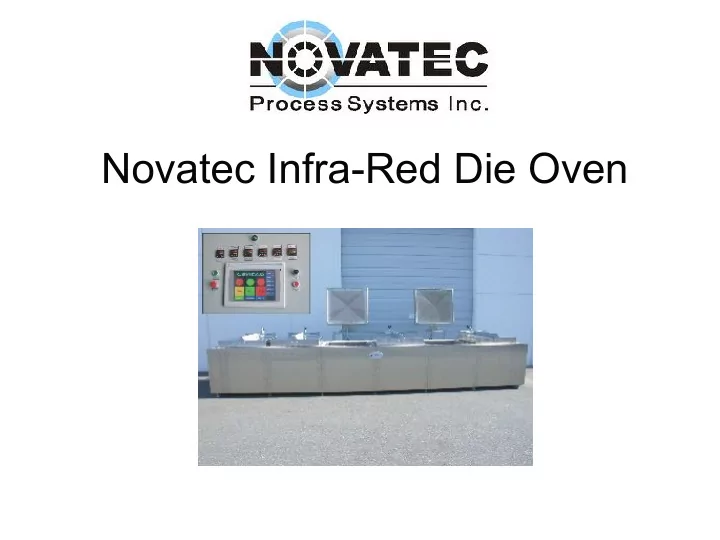
Novatec Infra-Red Die Oven Summary This article shows the - - PowerPoint PPT Presentation
Novatec Infra-Red Die Oven Summary This article shows the superiority of the Infra- Red technology over convection air flow. The comparison is through theory, heating process and efficiency. Short cycle heating and die management is one of
most common design over the years. The tooling is heated by circulating hot air through a common chamber using a blower
throughout or uneven temperature profile on the face will not run
can be produced to correct the differences. Short production runs produce off-tolerance material and high die failure.
another cause of rapid oxidation.
to heat lots of dies in case of extrusion issues. This means that dies are left at elevated temperatures for extended periods of time. The die bearing is exposed to rapid oxidation unnecessarily.
Why convection air heats dies unevenly:
resistance from inlet to outlet in the convection process. The physical blockage of the air stream causes uneven exposure to the die surface.
Heated air escapes every time the lid is opened.
Die Direction of Air
dies further away causing incorrect heat time. It is virtually impossible to avoid this in the die exchange process. Heated dies are then actually cooled without operator knowledge. The biggest cause of unevenly heated dies is when a cold die is placed next to a hot die causing the heated die face to be cooled on one side. This thermal gradient is the cause of die breakage, poor run out and inaccurate non-conformant extrusion dimensions using the first billet.
Most extruders use traditional convection chest ovens for die heating. The air in a common chamber is heated and
transfer energy to the steel through conduction. This procedure is slow and inefficient. Infra-Red energy uses a band of electromagnetic waves to “excite” the metal molecules in a die through radiation. This molecular excitation is similar to the microwave technology. Infra- Red energy does not use air temperature for thermal transfer. Air is an insulator so the thermal process is accelerated.
Infra-Red is a kind of Radiation which transfer heat from object
to another by electromagnetic transmission. The Infra-Red is located between visible light and radio in the electromagnetic
microns.
When the Infra-Red energy reaches the surface to be heated, the molecules vibrate, converting to heat energy. Heat then travels through the product by conduction.
About Novatec
Novatec is based in Surrey, British Columbia .The company has been producing Infra-Red equipment for a variety of applications for the past 20 years. In 1990, an aluminum extruder asked Novatec to explore the possibility of heating extrusion dies with Infra-Red technology, and the Novatec Infra-Red Die Oven was developed. Since that time, a number of extruders have installed the ovens and have reported dramatic improvements in speed, flexibility, and quality.
Past attempts to use Infra-Red waves involved broad band heating. Generating this spectrum was not energy efficient. Novatec has developed the Infra-Red band technology to focus the wave energy to match the absorption in steel. Generating a small band of Infra-Red waves gives a focus energy for absorption. This maximizes energy transfer.
Spectrum Absorption
% Absorption 25 50 75 100 Infra-Red Wave Length (Micron) 1 2 3 4 5 6 7 8 Metal
Novatec Infra-Red Die Ovens heat dies much faster than
convection ovens. As explained above, this is because the dies are being heated by infrared waves, not air. Air itself is an insulator of thermal energy, and therefore, is a poor medium for thermal transfer. Novatec’s Infra-Red Die Ovens single out the wavelength needed to heat die steel only…not heat all the air in the oven.
Metal Sheath Heater Novatec Black Body Infra-Red Heater
Heater Efficiency Comparison
Press (T) Die Size (Dia. X thickness) (mm) Die Temp (℃) Heat Time Infra-Red Convection 2800 430 x 330 475 2Hrs 30mins 4~5Hrs 2800 430 x 190 475 2hrs 00mins 4~5Hrs 3680 520 x 245 475 2Hrs 15mins 5~6Hrs 3680 520 x 340 480 2Hrs 35mins 5~6Hrs
Because of the wavelength heating process explained
above, the efficiency of the die heating process is greatly
but also the power draw to maintain oven temperature once heated is less than 500 watts. (By contrast, a typical hair dryer
alone is a significant benefit when using Novatec’s Infra-Red Die Oven.
Extrusion Die Oven - Electricity Usage Comparison
Convection Air Flow Oven NOVATEC Infra-Red Oven Each Cavity: 10 Dies 24 kW 480V Each Cavity: 2 Dies 22 kW 480V Die Heat Up Cycle: 8Hours X 20.4 kW/hr =163.2 kWh @ 85% Power Draw Die Heat Up Cycle : 1Hour X 18.7k W/hr = 18.7 kWh @ 85% Power Draw Total Cycle: 8 Hours 163.2 kW X $0.07 kWh = $11.42 Total Cycle: 1 Hour 18.7 kW X $0.07 kWh = $1.31 Total Cost to Heat Each Die: $11.42 ÷ 10 = $1.14 Total Cost to Heat Each Die: $1.31 ÷ 2 = $0.65 Die Temperature Holding Cycle: 20.4 kWh÷10 Dies X $0.07/kWh = $0.14 Per Die Per Hour Die Temperature Holding Cycle: 0.5 kWh÷2 Dies X $0.07/kWh = $0.0175 Per Die Per Hour The Infra-Red Oven is 52% more cost effective than a Convection Oven.
Extruders who use the Novatec Infra-Red Die Ovens have
reported a dramatic decrease in die failure and breakage. Not only do convection ovens take longer to heat a die, they heat dies
convection oven, a 14 inch die can have as much as a 100 degree difference between one side of the die to the other. This will cause uneven runout in multi-hole dies, and consequently, uneven stresses on the die. All of this results in premature die failure and breakage and higher scrap rates. Novatec’s Infra-Red technology heats dies to within single digit temperature variation throughout the die, reducing die failure.
This Chart shows the heat up time for a 16"x 6" die at 4 different thermocouple points in the die. Note the evenness of the heating throughout the die. It reached target temperature in 91 minutes.
Temp (deg. F) 225 450 675 900 Time (min.) 1 7 13 19 25 31 37 43 49 55 61 67 73 79 85 91 97 103 109 115 121 127 133
Middle : 3" Dep Oven Set Point Surface Temperature Front : 1" Deep Back : 1" deep
As mentioned above, a 14-inch die would be heated in less
than 60 minutes with a Novatec Infra-Red Die Oven, as opposed to 4 hours in a convection oven. This will provide increased flexibility of die changeovers on the extrusion press, and reduce throughput time.
Because the dies do not have to stay in the oven for 4+
hours, the die bearings are not subject to excessive oxidation prior to extrusion. This provides a higher extrusion finish. Also, airflow systems, such as those used in a convection oven, tend to deposit particles on dies and bearings. Novatec Infra-Red Die Ovens do not require an airflow system, and therefore, keep the dies free of contaminants.
Mechanical Contactor prevents thermal run away
normal condition, i.e. power outage, power spike
Unique PLC System Automation Control
ORION Series Little, Tiny, SCADA ! Interface up to 20 loops of control. Include profiling, single set-point recipes, trending, alarm monitoring\history and graphic
acquisition with historical viewing, and you have ORION.
Real Time and Historical Trends Profile open, edit, save and download!
Temperature
2 Cavity Oven 3 Cavity Oven
Drawer Oven 6 Cavity Oven
Be on the leading edge of extrusion technology! We’re all looking for ways to stay ahead of the competition,
and this is especially true in the extrusion business. Novatec’s Infra-Red technology is truly on the cutting edge for this industry. It can be the key that gives your plant the edge you need over your competitors. Don’t wait until they have one, too! Call today and explore the possibilities of Novatec’s Infra-Red Die Oven for your plant.