Pinot Noir: The Savage Yet Seductive Grape The Beauty and the - - PowerPoint PPT Presentation

pinot noir the savage yet seductive grape the beauty and
SMART_READER_LITE
LIVE PREVIEW

Pinot Noir: The Savage Yet Seductive Grape The Beauty and the - - PowerPoint PPT Presentation

Pinot Noir: The Savage Yet Seductive Grape The Beauty and the Beast Dr. Karl Kaiser CCOVI Professional Affiliate Brock University, St. Catharines, ON Introduction to Pinot Noir The Story of the Origin Quotes taken from Pinot


slide-1
SLIDE 1

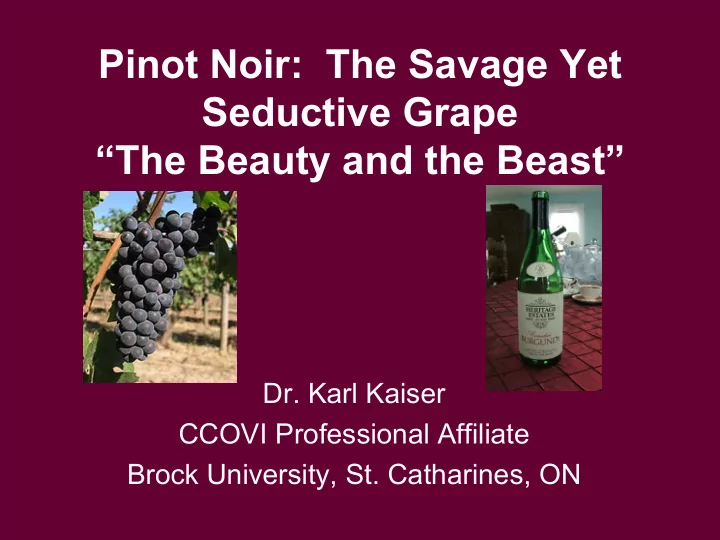
Pinot Noir: The Savage Yet Seductive Grape “The Beauty and the Beast”

  • Dr. Karl Kaiser

CCOVI Professional Affiliate Brock University, St. Catharines, ON

slide-2
SLIDE 2

Introduction to Pinot Noir

The Story of the Origin

Quotes taken from “Pinot Noir” by Andrew Barr, Penguin Group, England 1992 “Pinot Noir is the grape of Burgundy. At its best, and

  • nly then, red burgundy is the finest wine in the world.

If Claret (Bordeaux) appeals to the intellect, Burgundy appeals to the senses. It is the most delicious and sensuous red wine in the world. It is softer, lusher, more exuberant and most exciting.” (Andrew Barr).

  • The grape however is a very unreliable variety
  • Unless the right clone of Pinot is grown on the right trellising
  • r trainings system in exactly the right climate and picked at

precisely the right time, they wines will not be successful

slide-3
SLIDE 3

Background on Pinot

  • Because of these uncertainties, many wine connoisseurs

have stayed away from Burgundy because they believe one would have to spend thousands of dollars to buy a good bottle of burgundy……only one in 20 is worth the money

  • Today, many new world wine regions have adopted this

grape variety, but not so many wines have been successful at the beginning

– California, Oregon, New Zealand, Australia and South Africa (which subsequently developed the Pinotage grape)

  • Ontario has been adopting this grape for a while, but on a

limited scale

– I first worked with Pinot in 1987 from the St. Davids region

slide-4
SLIDE 4

Climatic Requirements

  • Cool Climate Grape

– One of the failures in new world regions was that it was planted in very warm climates

All Fruit plants produce their best and most complex fruit at their cultivatable limits

  • The fruit must attain its physiological maturity
  • In a limited climate

– if the temperature is too hot, the fruit is overripe, gets mushy and tastes like jam – if the temperature is too cold, the fruit tastes sour with little flavour

  • In the case of grapes, cool climate is defined as one in

which wine makers usually have to warm up the grapes to get them fermenting whereas a warm climate allows for instant fermentation

  • Ontario seems to swing back and forth between cool and

warm climate

slide-5
SLIDE 5

Soil

  • Much has been argued about climate versus soil
  • In Burgundy, the subsoil rests on very old limestone rock
  • In Oregon, the soil is young and volcanic, no limestone at all

“What matters in Burgundy is the taste of soil and the growing conditions – the Terroir- of each particular

  • vineyard. Pinot Noir shows terroir more than any other

variety because it has no taste of its own. It is a sort of ghost”. Quote from Aubert de Villaine, the co-owner of the Domaine de la

Romanee-Conti taken from “Pinot Noir” by Andrew Barr, p9.

  • Lalou Bize-Leroy states “Pinot Noir does have a taste”

she says, “but I don’t want it. A wine from Burgundy should express the Terroir and should not taste of Pinot Noir such as in Oregon. We have a term for this, called pinotter”

slide-6
SLIDE 6

Terroir

  • There is more and more agreement that terroir is a

combination of climate, soil, and management such as vine spacing, yields, fertilization, rootstock, clones, and the actual winemaking.

– A great book that summarizes multiple factors creating terroir is called “Terroir, The Role of Geology, Climate and Culture in the Making of French Wines”. James E. Wilson, forwarded by Hugh Johnson, University of California Press, 1999 – Physical elements of the vineyard habitat such as the vine, subsoil, site, drainage, meso and microclimate are all included in Terroir.

  • Robert Parker says think of Terroir as you do of salt,

pepper and garlic

slide-7
SLIDE 7

Clones

  • Because of the genetic instability of Pinot noir, over 1000

clones have been identified

  • Best known clones available are all originating from the

vineyard of Jean-Marie Ponsot in Morey-Saint Denis

– Clones 113, 114, 115, 667, 777 – All are allowed for importation into Canada

  • Historically in Burgundy, vines were selected and

planted from the best performing vines in the vineyard

  • This was called “massal” selection and most vineyards

had a random set of clones

  • This obviously, at least to my conviction, would produce

more complex wines since some would bring acidity,

  • thers more fruit, others more colour and others more

tannin

slide-8
SLIDE 8

Vine Spacing

Spacing in Burgundy vs spacing in Canada Where the wine making starts

  • Important for yield i.e yield per individual vine

necessary to produce economical yields per acre with higher quality

  • Burgundy: 4000 vines/acre or 10,000 vines/ha
  • 1 m2/vine
  • Spacing decision is of ultimate importance in

defining potential yield and quality

  • See table for vine spacing and tonnage
slide-9
SLIDE 9

Vine spacing and crop load

0.5 kg/vine 1.25 kg/vine 2.25 kg/vine Required kg/vine 2000 kg/acre 2000 kg/acre 2000 kg/acre Required kg/acre 5000 kg/ha 5000 kg/ha 5000 kg/ha Required kg/ha 30 hL/ha 30 hL/ha 30 hL/ha Desired hL/ha 10,000 vines/ha 4000 vines/ha 2222 vines/ha Vines/ha 4000 vines/acre 1600 vines/acre 888 vines/acre Vines/acre 1 m2/vine 2.5 m2/vine 4.5 m2/vine Area/vine 1.2m X 0.8m 1.0m X 1.0m 2.5m X 1m 3m X 1.5m Row spacing

Burgundy Spacing New Ontario spacing Old spacing

slide-10
SLIDE 10

Desired Crop Load for Quality Pinot Noir Production

  • The legal limit for a grand Cru in

Coton is 35 hl/ha

  • The Burgundian experience vs our

Ontario experience shows that the maximum yield for any kind of quality in Burgundy is 40-45 hl/ha and in Ontario it is 30 hl/ha at 1,600 vines/acre (4000 vines/ha) which amounts to 1.25 kg/vine

– In our best Pinot Noirs, we had only 15-20 hl/ha which corresponds to 2.5-3 tonnes/ha or 1-1.2 tonnes/acre

slide-11
SLIDE 11

Summary of Important Viticultural Aspects of Growing Pinot noir

  • The number of vines/acre is of utmost

importance in any soil and climate to produce quality Pinot Noir

  • Wide spacing is futile and totally

uneconomical for producing good Pinot Noir

  • Pinot Noir is made in the vineyard
  • Since it ripens unevenly, it is a “lying grape”

because the top of the bunch ripens before the berries in the middle

slide-12
SLIDE 12

Summary of Important Viticultural Aspects of Growing Pinot noir

  • “One should not wait until all the grapes have reached the

same degree of maturity”, wrote Abbe Tainturier in the eighteenth century. “Cooked, roasted and green grapes are all necessary- the green ones bring liveliness to the wine. Experience has taught us that complete maturity produces fat, heavy wines that ooze like oil”

  • “It may well be in fact that Pinot Noir produces the best

flavours before they are fully ripe. They may well produce the best wines if they are picked at 11.5-12% potential alcohol-the level they normally achieve in Burgundy – rather than the 13% in which they are generally picked in warmer climates” from Pinot Noir by Andrew Barr p 19

  • My preference is harvesting grapes at 12.5% potential

alcohol (22 Brix) and then chaptalize if need be

slide-13
SLIDE 13

Pinot Noir Historical Synonyms

Blauer Spatburgunder, Spatburgunder, Blauburgunder, Blauer Klevner, Klavner, Clavner, Klebrot Old names: Schwarzer Burgunder, Schwarzer Riesling, Sussling, Sussedel, Sussrot, Mohrchen, Malterdinger Germany Nagy Burgundi, Kisburgundikek, Pinot Noir Hungary Rouci, Roucimodre Czechoslovakia Burgundac Crni, Modraklevanyka Yugoslavia Blauer Spatburgunder, Blauer Nurnberger Austria Pinot Nero, Pignol, Pignola Italy Pinot Noir, Cortaillod, Blauer Spatburgunder Klevner Switzerland Pineau, Franc Pineau, Noirien, Savagnin Noir, Savagnin (ur), Morillon, Auvergnat, Plant Dore, Vert Dore (champagne), Pinot, Franc Norien, Bourgignon Noir, Plant de Cumieres France

slide-14
SLIDE 14

Origin of Pinot and related varieties

Pinot pedigree

Traminer X Schwarzriesling ? X Pinot noir X Heunisch Saint Laurent Aligote Auxerrois Chardonnay Melon Pinot gris, Pinot blanc

slide-15
SLIDE 15

The Vine, the Grape, the Wine

The Plant

  • A variety for cooler climates
  • Relatively vigorous vine, with dark green leaves which are

relatively rough

  • Its canes are of moderate thickness but can grow into

bullwood if grown on too light a soil or if it had too much nitrogen fertilization

  • Budding is relatively late, ripening is “middle early to

middle”

– in Ontario, it ripens in most years from middle to end of September and in Burgundy, it is said that it takes 100 days from the flowering of the roses to the harvest of Pinot Noir – the flowering of roses – early June – is also the flowering of the vines

  • Yields are moderately low, wood maturity is moderately

good, therefore cold hardiness is moderately good but it can have bud damage at -17°C particulary after

  • vercropping or a very late harvest in a cold autumn
  • Professor Galet recommends calcerous soils (lime

content) which should be well drained - Pinot Noir needs warm soils

slide-16
SLIDE 16

The Vine, the Grape, the Wine

The Bunches

  • Compact and small, usually pine-cone (Pinot)

shaped being only approximately 7-10 cm long for the better clones

  • The lesser clones have frequently larger

bunches The Berries

  • Relatively thin-skinned and because of this,

and the tightness of the bunches,it is quite susceptible to grey rot also called bunch rot

  • r more scientifically “botrytis”
  • The fungus not only damages the fruit but

destroys the red wine colouring matter in the skins

slide-17
SLIDE 17

The Vine, the Grape, the Wine

The Juice

  • There is virtually no colour in the juice and for this

reason, if the grapes are cold pressed (such as in Champagne), the juice is often vinified into white wine

  • Unlike Chardonnay, Pinot Noir does not reach high

sugar levels with ease

  • Its acid content is relatively low and most often, the pH is

high (3.3-3.4) inviting microbial problems

– In Ontario, often the pH is 3.5 and higher – Due to young vines and fertile soils lending to vines not always in balance – Over application of potash may also compound the problem (the Burgundians blame their higher pHs on the potash mines in the Alsace)

slide-18
SLIDE 18

The Vine, the Grape, the Wine

The Colour

  • Pinot Noir looks almost black (noir) when ripe, but

most often, this is only on the sun-exposed outside of the bunch

– Particularly when the vine had too much yield, the bunch’s colour on the portion hidden from the sun, remains pink or even greenish – This uneven appearance often misleads one to assume that Pinot Noir is ripe

  • Since the berries are thin-skinned, not much red wine

colouring matter (anthocyanin) is embedded and colour extraction is often poor

  • However, the late Andre Noblet who was almost as

well known for his sexist comments as for having been manager of the Domaine de la Romanee-Conti,

  • nce declared “colour in a beautiful wine is no

more important than clothes on a beautiful woman” taken from “Pinot Noir” by Andrew Barr

slide-19
SLIDE 19

The Vine, the Grape, the Wine

Other Characteristics

  • Probably the most sensitive variety

to overcropping

– The wine will not forgive if too many bunches are left, hence bunch thinning is

  • f utmost importance
  • Vines should be pruned to only 8-10

buds/m2 which will give 1 kg/m2 of fruit at one bunch per shoot.

– Maximum yield affordable in order to

  • btain ripe fruit
  • Overcropping will produce low

sugar, poor colour and easy bunchrot and poor cold hardiness

slide-20
SLIDE 20

The Vine, the Grape, the Wine

The wine

  • The wine should have one or more of the following aroma

characterisitcs depending on the year, location, vinification techniques and age of the wine

– Tree fruit: plum, cherry – Berry: raspberry, strawberry – Vine: cassis, blackberry – Floral: violets, etc. – Rustic: animal, compost, farmyard when old

  • In reality, Pinot Noir vines whether young or old have an aroma (and

bouquet when old) which is hard to describe but is wholly their own

– Single, straight forward terms as above do not do justice and their colour is often not as impressive when compared to other famous wines

  • Relatively lower tannin levels in comparison to other great red wines

requires Pinot Noir to have a good degree of acidity to provide the mouth-watering freshness and delicacy it needs to be a great wine

slide-21
SLIDE 21

The Making of Pinot Noir Wine

  • As mentioned already, low yields in the vineyard are

COMPULSORY

  • In Burgundy, pH is lower than in Ontario and TAs are

higher

  • In the Table on the next slide, across five different

vintages, compare how parameters vary in the juice

  • The Mean values of 143 samples are recorded based on

data from Pierre Dupuy, INRA Dijon France 1985

slide-22
SLIDE 22

Pinot Noir Harvest Parameters in Burgundy

107 3.06 11.9 11.88 202 1969 285 3.30 9.3 10.30 175 1968 209 3.13 9.3 11.82 201 1967 112 3.34 9.6 12.53 213 1966 401 3.14 12.6 9.95 169 1965 Rainfall (mm) July-Sept pH TA (g/L tartaric acid) Potential Alcohol (%) Sugar (g/L) Year

slide-23
SLIDE 23

Ontario Pinot Harvest Parameters

  • Ontario: since most vines are young, and

vigourous, they store high potassium content in the berries

  • pHs are quite high due to the buffering capacity

from the potassium and the TAs are low

  • In most years, “for potassium fining”, ie adding

tartaric acid (ca 1-1.5 g/L) to lower the pH and reduce the potassium content might be appropriate

– ie add tartaric acid right into the crushed grapes to raise acidity and lower the pH before sulfiting – Optimal pH to target in the juice is pH 3.2-3.3

slide-24
SLIDE 24

Challenges in Ontario

  • Although there are as many opinions in

Burgundy as there are domains, really no secrets exist

  • I have undertaken to catagorize three

distinct philosophies in making Pinot Noir

– The Traditional Way – Current, modern practices – Guy Accad’s Way (cold soaking, cold maceration)

slide-25
SLIDE 25
  • A. The Traditional Burgundian Way

This is the way by which I have produced almost all Pinot Noir I have made 1. Hand pick and sort the grapes in the vineyard

  • May require harvesting twice
  • Eliminate everything you don’t want ie unripe fruit, botrytis, etc

(we had no sorting tables, so sorting while the grapes were being harvested was the only way)

2. Destem and Crush almost all of the grapes and transfer to the fermenting vats (ie be very frugal and prudent with the number of full clusters to avoid excess carbonic maceration and to avoid excess unripe stems that will add green and tannic bitterness)

– Wines made with a large portion of whole clusters taste like Beaujolais in their youth, aromas of bubble gum and bananas

slide-26
SLIDE 26
  • A. The Traditional Burgundian Way
  • 3. Determine Brix, pH and TA

– If pH high and TA low, add tartaric acid to achieve a TA of at least 8.5 g/L – Optimal 22-22.5Brix (if sugar is needed, wait to chaptalize until fermentation is about half-way through)

  • 4. Evaluate soundness of fruit and determine how much

sulfur dioxide to add Very Important to adjust acidity if necessary prior to adding SO2 to ensure maximal effectiveness

– Very sound fruit, add 35 ppm SO2 – Sound fruit, add 50 ppm – Troubled fruit, add 75 ppm – No higher than 100 ppm added

slide-27
SLIDE 27
  • A. The Traditional Burgundian Way
  • 5. Fermentation Vats

Four commonly used types in Ontario Square bins

– Used for hand punchdown – Most wineries already have them available

Shallow round wooden vats

– Used for hand punchdown

(In Burgundy, concrete tanks are still used) Larger stainless steel vats

– For pumping over

Classical burgundy vats

– For pumping over – Conical in shape – Produces thick cap that allows for good extraction when pumped over – provides for easy emptying

slide-28
SLIDE 28
  • A. The Traditional Burgundian Way
  • 6. Yeasting

– After sulfiting, give the must a rest before adding the yeast i.e.

  • vernight

– Might have to warm up must to 15°C to start fermentation – My favourite yeasts are Lalvin RA17 and Lalvin RC212

7. Fermentation

– Punch down two to three times daily – Around 26°C, you might chaptalize if necessary to prolong the fermentation to assist in extraction from the skins (usually around day 4-5 of the fermentation) – Try to reach, at least once, 30°C for maximal colour extraction, normally around the 6th day – Stop punch down after 8-9 days when the wine gets dry – Press off skins on day 12-14 (my favorite day was 13) – In a “green year”, do not leave for an extended maceration after 8-9 days to avoid green tannin extraction

slide-29
SLIDE 29
  • A. The Traditional Burgundian Way
  • 8. Colour Stabilization

– Since Pinot noir has only four types of colour pigments (vs seven in Cabernet Sauvignon), we need to preserve every ounce of colour – Colour stabilization requires tannins for polymerization

slide-30
SLIDE 30
  • B. Present Day Techniques for

Producing Pinot Noir

  • More recent techniques in wine making include

– Extended maceration

  • If you intend to do an extended maceration, to as long as 30 days or

more, do not punch down or pump over too frequently (ie not more than twice a day) or after 6-7 days to avoid over extraction of tannin

  • Particularly, do not press off the skins around 18-20 day mark because

you will obtain overextracted, tannic, bitter wines

  • In the extended maceration process, you must wait for 25-30 days by

which time the tannin-shift has already occurred

  • The tannin shift means polymerization of tannin complexes which can

then precipiate out

  • Tannin polymerization can also stabilize the colour by complexing with

the anthocyanins

  • The tannin shift can easily be detected organoleptically by tasting the

wine

  • One draw back, this procedure ties up tank space for an extended period
  • f time
  • This is not a technique I routinely used due to limited tank space and

room

slide-31
SLIDE 31
  • C. Guy Accad Way: Cold Soaking
  • Guy Accad, a french Burgundian consulting enologist,

proposed to cold macerate the crushed grapes for a long time with high SO2 dosages

  • This implies that the fermentation even by indigenous

yeast is postponed by adding high SO2 dosages (150- 250 ppm), and storing the must at cold temperatures (4- 7°C) for 7-10 days

  • The high SO2 addition causes several problems

– Blocks the links between tannin since they do not precipiate out during the fermentation and the wines are harsher and more tannic – Enhances Beaujolais aromas of bubblegum and bananas

  • The Accadian technology will not go much above 25°C
  • The bubble gum and banana aromas are caused by the

slow and low temp fermentation rather than by the prefermentation cold maceration

slide-32
SLIDE 32

Use of Whole bunches

  • In Burgundy, usually the stocks/stems are brown

and mature, lignified, they do not give off green tannins

  • However, historically, before crushing machines

were invented, all grapes were put into the vat as whole bunches

  • The grapes were stomped by people
  • This was called pigeage
  • Consequently, we can assume some berries

were not crushed and were intact, and subject to some carbonic maceration

  • Maybe this was the reason why very old

burgundys were said to have tasted different

slide-33
SLIDE 33

Or was the unique taste due to something else?

  • According to a story told by Edward Ott in “A

Tread of Grapes”, the monks who used to make the wine at Clos de Vougeot climbed naked into the vats on three occasions during vinification. “It was the only occasion in the year when the monks had a bath, and for many years after this unhygienic stirring was abandoned, it was said that a real burgundy expert could declare by taste whether a wine was pre- or post –pigeage.”

slide-34
SLIDE 34

What is Barnyard Aroma all about in Pinot Noir

  • This is what the Burgundians call “le gout de terroir”
  • “there is something animal, often something erotic about

great Burgundy” wrote Anthony Hansen in his book on the region.

  • He added a phrase that will live forever

“Great Burgundy smells of shit”

  • More recent Burgundys and New World Pinot Noirs do

not have this descriptor

  • We do know that some of this character might have

come from old barrels infected with Brettanomyces yeast

slide-35
SLIDE 35

Making Pinot Noir in lesser years

Le Saignee (bleeding)

  • In years where the grapes are not fully ripe and one fears

there is not going to be enough colour extraction, there is an effective way for colour improvement, but reduces red wine volume

  • It is a judgement call by the winemaker how much free run

juice he would draw off from the fermenting vat to increase the solids to liquid ratio

– It could be 5, 10 or 15% of the original volume

  • As already stated, we are dealing with grapes in a lesser

year so one should be cautious of the total time frame for fermentation and maceration

  • I have used this technique almost every other year to

some small extent

slide-36
SLIDE 36

Oak Aging

  • Since Pinot Noir is a fragile red wine, too many new

world winemakers have overpowered their Pinot Noir wines with too many new oak barrels

  • Too much new oak will make the wine too tannic and

the wood flavours will overpower the delicate wine aromas and flavours

  • Our experience was as follows:

As a good approach, I would recommend to use

– 1/3 new (first fill) oak barrels – 1/3 second fill oak barrels – 1/3 third fill oak barrels (these percentages are not fixed)

  • American oak is too perfumey for Pinot Noir
  • A tight grain French oak is recommended with a

medium to medium+ toast level

slide-37
SLIDE 37

Summary

  • In closing, Pinot Noir is a viticulturalist’s and

winemaker’s challenge

  • In winemaking, if it ferments too cool, there will

be little colour and if it ferments too hot, it looses its delicate fruit

  • Making it even more difficult are the vast

differences within the numerous clones and the various degrees of ripeness from bunch to bunch

  • For many, Pinot Noir, at its best, has no other
  • match. On the other hand, it can also be terribly

poor, when at its worst

slide-38
SLIDE 38

Closing

“The thought, I must admit, delights me, for there is something untamed and ferocious about the smell and taste of top Pinot Noir wines, particularly when they are young or still maturing”

From “Burgundy” by Anthony Hanson, Faber and Faber, London, 1982 p76

Hence, “The Beauty and the Beast”