
SLIDE 1
Pinot Noir: The Savage Yet Seductive Grape “The Beauty and the Beast”
- Dr. Karl Kaiser
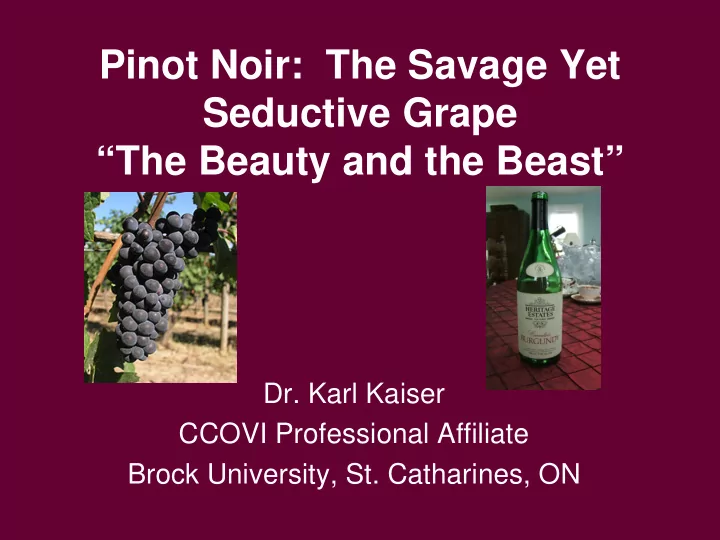
Pinot Noir: The Savage Yet Seductive Grape The Beauty and the - - PowerPoint PPT Presentation
Pinot Noir: The Savage Yet Seductive Grape The Beauty and the Beast Dr. Karl Kaiser CCOVI Professional Affiliate Brock University, St. Catharines, ON Introduction to Pinot Noir The Story of the Origin Quotes taken from Pinot Noir
– California, Oregon, New Zealand, Australia and South Africa (which subsequently developed the Pinotage grape)
– I first worked with Pinot in 1987 from the St. Davids region
– One of the failures in new world regions was that it was planted in very warm climates
– if the temperature is too hot, the fruit is overripe, gets mushy and tastes like jam – if the temperature is too cold, the fruit tastes sour with little flavour
Romanee-Conti taken from “Pinot Noir” by Andrew Barr, p9.
– A great book that summarizes multiple factors creating terroir is called “Terroir, The Role of Geology, Climate and Culture in the Making of French Wines”. James E. Wilson, forwarded by Hugh Johnson, University of California Press, 1999 – Physical elements of the vineyard habitat such as the vine, subsoil, site, drainage, meso and microclimate are all included in Terroir.
– Clones 113, 114, 115, 667, 777 – All are allowed for importation into Canada
Row spacing 3m X 1.5m 2.5m X 1m 1.2m X 0.8m 1.0m X 1.0m Area/vine 4.5 m2/vine 2.5 m2/vine 1 m2/vine Vines/acre 888 vines/acre 1600 vines/acre 4000 vines/acre Vines/ha 2222 vines/ha 4000 vines/ha 10,000 vines/ha Desired hL/ha 30 hL/ha 30 hL/ha 30 hL/ha Required kg/ha 5000 kg/ha 5000 kg/ha 5000 kg/ha Required kg/acre 2000 kg/acre 2000 kg/acre 2000 kg/acre Required kg/vine 2.25 kg/vine 1.25 kg/vine 0.5 kg/vine
– In our best Pinot Noirs, we had only 15-20 hl/ha which corresponds to 2.5-3 tonnes/ha or 1-1.2 tonnes/acre
France Pineau, Franc Pineau, Noirien, Savagnin Noir, Savagnin (ur), Morillon, Auvergnat, Plant Dore, Vert Dore (champagne), Pinot, Franc Norien, Bourgignon Noir, Plant de Cumieres Switzerland Pinot Noir, Cortaillod, Blauer Spatburgunder Klevner Italy Pinot Nero, Pignol, Pignola Austria Blauer Spatburgunder, Blauer Nurnberger Yugoslavia Burgundac Crni, Modraklevanyka Czechoslovakia Rouci, Roucimodre Hungary Nagy Burgundi, Kisburgundikek, Pinot Noir Germany Blauer Spatburgunder, Spatburgunder, Blauburgunder, Blauer Klevner, Klavner, Clavner, Klebrot Old names: Schwarzer Burgunder, Schwarzer Riesling, Sussling, Sussedel, Sussrot, Mohrchen, Malterdinger
Traminer Schwarzriesling X Pinot noir X X Heunisch ? Saint Laurent Aligote Auxerrois Chardonnay Melon Pinot gris, Pinot blanc
The Plant
relatively rough
bullwood if grown on too light a soil or if it had too much nitrogen fertilization
middle”
– in Ontario, it ripens in most years from middle to end of September and in Burgundy, it is said that it takes 100 days from the flowering of the roses to the harvest of Pinot Noir – the flowering of roses – early June – is also the flowering of the vines
good, therefore cold hardiness is moderately good but it can have bud damage at -17°C particulary after
content) which should be well drained - Pinot Noir needs warm soils
– In Ontario, often the pH is 3.5 and higher – Due to young vines and fertile soils lending to vines not always in balance – Over application of potash may also compound the problem (the Burgundians blame their higher pHs on the potash mines in the Alsace)
The Colour
most often, this is only on the sun-exposed outside of the bunch
– Particularly when the vine had too much yield, the bunch’s colour on the portion hidden from the sun, remains pink or even greenish – This uneven appearance often misleads one to assume that Pinot Noir is ripe
colouring matter (anthocyanin) is embedded and colour extraction is often poor
well known for his sexist comments as for having been manager of the Domaine de la Romanee-Conti,
more important than clothes on a beautiful woman” taken from “Pinot Noir” by Andrew Barr
– The wine will not forgive if too many bunches are left, hence bunch thinning is
– Maximum yield affordable in order to
The wine
characterisitcs depending on the year, location, vinification techniques and age of the wine
– Tree fruit: plum, cherry – Berry: raspberry, strawberry – Vine: cassis, blackberry – Floral: violets, etc. – Rustic: animal, compost, farmyard when old
bouquet when old) which is hard to describe but is wholly their own
– Single, straight forward terms as above do not do justice and their colour is often not as impressive when compared to other famous wines
requires Pinot Noir to have a good degree of acidity to provide the mouth-watering freshness and delicacy it needs to be a great wine
(we had no sorting tables, so sorting while the grapes were being harvested was the only way)
– Wines made with a large portion of whole clusters taste like Beaujolais in their youth, aromas of bubble gum and bananas
– If pH high and TA low, add tartaric acid to achieve a TA of at least 8.5 g/L – Optimal 22-22.5Brix (if sugar is needed, wait to chaptalize until fermentation is about half-way through)
– Very sound fruit, add 35 ppm SO2 – Sound fruit, add 50 ppm – Troubled fruit, add 75 ppm – No higher than 100 ppm added
Four commonly used types in Ontario Square bins
– Used for hand punchdown – Most wineries already have them available
Shallow round wooden vats
– Used for hand punchdown
(In Burgundy, concrete tanks are still used) Larger stainless steel vats
– For pumping over
Classical burgundy vats
– For pumping over – Conical in shape – Produces thick cap that allows for good extraction when pumped over – provides for easy emptying
– After sulfiting, give the must a rest before adding the yeast i.e.
– Might have to warm up must to 15°C to start fermentation – My favourite yeasts are Lalvin RA17 and Lalvin RC212
– Punch down two to three times daily – Around 26°C, you might chaptalize if necessary to prolong the fermentation to assist in extraction from the skins (usually around day 4-5 of the fermentation) – Try to reach, at least once, 30°C for maximal colour extraction, normally around the 6th day – Stop punch down after 8-9 days when the wine gets dry – Press off skins on day 12-14 (my favorite day was 13) – In a “green year”, do not leave for an extended maceration after 8-9 days to avoid green tannin extraction
– Extended maceration
more, do not punch down or pump over too frequently (ie not more than twice a day) or after 6-7 days to avoid over extraction of tannin
you will obtain overextracted, tannic, bitter wines
which time the tannin-shift has already occurred
then precipiate out
the anthocyanins
wine
room
– Blocks the links between tannin since they do not precipiate out during the fermentation and the wines are harsher and more tannic – Enhances Beaujolais aromas of bubblegum and bananas
– It could be 5, 10 or 15% of the original volume
– 1/3 new (first fill) oak barrels – 1/3 second fill oak barrels – 1/3 third fill oak barrels (these percentages are not fixed)
From “Burgundy” by Anthony Hanson, Faber and Faber, London, 1982 p76