Pilot REDD+ project in community managed forests in three watershed - - PowerPoint PPT Presentation

pilot redd project in community managed forests in three
SMART_READER_LITE
LIVE PREVIEW

Pilot REDD+ project in community managed forests in three watershed - - PowerPoint PPT Presentation

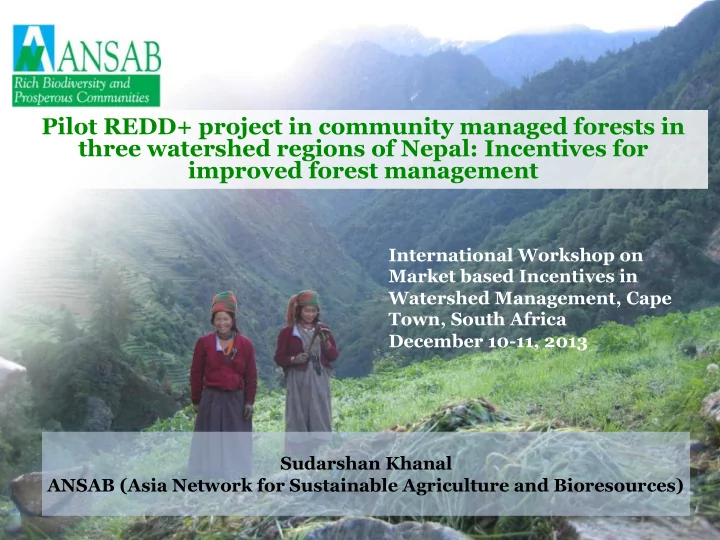
Pilot REDD+ project in community managed forests in three watershed regions of Nepal: Incentives for improved forest management International Workshop on Market based Incentives in Watershed Management, Cape Town, South Africa December 10-11,


slide-1
SLIDE 1

International Workshop on Market based Incentives in Watershed Management, Cape Town, South Africa December 10-11, 2013

Pilot REDD+ project in community managed forests in three watershed regions of Nepal: Incentives for improved forest management

Sudarshan Khanal ANSAB (Asia Network for Sustainable Agriculture and Bioresources)

slide-2
SLIDE 2

www.ansab.org

ANSAB

— Civil Society Organization,

governed by an International Board, established in 1992

— Works in South Asia &

headquartered in Kathmandu, Nepal

— Vision: Rich biodiversity &

prosperous communities

— Mission: Generate & implement

community-based, enterprise-

  • riented solutions
slide-3
SLIDE 3

www.ansab.org

Setting the scene… REDD+ in CF

— REDD+ - an emerging market-based approach

under the United Nations Framework Convention

  • n Climate Change (UNFCCC) for reducing carbon

emission

— Multiple co-benefits including reduced soil

erosion, improved watershed conditions, increased fresh water supply, and enhanced potential for provision of other essential ecosystem

— Addresses the Resource use problems of watershed

classified by FAO

slide-4
SLIDE 4

www.ansab.org

Setting the scene… REDD+ in CF

— Community forestry in Nepal is a successful global

example of effective measure to retract or at least to reduce deforestation in mountainous landscape.

— Carbon payments may be seen as a co-benefit of

successful community forestry activities that reduce carbon emission activities.

slide-5
SLIDE 5

www.ansab.org

Pilot REDD+ Project in Nepal

— NORAD funded project (2009-2013) — Asia Network for Sustainable Agriculture and

Bioresources (ANSAB),

— International Centre for Integrated Mountain

Development (ICIMOD) and

— Federation of Community Forest Users, Nepal

(FECOFUN)

slide-6
SLIDE 6

www.ansab.org

112 community forests in 3 watersheds

slide-7
SLIDE 7

www.ansab.org

slide-8
SLIDE 8

www.ansab.org

Pilot-FCTF (Forest Carbon Trust Fund)

— US $ 100,000 Seed grant per year — Multi-stakeholder – Government, civil society

  • rganizations, indigenous group organizations, private

sectors

— 60% weightage – socio-economic parameters (10% for

number of household of indigenous people, 15% for number of Dalit households, 15% for population of women in forest user groups, and 20% for the population of poor households)

— 40% for forest carbon (24% for stock and 16% for

increment)

slide-9
SLIDE 9

www.ansab.org

FCTF Governance

slide-10
SLIDE 10

www.ansab.org

Forest Carbon Measurement

slide-11
SLIDE 11

www.ansab.org

Carbon enhancement

Improved Forest Management & Protection

— Revision of community forest management plans and incorporation of

REDD provisions

— Building capacity of communities for improved forest management and

good governance

— Patrolling forest areas by forest guards and promoting social fencing

Assisted Natural Regeneration

— Regulating free grazing and promote stall-feeding — Removal of invasive species and weeds — Controlling forest fire

slide-12
SLIDE 12

www.ansab.org

Afforestation and Reforestation

— Re-planting of indigenous tree species in denuded areas and other

potential areas in CFs

— Growing bamboos and other fast growing species like Alder

Reducing pressure on forest use

— Alternative energy promotion – biogas and improved cook stoves to

reduce extraction of fuel wood from CFs

— Plantation of fast growing species (Melia azadirachta, Bauhnia

varigata etc.) and grass and legume-based fodder in private land to meet communities’ firewood and fodder demand

— Support poor and marginalized in alternative livelihoods options, such

as poultry, fishery, goat keeping, piggery, handicraft making and tailoring to reduce dependency on forest resources for their livelihoods

slide-13
SLIDE 13

www.ansab.org

REDD+ seed grant payment

Watershed 2010 2011 2012 Average Carbon stock Average Carbon stock Payment Average Carbon stock Payment Ton carbon Ton carbon USD Ton carbon USD Charnawati 620,434 627,477 45,534.93 635,698.3 44,187.9 Ludhikhola 197,362 202,370 27,560.13 205,112.4 26,120.65 Kayarkhola 343,525 345,175 21,904.94 347,997.2 24,691.45

slide-14
SLIDE 14

www.ansab.org

slide-15
SLIDE 15

www.ansab.org

Payment in the project output

Identify and periodic assessment of drivers of forest degradation, initiate forest enhancement activities Establish baseline

  • f forest carbon

and periodic monitoring Setting indicators/ criteria (social, biophysical) Operate trust fund REDD payment disbursement Review, adjust and adapt Develop Project Design Document (PDD) Frame Measurement, reporting and Verification (MRV) system Standardized measurement methodologies and guidelines Set up pilot trust fund and regulate REDD+ payment

slide-16
SLIDE 16

www.ansab.org

Limitations

— Performance on socio-economic parameters scored

more than carbon performance

— Some CFUGs received multiple payments (same

person as woman, poor and Dalit)

slide-17
SLIDE 17

www.ansab.org

Lessons learnt

— Linking community forestry and REDD+ offers an

example of an effective, decentralized and sustainable system to achieve optimum outcomes for carbon, biodiversity and other ecosystem benefits.

— Forest user groups can themselves monitor and report

  • n carbon stocks and increment. Engagement of local

people in carbon monitoring helps to minimize cost and increases their ownership in whole process

— Maintaining social equity, especially ethnicity, gender

and well-being, in benefit sharing is crucial for bringing positive change in the behavior of community members.

slide-18
SLIDE 18

www.ansab.org

— Carbon stock and increment in community forests

could be used, without socio-economic parameters, in the allocation of FCTF. The socio-economic factors should be considered only at the use of carbon money at CFUG level.

— Forest User Groups are prepared to co-fund

activities that provide REDD+ co-benefits.

slide-19
SLIDE 19

— Visit www.ansab.org to

¡ Read our detailed capability statement ¡ Watch short documentaries about our

work

¡ Consult more than 50 publications ¡ Subscribe to our newsletter, price list &

more

Thank You!