Physics 2D Lecture Slides Lecture 30: March 9th 2005 Vivek Sharma - - PDF document

physics 2d lecture slides lecture 30 march 9th 2005
SMART_READER_LITE
LIVE PREVIEW

Physics 2D Lecture Slides Lecture 30: March 9th 2005 Vivek Sharma - - PDF document

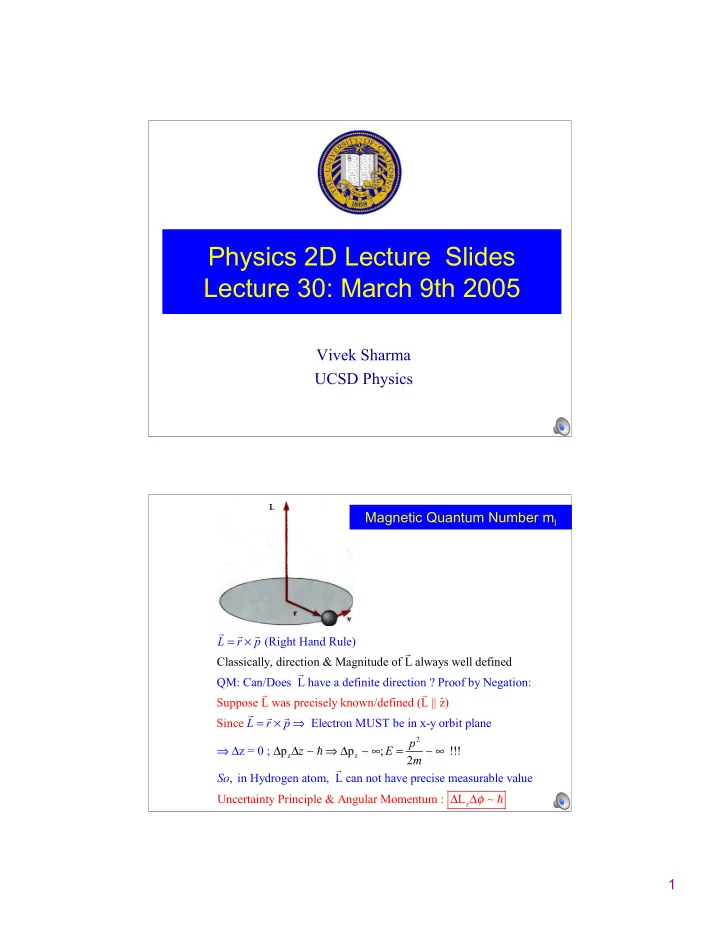
Physics 2D Lecture Slides Lecture 30: March 9th 2005 Vivek Sharma UCSD Physics Magnetic Quantum Number m l = L r p (Right Hand Rule) Classically, direction & Magnitud e of L always well defi n ed QM:


slide-1
SLIDE 1

1

Physics 2D Lecture Slides Lecture 30: March 9th 2005

Vivek Sharma UCSD Physics

Magnetic Quantum Number ml

(Right Hand Rule) QM: Can/Does L have a definite direction Classically, direction & Magnitud ? Proof by Negat ˆ Suppose L was precisely known/defined (L || z) e of L S always well defi n ed : n io L r p =

  • 2

z z z

Electron MUST be in x-y orbit plane z = 0 ; , in Hydrogen atom, L can not have precise measurable ince Uncertainty Principle & An p p ; !!! gular Momentum value : L 2 p z E L r p So m

  • =
  • =
slide-2
SLIDE 2

2

Magnetic Quantum Number ml

Z

Arbitararily picking Z axis as a reference In Hydrogen atom, L can not have precise measurable value L vector spins around Z axis (precesses). The Z component of L : | direction L | ; 1 :

l l

m m = = ±

  • Z

Z

, 2, 3... ( 1) It can never be that |L | ( 1) (break : since | L | | | (always) sin s Uncertainty Pri So......the Electron's dance has be c ncip e le) gun !

l l

l m l l m l Note L l ± ± ± < + = = + <

  • Consider = 2

| L |= ( +1) = 6

L=2, ml=0,±1, ± 2 : Pictorially Electron “sweeps” Conical paths of different ϑ: Cos ϑ = LZ/L On average, the angular momentum Component in x and y cancel out <LX> = 0 <LY> = 0

slide-3
SLIDE 3

3 Where is it likely to be ?  Radial Probability Densities

l

2 * 2 2 m 2

( , , ) ( ) . ( ) . ( ) ( , , ) | Y Probability Density Function in 3D: P(r, , ) = =| | Y | : 3D Volume element dV= r .sin . . .

  • Prob. of finding parti

| | . cle in a ti n

l l l

nl nl l m l n m m l l

Note d r R r r r d R d R

  • =
  • =
  • =

l l

2 2 2 2 m 2 2 2 2 m

y volume dV is P.dV = | Y | .r .sin . . . The Radial part of Prob. distribution: P(r)dr P(r)dr= | ( ) | When | ( ) | ( ) & ( ) are auto-normalized then P(r)dr | | . | | = . |

l l l

lm l m m n nl n l l

R R r d R dr d d r d d

  • 2

2 2 2 nl 2 2

in other words Normalization Condition: 1 = r |R | dr Expectation Values P(r)=r | <f( | | . . ; r)>= f(r).P(r)dr

nl l

r r R d

  • dv

Ground State: Radial Probability Density

2 2 2 2 3 2 2 3 2 2

( ) | ( ) | .4 4 ( ) Probability of finding Electron for r>a To solve, employ change of variable 2r Define z= ; limits of integra 4 1 2 tion a

r a r a a r a r a

r e dr P r dr r r dr P r dr r e a change P a P z

  • >
  • >
  • =
  • =
  • =

=

  • 2

2 2

(such integrals called Error. Fn) 1 =- [ 2 2] | 66. 5 0.667 2 7% !!

z z

e dz z z e e

  • +

+ = =

slide-4
SLIDE 4

4 Most Probable & Average Distance of Electron from Nucleus

2 2 3 2 2 2 3

4 In the ground state ( 1, 0, 0) ( ) Most probable distance r from Nucleus What value of r is P(r) max? dP 4 2 =0 . 2 dr Most Probable Distance:

r a l r a

d n l m P r dr r e a r r e r a dr e a

  • =

= = =

  • =
  • +
  • 2

2 2 2 3

2 2 ... which solution is correct? (see past quiz) : Can the electron BE at the center of Nucleus (r=0)? 4 ( 0) 0! (Bohr guess Most Probable distance ed rig

r a a

r r r

  • r r

a a P r e r a a

  • =
  • +

=

  • =

= = = = =

  • 2

2 3 r=0 3 n

ht) 4 <r>= rP(r)dr= What about the AVERAGE locati . ...

  • n <r> of the electron in Ground state?

2r cha ....... Use general for nge of variable m z= a z ! ( 4

z z z r a

r r e a r z e dz e dz n n d n r a

  • =

< >= = =

  • 1)(

2)...(1) 3 3! ! Average & most likely distance is not same. Why? 4 2 Asnwer is in the form of the radial Prob. Density: Not symmetric n a a r a

  • <

>= =

  • Radial Probability Distribution P(r)= r2R(r)

Because P(r)=r2R(r) No matter what R(r) is for some n The prob. Of finding electron inside nucleus =0

slide-5
SLIDE 5

5 Normalized Spherical Harmonics & Structure in H Atom Excited States (n>1) of Hydrogen Atom : Birth of Chemistry !

211 210 21- 200 n 1 211 21 1 1

Features of Wavefunction in & : Consider Spherically Symmetric (last slide) Excited , , States (3 & each with same E ) : are all states 1 Z =R Y 2, 2 = p a n l

  • =

=

  • =
  • 21

1

2 * 2 211 211 210 21 1 l 1 3/2

sin | | | | sin Max at = ,min at =0; Symm in 2 W (r) hat about (n=2, =1, Y ( , ); 1 3 Y ( , ) cos ; 2 Function is max at =0, min a m 2 . 8 t ) = . i

Zr a

Z e R r e a

  • =
  • =
  • =
  • z

We call this 2p state because of its extent in z

2pz

slide-6
SLIDE 6

6 Excited States (n>1) of Hydrogen Atom : Birth of Chemistry !

2 1 2 2

Remember Principle of Linear Superposition for the TISE which is basically a simple differential equat Principle of Linear Superposition If are sol. ion:

  • f TISE

then a "des

  • 2m

igne a U nd E

  • +
  • =
  • '

1 2 2 2 ' ' ' '

To check this, just substitute in pla r" wavefunction made of linear sum i ce of & convince yourself that s also a

  • sol. of the diff. equ
  • ation !

2m The a b U E

  • =

+

  • +

=

  • diversity in Chemistry and Biology DEPENDS
  • n this superposition rule

2pz Designer Wave Functions: Solutions of S. Eq !

[ ] [ ]

x y

2p 211 21 1 2p 211 21 1

Linear Superposition Principle means allows me to "cook up" wavefunctions 1 ......has electron "cloud" oriented along x axis 2 1 ......has electron "cloud" oriented along 2

  • =

+ =

  • 200

210 211 21 1

2 ,2 ,2 ,2 Similarly for n=3 states ...and so on ...can get very complicated structure in & .......whic y axis So from 4 solutio h I can then mix & match ns to make electron , , , s "

x y z

s p p p

  • most likely"

to be where I want them to be !

slide-7
SLIDE 7

7 Designer Wave Functions: Solutions of S. Eq !

n = 1,2,3,4,5,.... 0,1,2,3 The hydrogen ,,4....( 1) m atom brought to you by the , 1, 2, 3,.. The Spatial Wave Function of the Hydrogen Atom letters ( , . ,

l

r l n l

  • =
  • =

±

  • ±

± ±

l

m

) ( ) . ( ) . ( ) Y (Spherical Harmonics)

l l

m nl lm nl l

R r R

  • =
  • =

2 2 2 2 2 2 2 2 2 2 2

m 1 sin ( 1) ( ) 0.....(2) sin sin .................(1) d 1 2m ke ( 1) (E m 0.. + )- ( ) r

l l

d d l l d r l l r R r r dr d d r r d

  • +
  • +
  • +

=

  • +
  • =
  • =
  • +
  • 0....(3)

These 3 "simple" diff. eqn describe the physics of the Hydrogen atom.

Typo Fixed

slide-8
SLIDE 8

8

Cross Sectional View of Hydrogen Atom prob. densities in r,θ,φ Birth of Chemistry (Can make Fancy Bonds Overlapping electron “clouds”)

Z Y

What’s the electron “cloud” : Its the Probability Density in r, θ,φ space!

What’s So “Magnetic” ?

Precessing electron Current in loop  Magnetic Dipole moment µ The electron’s motion  hydrogen atom is a dipole magnet

slide-9
SLIDE 9

9

The “Magnetism”of an Orbiting Electron

Precessing electron Current in loop  Magnetic Dipole moment µ

2

Area of current lo Electron in motion around nucleus circulating charge curent ; 2 2

  • e

Magnetic Moment | |=i

  • p

A= ; 2m Like the L, magneti A= r

  • e
  • e

2m 2m c i e e ep i r T mr v r r p p L

  • µ
  • µ
  • =

= =

  • =
  • =
  • z
  • e
  • e

z component, ! 2 moment also prece m sses about "z" axi m s 2

z l B l

L m m quantized µ µ µ

  • =

= = =

  • Quantized Magnetic Moment

z e

  • e
  • e

2m 2m Bohr Magnetron e = 2m

z l B l B

L m m µ µ µ

  • =

=

  • =

=

  • Why all this ? Need to find a way to break the Energy Degeneracy

& get electron in each ( , , ) state to , so we can "talk" to it and make it do our bidding: Walk identify this wa " y its , ta elf i lk th s

l

n l m way!"

slide-10
SLIDE 10

10 “Lifting” Degeneracy : Magnetic Moment in External B Field

Apply an External B field on a Hydrogen atom (viewed as a dipole) Consider (could be any other direction too) The dipole moment of the Hydrogen atom (due to electron orbit) experi B || e Z axis

  • Torque

which does work to align || but this can not be (same Uncertainty principle argument) So, Instead, precesses (dances) around ... like a spinning nces top T a he Azimuthal angle B B B

  • µ

µ µ =

  • L

|projection along x-y plane : |dL| = Lsin .d |dL| ; Change in Ang Mom. Ls changes with time : calculate frequency Look at Geometry: | | | | sin 2 d 1 |dL 1 = = = sin dt Lsin dt Lsin 2 in q dL dt LB dt m q LB m d qB

  • =
  • =

=

  • =

L depends on B, the applied externa

Larmor Freq 2 l magnetic f l ie d

e

m

  • “Lifting” Degeneracy : Magnetic Moment in External B Field

WORK done to reorient against field: dW= d =- Bsin d ( Bcos ) : This work is stored as orientational Pot. Energy U Define Magnetic Potential Ene dW= - rgy U=- . dU B d d B W µ µ µ

  • µ

= =

  • e

cos . e Change in Potential Energy U = 2m

L z l l

B m B m B µ

  • µ
  • =

=

  • In presence of External B Field, Total energy of H atom changes to

E=E So the Ext. B field can break the E degeneracy "organically" inherent in the H atom. The E

L l

m

  • +

nergy now depends not just on but also

l

n m

Zeeman Effect in Hydrogen Atom

slide-11
SLIDE 11

11

Zeeman Effect Due to Presence of External B field

Energy Degeneracy Is Broken Electron has “Spin”: An additional degree of freedom

Even as the electron rotates around nucleus, it also “spins” There are only two possible spin orientations: Spin up : s = +1/2 ; Spin Down: s=-1/2 “Spin” is an additional degree of freedom just Like r, θ and ϕ Quantum number corresponding to spin orientations ml = ± ½ Spinning object of charge Q can be thought of a collection of elemental charges Δq and mass Δm rotating in circular orbits So Spin  Spin Magnetic Moment  interacts with B field

slide-12
SLIDE 12

12

Stern-Gerlach Expt⇒ An additional degree of freedom: “Spin” for lack of a better name

!

µ

  • Silver

Hydrogen (l=0)

B

F= - U ( .B) B B B When gradient only along in inhomogenous B field, experiences force F B ( ) moves particle up or down z (in addition to torque causing Mag. momen z, 0; t

  • z

t

z B

x y F m µ µ µ

  • =
  • =
  • =

=

  • precess about B field direction

Four (not 3) Numbers Describe Hydrogen Atom  n,l,ml,ms

i i

"Spinning" charge gives rise to a dipole moment : Imagine (semi-clasically charge q, radius r Total charg , ) electron as s e uniformly dist phere ribut in ed correctl : q= q ; ! : a y

s

µ

  • i

i

s S s

s electron spins, each "chargelet" rotates c 2 2 In a Magnetic Field B magnetic energy due to spin Net urrent dipole mo U . ment

s i s e e

q q g S m m B µ µ µ µ

  • =

=

  • =
  • J = L + S

( ) 2 Notice that the net dipole moment vector is not to J (There are many such "ubiqui Angular Momentum in H Atom Net Magnetic Moment of H tous" qu atom: antum

s e

e L gS m µ µ µ µ

  • =

+ = +

  • numbers for elementary particle but we

won't teach you about them in this course !)

Δq

slide-13
SLIDE 13

13 Doubling of Energy Levels Due to Spin Quantum Number

Under Intense B field, each {n , ml } energy level splits into two depending on spin up or down

In Presence of External B field

Spin-Orbit Interaction: Angular Momenta are Linked Magnetically

Electron revolving around Nucleus finds itself in a "internal" B field because in its frame of reference, the nucleus is orbiting around it.

This B field, , interacts with electron's spin dipole moment . Energy larger when smaller when anti-paralle due to l States with but diff. spins

  • rbital motion

S || B, same ( , , e e ) n rg

s m l

U B n l m µ µ =

  • y level splitting/doubling due to S
  • +Ze
  • e

+Ze

  • e

B B B Under No External B Field There is Still a Splitting! Sodium Doublet & LS coupling

slide-14
SLIDE 14

14

Vector Model For Total Angular Momentum J

Neither Orbital nor Spin angular Momentum Coupling of Orbital & Spin magnetic moments conserv are conserved seperately! so long as there are no ex J = L + S is ternal torque e s esen d pr

  • z

| | ( 1) w t Rules for Tota | |, , -1, - 2..

  • 1,

l Angular Momentum Quanti

  • 2......,...

....., ith

  • .,|

zat ion

  • |

J : with

j j

j l s l s m j j J j l j j l s j m s = + = + = + = +

  • = -3/ 2, 1/ 2,1/ 2,3/ 2

= 1/ 2 In general takes (2 1) values Even # 1 Example: state with ( 1, ) 2 3/ 2 j

  • f orientations

Spectrographic Notation: Final Label = 1/2

j j j

m m s j j m l

  • =
  • =

=

  • ±
  • +

1/2 3/2

1 2 S P

Complete Description of Hydrogen Atom

n j

Complete Description of Hydrogen Atom

1/2 3/2

1 2 S P

n j

{ , , , } LS Coupling Full description

  • f the Hydr
  • ge

{ , , , } 4 D n atom .O F. : .

l s s

n l m m n l j m corresponding to

  • How to describe multi-electrons atoms like He, Li etc?

How to order the Periodic table?

  • Four guiding principles:
  • Indistinguishable particle & Pauli Exclusion Principle
  • Independent particle model (ignore inter-electron repulsion)
  • Minimum Energy Principle for atom
  • Hund’s “rule” for order of filling vacant orbitals in an atom
slide-15
SLIDE 15

15 Multi-Electron Atoms : >1 electron in orbit around Nucleus

ignore electron-electron inte In Hydrogen Atom (r, , )=R(r In n-electron atom, to simplify, complete wavefunction, in "independent"part ). ( ). ( ) { , , , } icle ap rac prox" : (1,2, tions

j

n l j m

  • Complication

Electrons are identical particles, labeling meanin 3,..n)= (1). (2). (3)... ( ) ??? Question: How many electrons can have same set of quan gless! Answer: No two elec t trons in an um #s? n

  • atom can have SAME set of quantum#s

(if not, all electrons would occupy 1s state (least Example of Indistinguishability: elec energy). tron-ele .. no struct ctron scatte ure!! ring

e- e- Small angle scatter large angle scatter Quantum Picture

If we cant follow electron path, don’t know between which of the two scattering Event actually happened

Helium Atom: Two electrons around a Nucleus

2 2 1 1 1 1 2 2 2

In Helium, each electron has : kinetic energy + electrostatic potential energy If electron "1" is located at r & electron "2"is located at r then TISE has (2 terms like: ; H

  • )

m ( ) H

  • 2

e e k r =

  • =

+

  • 1

2 2 2 1 1 2 2 2 2 2 1

(2 )( ) 2m H H E Independent Particle App ; H & H are same except for "label" e ignore repulsive U=k term |r | Helium WaveFunctio such th n: = (r , ); Probabil a t x t ro i e e r k r r

  • +

+

  • =
  • 1

2 2 1 1 2 2 1 * 1 2 1 2

| (r , ) | | (r , y (r , ) (r , ) But if we exchange location of (identical, indistinguishable) electrons I ) | (r , ) (r , ).................... n general, when ...Bosonic System (made of photo r r P r r r r

  • =

= =

  • 1

2 2 1

ns, e.g) (r , ) (r , ).....................fermionic System (made of electron, proton e.g) Helium wavefunction must be when if electron "1" is in state a & ele c OD tr D;

  • n "2" is

r r

  • =
  • 1

2 a 1 b 2 1 a 1 b 2 a 1 b 2

in state b Then the net wavefunction (r ,r )= ( ). ( ) satisfies H ( ). ( ) ( ). ( )

ab a

r r r r E r r

  • =

2 a 1 b 2 a 1 b 2 1 2 a 1 b 2 a 1 b 2

H ( ). ( ) ( ). ( ) and the sum [H +H ] ( ). ( ) ( ) ( ). ( ) Total Heliu

b a b

r r E r r r r E E r r

  • =

= +

a b

m Energy E E +E =sum of Hydrogen atom like E

  • e-

e-

a b

slide-16
SLIDE 16

16 Helium Atom: Two electrons around a Nucleus

1 2 2 1 a 2 b 1 1 2 a 1 b 2

Helium wavefunction must be ODD anti-symmetric: (r , ( ). ( ) It is i (r ,r )=- (r ,r ) So it mpossible to tell, by looking at probability or energy which must be tha r ) t p ( ). ( ) art =

a a a b b b

r r r r

  • 1

2 1 2

(r ,r )= (r ,r )=0... Pauli Exclusi icular electron is in which state

  • n principle

If both are in the same quantum state a=b & General Principles for Atomic Struc

aa bb

  • 1. n-electron system is stable when its total energy is minimum

2.Only one electron can exist in a particular quantum state in an atom...not 2 or ture for n- more !

  • 3. S

electr hells

  • n system

& Sub : Shells In Atomic Structure : (a) ignore inter-electron repulsion (crude approx.) (b) think of each electron in a constant "effective" mean Electric field (Effective field: "Seen" Nuclear charge (+Ze) reduced by partial screening due to other electrons "buzzing" closer (in r) to Nucleus) Electrons in a SHELL: have same n, are at similar <r> from nucleus, have similar energies Electons in a SubShe hav ll: e sa those with lower closer to nucleus, mor me principal quantum number n ,

  • all electrons in sub-shell have same en
  • Energy de

ergy, with m e tight inor de ly bound pendence pends

  • n
  • ,

n

l s

l l m m e- e-

a b

Shell & Sub-Shell Energies & Capacity

capacity limited due to Pauli Exclusion principle Shell is made of sub-shells (

  • 1. Shell & subshell

2.

  • 3. Subshell

( , ), given 0,1,

  • f same principal quantum

2,3,..( -1), for # any n )

l

n l n l n l m

  • =
  • =

[ ]

1 2 MAX

1 2 1 N 2.(2 1) 2 , 1 , 1, 2,.. (2 1) The "K" Shell (n=1) holds 2 3 5 ..2( 1) 1 2( ) (1 (2 1)) 2 2 4. , electro

  • Max. # of electrons in a shell =

subshell capacity n "L" S s he

s n l

m l n l n n n

  • =

= ±

  • =

+ = + + +

  • +

= +

  • =
  • ± ±
  • +
  • i

i i i

M shell (n=3) holds 18 electrons ......

  • 5. Shell is closed when fully
  • 6. Sub-Shell closed when

(a) L ll (n=1) holds , 0, 8 electro Effective

  • c

charge distribution= symm cupied ns, S = =

  • i

i

6.Alkali Atoms: have a s etric (b) Electrons are tightly bound since they "see" large nuclear charge (c) Because L No dipole moment No ability to attract electrons ! ingle gas! Inert Noble =

  • "s" electron in outer orbit;

nuclear charge heavily shielded by inner shell electrons very small binding energy of "valence"electron large orbital radius of valence electron

  • Energy
slide-17
SLIDE 17

17

Electronic Configurations of n successive elements from Lithium to Neon

That’s all I can teach you this quarter; Rest is all Chemistry !

Hund’s Rule: Whenever possible

  • electron in a sub-shell remain unpaired
  • States with spins parallel occupied first
  • Because electrons repel when close together
  •  electrons in same sub-shell (l) and same spin
  • Must have diff. ml
  • (very diff. angular distribution)
  • Electrons with parallel spin are further apart
  • Than when anti-parallel⇒lesser E state
  • Get filled first

Periodic table is formed