Physics 2D Lecture Slides Lecture 27: March 2nd 2005 Vivek Sharma - - PDF document

physics 2d lecture slides lecture 27 march 2nd 2005
SMART_READER_LITE
LIVE PREVIEW

Physics 2D Lecture Slides Lecture 27: March 2nd 2005 Vivek Sharma - - PDF document

Physics 2D Lecture Slides Lecture 27: March 2nd 2005 Vivek Sharma UCSD Physics Quantum Mechanics In 3D: Particle in 3D Box z Extension of a Particle In a Box with rigid walls 1D 3D Box with Rigid Walls (U= ) in X,Y,Z dimensions


slide-1
SLIDE 1

1

Physics 2D Lecture Slides Lecture 27: March 2nd 2005

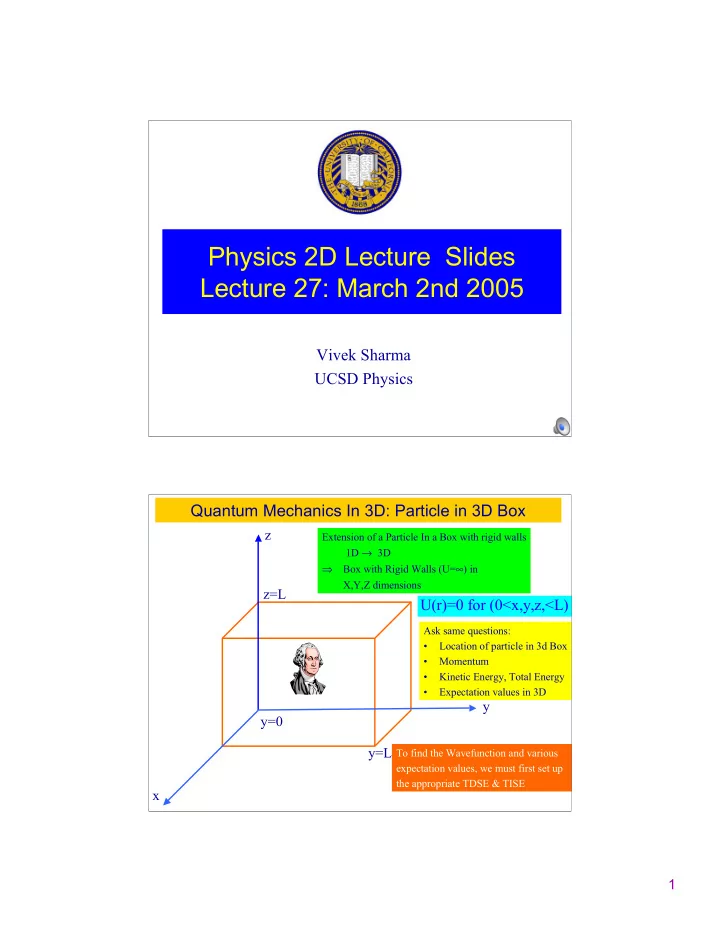
Vivek Sharma UCSD Physics Quantum Mechanics In 3D: Particle in 3D Box

Extension of a Particle In a Box with rigid walls 1D → 3D ⇒ Box with Rigid Walls (U=∞) in X,Y,Z dimensions

y y=0 y=L z=L z x

Ask same questions:

  • Location of particle in 3d Box
  • Momentum
  • Kinetic Energy, Total Energy
  • Expectation values in 3D

To find the Wavefunction and various expectation values, we must first set up the appropriate TDSE & TISE

U(r)=0 for (0<x,y,z,<L)

slide-2
SLIDE 2

2

The Schrodinger Equation in 3 Dimensions: Cartesian Coordinates

2 2 2 2 2 2 2 2 2 2 2 2 2 2 2 2 2 2 2

Time Dependent Schrodinger Eqn: ( , , , ) ( , , , ) ( , , ) ( , ) .....In 3D 2 2 2 2 2 x y z t x y x y z t U x y z x t i m t m x m y m z m So

  • +
  • =
  • =

+

  • +
  • +
  • =

+

  • x

2 x x

[K ] + [K ] + [K ] [ ] ( , ) [ ] ( , ) is still the Energy Conservation Eq Stationary states are those for which all proba [ ] = bilities so H x t E K x t z

  • =
  • =
  • i t

are and are given by the solution of the TDSE in seperable form: = (r)e This statement is simply an ext constant in time ( ension of what we , derive , , ) ( , ) d in case of x y z t r t

  • =
  • 1D

time-independent potential

y z x

Particle in 3D Rigid Box : Separation of Orthogonal Spatial (x,y,z) Variables

1 2 3 1 2 2 3 2

in 3D: x,y,z independent of each ( , , ) ( ) ( ) ( ) and substitute in the master TISE, after dividing thruout by = ( ) ( ) (

  • ( , , )

( ,

  • ther , wr

, ) ( , , ) and ) ( , ite , ) n 2m x y z TISE x y z U x y z x y z E x y x y z x y z z

  • =

+ =

  • 2

2 1 2 1 2 2 2 2 2 2 3 2 3 2 1 2 2

( ) 1 2 ( ) This can only be true if each term is c

  • ting that U(r)=0 fo
  • nstant for all x,y,z

( ) 1 2 ( ) ( 2 r (0<x,y,z,<L) ( ) 1 2 ( ) z E Const m z z y m x m x x x m y y

  • +
  • +

=

  • =
  • 2

2 3 3 3 2 2 2 2 2 2 1 1 2 2 1 2 3

) ( ) ; (Total Energy of 3D system) Each term looks like ( ) ( ) ; 2 With E particle in E E E=Constan 1D box (just a different dimension) ( ) ( ) 2 So wavefunctions t z E z m z y y E x E x y m

  • =
  • =

= =

  • +

+

  • 3

3 1 2 2 1

must be like , ( ) sin x , ( ) s ) s n in ( i y y k x k z k z
slide-3
SLIDE 3

3 Particle in 3D Rigid Box : Separation of Orthogonal Variables

1 1 2 2 3 3 i

Wavefunctions are like , ( ) sin Continuity Conditions for and its fi ( ) sin y Leads to usual Quantization of Linear Momentum p= k .....in 3D rst spatial derivative ( ) s sin x ,

x i i

z k z n k x L y k p k

  • =
  • =
  • 1

2 3 2 2 1 3 1 2 2 2 2 2 2 3

; ; Note: by usual Uncertainty Principle argumen (n ,n ,n 1,2,3,.. ) t neither of n ,n ,n 0! ( ?) 1 Particle Energy E = K+U = K +0 = ) 2 ( m 2 (

z y x y z

n why p n L n mL p n L L p p p

  • =

=

  • =
  • =
  • +

+ =

  • 2

2 2 1 2 3 2 1 2 3 2 1 E i 3

  • 3

1

) Energy is again quantized and brought to you by integers (independent) and (r)=A sin (A = Overall Normalization Co sin y (r) nstant) (r,t)= e [ si n ,n ,n sin x sin x ys n in ]

t

k n n k A k k k k z z

  • +

+ =

  • E
  • i

e

t

  • Particle in 3D Box :Wave function Normalization Condition

3 * 1 1 2 1 x,y, E E

  • i
  • i

2 E E i i * 2 2 2 2 2 3 * 3 z 2

(r) e [ sin y e (r) e [ s (r,t)= sin ] (r,t)= sin ] (r,t) sin x sin x sin x in y e [ si Normalization Co (r,t)= sin ] ndition : 1 = P(r)dx n y dyd 1 z

t t t t

k z k k k A k A k A k z k k A z

  • =

= =

  • L

L L 2 3 3 E 2 2 2 1 2 3 x=0 y= 2 2

  • 1

z 3 i 2 =0

sin x dx s sin y dy sin z dz = ( 2 2 2 2 2 an r,t)= d [ s sin i i e x y n ] n

t

L k L L A A k L k k k k z L

  • =
slide-4
SLIDE 4

4

Particle in 3D Box : Energy Spectrum & Degeneracy

1 2 3

2 2 2 2 2 n ,n ,n 1 2 3 i 2 2 111 2 2 2 211 121 112 2 2

3 Ground State Energy E 2 6 Next level 3 Ex E ( ); n 1,2,3... , 2 s cited states E = E E 2 configurations of (r)= (x,y,z) have Different ame energy d

i

mL mL n n n n mL

  • =

+ + =

  • =
  • =

=

  • egeneracy

y y=L z=L z x x=L

2 2 211 121 112 2

Degenerate States 6 E = E E 2mL

  • =

=

  • x

y z E211 E121 E112 ψ E111 x y z ψ Ground State

slide-5
SLIDE 5

5

Probability Density Functions for Particle in 3D Box

Same Energy  Degenerate States Cant tell by measuring energy if particle is in 211, 121, 112 quantum State

Source of Degeneracy: How to “Lift” Degeneracy

  • Degeneracy came from the

threefold symmetry of a CUBICAL Box (Lx= Ly= Lz=L)

  • To Lift (remove) degeneracy 

change each dimension such that CUBICAL box  Rectangular Box

  • (Lx≠ Ly ≠ Lz)
  • Then

2 2 2 2 2 2 3 1 2 2 2 2

2 2 2

x y z

n n n E mL mL mL

  • =

+ +

  • Energy
slide-6
SLIDE 6

6

2

( ) kZe U r r =

The Coulomb Attractive Potential That Binds the electron and Nucleus (charge +Ze) into a Hydrogenic atom

F V

me

+e

r

  • e

The Hydrogen Atom In Its Full Quantum Mechanical Glory

2

( ) kZe U r r =

2 2 2

By example of particle in 3D box, need to use seperation of variables(x,y,z) to derive 3 in 1 1 This approach will dependent d ( ) M iffer

  • re compli
  • ential. eq

cated form of U than bo get x ns . U r r x y z

  • =
  • +

+

2 2 2 2

To simplify the situation, use appropriate variables Independent Cartesian (x,y,z)

  • Inde. Spherical Polar (r, ,

very ugly since we have a "conjoined triplet" Instead of writing Laplacian ) x y

  • =

+

  • 2

2 2 2 2 2 2 2 2 2 2 2 2 2 2 2 2 2 2

, write 1 sin TISE for (x,y,z)= (r, , ) become 1 r 1 (r, , ) (r, , ) r s 1 2m + 1 = s (E-U(r)) in si si n 1 sin s (r, , ) n in r r r r z r r r r r r

  • +
  • +

+

  • +

+

  • !!!! fun!!!

(r, , ) =0

  • r
slide-7
SLIDE 7

7

Spherical Polar Coordinate System

2

( sin ) Vol ( )( ) = r si ume Element dV n dV r d rd dr drd d

  • =

Don’t Panic: Its simpler than you think !

2 2 2 2 2 2 2 2 2 2 2 2

1 2m + (E-U(r)) sin Try to free up las 1 (r, , ) =0 r all except This requires multi t term fro plying thruout by sin si 1 sin si si si m n n n r r r r r r r r r

  • +

+

  • +
  • 2

2 2 2 2 2

2m ke + (E+ ) r (r, , )=R(r). ( ). ( ) Plug it into the TISE above & divide thruout by (r, , )=R(r). ( ). sin =0 For Seperation of Variables, Write ( , , ) r Note tha ( t : ) n r r

  • +
  • 2

2 2 2 2 2 2 2

( ). ( ) ( , , ) ( ) ( ) ( , , ) ( ) ( ) s R(r) r ( ) when substituted in TI in sin =0 Rearrange by ta sin king the sin SE ( ) 1 2m ke + (E+ ) r r R r r R r R r r R r r

  • =
  • =
  • =
  • +

+

  • 2

2 2 2 2 2 2 2 2

2m ke 1 + (E+ ) r LHS is fn. of r, & RHS is fn of only , for equality to be true for all r, , LHS= constant = RH term on RHS sin s S = sin sin m in =-

l

R r r R r r

  • +
slide-8
SLIDE 8

8

2 2 2 2 2 2 2 2 2

sin sin =m Divide Thruout by sin and arrange all terms with r aw Now go break up LHS to seperate the terms... r .. 2m ke LHS: + (E+ ) a & sin si y from r 1 n

l

R r r r r r R r R

  • +
  • 2

2 2 2 2

m 1 sin sin sin Same argument : LHS is fn of r, RHS is fn of , for them to be equal for a LHS = const = 2m ke (E+ )= r What do we have after shuffl ll r, = ( in 1) g RHS

l

l l R r r

  • +
  • +
  • 2

2 2 2 2 2 2 2 2 2 2

! m 1 sin ( 1) ( ) 0.....(2) sin sin ............... d ..(1) 1 2m ke ( 1) (E+ )- ( ) 0....( m 0. 3 . ) r T

l l

d R r l l r R r r dr d d l d d r l d r

  • +

+

  • +
  • +

=

  • =
  • +

=

  • hese 3 "simple" diff. eqn describe the physics of the Hydrogen atom.

All we need to do now is guess the solutions of the diff. equations Each of them, clearly, has a different functional form

Solutions of The S. Eq for Hydrogen Atom

2 2 2

d The Azimuthal Diff. Equation : m Solution : ( ) = A e but need to check "Good Wavefunction Condition" Wave Function must be Single Valued for all ( )= ( 2 ) ( ) = A e

l l

l im im

d

  • +

=

  • +

( 2 ) 2 2

A e 0, 1, 2, 3....( ) The Polar Diff. Eq: Solutions : go by the name of "Associated Legendre Functions" 1 m sin ( 1) ( ) sin si Quantum # n

l

l im l

d d Magnetic l d m l d

  • +
  • +

+

  • =
  • =
  • =

± ± ±

  • nly exist when the integers and

are related as follows 0, 1, 2, 3.... : Orbital Q ; ua p nt

  • sit

um N ive numb umber er 1 For 0, =0 ( ) = ; 2 For

l l l

l m l l l m l m

  • =

± ± ± ± = =

2

1, =0, 1 Three Possibilities for the Orbital part of wavefunction 6 3 [ 1, 0] ( ) = cos [ 1, 1] ( ) = sin 2 2 10 [ 2, 0] ( ) = (3cos 1).... so on and so forth (see book) 4

l l l l

l m l m l m l m and

  • =

±

  • =

= = = ± = =

  • Φ
slide-9
SLIDE 9

9

Solutions of The S. Eq for Hydrogen Atom

2 2 2 2 2 2 2 2

1 2m ke ( 1) The Radial Diff. Eqn: (E+ )- ( ) r : Associated Laguerre Functions R(r), Solutions exist only if:

  • 1. E>0 or has negtive values given by

ke 1 E=- 2a d R r l l r R r r dr r r Solutions n

  • +
  • +

=

  • 2

2

  • 2. And when n = integer such that

0,1,2,3,4,,,( 1) n = principal Quantum # or the "big daddy" qunatu To ; Bohr Summa m # : The hy Rad r droge ize n ius atom a l mke n =

  • =

=

  • n = 1,2,3,4,5,....

0,1,2,3,,4....( 1) m 0, 1, 2, 3,. Quantum # appear only in Trappe is brought to you d systems The Spati by the letters al Wave Function o f the Hydrogen Atom ..

l

l n l

  • =
  • =

± ± ± ±

l

m

( , , ) ( ) . ( ) . ( ) Y (Spherical Harmonics)

l l

m nl lm nl l

r R r R

  • =
  • =

Radial Wave Functions & Radial Prob Distributions

  • r/a

3/2 r

  • 2

a 3/2 2 3 2 3/2

R(r)= 2 e a 1 r (2 n 1 0 0 2 0 0 3 0 0

  • )e

a 2 2a 2 r (27 18 2 ) a 81 3a

l r a

r e a l m

  • +

n=1  K shell n=2  L Shell n=3  M shell n=4  N Shell

…… l=0 s(harp) sub shell l=1 p(rincipal) sub shell l=2 d(iffuse) sub shell l=3 f(undamental) ss l=4 g sub shell ……..

slide-10
SLIDE 10

10

Symbolic Notation of Atomic States in Hydrogen

2 2 4 4 2 ( 0) ( 1) ( 2) ( 3) ( 4 3 3 3 ) ..... 1 4 3 1 s p s l p l d l f l g l s l s d n p s p = = =

  • =

=

  • 5 5 5 5

4 5 4 5 s p d f g d f

Note that:

  • n =1 non-degenerate system
  • n1>1 are all degenerate in l and ml.

All states have same energy But different spatial configuration

2 2

ke 1 E=- 2a n

  • Facts About Ground State of H Atom
  • r/a

3/2

  • r/a

100

2 1 1 ( ) e ; ( ) ; ( ) a 2 2 1 ( , , ) e ......look at it caref

  • 1. Spherically s

1, 0, ymmetric no , dependence (structure)

  • 2. Probab

ully i

l

n l r r a m R

  • =
  • =
  • =
  • =
  • =

= =

2 2 100 3

Likelihood of finding the electron is same at all , and depends only on the radial seperation (r) between elect 1 lity Per Unit Volume : ( , ron & the nucleus. 3 Energy ,

  • f Ground ta

) S

r a

r e a

  • =

2

ke te =- 13.6 2a Overall The Ground state wavefunction of the hydrogen atom is quite Not much chemistry or Biology could develop if there was

  • nly the ground state of the Hydrogen Ato

We ne m e ! boring eV = d structure, we need variety, we need some curves!