Physics 2D Lecture Slides Lecture 18: Feb 9th 2005 Vivek Sharma - - PDF document

physics 2d lecture slides lecture 18 feb 9th 2005
SMART_READER_LITE
LIVE PREVIEW

Physics 2D Lecture Slides Lecture 18: Feb 9th 2005 Vivek Sharma - - PDF document

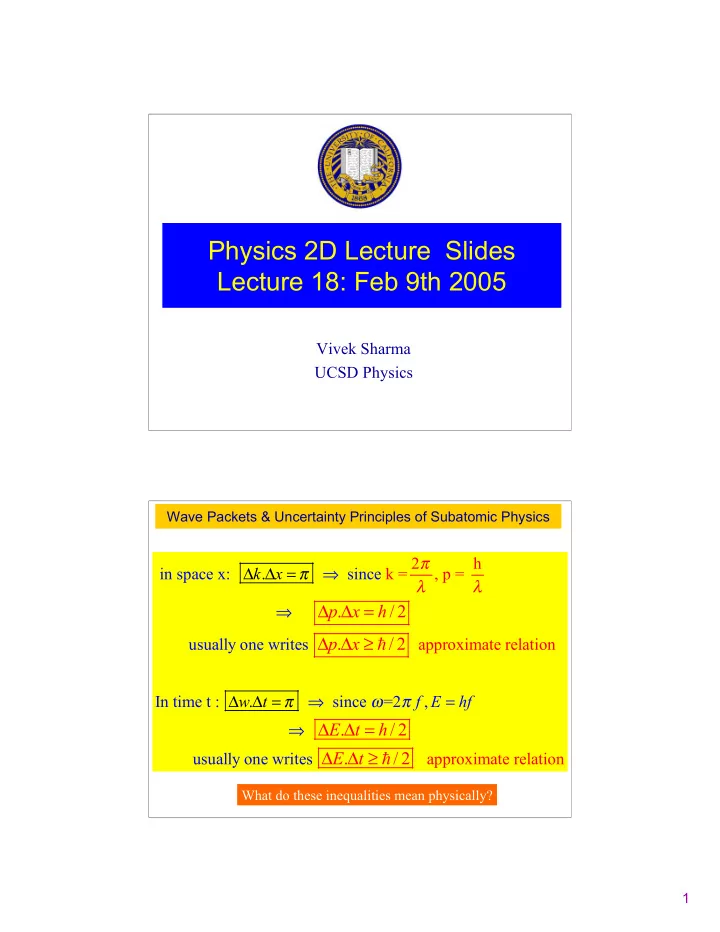
Physics 2D Lecture Slides Lecture 18: Feb 9th 2005 Vivek Sharma UCSD Physics Wave Packets & Uncertainty Principles of Subatomic Physics 2 h = in space x: k . x since k = , p = = p .


slide-1
SLIDE 1

1

Physics 2D Lecture Slides Lecture 18: Feb 9th 2005

Vivek Sharma UCSD Physics

Wave Packets & Uncertainty Principles of Subatomic Physics

in space x: since usual 2 h k = , p = approximate relation ly one writes In time t : since =2 , . .

. / 2 . / 2

k x w f E hf t

p x h p x

  • =
  • =

=

=

usually approximate re

  • ne write

lation s

. / 2 . / 2 E t h E t =

  • What do these inequalities mean physically?
slide-2
SLIDE 2

2 Signal Transmission and Bandwidth Theory

  • Short duration pulses are used to transmit digital info

– Over phone line as brief tone pulses – Over satellite link as brief radio pulses – Over optical fiber as brief laser light pulses

  • Ragardless of type of wave or medium, any wave pulse

must obey the fundamental relation

» ΔωΔt ≅ π

  • Range of frequencies that can be transmitted are called

bandwidth of the medium

  • Shortest possible pulse that can be transmitted thru a

medium is Δtmin ≅ π/Δω

  • Higher bandwidths transmits shorter pulses & allows high data rate

Crucial Concept: Measurement Error

…and ….How well can you know it ?

slide-3
SLIDE 3

3

Know the Error of Thy Ways: Measurement Error Δ

  • Measurements are made by observing something : length, time, momentum,

energy

  • All measurements have some (limited) precision`…no matter the instrument used
  • Examples:

– How long is a desk ? L = (5 ± 0.1) m = L ± ΔL (depends on ruler used) – How long was this lecture ? T = (50 ± 1)minutes = T ± ΔT (depends on the accuracy of your watch) – How much does Prof. Sharma weigh ? M = (1000 ± 700) kg = m ± Δm

  • Is this a correct measure of my weight ?

– Correct (because of large error reported) but imprecise – My correct weight is covered by the (large) error in observation

Length Measure Voltage (or time) Measure

  • r

Measurement Error : x ± Δx

  • Measurement errors are unavoidable since the measurement procedure is an experimental one
  • True value of an measurable quantity is an abstract concept
  • In a set of repeated measurements with random errors, the distribution of measurements

resembles a Gaussian distribution characterized by the parameter σ or Δ characterizing the width

  • f the distribution

Measurement error large Measurement error smaller

slide-4
SLIDE 4

4

Interpreting Measurements with random Error : Δ

True value

Where in the World is Carmen San Diego?

  • Carmen San Diego hidden inside a big box of length L
  • Suppose you can’t see thru the (blue) box, what is you best estimate
  • f her location inside box (she could be anywhere inside the box)

x X=0 X=L Your best unbiased measure would be x = L/2 ± L/2 There is no perfect measurement, there are always measurement error

slide-5
SLIDE 5

5

Wave Packets & Matter Waves

What is the Wave Length of this wave packet? λ−Δλ < λ < λ+Δλ De Broglie wavelength λ = h/p Momentum Uncertainty: p-Δp < p < p+Δp Similarly for frequency ω or f ω−Δω < ω < ω+Δω Planck’s condition E= hf = hω/2  E-ΔE < E < E + ΔE

Back to Heisenberg’s Uncertainty Principle & Δ

  • Δx. Δp ≥ h/4π ⇒

– If the measurement of the position of a particle is made with a precision Δx and a SIMULTANEOUS measurement of its momentum px in the X direction , then the product of the two uncertainties (measurement errors) can never be smaller than ≅h/4π irrespective of how precise the measurement tools

  • ΔE. Δt ≥ h/4π ⇒

– If the measurement of the energy E of a particle is made with a precision ΔE and it took time Δt to make that measurement, then the product of the two uncertainties (measurement errors) can never be smaller than ≅h/4π irrespective of how precise the measurement tools

These rules arise from the way we constructed the Wave packets describing Matter “pilot” waves

Perhaps these rules Are bogus, can we verify this with some physical picture ??

slide-6
SLIDE 6

6

The Act of Observation (Compton Scattering)

Act of observation disturbs the observed system

The Act of Observation : Your Eye is a Camera

your eye is a camera pupil is the aperture retina is the “film”

slide-7
SLIDE 7

7

Compton Scattering: Shining light to observe electron

Light (photon) scattering off an electron I watch the photon as it enters my eye hgg g The act of Observation DISTURBS the object being watched, here the electron moves away from where it was originally λ=h/p= hc/E = c/f

Act of Watching: A Thought Experiment

Eye

Photons that go thru are restricted to this region of lens

Observed Diffraction pattern

slide-8
SLIDE 8

8

Diffraction By a Circular Aperture (Lens)

See Resnick, Halliday Walker 6th Ed , Ch 37, pages 898-900 Diffracted image of a point source of light thru a lens ( circular aperture of size d ) First minimum of diffraction pattern is located by

sin 1.22 d

  • =

See previous picture for definitions of ϑ, λ, d

Resolving Power of Light Thru a Lens

Resolving power x 2sin

  • Image of 2 separate point sources formed by a converging lens of

diameter d, ability to resolve them depends on λ & d because of the Inherent diffraction in image formation

Not resolved resolved barely resolved

ΔX d ϑ Depends on d

slide-9
SLIDE 9

9

  • Incident light (p,λ) scatters off electron
  • To be collected by lens  γ must scatter thru angle α
  • -ϑ ≤α≤ϑ
  • Due to Compton scatter, electron picks up momentum
  • PX , PY
  • After passing thru lens, photon diffracts, lands

somewhere on screen, image (of electron) is fuzzy

  • How fuzzy ? Optics says shortest distance between two

resolvable points is :

  • Larger the lens radius, larger the ϑ⇒ better resolution

Putting it all together: act of Observing an electron Eye

Photons that go thru are restricted to this region of lens

Observed Diffraction pattern

sin sin electron momentum uncertainty is ~2h p sin

x

h h P

  • 2sin

x

  • =

2 sin . 2sin . 2 / p h p x h x

  • =
  • Pseudo-Philosophical Aftermath of Uncertainty Principle
  • Newtonian Physics & Deterministic physics topples over

– Newton’s laws told you all you needed to know about trajectory of a particle

  • Apply a force, watch the particle go !

– Know every thing ! X, v, p , F, a

– Can predict exact trajectory of particle if you had perfect device

  • No so in the subatomic world !

– Of small momenta, forces, energies – Cant predict anything exactly

  • Can only predict probabilities

– There is so much chance that the particle landed here or there – Cant be sure !....cognizant of the errors of thy observations

Philosophers went nuts !...what has happened to nature Philosophers just talk, don’t do real life experiments!
slide-10
SLIDE 10

10

All Measurements Have Associated Errors

  • If your measuring apparatus has an intrinsic inaccuracy

(error) of amount Δp

  • Then results of measurement of momentum p of an
  • bject at rest can easily yield a range of values

accommodated by the measurement imprecision :

– -Δp ≤ p ≤ Δp

  • Similarly for all measurable quantities like x, t, Energy !

Matter Diffraction & Uncertainty Principle

Incident Electron beam In Y direction x Y

Probability

Momentum measurement beyond slit show particle not moving exactly in Y direction, develops a X component Of motion ΔPX =h/(2π a) X component PX of momentum ΔPX

slit size: a

slide-11
SLIDE 11

11

Heisenberg’s Uncertainty Principles

  • Δx. Δp ≥ h/4π ⇒

– If the measurement of the position of a particle is made with a precision Δx and a SIMULTANEOUS measurement of its momentum px in the X direction , then the product of the two uncertainties (measurement errors) can never be smaller than ≅h/4π irrespective of how precise the measurement tools

  • ΔE. Δt ≥ h/4π ⇒

– If the measurement of the energy E of a particle is made with a precision ΔE and it took time Δt to make that measurement, then the product of the two uncertainties (measurement errors) can never be smaller than ≅h/4π irrespective of how precise the measurement tools

What do these simple equations mean ?

The Quantum Mechanics of Christina Aguilera!

Christina at rest between two walls originally at infinity: Uncertainty in her location ΔX = ∞ . At rest means her momentum P=0 , ΔP=0 (Uncertainty principle) Slowly two walls move in from infinity on each side, now ΔX = L , so Δp ≠ 0 She is not at rest now, in fact her momentum P ≈ ± (h/2π L)

L

X Axis

Bottomline : Christina dances to the tune of Uncertainty Principle!

Christina’s Momentum p

2 2

On average, measure <p> = 0 but there are quite large fluctuations! Width of Distribution = ( ) ( ) ;

ave ave

P P L P P P

  • =
slide-12
SLIDE 12

12

A bound “particle” is one that is confined in some finite region of space. One of the cornerstones of Quantum mechanics is that bound particles can not be stationary – even at Zero absolute temperature !

There is a non-zero limit on the kinetic energy of a bound particle

Implications of Uncertainty Principles

Matter-Antimatter Collisions and Uncertainty Principle

γ

Look at Rules of Energy and Momentum Conservation : Are they ? Ebefore = mc2 + mc2 and Eafter = 2mc2 Pbefore = 0 but since photon produced in the annihilation  Pafter =2mc ! Such violation are allowed but must be consumed instantaneously ! Hence the name “virtual” particles

slide-13
SLIDE 13

13

Fluctuations In The Vacuum : Breaking Energy Conservation Rules

ΔE . Δt ≈ h/2π implies that you can (in principle) pull out an elephant + anti-elephant from NOTHING (Vaccum) but for a very very short time Δt !! Vaccum, at any energy, is bubbling with particle creation and annihilation

2

H

  • w

Muc Ho h Time : w cool i s th t ! 2 a t Mc =

  • t2

t1 How far can the virtual particles propagate ? Depends on their mass

Strong Force Within Nucleus  Exchange Force and Virtual Particles

  • Strong Nuclear force can be modeled as exchange of

virtual particles called π± mesons by nucleons (protons & neutrons)

  • π± mesons are emitted by proton and reabsorbed by a

neutron

  • The short range of the Nuclear force is due to the “large”

mass of the exchanged meson

  • Mπ = 140 MeV/c2

repulsive force: skaters exchange ball attractive: grab ball from each other’s hand

slide-14
SLIDE 14

14

Range of Nuclear Exchange Force

2 2

How long can the emitted virtual particle last? t The virtual particle has rest mass + kinetic e Particle can not live for more than t / nergy Its Range R of the meson (and t energy hu M E E c Mc

  • 34

2 2 1 2 3 15 2

1. M=140 MeV/c s the exchange force) R= 06 10 . (140 c t = c / / For / ) (1.60 10 / ) 1 1 4 .4 1. J s R MeV c c J MeV R m Mc Mc fm

  • =
  • =
  • Subatomic Cinderella Act !
  • Neutron emits a charged pion for a time

Δt and becomes a (charged) proton

  • After time Δt , the proton reabsorbs

charged pion particle (π -) to become neutron again

  • But in the time Δt that the positive

proton and π - particle exist, they can interact with other charged particles

  • After time Δt strikes , the Cinderella act

is over !

This heralds the death of common sense in subatomic world