
SLIDE 1
1
Physics 2D Lecture Slides Lecture 20: Feb 15th 2005
Vivek Sharma UCSD Physics
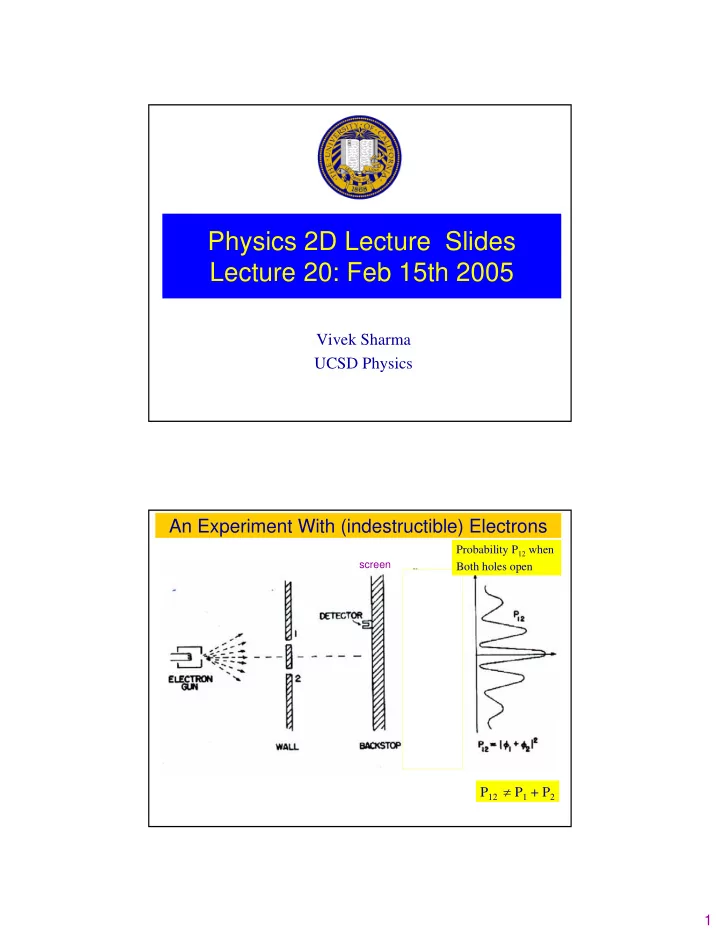
An Experiment With (indestructible) Electrons
Probability P12 when Both holes open
P12 ≠ P1 + P2
screen
Physics 2D Lecture Slides Lecture 20: Feb 15th 2005 Vivek Sharma - - PDF document
Physics 2D Lecture Slides Lecture 20: Feb 15th 2005 Vivek Sharma UCSD Physics An Experiment With (indestructible) Electrons Probability P 12 when screen Both holes open P 12 P 1 + P 2 1 Is There No Way to Beat The Uncertainty Principle?
1
Vivek Sharma UCSD Physics
Probability P12 when Both holes open
P12 ≠ P1 + P2
screen
2
Is There No Way to Beat The Uncertainty Principle?
– Mount the wall on rollers, put a lot of grease frictionless – Wall will move when electron hits it – Watch recoil of the wall containing the slits when the electron hits it – By watching whether wall moved up or down I can tell
Measuring The Recoil of The Wall Not Watching Electron !
My ingenious scheme to beat nature
3
Losing Out To Uncertainty Principle
– must know the initial momentum of the wall before electron hit it – Final momentum after electron hits the wall – Calculate vector sum = recoil
– To do this ⇒ must know momentum at all times exactly so ΔP = 0 knowledge of wall location is imprecise, ΔX = ∞ [so can not know the position of wall exactly] – If don’t know the wall location, then dont know where the holes were – Holes will be in different place for every electron that goes thru – The center of interference pattern will have different (random) location (interference pattern) for each electron – Such random shift is just enough to smear out the I. pattern so that no interference is observed !
Summary
probability amplitude
– P = probability – Ψ= probability amplitude, – P=| Ψ|2
amplitude for the event is the sum of the probability amplitudes for each way considered separately. There is interference:
– Ψ= Ψ1+ Ψ2 – P=|Ψ1+ Ψ2|2
whether one or other alternative is actually taken, the probability of the event is the sum of probabilities for each alternative. The interferenence is lost: P = P1 + P2
4
through, we are examining particle-like behavior
using wave like behavior of electron Bohr’s Principle of Complementarity: It is not possible to simultaneously determine physical
The Bullet Vs The Electron: Each Behaves the Same Way
5
Quantum Mechanics of Subatomic Particles
by a Complex wave function Ψ(x,y,z,t)
the particle under the force (in a potential e.g Hydrogen )
some point (x,y,z) and time t is given by
– P(x,y,z,t) = Ψ(x,y,z,t) . Ψ*(x,y,z,t) =| Ψ(x,y,z,t) |2
location then the probability of the event is
– Ψ = Ψ1 + Ψ2 – P = | Ψ* Ψ| = |Ψ1|2 + |Ψ2|2 +2 |Ψ1 |Ψ2| cosφ
Wave Function of “Stuff” & Probability Density
particle, its possible to assign probability P(x)dx of finding particle between x and x+dx
the probability that a photon will strike a given point within the pattern P(x,t)= |Ψ(x,t) |2 x x=a x=b Probability of a particle to be in an interval a ≤ x ≤b is area under the curve from x=a to a=b
6
Ψ: The Wave function Of A Particle
NORMALIZED
– Given the wavefunction at some instant (say t=0) find Ψ at some subsequent time t – Ψ(x,t=0) Ψ(x,t) …evolution – Think of a probabilistic view of particle’s “newtonian trajectory”
2nd law for subatomic systems
2
| ( , ) | 1 x t dx ψ
+∞ −∞
=
*
( ) ( , ) ( , )
b a
P a x b x t x t dx ψ ψ ≤ ≤ = ∫
The Wave Function is a mathematical function that describes a physical
rigorous properties :
must be continuous d dx ψ
Bad (Mathematical) Wave Functions Of a Physical System : You Decide Why
7
A Simple Wave Function : Free Particle
– Has No relationship, no mortgage , no quiz, no final exam….its essentially a bum ! – how to describe a quantum mechanical bum ?
2 2
E ; = For non-relativistic particles p k E= (k)= 2m 2m p k ω ω = ⇒
Has definite momentum and energy but location unknown ! Wave Function of Different Kind of Free Particle : Wave Packet
( )
Sum of Plane Waves: ( ,0) ( ) ( , ) ( ) Wave Packet initially localized in X, t undergoes dispersion
ikx i kx t
x a k e dk x t a k e dk
ω +∞ −∞ +∞ − −∞
Ψ = Ψ = Δ Δ
Combine many free waves to create a Localized wave packet (group) The more you know now, The less you will know later Why ?
Spreading is due to DISPERSION resulting from the fact that phase velocity of individual waves making up the packet depends on λ (k)
8
Normalization Condition: Particle Must be Somewhere
: ( ,0) , C & x are constants This is a symmetric wavefunction with diminishing amplitude The Amplitude is maximum at x =0 Prob Norma ability is max too lization Condition: How to figure
x x
Example x Ce ψ
−
= ⇒
+ + 2 2 2 2 2 2 2
x + ) = A real particle must be somewhere: Probability of finding particle is finite 1 2 2 2 ( , 0
1 t C ) ?
x x x x
x C e dx C C x dx C e x x d ψ
∞ ∞ − ∞ − ∞ ∞
⎡ ⎤ ⇒ = = = ⎢ ⎥ ⎣ ⎦ ∞ ≤ ≤ ∞ = =
1 ( , 0)
x x
x e x ψ
−
= ⇒
Where is the particle within a certain location x ± Δx
Prob |Ψ(x,0)|2 x ?
+x +x 2 2 2
2 2 2
x x
− − −
Lets Freeze time (t=0)
9
Where Do Wave Functions Come From ?
dependent Schrödinger Differential Equation (inspired by Wave Equation seen in 2C)
particle under certain force
– F(x) =
2 2 2
( , ) ( , ) ( ) ( , ) 2 x t x t U x x t i m x t ∂ Ψ ∂Ψ − + Ψ = ∂ ∂
U x x ∂ − ∂
Schrodinger had an interesting life
2 2 2
10
Schrodinger Wave Equation
Wavefunction which is a sol. of the Sch. Equation embodies all modern physics experienced/learnt so h E=hf, p= , . , . , quantiza tion etc Schrodinge fa r Equation is a D r: x p E t λ ψ Δ Δ Δ Δ ∼ ∼ (x,0) (x,t) Evolves the System as a function ynamical Equation much like Newton's Equation F
The Schrodinger Eq. propogates the Force(potentia system forwar l d & backward = a ) m ψ ψ
→
→ →
(x, t) = (x,0) Where does it come from ?? ..."First Principles"..no real derivation exists
t
d t dt ψ ψ δ ψ δ
=
⎡ ⎤ ± ⎢ ⎥ ⎣ ⎦
Time Independent Sch. Equation
( )
2 2 i(kx 2
The Wave function is factorizable: can be broken up ( , ) ( , ) ( ) ( , ) 2 x,t ( ) : Plane Wave (x,t ( )=e ) Exa x t x t U x x t i m x t x mple t ψ φ ∂ Ψ ∂Ψ − + Ψ = ∂ ∂ Ψ = Ψ
i(kx)
2 2 2 2 2 2
( ) ( ). ( ) ( ) ( ) ( ) 2m
( ) 1 In suc ( ) . ( ) 2m ( ) h cases, use seperation of variables to get : Divide Throughout by (x,t e e L )= HS ( ( x) ( t) s ) i x t t U x x t i x x t x t U x i x x t t
ω ω
ψ φ φ ψ φ ψ ψ φ φ ψ φ ψ ∂ ∂ + = ∂ ∂ ∂ Ψ ⇒ ∂ = ∂ + = ∂
x and t are independent variables, hence : RHS = LHS = Constant = E ⇒
11
Factorization Condition For Wave Function Leads to:
2 2 2
( ) ( ) ( ) 2m ( ) ( ) x U x x E x x t i E t t ψ ψ ψ φ φ ∂ + = ∂ ∂ = ∂
ikx
What is the Constant E ? How to Interpret it ? Back to a Free particle : (x,t)= Ae e , (x)= Ae U(x,t) = 0 Plug it into the Time Independent Schrodinger Equation (TISE)
ω
ψ Ψ ⇒
2 2 2 2 2 (
2 2 ) ( ) 2
(NR Energy) 2 2 Stationary states of the free particle: (x,t)= (x)e ( , ) ( ) Probability is static in time t, character of wave function ( ) depends on 2
ikx ikx
k p E m m x d Ae E t A dx x e m
ω
ψ ψ − = = = Ψ ⇒ = = ⇒ Ψ +
x ψ
A More Interesting Potential : Particle In a Box
U(x,t) = ; x 0, x L U(x,t) = 0 ; 0 < X < Write the Form of Potential: Infinite Wall L ∞ ≤ ≥
infinite energy to overcome potential of wall
U(x)
What happens when the joker is subatomic in size ??
12
Example of a Particle Inside a Box With Infinite Potential
(a) Electron placed between 2 set of electrodes C & grids G experiences no force in the region between grids, which are held at Ground Potential However in the regions between each C & G is a repelling electric field whose strength depends on the magnitude of V (b) If V is small, then electron’s potential energy vs x has low sloping “walls” (c) If V is large, the “walls”become very high & steep becoming infinitely high for V→∞ (d) The straight infinite walls are an approximation of such a situation
U=∞
U(x)
U=∞ Ψ(x) for Particle Inside 1D Box with Infinite Potential Walls
2 2 2 2 2 2 2 2 2 2 2
Inside the box, no force U=0 or constant (same thing) ( ) ( ) ; ( ) ( ) fig
( ) ( ) ure out 2m what (x) solves this diff e 2 q. In General the solu d x x E d x k x dx d x k x dx x dx mE k
ψ ψ ψ ψ ψ ψ ψ ψ ⇒ ⇒ ⇒ = − + = ⇐ + = =
t p io pl n is y BO ( ) UNDA R (A,B are constants) Need to figure out values of A, B : How to do that ? We said ( ) must be continuous everywhe Y Conditions on the Physical Wav re So efunction x A sinkx B coskx x ψ ψ = + match the wavefunction just outside box to the wavefunction value just inside the box & A Sin kL = 0 At x = 0 ( 0) At x = L ( ) ( 0) 0 (Continuity condition at x =0) & ( ) x x L x B x L ψ ψ ψ ψ ⇒ ∴ ⇒ = = ⇒ = = = = ⇒ = = =
2 2 2 n 2
(Continuity condition at x =L) n kL = n k = , 1,2,3,... L So what does this say about Energy E ? : n E = Quantized (not Continuous)! 2 n mL π π π ⇒ ⇒ = ∞
Why can’t the particle exist Outside the box ? E Conservation ∞ ∞ X=L
13
Quantized Energy levels of Particle in a Box What About the Wave Function Normalization ?
n We will call n Quantum Number , just like in Bohr's Hydrogen atom W The particle's Energy and Wavefu hat about the wave functions cor nct res ion a pondi re determi ng to each ned by a
nu e mb g er ner →
n L * 2 2 2 n 2 n
y states? sin( ) sin( ) for 0<x < L = 0 for Normalized Condition : 1 x 0, x L Use 2Sin 1 2 2 2 1 1 c = ( )
2
L
n x dx A S n x A kx A L Cos A in L π ψ θ π ψ θ ψ = = ≥ ≥ = − = − =
n 2
) and since cos = sin 2 1 2 So 2 2 sin( ) sin ...What does this look ) l ( ike?
L
n x kx L L L n x L A L A L π θ π θ ψ = ⎛ ⎞ ⎜ ⎟ ⎝ ⎠ = ⇒ = =
14
Wave Functions : Shapes Depend on Quantum # n
Wave Function
Probability P(x): Where the particle likely to be
Zero Prob
Where in The World is Carmen San Diego?
probability of finding the particle somewhere in x
– For n=1 (ground state) particle most likely at x = L/2 – For n=2 (first excited state) particle most likely at L/4, 3L/4
– How does the particle get from just before x=L/2 to just after? » QUIT thinking this way, particles don’t have trajectories » Just probabilities of being somewhere
Classically, where is the particle most Likely to be : Equal prob of being anywhere inside the Box NOT SO says Quantum Mechanics!
15
Remember Sesame Street ?
This particle in the box is brought to you by the letter
Its the Big Boss Quantum Number
How to Calculate the QM prob of Finding Particle in Some region in Space
3 3 3 4 4 4 2 2 1 L L L 4 4 4 3 / 4 / 4
Consider n =1 state of the particle L 3 Ask : What is P ( )? 4 4 2 2 1 2 P = sin . (1 cos ) 2 1 2 1 1 2 3 2 sin sin . sin . 2 2 2 2 4 4 1
L L L L L
L x x x dx dx dx L L L L L L x L L P L L L L P π π ψ π π π π π ≤ ≤ ⎛ ⎞ = = − ⎜ ⎟ ⎝ ⎠ ⎡ ⎤ ⎡ ⎤ ⎛ ⎞ = − = − − ⎜ ⎟ ⎢ ⎥ ⎢ ⎥ = ⎣ ⎦ ⎣ ⎦ ⎝ ⎠
Classically 50% (equal prob over half the box size) Substantial difference between Class 1 ( 1 1) 0.818 8 ical & Quantu 1. m predictio 8 n 2 s % 2π − − − ⇒ = ⇒ ⇒
16
When The Classical & Quantum Pictures Merge: n→∞
But one issue is irreconcilable: Quantum Mechanically the particle can not have E = 0 This is a consequence of the Uncertainty Principle The particle moves around with KE inversely proportional to the Length Of the 1D Box