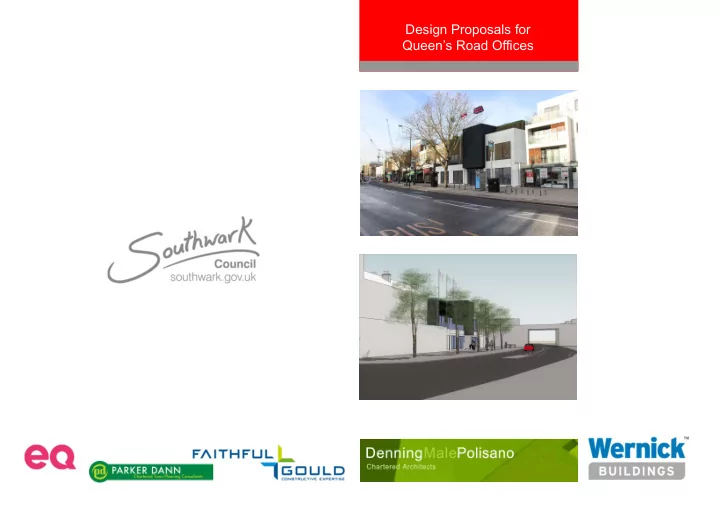
SLIDE 1
Design Proposals for Queen’s Road Offices
SLIDE 2 History 1980
Site Cleared for construction of the Day Centre.
1862-71
First recorded development on local maps
1874
Huge development in the early 1870s with the coming of the Railway. The site and surrounding neighbourhood fully developed and remaining unchanged for
1968 1842
Open agricultural land
SLIDE 3
Townscape
Queen’s Road Asylum Road
SLIDE 4
Potential Impacts Daylight/Sunlight Overlooking/Privacy Noise
A Noise Impact Assessment has been to undertaken and found that projected levels are significantly below typical background levels which indicates that the sound source will have a low impact on the residential properties.
SLIDE 5
Overlooking
There are no specific rules relating to overlooking but it is an understandable concern of residents
.
Conflict of light in and vision out. Screening- Natural – Gaps filled Screening- Applied – Timber slats – oblique angles In other areas, where the issue is less pressing, frosted or etched glass restrict views from windows.
SLIDE 6 The ’45o’ Rule
Daylight and Sunlight #1
The 25o Rule The ’45o’ Rule Rules for assessing the impact of new developments on Sunlight and Daylight reaching existing properties Residential Design Standards adopted by the Local Authority require that certain tests are applied where proposed development faces the affected windows of neighbouring properties.
The 25o Rule
There are also standards for measuring the impact of
- vershadowing from proposed new developments.
Assessments show that the proposed form complies with the established guidelines Overshadowing Analysis – Sun path 21st March Shadowing
SLIDE 7 Daylight and Sunlight #2
The rules were applied to all habitable windows that look
- n to the site and a notional ‘tent’ established, below
which the building form could be developed without contravention of established standards. Application of the 25o and 45o Rules King’s Grove Section showing the proposed building
2pm 3pm 4pm 2-Storey 4-Storey
Height constraints established by the 25o and 45o Rules
3-Storey
SLIDE 8
The Design
The 4-storey option
It is a design intent to make the building to be fully accessible as possible for all users.
SLIDE 9
The Building
The preferred 3-storey option
SLIDE 10 The Building
GEA (sq.m.) (sq.ft.) GIA (sq.m.) (sq.ft.) Gnd Floor 1823 19623 1744 18772 1st Floor 1639 17642 1555 16738 2nd Floor 1052 11324 1003 10796 4514 48588 4302 46306
Ground Floor 1st Floor 2nd Floor
SLIDE 11 TREES We will retain as many trees as possible. Replacement planting will be provided both on and off site to enhance local areas. The trees to be replaced as a result of this development are shown in red tone on the plan.
Ecology
HABITATS Environmental appraisals have shown that there are no habitats of principal importance
- n the site and those habitats present were
- f limited value to wildlife.
The Ecological value will be enhanced at roof level Green Roofs
- A ‘green’ roof will provide habitats for bees
and insects, give shelter to a range of small invertebrates and reduce rainwater run off rates
SLIDE 12 Sustainability
A BREEAM “excellent” rating is sought.
- Enhanced levels of thermal insulation
- Photovoltaic panels.
- Batteries to store the energy.
- A ‘green’ roof will reduce rainwater run off rates.
- SUDS drainage will prevent surcharging the drainage system.
- Efficient Service plant to reduce energy, waste and pollution.
- Electric charging for pool cars,
- Sourcing of sustainable materials and products
- Smart controls to reduce energy usage.
- Use of recycled and recyclable materials
SLIDE 13 Demolition and Construction
OFF- SITE CONSTRUCTION
- Factory Construction
- Safety
- Speed
- Quality
- Reduced waste
- efficient processes.
Demolition
- Programme - 12 weeks
- Strict Control on site
- Designated person to respond to residents concerns.
- Monday to Friday 0800 to 1700 and Saturdays 0800 to 1300.
- Enclosed site and areas near boundaries will be scaffolded and
sheeted
- Access will be via Asylum Road
- Dust suppression
- Wheel wash
SLIDE 14
Transport and Parking
Parking
No staff parking will be provided - 7 car spaces including two to disabled parking bays will be provided for pool use only. A parking survey assessed that there is a clear trend towards vehicles parking either for short 1-2 hour intervals, or for periods of over 12 hours, indicates predominantly residential and shopping uses. The existing high parking demand will deter future car users and therefore the proposed development, will not result in a loss of on-street parking spaces.
Public Transport
The site is well served by public transport with numerous bus routes and Queen’s Road station a matter of minutes away.
Travel Plan
A Travel Plan will be developed to encourage sustainable journeys. 84 secure cycle storage spaces will be provided. This is twice that required by current planning policy. Showers and lockers for will encourage walking and cycle usage. The Plan will encourage staff to make sustainable travel choices.
Asylum Road Frontage – Parking arrangement Staff Cycle Store