Physics 2D Lecture Slides Lecture 14: Feb 1 st 2005 Vivek Sharma - - PDF document

physics 2d lecture slides lecture 14 feb 1 st 2005
SMART_READER_LITE
LIVE PREVIEW

Physics 2D Lecture Slides Lecture 14: Feb 1 st 2005 Vivek Sharma - - PDF document

Physics 2D Lecture Slides Lecture 14: Feb 1 st 2005 Vivek Sharma UCSD Physics Compton Effect: what should Happen Classically? Plane wave [f, ] incident on a surface with loosely bound electrons interaction of E field of EM wave with


slide-1
SLIDE 1

1

Physics 2D Lecture Slides Lecture 14: Feb 1st 2005

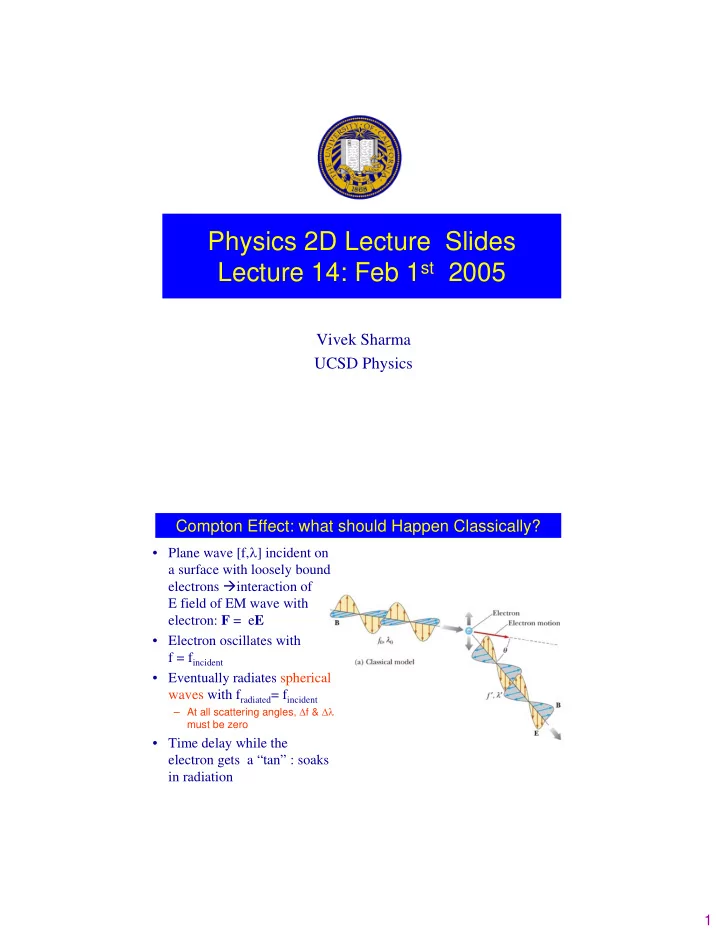
Vivek Sharma UCSD Physics Compton Effect: what should Happen Classically?

  • Plane wave [f,λ] incident on

a surface with loosely bound electrons interaction of E field of EM wave with electron: F = eE

  • Electron oscillates with

f = fincident

  • Eventually radiates spherical

waves with fradiated= fincident

– At all scattering angles, Δf & Δλ must be zero

  • Time delay while the

electron gets a “tan” : soaks in radiation

slide-2
SLIDE 2

2

Compton Scattering : Summary of Observations

How does one explain this startling anisotropy?

'

(1 cos ) ! Not isotropy in distribution of scatte (

  • )

red radiati n

  • λ

λ λ θ Δ = ∝ −

Compton Effect : Quantum (Relativistic) Pool

slide-3
SLIDE 3

3

Compton Scattering: Quantum Picture

2 e e e

E+m ' p = p'cos +p cos p'sin -p sin Use these to e Energy Conservation: Momentum Conserv liminate electron deflection angle (n

  • t measured

: )

e

c E E θ φ θ φ = + =

e e e 2 2 2 2 4 2 e 2 2 e e 2

p 2 'cos p cos 'cos p sin 'sin Square and add Eliminate p & using E & E ( ') '

e e e e

p c m c E E m p p p E p pp p c φ θ φ θ θ = = − + + = = + − = − ⇒

( )

2 2 2 2 2 2 2 2 2 2 2 2 2 2 2 2 2

( ') ' 2 ' 2( ') ( ' ) ( 2 'cos ( ) E For light p= c ' ( ') 'cos E-E' 1 )(1 co ' ' ' 2 co (1 cos ) EE' s s )

e e e e

E E m c EE E E m c E E EE E mc p pp p E E E E E mc h E E c c c c m m c c θ θ θ θ λ λ θ ⇒ = ⇒ − + − = − ⇒ = − − ⇒ − + = + ⎡ ⎤ − + + ⎣ − + − − = − ⎦ ⎡ ⎤ − + ⎢ ⎥ ⎣ ⎦

Compton Scattering: The Quantum Picture

2 e e e

E+m ' p = p'cos +p cos p'sin -p sin Use these to e Energy Conservation: Momentum Conserv liminate electron deflection angle (n

  • t measured

: )

e

c E E θ φ θ φ = + =

slide-4
SLIDE 4

4

( ' ) ( )(1 cos )

e

h m c λ λ θ − = −

Rules of Quantum Pool between Photon and Electron Checking for h in Compton Scattering

Plot scattered photon data, calculate slope and measure “h”

Δλ

1-cos ϑ

( ' ) ( )(1 cos )

e

h m c λ λ θ − = −

It’s the same value for h again !!

C

  • m

p t

  • n

w a v e l e n g t h λC = h / me c

Energy Quantization is a UNIVERSAL characteristic

  • f energy transactions !
slide-5
SLIDE 5

5

Saw what light does, Now examine nature

  • f matter
  • Fundamental Characteristics of different forms of matter

– Rest Mass (m) – Electric Charge (q)

  • Measurable

– using some combination of E & B fields interacting with the particle – Or E/B or some other macroscopic force

e.g. Drag Force

The “magic” is that one is measuring tiny tiny numbers using Macroscopic devices

( ) F q E v B = + ×

  • Reading Assignment, one problem

from here may be on the quiz

Thomson’s Determination of e/m of the Electron

  • In E Field alone, electron lands at D
  • In B field alone, electron lands at E
  • When E and B field adjusted to cancel

each other’s force electron lands at F e/m = 1.7588 x 10¹¹ C/Kg

slide-6
SLIDE 6

6

Millikan’s Measurement of Electron Charge

Find charge on oil drop is always in integral multiple of some Q qe = 1.688 x 10⁻¹⁹ Coulombs me = 9.1093 x 10⁻³¹ Kg Fundamental properties (finger print) of electron (similarly can measure proton properties etc) Bragg Scattering

photographic film

slide-7
SLIDE 7

7

Summary : From X Ray (EM Wave) Scattering data, Size of the Atom was known to be about 10-10 m

Where are the electrons inside the atom?

Early Thought: “Plum pudding” model Atom has a homogenous distribution of Positive charge with electrons embedded in them (atom is neutral)

  • How to test these hypotheses? Shoot “bullets” at the atom and

watch their trajectory. What Kind of bullets ?

  • Indestructible charged bullets Ionized He++ atom = α++ particles
  • Q = +2e , Mass Mα=4amu >> me , Vα= 2 x 10 7 m/s (non-relavistic)

[charged to probe charge & mass distribution inside atom] e- e- e- e- e- e- e- e- e- e- e- e- e- e- e- e- e- e- e-

Positively charged matter

?

+ Core

  • r

+

slide-8
SLIDE 8

8

Plum Pudding Model of Atom

  • Non-relativistic mechanics (Vα/c = 0.1)
  • In Plum-pudding model, α-rays hardly scatter because

– Positive charge distributed over size of atom (10-10m) – Mα >> Me (like moving truck hits a bicycle) – predict α-rays will pass thru array of atoms with little scatter (~1o)

Need to test this hypothesis Ernest Rutherford

Probing Within an Atom with α Particles

  • Most α particles pass thru gold foil with nary a deflection
  • SOME (≅10-4) scatter at LARGE angles Φ
  • Even fewer scatter almost backwards Why
slide-9
SLIDE 9

9

“Rutherford Scattering” discovered by his PhD Student (Marsden)

Rutherford Discovers Nucleus (Nobel Prize)

slide-10
SLIDE 10

10

Force on α-particle due to heavy Nucleus

  • Outside radius r =R, F ∝ Q/r2
  • Inside radius r < R, F ∝ q/r2 = Qr/R2
  • Maximum force at radius r = R

2

particle trajectory is hyperbolic Scattering angle is related to impact par. Impact Parameter cot 2 kq Q b m v

α α α

α θ ⎛ ⎞⎛ ⎞ = ⎜ ⎟⎜ ⎟ ⎝ ⎠ ⎝ ⎠ Rutherford Scattering: Prediction and Experimental Result

2 2 4 2 2 2 4

1 4 ( / 2) 2 k Z e NnA n R m v Sin

α α

ϕ Δ = ⎛ ⎞ ⎜ ⎟ ⎝ ⎠

  • # scattered Vs φ depends on :
  • n = # of incident alpha particles
  • N = # of nuclei/area of foil
  • Ze = Nuclear charge
  • Kα of incident alpha beam
  • A= detector area
slide-11
SLIDE 11

11

Rutherford Scattering & Size of Nucleus

2

distance of closest appoach r size of nucleus 1 Kinetic energy of = K = 2 particle will penetrate thru a radius r until all its kinetic energy is used up to do work AGAINST the Coulomb potent m v

α α β

α α ∝

( )( )

  • Al

2 15 2 15

  • 10

2

For K =7.7.MeV, Z 13 2 ial of the Size of Nucleus = 10 Siz Nucleus: 2 1 K = 8 2 4.9 e of Ato m = 1 10 2 kZ Ze e m v MeV k e r m K kZe r K m m r

α α α β α α −

= ⇒ = = × = = ⇒ = nucleus nucleus

Dimension Matters !

  • 15
  • 10

Size of Nucleus = 10 Size of Atom = 10 m m

  • how are the electrons located inside an atom
  • How are they held in a stable fashion
  • necessary condition for us to exist !
  • All these discoveries will require new experiments and observations
slide-12
SLIDE 12

12

Rutherford Atom & Classical Physics

?

Continuous & Discrete spectra of Elements

slide-13
SLIDE 13

13

Visible Spectrum of Sun Through a Prism

Emission & Absorption Line Spectra of Elements

slide-14
SLIDE 14

14

Kirchhoff’ Experiment : “D” Lines in Na

D lines darken noticeably when Sodium vapor introduced Between slit and prism

Emission & Absorption Line Spectrum of Elements

  • Emission line appear dark

because of photographic exposure

Absorption spectrum of Na While light passed thru Na vapor is absorbed at specific λ

slide-15
SLIDE 15

15

Spectral Observations : series of lines with a pattern

  • Empirical observation (by trial & error)
  • All these series can be summarized in a simple formula

2 7 1 2

1 1 1 , , 1,2,3,4.. Fitting to spectral line serie s R= data 1.09737 10

f i i f i

R n n n n n m λ

× ⎛ ⎞ = − > = ⎜ ⎟ ⎜ ⎟ ⎝ ⎠

How does one explain this ? The Rapidly Vanishing Atom: A Classical Disaster !

Not too hard to draw analogy with dynamics under another Central Force Think of the Gravitational Force between two objects and their circular orbits. Perhaps the electron rotates around the Nucleus and is bound by their electrical charge

2 2 2 1 2 1

M M F= G k r r Q Q ⇒

Laws of E&M destroy this equivalent picture : Why ?