Physics 2D Lecture Slides Lecture 16: Feb 7th 2005 Vivek Sharma - - PDF document

physics 2d lecture slides lecture 16 feb 7th 2005
SMART_READER_LITE
LIVE PREVIEW

Physics 2D Lecture Slides Lecture 16: Feb 7th 2005 Vivek Sharma - - PDF document

Physics 2D Lecture Slides Lecture 16: Feb 7th 2005 Vivek Sharma UCSD Physics Bohrs Atom: Emission & Absorption Spectra photon photon 1 Another Look at the Energy levels 2 2 ke Z = E n 2 2 a


slide-1
SLIDE 1

1

Physics 2D Lecture Slides Lecture 16: Feb 7th 2005

Vivek Sharma UCSD Physics

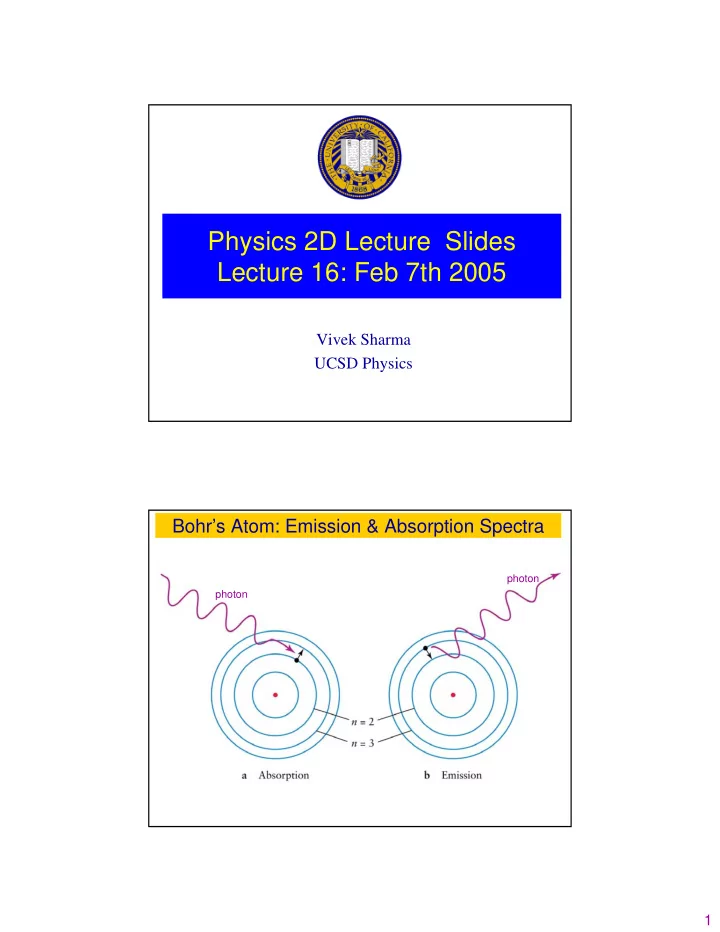
Bohr’s Atom: Emission & Absorption Spectra

photon photon
slide-2
SLIDE 2

2

Another Look at the Energy levels

2 2 2

2

n

ke Z E a n ⎛ ⎞ = −⎜ ⎟ ⎝ ⎠

Rydberg Constant

Atomic Excitation by Electrons: Franck-Hertz Expt

Other ways of Energy exchange are also quantized ! Example:

  • Transfer energy to atom by colliding electrons on it
  • Accelerate electrons, collide with Hg atoms, measure energy

transfer in inelastic collision (retarding voltage)

slide-3
SLIDE 3

3

Atomic Excitation by Electrons: Franck-Hertz Expt

Plot # of electrons/time (current) overcoming the retarding potential (V) Equally spaced Maxima and minima in I-V curve Atoms accept only discrete amount of Energy, no matter the fashion in which energy is transffered ΔE ΔE

Bohr’s Explanation of Hydrogen like atoms

  • Bohr’s Semiclassical theory explained some spectroscopic

data Nobel Prize : 1922

  • The “hotch-potch” of clasical & quantum attributes left

many (Einstein) unconvinced

– “appeared to me to be a miracle – and appears to me to be a miracle today ...... One ought to be ashamed of the successes of the theory”

  • Problems with Bohr’s theory:

– Failed to predict INTENSITY of spectral lines – Limited success in predicting spectra of Multi-electron atoms (He) – Failed to provide “time evolution ” of system from some initial state – Overemphasized Particle nature of matter-could not explain the wave- particle duality of light – No general scheme applicable to non-periodic motion in subatomic systems

  • “Condemned” as a one trick pony ! Without fundamental

insight …raised the question : Why was Bohr successful?

slide-4
SLIDE 4

4

Prince Louise de Broglie & Matter Waves

  • Key to Bohr atom was Angular momentum quantization
  • Why this Quantization: mvr = |L| = nh/2π ?
  • Invoking symmetry in nature, Louise de Broglie

(Da Prince of France !) conjectured:

Because photons have wave and particle like nature particles may have wave like properties !! Electrons have accompanying “pilot” wave (not EM) which guide particles thru spacetime

A PhD Thesis Fit For a Prince

  • Matter Wave !

– “Pilot wave” of λ = h/p = h / (γmv) – frequency f = E/h

  • Consequence:

– If matter has wave like properties then there would be interference (destructive & constructive)

  • Use analogy of standing waves on a plucked

string to explain the quantization condition of Bohr orbits

slide-5
SLIDE 5

5

Matter Waves : How big, how small

34 34

1.Wavelength of baseball, m=140g, v=27m/s h 6.63 10 . = p (.14 )(27 / ) size of nucleus Baseball "looks"

  • 2. Wavelength of electr

like a particle 1.75 10

baseball

h J s mv kg m s m λ λ

− −

× = <<< = ⇒ × = ⇒

1 2

  • 31

19

  • 24

3 2 4 4

  • n K=120eV (assume NR)

p K= 2 2m = 2(9.11 10 )(120 )(1.6 10 ) =5.91 10 . / 6.63 10 Size . 5.91 10 . /

  • f at

1

  • 1.12

e e

p mK eV Kg m s J s kg m s h m p λ λ

− − − −

⇒ = × × × × = = × ⇒ = ×

  • m !!

Models of Vibrations on a Loop: Model of e in atom

Modes of vibration when a integral # of λ fit into loop ( Standing waves) vibrations continue Indefinitely Fractional # of waves in a loop can not persist due to destructive interference

slide-6
SLIDE 6

6

De Broglie’s Explanation of Bohr’s Quantization Standing waves in H atom: s Constructive interference when n = 2 r Angular momentum Quantization condit ince h = p ...... io ! ( ) 2 n h m NR nh r m n mvr v v λ π λ π ⇒ ⇒ = = =

  • n = 3

This is too intense ! Must verify such “loony tunes” with experiment

Reminder: Light as a Wave : Bragg Scattering Expt

Interference Path diff=2dsinϑ = nλ

Range of X-ray wavelengths scatter Off a crystal sample X-rays constructively interfere from Certain planes producing bright spots

slide-7
SLIDE 7

7

Verification of Matter Waves: Davisson & Germer Expt If electrons have associated wave like properties expect interference pattern when incident on a layer of atoms (reflection diffraction grating) with inter-atomic separation d such that path diff AB= dsinϑ = nλ Layer of Nickel atoms

Atomic lattice as diffraction grating

Electrons Diffract in Crystal, just like X-Rays !!

Diffraction pattern produced by 600eV electrons incident on a Al foil target Notice the waxing and waning of scattered electron Intensity. What to expect if electron had no wave like attribute

slide-8
SLIDE 8

8

Davisson-Germer Experiment: 54 eV electron Beam

Scattered Intensity Polar Plot Cartesian plot max Max scatter angle Polar graphs of DG expt with different electron accelerating potential when incident on same crystal (d = const)

Peak at Φ=50o when Vacc = 54 V

Analyzing Davisson-Germer Expt with de Broglie idea

10 acc acc 2 2

de Broglie for electron accelerated thru V =54V 1 2 ; 2 2 If you believe de Broglie h = 2 (de Br 2 V = 54 Volts 1.6

  • g

p 2 F lie) Exptal d 7 10

  • r

predict

p eV mv K eV v m m h h mv eV m m eV p mv m m h meV m λ λ λ λ

  • =

= = ⇒ = = = = = × = = ⇒ =

nickel m

  • 10

ax

ata from Davisson-Germer Observation: Diffraction Rule : d sin = =2.15 10 (from Bragg Scattering) (observation from scattering intensity p n d =2.15 A 50 lo

  • )

F t r P

  • diff

m θ φ λ = ⇒ ×

  • pred
  • ict
  • bserv

1.67 rincipal Maxima (n=1); = agreement (2.15 A)(sin =1 50 ) .65

meas

A Excellent A λ λ λ =

slide-9
SLIDE 9

9

Davisson Germer Experiment: Matter Waves !

Excellent Agreeme 2 nt

predict

h meV λ =

Practical Application Electron Microscope !

slide-10
SLIDE 10

10

Electron Micrograph Showing Bacteriophage Viruses in E. Coli bacterium The bacterium is ≅ 1μ size

Electron Microscope : Excellent Resolving Power West Nile Virus extracted from a crow brain

slide-11
SLIDE 11

11

So Just What is Waving in Matter Waves ?

  • For waves in an ocean, it’s the

water that “waves”

  • For sound waves, it’s the

molecules in medium

  • For light it’s the E & B vectors
  • What’s waving for matter

waves ?

– It’s the PROBABLILITY OF FINDING THE PARTICLE that waves ! – Particle can be represented by a wave packet in

  • Space
  • Time
  • Made by superposition of

many sinusoidal waves of different λ

  • It’s a “pulse” of probability

Imagine Wave pulse moving along a string: its localized in time and space (unlike a pure harmonic wave)

What Wave Does Not Describe a Particle

  • What wave form can be associated with particle’s pilot wave?
  • A traveling sinusoidal wave?
  • Since de Broglie “pilot wave” represents particle, it must travel with same speed

as particle ……(like me and my shadow)

cos ( ) y A kx t ω = − + Φ cos ( ) y A kx t ω = − + Φ x,t y

2 , 2 k w f π π λ = =

p 2 2 p 2 p

In Matter: h ( ) = Phase velocity

  • f sinusoid

E (b) f = a l wave: (v ) v h ! v E mc c f c p h a p mv v m m h f v c λ γ γ γ λ λ γ = = = = = = > = ⇒

Conflicts with Relativity Unphysical Single sinusoidal wave of infinite extent does not represent particle localized in space Need “wave packets” localized Spatially (x) and Temporally (t)

slide-12
SLIDE 12

12

Wave Group or Wave Pulse

  • Wave Group/packet:

– Superposition of many sinusoidal waves with different wavelengths and frequencies – Localized in space, time – Size designated by

  • Δx or Δt

– Wave groups travel with the speed vg = v0 of particle

  • Constructing Wave Packets

– Add waves of diff λ, – For each wave, pick

  • Amplitude
  • Phase

– Constructive interference over the space-time of particle – Destructive interference elsewhere !

Wave packet represents particle prob localized Imagine Wave pulse moving along a string: its localized in time and space (unlike a pure harmonic wave)

[ ]

2 1 1 2 1 1 2 2 2 1 2 1 2 1 2 2 1

Resulting wave's "displacement " y = y : cos( ) cos( ) A+B A-B Trignometry : cosA+cos B =2cos( )cos( ) 2 2 2 cos( ) 2 2 since , k cos( ) 2 2

ave

k y y A k k w w x k k w x w t k x w t k k w w y A x t t + + ⎛ ⎞ − ⎜ + = − + − − − ⎡ ⎤ ⎛ ⎞ ∴ = − ⎜ ⎟ ⎟ ⎢ ⎥ ⎝ ⎠ ≅ ⎝ ⎠ ⎦ ≅ ⎣ ≅

' 1

y = A cos( ) ' 2 cos( ) = modulated amplit cos( ) A' oscillates in x,t ud 2 cos( ) , e 2 2 , 2 , 2

ave

ks wt k w y A x kx w w w k k w t A A x w k w t t − − Δ Δ ⎛ ⎞ = − Δ Δ ⎡ ⎤ ⎛ ⎞ ⎜ ⎟ ⎝ ⎠ ∴ = − ≡ ⎜ ⎟ ⎢ ⎥ ⎝ ⎠ ⎣ ⎦ ≅ Δ Δ

  • g

Phase Vel V Group Vel V : Vel of envelope=

ave p ave g

w k w k dw V dk = Δ = Δ

wave Group Or packet

slide-13
SLIDE 13

13

Wave Packet : Localization

  • Finite # of diff. Monochromatic waves always produce INFINTE

sequence of repeating wave groups can’t describe (localized) particle

  • To make localized wave packet, add “ infinite” # of waves with

Well chosen Ampl A, Wave# k, ang. Freq. w localized vgt x

( )

( ) Amplitude Fn diff waves of diff k have different amplitudes A(k) w = w(k), depends on type of wave, media ( , ) Group Velocity ( )

i k g x k wt k

e dk A x t dw V k dk k A ψ

∞ − −∞ =

= = = ⇒

Group, Velocity, Phase Velocity and Dispersion

p

In a Wave Packet: ( ) Group Velocity Since V ( )

g k k p p g p k k k k

w w k dw V dk wk def w k dV dw V V k dk dk V

= = =

= = = ⇒ = = = + ∴

p p p

Material in which V varies with are said to be Dispersive Individual harmonic waves making a wave pulse travel at different V thus changing shape of pulse an usu d b ally V ( ecome spread out )

p

V k orλ λ =

g g

In non-dispersive media, V In dispersive media V ,depends on

p p p

V dV V dk = ≠ 1ns laser pulse disperse By x30 after travelling 1km in optical fiber

slide-14
SLIDE 14

14

Matter Wave Packets

2 g 2

Energy E = hf = mc Consider An Electron: mass = m velocity = v, momentum = p ; 2 = 2 mc h 2 2 k h Wavelength = ; = Group Velocity / / : p 2 V dw dw dv dk dk dv dw d dv f k mv h dv π ω π γ π π γ λ λ γ ⇒ = = = = =

2 1/ g 2 2 1/ 2 2 3/ 2 2 3/ 2 2

/ V mc 2 mv 2 m h & v v v [1- Group velocity of electron Wave packet "pilot wave" ( ) ] h 2 v [1-( ) ] [1-( ) ] h[1-( ) ] / c c c c dk d dv dv dw dw dv v dk dk m h dv v π π π π ⎡ ⎤ ⎢ ⎥ = = ⎢ ⎥ ⎢ ⎥ ⎣ ⎦ ⎡ ⎤ ⎢ ⎥ = ⎢ ⎥ ⎢ ⎥ ⎣ = ⎦ = = ⇒

2 p

But velocity of individual waves is same as el making up the wave packet ect V ron's physical v (not physical e ) ! i y loc t w c c k v = = >

Wave Packets & Uncertainty Principle

  • Distance ΔX between adjacent minima = (X2)node - (X1)node
  • Define X1=0 then phase diff from X1 X2 =π

2 cos( ) cos( ) 2 2 k w y A x t kx wt Δ Δ ⎡ ⎤ ⎛ ⎞ = − − ⎜ ⎟ ⎢ ⎥ ⎝ ⎠ ⎣ ⎦

Amplitude Modulation w Node at y = 0 = 2A cos ( ) 2 2 . 2 Need to combine more to make small packet also implies . . 2 Need to combine more to make small packet k a k t x k x x p x h and w t t ω π π Δ Δ − ⇒ Δ Δ = ⇒ Δ ⇒ Δ Δ = Δ Δ = ⇒ Δ lso . E t h ⇒ Δ Δ =

What does This mean?