Hot Topics in Clinical Nutrition Hot Topics In Clinical Nutrition - - PDF document

hot topics in clinical nutrition
SMART_READER_LITE
LIVE PREVIEW

Hot Topics in Clinical Nutrition Hot Topics In Clinical Nutrition - - PDF document

Robert B. Baron MD MS Hot Topics in Clinical Nutrition Hot Topics In Clinical Nutrition Disclosure Robert Baron, MD MS No Relevant Financial Relationships Professor of Medicine Associate Dean for Graduate and Continuing Medical Education I


slide-1
SLIDE 1

Hot Topics in Clinical Nutrition

Robert B. Baron MD MS 1

Hot Topics In Clinical Nutrition

Robert Baron, MD MS

Professor of Medicine Associate Dean for Graduate and Continuing Medical Education

Disclosure

No Relevant Financial Relationships

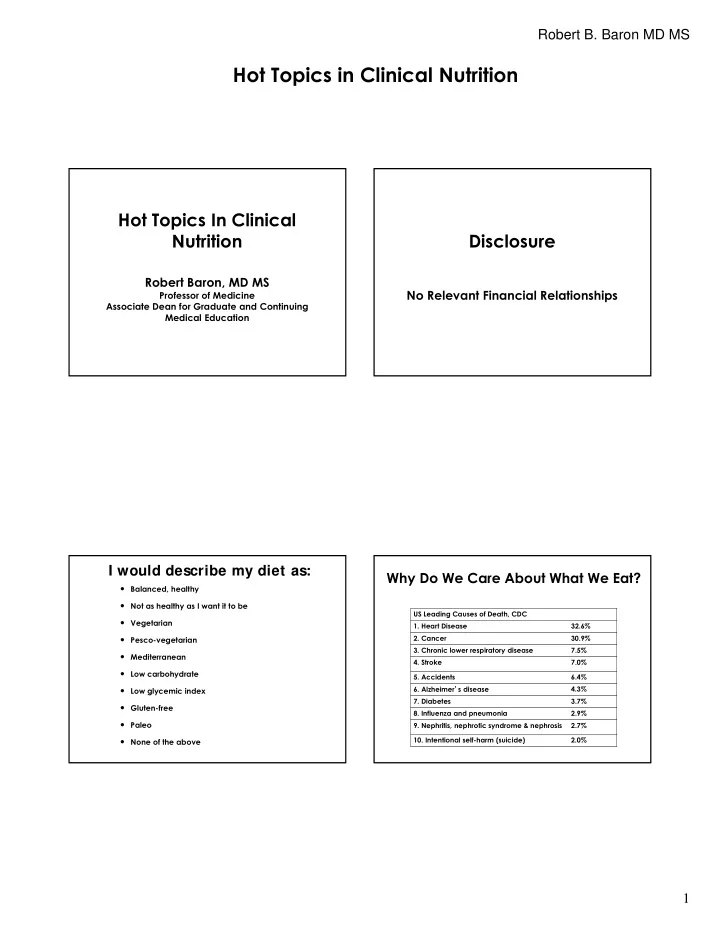
I would describe my diet as:

 Balanced, healthy  Not as healthy as I want it to be  Vegetarian  Pesco-vegetarian  Mediterranean  Low carbohydrate  Low glycemic index  Gluten-free  Paleo  None of the above

Why Do We Care About What We Eat?

US Leading Causes of Death, CDC

  • 1. Heart Disease

32.6%

  • 2. Cancer

30.9%

  • 3. Chronic lower respiratory disease

7.5%

  • 4. Stroke

7.0%

  • 5. Accidents

6.4%

  • 6. Alzheimer’s disease

4.3%

  • 7. Diabetes

3.7%

  • 8. Influenza and pneumonia

2.9%

  • 9. Nephritis, nephrotic syndrome & nephrosis

2.7%

  • 10. Intentional self-harm (suicide)

2.0%

slide-2
SLIDE 2

Hot Topics in Clinical Nutrition

Robert B. Baron MD MS 2 Why Do We Care About What We Eat?

US Leading Causes of Death, CDC

  • 1. Heart Disease

32.6%

  • 2. Cancer

30.9%

  • 3. Chronic lower respiratory disease

7.5%

  • 4. Stroke

7.0%

  • 5. Accidents

6.4%

  • 6. Alzheimer’s disease

4.3%

  • 7. Diabetes

3.7%

  • 8. Influenza and pneumonia

2.9%

  • 9. Nephritis, nephrotic syndrome & nephrosis

2.7%

  • 10. Intentional self-harm (suicide)

2.0%

Lifestyle and Disease

 1/3 of premature deaths in the U.S. are attributable

to poor nutrition and physical inactivity.

 Over 50% of American adults do not get the

recommended amount of physical activity.

 Only 10% of Americans eat a healthy diet

consistent with federal nutrition recommendations.

  • Too high in calories, saturated and trans fat,

salt, and refined sugars.

  • Too low in fruits, vegetables, whole grains,

calcium, and fiber.

Topics

 Total calories and macronutrient balance  Dietary Fiber  US Dietary Guidelines  Sodium  Vegetarian Diets and Mediterranean Diets  Antioxidants and B vitamins  Fish oil  Recommendations

U.S. Calorie Intake

 Calorie consumption in the U.S. has

increased 30% over the past 4 decades. Year Average calories consum ed 1970 2,057 2008 2,674

slide-3
SLIDE 3

Hot Topics in Clinical Nutrition

Robert B. Baron MD MS 3

Top calorie sources in U.S.

  • 1. Grain-based desserts
  • 2. Yeast breads
  • 3. Chicken and chicken-mixed dishes
  • 4. Soda, energy drinks, and sports drinks
  • 5. Pizza
  • 6. Alcoholic beverages
  • 7. Pasta and pasta dishes
  • 8. Mexican mixed dishes
  • 9. Beef and beef dishes
  • 10. Dairy desserts

Extra Calories From Eating Away From Home

Calories/ m eal at hom e Calories/ m eal at a restaurant Normal Weight 550 825 Overweight/ Obese 625 900

Public Health Nutrition, 2013

Macronutrient Composition

 Macronutrient composition: the relative

proportions of fat, carbohydrate, and protein in the diet

 Bottom line:

 a wide range of macronutrient composition

is consistent with a healthy diet

 in most clinical circumstances total calories

“trumps” macronutrient composition

 achieving desired calorie intake will

achieve most clinical goals

Dietary Fiber

 Plant matter  Not digested by human digestive enzymes  Some can be digested by gut bacteria  Includes  Cellulose, hemicellulose, pectins, gums, and

mucilages, lignins

 Classified as soluble or insoluble  IOM: Men 30-38 g/day. Women 21-25 g/day.

slide-4
SLIDE 4

Hot Topics in Clinical Nutrition

Robert B. Baron MD MS 4

Dietary Fiber:

The Most Important Nutrient?

 Heart: Lowers LDL, lowers triglycerides  Diabetes: Reduces blood sugar  Gut: Prevents constipation, hemorrhoids,

diverticular disease

 Weight: Promotes satiety Quantifying Dietary Fiber (per serving)

Apple: 4.4 Blueberries: 3.6 Orange: 3.0 Grapes 0.8 Pear: 5.5 Raspberries 8.0 White bread 0.7 Wheat bread 1.9 Wheat-bran cereal 7.4 Cornflakes 0.9 Oatmeal 4.8 Shredded wheat 6.1 Brown rice 1.5 White rice 0.3 Peanuts 9.1 Asparagus 1.4 Kidney beans 6.8 Broccoli 1.1 Carrot 1.7 Spinach 3.5 Tomato 1.0 Powdered psyllium 3.0

Principles of a Healthy Diet

Wide variety of foods High food quality Moderation (right quantity) “Basic Four” Food Groups (1956)

slide-5
SLIDE 5

Hot Topics in Clinical Nutrition

Robert B. Baron MD MS 5

Food Group Pyramid (1992) MyPlate (2010) MyPlate Dietary Guidelines 2010

 Enjoy food, but eat less  Make half your “plate” fruits and vegetables;

consume beans, whole grains, nuts and seeds

 Increase the intake of seafood & fat-free & low-fat

milk and milk products

 Drink water instead of sugary drinks  Compare sodium in foods and choose the lower v  Consume only moderate amounts of lean meats,

poultry & eggs

slide-6
SLIDE 6

Hot Topics in Clinical Nutrition

Robert B. Baron MD MS 6

Too Many Refined Grains

 Federal guidelines recommend six 1 ounce

servings per day for a 2000 calorie diet, and half should be whole grain.

 The average person eats 8 servings of grains per

day, and 7 of the 8 are refined.

What is a serving of grain?

 1/2 cup cooked rice or other cooked grain  1/2 cup cooked pasta  1/2 cup cooked hot cereal, such as oatmeal  1 six inch tortilla  1 slice of bread (1 oz.); ½ bun  1 very small (1 oz.) muffin  ½-1 cup ready-to-eat cereal

(½ cup = ½ a baseball)

Select whole grains

 Look for “whole” in the first ingredient

  • n the label.

 Aim for total carbs/fiber = <10 for

bread and <5 for cereals.

Way Too Much Added Sugar

The average person consumes 30 teaspoons of sugar and sweeteners per day (over 15% of calories). (Includes cane and beet sugar, high fructose corn syrup, corn syrup, dextrose, honey)

  • The AHA recommends < 6 teaspoons (24 grams)
  • f added sugar per day for women, and < 9 (36

grams) for men .

  • A 20 oz. soda has twice that.

Nutrition Action Health Letter, CSPI, March, 2013

slide-7
SLIDE 7

Hot Topics in Clinical Nutrition

Robert B. Baron MD MS 7

Salt and Public Policy

 Coronary Heart Disease Policy Model to quantify

benefits of modest salt reduction in U.S.

 Benefit through a reduction in systolic blood

pressure from 1-9 mm Hg in selected populations

 New cases of CHD decrease by 4.7 - 8.3 and

stroke by 2.4 to 3.9 /10,000

 Regulatory change leads to wide benefit and is

cost-effective

Bibbins-Domingo K, et al. NEJM 2010

Sodium reduction and BP control in individual patients

 Reduce sodium intake to ≤100 meq/d

(2.4 g Na): 2-8 mm Hg in SBP

 DASH Diet: 6 mm alone;  DASH diet plus sodium restriction: 14

mm Na

Dietary Guidelines 2010

Addressing Sodium:

 2,300 mg per day for general population  1,500 mg for aged 51+, African Americans

& hypertension, diabetes & kidney disease

Sodium

But:

1/2 of U.S. would qualify for 1,500 mg

recommendation

Average current intake 3,400 mg per day (1.5

teaspoon salt) Institute of Medicine: May 2013:

Limit everyone to 2,300 mg per day (1 teaspoon

salt)

Evidence doesn’t support lower recommendations

slide-8
SLIDE 8

Hot Topics in Clinical Nutrition

Robert B. Baron MD MS 8

80% in processed or pre‐ prepared foods

Salt in the US Diet

Sources: Mattes et al.

Top sodium sources in U.S.

  • 1. Yeast breads
  • 2. Chicken and chicken-mixed dishes
  • 3. Pizza
  • 4. Soda, energy drinks, and sports drinks
  • 5. Cold cuts
  • 6. Condiments
  • 7. Mexican mixed dishes
  • 8. Sausage, franks, bacon and ribs
  • 9. Regular chees
  • 10. Grain-based desserts

Sources of sodium in US

 35% from cereal and cereal

products

 26% from meat & meat products  8% from milk & milk products

Mediterranean Diet:

Healthy fats and good carbs with a big side of fruits and vegetables

slide-9
SLIDE 9

Hot Topics in Clinical Nutrition

Robert B. Baron MD MS 9

Primary Prevention of Cardiovascular Disease with a Mediterranean Diet

NEJM, Feb. 25, 2013

7447 Men and women, type 2 diabetes or at least 3 CV risk factors. 4.8 years Compared 1) Mediterranean diet supplemented with 4 Tbsp/day of olive oil or 2) with 1 ounce of nuts/day; vs. 3) a low fat diet (the control) Results: 288 cardiovascular events occurred: 3.8% in the olive oil group, 3.4% in the nut group, and 4.4% in the control group. (P=0.015)

Eat about 1 ounce of nuts most days

 1 ounce of nuts=1/4 cup or a small handful  But be aware of the calories…  1 ounce=160-200 calories

Vegetarian Diets

 Vegans  Fruitarians  Lacto-vegetarians  Lacto-ovo vegetarians  Pesco-vegetarians  Pollo-vegetarians  Flexitarians (Semi-vegetarians)

slide-10
SLIDE 10

Hot Topics in Clinical Nutrition

Robert B. Baron MD MS 10

Vegetarian Diets: Observational Study

 Adventist Health Study 2  73,000 participants; 2570 deaths  5.8 years follow-up  Compare: vegans, pesco-; lacto-ovo-;

and semi-vegetarians to non- vegetariants

 Outcome: lowest mortality in pesco-

vegetarians and vegans (15-20%).

Orlich, JAMA IM, 2013

Antioxidants

 Meta-analysis of 47 high-quality

randomized trials of antioxidants

 181,000 individuals  25,000 deaths

Bjelakovic, JAMA, 2007

Antioxidants: All-cause mortality

 Vitamin A

16% increase

 Beta-carotene

7% increase

 Vitamin E

4% increase

 Vitamin C

6% trend towards increase All p << 0.05 except vitamin C Bottom line: actively discourage anti-oxidant use

Bjelakovic, JAMA, 2007

Folate Supplements

 Pooled meta-analysis of 8 large, high

quality randomized trials

 37,485 individuals  5,125 deaths  9,326 major vascular events  3,010 cancers

Clarke, Archives IM, 2010

slide-11
SLIDE 11

Hot Topics in Clinical Nutrition

Robert B. Baron MD MS 11

Folate/Homocysteine RCTs

 Homocysteine

25% decrease

 Death

No effect: 1.02 (97-1.08)

 CVD events

No effect: 1.01 (.97-1.05)

 Cancer

No effect: 1.05 (.98-1.13) Folate does not prevent cancer or heart disease

Clarke, Archives IM, 2010

Folate And Neural Tube Defects (NTD)

 70% reduction in 2nd occurrences  4 mg of folate  63% reduction in 1st occurrence  0.4 mg of folate  Since flour fortification  46% reduction in NTD

Meta-analysis, Blencowe, IJE, 2010

Classification of Dietary Fat

Cochrane Library, 2009

Omega 3 Fatty Acids: Meta-analysis

  • 48 RCTs of 36,913 participants; 41 cohort

trials

  • No significant effect of omega 3 fats on

mortality, CV events, or cancer

  • Analysis of diet only trials: also no benefit
  • No reason to advise people to stop rich

sources of omega 3 fats, but better trials needed

slide-12
SLIDE 12

Hot Topics in Clinical Nutrition

Robert B. Baron MD MS 12

Since meta-analysis: Two additional RCTs

 ORIGIN trial: NEJM June 2012  12,536 patients with DM or high sugar  1 g daily of omega-3 x 6.2 years  NO reduction in death, CVD events  Risk and Prevention Trial: NEJM May 2013  12,513 patients at high risk for CVD  1 g daily of omega-3 x 5 years  NO reduction in death, CVD events

Dietary Supplements: Summary

 Beta-carotene

Discourage - harmful

 Vitamin E

Discourage - harmful

 Folate

Prevent neural tube defects

 Omega-3s

No benefit

Michael Pollan’s Three Rules

 Eat food  Not too much  Mostly plants

Baron’s Rules

 Eat unprocessed foods  Eat the right amount to maintain your weight  Eat something colorful at every meal (and

every snack)

 Don’t drink calories  If can’t make the “best” choice, make a

better choice

 Be as fit as you can be: exercise daily  Eat with your children

slide-13
SLIDE 13

Hot Topics in Clinical Nutrition

Robert B. Baron MD MS 13

The “Generic” Diet

 Continued debate: macronutrient balance,

amounts of meat/fish/fowl, other specific foods

 But almost all agree: Limit sugar, refined

grains, large amounts of saturated and trans

  • fat. Eat fruits and vegetables, healthy oils,

whole grains, legumes and nuts

 Bottom line: Master a “generic” diet for

primary care practice

Baron, RB JAMA Int Med, 2013

For More Information

 USDA’s Food & Nutrition Information Center:

http://fnic.nal.usda.gov/nal_display/index.php?info_cent er=4&tax_level=1

 CDC Division of Nutrition, Physical Activity & Obesity:

http://www.cdc.gov/nccdphp/dnpao/index.html

 USDA National Agricultural Library:

http://www.nutrition.gov/

 Center for Science in the Public Interest (CSPI):

http://www.cspinet.org/

 ChooseMyPlate.gov: http://www.choosemyplate.gov/

For More Information

 FDA: How to Understand and Use the Nutrition Facts

Label: http://www.fda.gov/Food/ResourcesForYou/Consumers/ NFLPM/ucm274593.htm

 FDA: Label Man – Make Your Calories Count:

http://www.accessdata.fda.gov/videos/CFSAN/HWM/hw mintro.cfm

 Nutrition.gov: Shopping, Cooking & Meal Planning:

http://www.nutrition.gov/shopping-cooking-meal- planning

 Healthy Eating Plate (Harvard):

http://www.hsph.harvard.edu/nutritionsource/what- should-you-eat/pyramid/