Hot Topics in Hot Topics in Sports Medicine 2015 Sports Medicine - - PowerPoint PPT Presentation

hot topics in hot topics in sports medicine 2015 sports
SMART_READER_LITE
LIVE PREVIEW

Hot Topics in Hot Topics in Sports Medicine 2015 Sports Medicine - - PowerPoint PPT Presentation

6/23/2015 Hot Topics in Hot Topics in Sports Medicine 2015 Sports Medicine 2015 Sports concussion Diagnosis Treatment Knee pain due to osteoarthritis + meniscus tear Exam Treatment evidence Carlin Senter M.D. Rotator


slide-1
SLIDE 1

6/23/2015 1

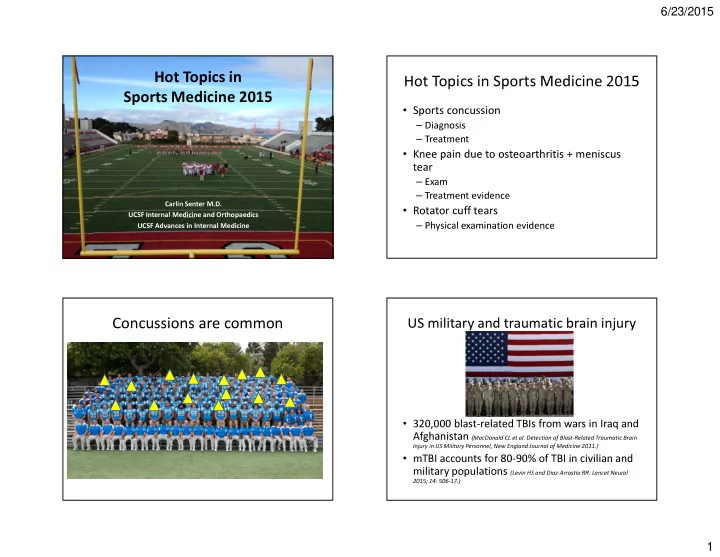
Hot Topics in Sports Medicine 2015

Carlin Senter M.D. UCSF Internal Medicine and Orthopaedics UCSF Advances in Internal Medicine

Hot Topics in Sports Medicine 2015

  • Sports concussion

– Diagnosis – Treatment

  • Knee pain due to osteoarthritis + meniscus

tear

– Exam – Treatment evidence

  • Rotator cuff tears

– Physical examination evidence

Concussions are common

US military and traumatic brain injury

  • 320,000 blast-related TBIs from wars in Iraq and

Afghanistan (MacDonald CL et al. Detection of Blast-Related Traumatic Brain

Injury in US Military Personnel, New England Journal of Medicine 2011.)

  • mTBI accounts for 80-90% of TBI in civilian and

military populations (Levin HS and Diaz-Arrastia RR. Lancet Neurol

2015; 14: 506-17.)

slide-2
SLIDE 2

6/23/2015 2

Concussion numbers increasing

Marin JR et al. Trends in visits for traumatic brain injury to emergency departments in the United States. JAMA. 2014 May 14;311(18):1917-9.

Concussion legislation

  • California: Education Code 49475 (effective

1/2012)

  • 1. Student athletes and guardians sign a concussion

information form yearly

  • 2. Athlete suspected of having concussion removed at

time of injury for the rest of the day

  • 3. Athlete can return only after cleared by healthcare

professional trained in evaluation and management

  • f concussion

http://fuerzadesign.com/wp-content/uploads/2014/10/thumbnail-United-States.jpg

Case #1

  • 40 y/o woman presents to your office for ER follow-up

two days after bike accident.

  • Slid out while crossing streetcar tracks on wet city

streets.

  • No loss of consciousness.
  • Taken by ambulance to ER.
  • Had trauma work-up including head CT (-).
  • Has headache, fatigue, dizziness, light sensitivity.

Trouble staying focused at work, sleeping more than usual.

  • Normal neck and neurologic exam.

Concussion definition

  • Type of mild traumatic brain injury
  • Blow to head, neck, body force to head
  • Rapid onset of neurologic impairment
  • Symptoms usually resolve in weeks, spontaneously,

but in some cases can be prolonged.

  • May or may not include loss of consciousness.
  • CT and MRI studies are normal

Adapted from 4th International Conference on Concussion in Sport (2012). Br J Sport Med.

slide-3
SLIDE 3

6/23/2015 3

Physical Cognitive Emotional Sleep

Concussion symptoms

http://www.cdc.gov/ncipc/tbi/Facts_for_Physicians_booklet.pdf. Accessed Nov. 9, 2008.

Clinic concussion evaluation

  • History of injury
  • PMHx ADHD, anxiety,

depression, head injury

  • Clinical status: improving or

worsening since time of injury?

  • Neck and neurological exam
  • Age > 60
  • GCS < 14 initially or < 15

two hours post injury

  • Vomiting more than once
  • Seizure
  • LOC
  • Focal neuro deficit
  • Suspected skull fx
  • Severe headache
  • Decreased alertness after

initially lucid

  • High velocity injury (hit by

car, fall from height)

  • Comorbid illness

(cirrhosis, diabetes, immunosuppression)

  • Pregnancy
  • Anticoagulants

Adapted from Levin HS and Diaz-Arrastia RR. Lancet Neurol 2015; 14: 506-17, using NICE 2014 and 2008 American College of Emergency Physicians/US CDC policy statement.

How severe is my concussion?

  • Concussion grading is retrospective

– Historically concussions were graded on the sideline based on amnesia and LOC at time of injury.

– American Academy of Neurology, 1997 – Cantu, 2001

– Studies have shown these factors not to be predictive

  • f recovery.
  • Only when the athlete recovers can you tell how

severe the concussion was

http://thehoopla.wpengine.netdna-cdn.com/wp- content/uploads/2012/10/rage-meter-1.jpg

slide-4
SLIDE 4

6/23/2015 4

Symptom resolution

  • Athletes become asymptomatic in 1-2 weeks

(Williams RM et al. Sports Med. 2015 Mar 28.)

  • Recovery in athletes may be faster than in others

(Levin HS and Diaz-Arrastia RR. Lancet Neurol 2015; 14: 506-17.)

  • Pre-existing neuropsychiatric disorder associated

with symptoms > 3 months (Levin HS and Diaz-Arrastia RR.

Lancet Neurol 2015; 14: 506-17.)

Case #1

  • 40 y/o woman presents to your office for ER follow-up

two days after bike accident.

  • Slid out while crossing streetcar tracks on wet city

streets.

  • No loss of consciousness.
  • Taken by ambulance to ER.
  • Had trauma work-up including head CT (-).
  • Has headache, fatigue, dizziness, light sensitivity.

Trouble staying focused at work, sleeping more than usual.

  • Normal neck and neurologic exam.

How would you treat this patient?

  • A. Order urgent head CT to rule out subtle

post traumatic bleed, return to clinic after CT.

  • B. Rest from work and biking, return to

clinic 1 week.

  • C. Return to work but rest from biking,

return to clinic in a month.

  • D. Return to work and biking.

Order urgent head CT to ... Rest from work and bikin.. Return to work but rest ... Return to work and biking.

14% 0% 18% 69%

Concussion treatment

  • Cognitive rest
  • Physical rest
  • Medication

– Tylenol – Ibuprofen after first 72 hours

  • No driving
  • No alcohol
  • Education
slide-5
SLIDE 5

6/23/2015 5

Return to school/work progression

No school. OK to do light reading, little bit TV, drawing, cooking as long as doesn’t worsen symptoms. 15 min cognitive activity at a time. Return to full day of school.

http://www.chop.edu/service/concussion-care- for-kids/returning-to-school.html

30 min schoolwork at a time until can do 1-2 hours. Return to ½ day of school.

Physical rest

  • Evidence sparse on benefit of rest
  • Management largely guided by expert opinion
  • No same-day return to play
  • Once concussion symptoms have resolved

gradually return to play

Return to play progression

Light aerobic activity Sport specific activity Game play Non- contact training Full contact practice

Clinician clearance Asymptomatic

2nd International Conference on Concussion in Sport (2004). 2005 Br J Sport Med 39:196.

Concussion statement 2012

slide-6
SLIDE 6

6/23/2015 6

Case #2

  • 55 y/o man with medial-sided pain and swelling
  • f the R knee for 6 weeks.
  • No locking, no instability
  • Exam: effusion, tender medial joint line and

above/below medial joint line, (+) medial knee irritation with medial McMurray, (+) medial pain with squat and Thessaly, no ligamentous laxity

  • He brings with him x-rays and MRI for your

review

EFFUSION

Area of tenderness

http://www.ski-injury.com/kneeanat.gif, Accessed 10/04/05. Accessed 10/4/05

Meniscus: McMurray

Sensitivity medial 65%, Specificity medial 93%

Magee, DJ. Orthopaedic Physical Assessment, 5th ed. 2008.

Meniscus: Thessaly

Video used with permission from Anthony Luke, MD.

slide-7
SLIDE 7

6/23/2015 7

Meniscus: squat 4 tests for meniscus tear

  • 1. Isolated joint line tenderness
  • 2. McMurray
  • 3. Thessaly
  • 4. Squat

These tests not needed in patients with knee OA. Do these tests in patients < 50 with isolated joint line tenderness.

Radiograph

3 views for knee pain

– Weight bearing flexed PA (aka notch view) – Lateral of affected side – Sunrise or merchant view

http://nurse-practitioners-and-physician- assistants.advanceweb.com/Features/Artic les/Knee-Osteoarthritis.aspx

MRI - report

  • Menisci: complex degenerative tearing of the

medial meniscus posterior horn and body.

  • Cruciate ligaments: intact
  • MCL/LCL: intact
  • Extensor mechanism: intact
  • Cartilage and bone: moderate-grade cartilage

loss over the medial femoral condyle and medial tibial plateau

slide-8
SLIDE 8

6/23/2015 8

Diagnosis?

  • A. Medial meniscus tear
  • B. ACL tear
  • C. Moderate medial compartment
  • steoarthritis
  • D. Patellar dislocation
  • E. Septic arthritis
  • F. Medial meniscus tear and moderate

medial compartment osteoarthritis

Medial meniscus tear ACL tear Moderate medial compa... Patellar dislocation Septic arthritis Medial meniscus tear a..

0% 0% 88% 2% 0% 10%

Initial treatment?

  • A. Refer for arthroscopic debridement of

meniscus tear and lavage

  • B. Nonoperative knee OA program
  • C. Refer for total knee arthroplasty

R e f e r f

  • r

a r t h r

  • s

c

  • p

i c d e . . . N

  • n
  • p

e r a t i v e k n e e O A p . . . R e f e r f

  • r

t

  • t

a l k n e e a r t h . . .

21% 2% 77%

  • 188 patients followed x 2 years
  • Primary endpoint WOMAC score (knee pain + fxn)
  • Avg age 60, 2/3 female, BMI 31
  • Excluded bucket handle meniscus and severe

varus or valgus alignment

Interventions

  • Control

– PT: 1 hour/week x 12 weeks – Home ex program 2x/day – Instruction on ADLS – Self management arthritis education reading + videotape – Medications (APAP, NSAIDs, hyaluronic acid injections)

  • Arthroscopic surgery

– Irrigation with saline – 1 or more of the following:

  • Debridement or excision
  • f degenerative meniscus

tears

  • Removal loose bodies,

chondral flaps, bone spurs

– Medical and physical therapy like controls

Kirkley et al. A Randomized Trial of Arthroscopic Surgery for Osteoarthritis of the Knee, NEJM, 2008.

slide-9
SLIDE 9

6/23/2015 9

Results

Kirkley et al. A Randomized Trial of Arthroscopic Surgery for Osteoarthritis of the Knee, NEJM, 2008. Katz JN et al. Surgery versus physical therapy for a meniscal tear and

  • steoarthritis. N Engl J Med. 2013 May 2;368(18):1675-84.

Surgery vs PT for meniscal tear and OA

  • Multicenter RCT
  • 351 patients with meniscus tear + OA
  • Meniscus sxs (clicking, popping, catching, giving

way, joint line pain, pain with twisting)

  • Avg. age 60 years
  • 50% men, 50% women
  • Primary outcome = change in WOMAC physical-

function score between groups at 6 mo

Interventions

  • Control (PT)

– Usually 6 weeks – 3-stage program

  • APAP, NSAIDs,

intraarticular steroid injections as needed

  • Arthroscopic partial

meniscectomy (APM)

– Trim damaged meniscus back to stable rim – Remove loose cartilage and bone

  • PT protocol
  • APAP, NSAIDs,

intraarticular steroid injections as needed

Katz JN et al. Surgery versus physical therapy for a meniscal tear and

  • steoarthritis. N Engl J Med. 2013 May 2;368(18):1675-84.
slide-10
SLIDE 10

6/23/2015 10

Results

Katz JN et al. Surgery versus physical therapy for a meniscal tear and

  • steoarthritis. N Engl J Med. 2013 May 2;368(18):1675-84.

Results

Katz JN et al. Surgery versus physical therapy for a meniscal tear and

  • steoarthritis. N Engl J Med. 2013 May 2;368(18):1675-84.

Conclusions

  • 30% crossed over from PT to APM at 6mo

– These people had WOMACs that didn’t improve until crossover

  • No sig difference in adverse events
  • PT and APM are reasonable options with similar
  • utcomes for these patients (with allowed cross
  • ver if not achieving relief with PT)
  • Starting with conservative approach is reasonable

Katz JN et al. Surgery versus physical therapy for a meniscal tear and

  • steoarthritis. N Engl J Med. 2013 May 2;368(18):1675-84.

Thorlund et al. Arthroscopic surgery for degenerative knee: systematic review and meta-analysis of benefits and harms. BMJ. 2015 Jun 16;350:h2747.

  • Benefits and harms of knee arthroscopy for degenerative knees
  • Meta-analysis of RCTs to determine benefit and including cohort

studies to determine harms

  • Arthroscopy effect size 2.4 mm on a 0-100 mm visual analog scale.

No effect after 6 months.

  • Harms: DVT, PE, infection, death
  • Conclusion: “These findings do not support the practise of

arthroscopic surgery for middle aged or older patients with knee pain with or without signs of osteoarthritis.”

slide-11
SLIDE 11

6/23/2015 11

Osteoarthritis with meniscus tear

  • Meniscus tear is part of the natural history of osteoarthritis
  • Treat as osteoarthritis initially
  • Imaging: Start with xray, MRI if exam c/w meniscus tear and not

improving with PT

  • Could consider arthroscopic meniscus surgery if weight loss, PT,

medications, injections not helping or if patient prefers surgical treatment but effect may be small and of short duration.

http://www.weddingbee.com/2009/07/20/rock-paper-scissors-shoot/

Caveats: Who to Refer

  • Younger patients
  • Bucket handle meniscus tears

– Knee locked due to meniscus blocking joint movement

  • Mechanical symptoms: locking, catching
  • Failure of nonoperative knee OA treatment

Non op treatment knee OA 2015

  • Mainstay

– Weight loss – Exercise – Pain control: APAP, NSAIDs (topical vs oral), injections

  • Increased concern use of

– APAP – Opioids

  • Stronger evidence

developing for

– Duloxetine – Tai Chi

  • Controversial

– Unloader brace – Specific types of rehab/exercise

3 excellent articles for Non-op knee OA treatment

  • Hochberg MC et al. American College of Rheumatology 2012

recommendations for the use of nonpharmacologic and pharmacologic therapies in osteoarthritis of the hand, hip, and knee. Arthritis Care Res (Hoboken). 2012 Apr;64(4):465- 74.

  • McAlindon TE et al. OARSI guidelines for the non-surgical

management of knee osteoarthritis. Osteoarthritis Cartilage. 2014 Mar;22(3):363-88.

  • Bannuru RR et al. Comparative effectiveness of pharmacologic

interventions for knee osteoarthritis: a systematic review and network meta-analysis. Ann Intern Med. 2015 Jan 6;162(1):46-54.

slide-12
SLIDE 12

6/23/2015 12

Case #3

57 y/o RHD man presents with R shoulder pain that started after he slipped and fell 3 months

  • ago. Pain at R deltoid. He tried physical therapy

without benefit. Waking at night from sleep due to pain.

Differential diagnosis?

Rotator cuff disease in primary care

  • The 3rd most frequent musculoskeletal reason

patients present to the office

  • The most common cause of shoulder pain in

patients in the US primary care settings

Whittle S, Buchbinder R. In the clinic. Rotator cuff disease. Ann Intern Med. 2015 Jan 6;162(1):ITC1-15.

What is rotator cuff disease?

  • Impingement
  • Tendinitis/tendinopathy
  • Partial thickness tear
  • Full thickness tear
slide-13
SLIDE 13

6/23/2015 13

Rotator cuff disease treatment

Most do well with conservative treatment

  • Impingement
  • Tendinitis, tendinopathy
  • Partial tear
  • Full thickness tear Consider ortho referral.

PT +/- Injection +/- Medication

Rotator cuff surgery outcomes

Better if (acute) full thickness rotator cuff tears fixed earlier than later

  • Smaller tear size associated with better
  • utcome (Cofield RH et al. Surgical repair of chronic rotator cuff tears. JBJS

2001.)

  • Less fatty infiltration and muscle atrophy

associated with better outcome (Gladstone JN et al. Fatty

infiltration and atrophy of the rotator cuff do not improve after rotator cuff repair and correlate with poor functional outcome. AJSM 2007.)

Shoulder: diagnosis driven exam

Active ROM Decreased Normal Passive ROM Normal Decreased Xray Frozen shoulder Normal GH joint OA Abnormal Rotator cuff tear Other rotator cuff dz Labral tear Biceps tendinitis AC joint OA

Physical exam maneuvers that increase likelihood of rotator cuff disease

  • 1. Painful arc
  • 2. Drop arm test
slide-14
SLIDE 14

6/23/2015 14

Pain test: Painful arc

  • JAMA. Rational clinical exam: Does this patient have rotator cuff disease? Aug

2013.

If painful, positive LR 3.7 for RCD. If not painful, negative LR 0.36 for RCD.

Pain/strength test: Drop arm test

  • JAMA. Rational clinical exam: Does this patient have rotator cuff disease? Aug

2013.

Positive LR 3.3, negative LR 0.82 for rotator cuff disease.

Physical exam maneuvers that increase likelihood of full thickness rotator cuff tear

  • 1. External rotation

lag test

  • 2. Internal rotation

lag test

https://www.healthbase.com/hb/images/cm /procedures/orthopedics/rotator_cuff_tear.j pg

Strength test: External rotation lag test

Positive LR 7.2, Negative LR 0.57 for full thickness rotator cuff tear

  • JAMA. Rational clinical exam: Does this patient have rotator cuff disease? Aug 2013.
slide-15
SLIDE 15

6/23/2015 15

Pain & Strength test: Subscapularis = internal rotation lag test aka ‘lift off’

  • JAMA. Rational clinical exam: Does this patient have rotator cuff disease? Aug 2013.

Positive LR 5.6, negative LR 0.04 for full thickness rotator cuff tear

Case #3

57 y/o RHD man presents with R shoulder pain that started after he fell 3 months ago. Pain at R

  • deltoid. He tried physical therapy without
  • benefit. Waking at night from sleep due to pain.

Exam: no atrophy. Nontender biceps, AC Joint. AROM symmetric bilaterally (forward flexion, external + internal rotation, abduction). (+) painful arc, (+) drop arm, (+) ER lag, (+) IR lag

Diagnosis

  • A. Adhesive capsulitis
  • B. Rotator cuff tear
  • C. Impingement syndrome
  • D. Glenohumeral joint osteoarthritis

A d h e s i v e c a p s u l i t i s R

  • t

a t

  • r

c u f f t e a r I m p i n g e m e n t s y n d r

  • m

e G l e n

  • h

u m e r a l j

  • i

n t

  • s

t e . . .

4% 0% 2% 95%

Shoulder: diagnosis driven exam

Active ROM Decreased Normal Passive ROM Normal Decreased Xray Frozen shoulder Normal GH joint OA Abnormal Rotator cuff tear Other rotator cuff dz Labral tear Biceps tendinitis AC joint OA

slide-16
SLIDE 16

6/23/2015 16

Treatment

  • A. Refer for surgical consult
  • B. Repeat trial of physical therapy,

f/u 3 months.

  • C. Give NSAIDs and activity

modification, f/u 3 months

  • D. Give subacromial injection, f/u 3

months

R e f e r f

  • r

s u r g i c a l c

  • n

s u l t R e p e a t t r i a l

  • f

p h y s i c a l t . . . G i v e N S A I D s a n d a c t i v i t . . . G i v e s u b a c r

  • m

i a l i n j e c t i

  • n

. . .

81% 5% 7% 7%

3 excellent shoulder articles

  • 1. O'Kane JW, Toresdahl BG. The evidenced-based

shoulder evaluation. Curr Sports Med Rep. 2014 Sep-Oct;13(5):307-13.

  • 2. Hermans J et al. Does this patient with shoulder

pain have rotator cuff disease?: The Rational Clinical Examination systematic review. JAMA. 2013 Aug 28;310(8):837-47.

  • 3. Whittle S, Buchbinder R. In the clinic. Rotator

cuff disease. Ann Intern Med. 2015 Jan 6;162(1):ITC1-15.

Thank you!

Carlin Senter, M.D. Primary Care Sports Medicine UCSF Internal Medicine and Orthopaedics