Objectives Describe the five most common myths in sports nutrition - - PDF document

objectives
SMART_READER_LITE
LIVE PREVIEW

Objectives Describe the five most common myths in sports nutrition - - PDF document

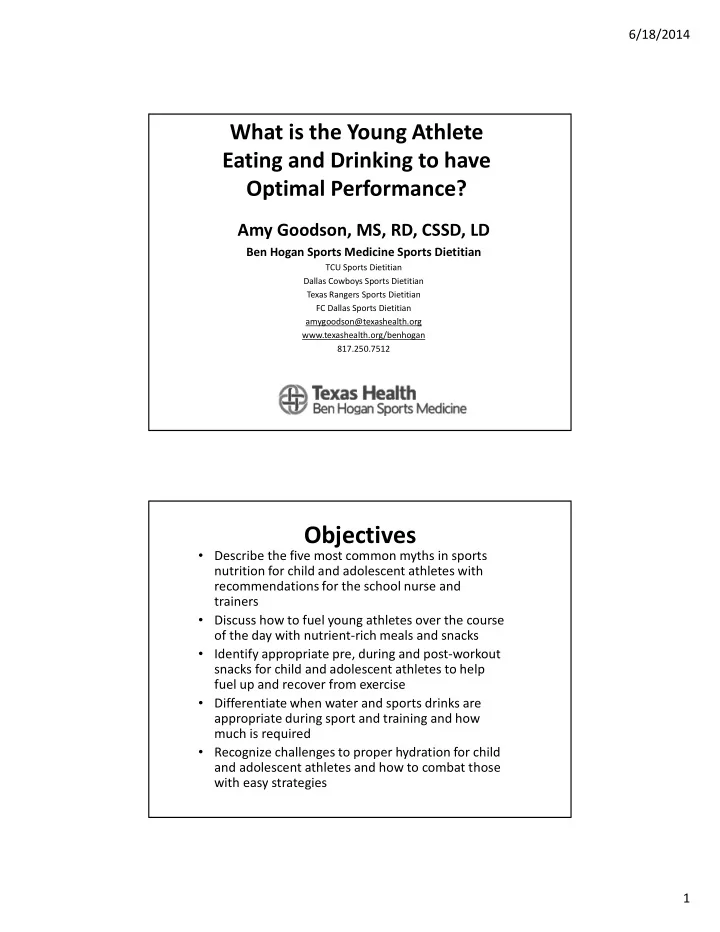
6/18/2014 What is the Young Athlete Eating and Drinking to have Optimal Performance? Amy Goodson, MS, RD, CSSD, LD Ben Hogan Sports Medicine Sports Dietitian TCU Sports Dietitian Dallas Cowboys Sports Dietitian Texas Rangers Sports Dietitian


slide-1
SLIDE 1

6/18/2014 1

Amy Goodson, MS, RD, CSSD, LD

Ben Hogan Sports Medicine Sports Dietitian

TCU Sports Dietitian Dallas Cowboys Sports Dietitian Texas Rangers Sports Dietitian FC Dallas Sports Dietitian amygoodson@texashealth.org www.texashealth.org/benhogan 817.250.7512

What is the Young Athlete Eating and Drinking to have Optimal Performance?

Objectives

  • Describe the five most common myths in sports

nutrition for child and adolescent athletes with recommendations for the school nurse and trainers

  • Discuss how to fuel young athletes over the course
  • f the day with nutrient-rich meals and snacks
  • Identify appropriate pre, during and post-workout

snacks for child and adolescent athletes to help fuel up and recover from exercise

  • Differentiate when water and sports drinks are

appropriate during sport and training and how much is required

  • Recognize challenges to proper hydration for child

and adolescent athletes and how to combat those with easy strategies

slide-2
SLIDE 2

6/18/2014 2

5 Most Common Sports Nutrition Myths for Young Athletes

  • Young athletes should not be forced to eat

and drink before and after exercise

  • Sports drinks are full of sugar and young

athletes don’t need them

  • Post-workout drinks/shakes have too much

sugar

  • Sodium (salt) is bad
  • Dairy is not good for you

Sports Nutrition Basics

  • Fuel frequently

– Goal is to eat smaller, more frequent meals to keep energy levels up over the course of the day – Example: Breakfast-Snack-Lunch-Post Workout Snack-Dinner-Snack

  • Nutrients that athletes need

– Carbohydrates – Protein – Fat – Fruit – Vegetables – Low-fat dairy

slide-3
SLIDE 3

6/18/2014 3

Carbohydrate Recommendations

  • Carbohydrate Intake

– Due to the lack of research, it is unclear whether young athletes need the same carbohydrate intake as adult athletes due to a decrease in functioning of the glycolytic pathway – General recommendations is 50% of total energy intake from quality carbohydrates

  • Young athletes should limit processed sugars and snack

foods as an energy source throughout the day

– During exercise, research supports that refined carbohydrate can still be helpful

  • Sports drinks, energy bars, gus, etc.

Carbohydrates

  • Purpose: Body’s “choice” for energy; primary

energy contributor during exercise

  • Goal: Have some carbohydrate at every meal and

snack to maintain energy levels

  • Types of carbohydrates

– Simple: jelly, cookies, hard candy, juice – Complex: bread, pasta, cereal, bagels

  • Whole grains and wheat products
  • Fruits
  • Vegetables
  • Dairy products
  • Sports drinks/gels/goos/blocks
slide-4
SLIDE 4

6/18/2014 4

Carbohydrates: Best Choices

  • Why grains?

– Rich in carbohydrates, B vitamins, give lots of energy

  • Should be the largest part of your diet
  • Best choices

– Wheat bread, oat bread, wheat bagels, wheat English muffins, wheat tortillas – Cereals: Total, Shredded Wheat, Cheerios, Granola – Oatmeal, Cream of Wheat – Brown Rice/Wheat or Multi-grain Pasta – Wheat crackers/whole grain granola bars

Protein & Fat Recommendations

  • Protein Intake

– Dietary recommendation is 0.8-1.0 gm/kg BW for non-active adolescents – Upper limit for protein intake for adolescent athletes in training is 1.7 gm/kg BW

  • Fat Intake

– Though young athletes use more fat as fuel during exercise, there appears to be no greater need for higher fat intake – Dietary recommendation is the same as adults, 20- 35% of total daily energy intake – High fat intake before exercise tends to reduce the magnitude of growth hormone secretion naturally produced in young athletes during exercise

slide-5
SLIDE 5

6/18/2014 5

Protein: Best Choices

  • Purpose: Build/repair muscles, hair/nail growth,

boosts immunity, RBC production

  • Goal: Have some carbohydrate at every meal and

snack to maintain energy levels

  • Lean meat

– Chicken, turkey, lean ham, lean red meat, fish, tuna, turkey bacon and turkey sausage

– Take the skin off of meat

  • Eggs and egg whites
  • Low-fat dairy products

– Milk, cheese, yogurt, cottage cheese

  • Whey protein powders and smoothies/shakes

made with it…whey protein absorbs very quickly

  • Nuts, seeds, peanut butter, beans, soy foods

Protein: Best Choices

  • Low-fat dairy is a great way to get quality

protein as well as calcium, Vitamin D and potassium in young athletes

– 90% water which helps replace fluids and rehydrate the body – Contains calcium, Vitamin D and phosphorus to help promote, maintain and build strong bones – Contains protein to reduce muscle breakdown – Contains carbohydrate to fuel muscles during exercise and help muscles recover after exercise – Contains potassium which helps with fluid and mineral balance and muscle contraction – Contains B vitamins that help convert food to energy to fuel working muscles

slide-6
SLIDE 6

6/18/2014 6

Fat: Best Choices

  • Saturated Fats: “Bad Fats”

– Fried foods, pastries/baked goods, creamy foods

  • Unsaturated Fats: “Good Fats”

– Peanut butter, almond butter, nuts, seeds – Olive oil and Canola Oil – Avocado – Flaxseed or flaxseed oil

  • Can buy milled, as oil, or in breads and cereals

– Fats in fish like salmon

  • Remember that you get some fat in dairy

products, meats, whole eggs, and energy bars/shakes

Start the day with breakfast

  • Cheap, Quick On-the Go Breakfasts

– Whole wheat bagel w/2 spoons peanut butter, banana & 1 bottle 2% milk – Energy bar, banana &1 bottle 2% milk – Peanut butter & jelly sandwich on wheat bread, Yoplait 2x Protein Yogurt and 8 oz low- fat milk – Peanut butter crackers, 1 cup trail mix, 1 bottle 2% milk – Smoothie w/fruit, milk & whey protein powder – Nature Valley Granola bar & add peanut butter on top, string cheese, 1 bottle 2% milk – Quaker Oatmeal On-the-Go bar, Individual bag of nuts, 1 bottle 2% chocolate milk

slide-7
SLIDE 7

6/18/2014 7

Brown Bag Lunches

  • Peanut butter and jelly sandwich on 100% whole

wheat bread, 6 oz low-fat Greek yogurt with ½ cup berries, baby carrots, Fiber One granola bar

  • Turkey and 2% cheese roll-ups, 1 serving 100%

whole wheat crackers, baby carrots and ¼ cup hummus, 1 fruit and a Kashi TLC cookie

  • 100% whole wheat tortilla with ½ cup black beans,

½ cup brown rice and 1 slice 2% cheese, celery and Jif-to-Go Natural peanut butter for dipping, 1 cup fruit

  • 6 oz low-fat Greek yogurt with ½ cup granola and a

sliced apple for dipping, an individual pack nuts, a string cheese, and 2-3 baby skewers with roasted veggies

Fueling Snacks

  • Energy bar
  • Individual bag trail mix
  • Beef jerky and a banana
  • Granola bar and nuts
  • Whole wheat crackers

and string cheese

  • Yoplait 2x Protein

Yogurt and fruit

  • Hummus and whole wheat

pita bread/pita chips

  • Apple and peanut butter
  • Popcorn and string cheese
  • Peanut butter bites

– Stir ½ cup peanut butter and ¼ cup honey together – Stir in 1 cup oats and ½ cup whey protein powder – Roll into 20-22 balls and refrigerate – Approx 70 calories, 7 carb, 2 fiber, 3 protein, 3 fat each

slide-8
SLIDE 8

6/18/2014 8

Healthy Convenient Store Snacks

  • 7-11’s and Quick Trips offer the most options
  • Peanut butter crackers/peanut butter filled pretzels
  • Individual bags of trail mix or nuts & a fruit
  • Whole grain granola bars & string cheese/nuts
  • Box of whole wheat crackers & string cheese
  • Protein bar & banana/milk
  • Turkey/ham and cheese sandwiches/wraps & baked

chips/ fruit cups

  • Yogurt & fruit parfaits & a bag of nuts
  • Ready-to-drink Protein Shake & a fruit/granola bar
  • Add milk/chocolate milk to any snack to increase

calories and protein

Pre-Exercise Meal Timing

  • How much time should I allow for

digestion of food before exercise?

– Allow 3-4 hours for large meal

  • Meat, pasta, vegetables, salad, roll

– Allow 2-3 hours for smaller meal

  • Sandwich, crackers/baked chips, fruit

– Allow 1-2 hours for a blenderized meal to digest

  • Smoothie, protein drink/shake
  • Carbohydrate snack 30 minutes before

exercise provides “energy burst” for performance

– 50-70% carbohydrate, low-moderate protein – Granola bar, fruit, peanut butter crackers, etc.

slide-9
SLIDE 9

6/18/2014 9

Pre-Exercise Eating

  • Pre-exercise meal

– High carbohydrate – Low in fat & fiber

  • These slow down digestion

– Moderate protein – Combine protein + carbohydrate – Plenty of fluids

  • Immediate Pre-exercise Snack

– 30 minutes before workout/game – High carbohydrate, small amount of protein to provide you with a boost of energy

Early Morning Training

  • Lots of carbohydrate; more bland foods
  • Good choices for early morning:

– Shake with carbohydrates & some protein

  • Shake powder mixed with water or skim milk, fruit,

low-fat Greek yogurt, ice and water

– Energy bar like Balance, Zone, Clif, Go Lean Crunchy, Luna, Power Bar Harvest/Triple Threat, Gatorade, Odwalla – Low-fat granola bar like Kashi crunchy/chewy, Nature Valley, Quaker Oatmeal Square – Fruit (i.e. banana, nothing very acidic) – Plain bagel or dry cereal/granola mix

slide-10
SLIDE 10

6/18/2014 10

During Workouts

  • Carbohydrate-rich foods/drinks

– Carbohydrates digest the quickest & thus provide energy faster!

  • Carbohydrate is needed for activity longer than
  • ne hour of consistent movement

– 30-60 grams of carbohydrate per hour after the first hour of exercise

  • Fluid need – match sweat losses

– Consume 5-10 oz fluid every 15-20 minutes – Water and sports drink to replace electrolytes

  • Avoid fat, protein, & fiber when exercising. These

slow digestion & increase time in which energy is available to be used.

Mid-Practice/Half-time Snacks

  • Carbohydrates, some protein, little to no

fat

– Fruit/fruit snacks – Energy bars – Granola bars – Peanut butter crackers – Quarter PBJs if long practice/game – Dry cereal/trail mix with minimal nuts – Salty snacks

  • Goldfish, pretzels, crackers, animal crackers

– Sports drink with snack

slide-11
SLIDE 11

6/18/2014 11

Post-Exercise Nutrition

  • The three R’s to post-workout recovery:

– Replenish carbohydrate burned during exercise – Repair damage done to lean muscle mass – Rehydrate the body to euhydration (normal)

Post-Exercise 2-Hour Window

  • 2-Hour Window of Recovery

– Your body has a specific time period, post-exercise, when you are able to more effectively take up nutrients – 0-45 minutes

  • Best time to eat at least a snack as your

muscles are more sensitive to absorb nutrients!

– 45 minutes – 2 hours

  • Try to get a normal-size meal or larger snack
  • The window is the most important time to consume

plenty of carbohydrate, protein, & fluids to replenish & refuel

  • Essential if participating in twice a day training
slide-12
SLIDE 12

6/18/2014 12

Post-Exercise Eating

  • Carbohydrate - Replenish

– Body NEEDS lots of carbohydrate post-exercise to replace energy stores – Simple carbs are best: milk, spots drink, fruit, juice

  • Protein - Rebuild

– Body needs some protein to start repairing tiny muscle tears – Provide some protein, ideally 5-10 grams, for young athletes – Ideally 20 gm protein immediately post- workout for older (teenage) athletes

  • Whey protein is the highest in BCAAs, specifically leucine

which has been shown to re-synthesize muscle the fastest after a workout

Post-Exercise Eating

  • Carb-Protein Combo Food Examples

– If you have products available:

  • Carb-Protein Ready-to-Drink Shake

– Muscle Milk or EAS

  • Energy bar & Gatorade
  • Smoothie made with 1-2 cups low-fat milk, fruit,

cold water, ice, and low-fat Greek yogurt

– If you are on a budget:

  • 16-20 oz low-fat chocolate milk
  • Granola bar and 12 oz low-fat milk
  • Yoplait Greek 2x Protein Yogurt and a string cheese
  • 6 oz low-fat Greek yogurt with berries and honey
slide-13
SLIDE 13

6/18/2014 13

Sample Morning Workout Day Eating Example

  • Small pre-workout snack 5:30-6:30am
  • Hydrate during workout
  • Breakfast – within 30 minutes

– If going to be longer, drink chocolate milk

  • r small shake
  • Mid-morning snack – 10:00am
  • Lunch – 11:30am-1:00 pm
  • Afternoon snack – 3:30-4:30pm
  • Dinner – 6:00-7:30 pm
  • Evening snack – 9:00 pm

Sample Afternoon Workout Day Eating Example

  • Breakfast – 7:00-8:30 am
  • Mid-morning snack – 10:00am
  • Lunch – 11:30am-1:00 pm
  • Small pre-workout snack – 3:00-4:00pm
  • Hydrate during workout
  • Post-workout snack – within 30 minutes
  • Dinner – 6:00-7:30 pm
  • Evening snack – 9:00 pm
slide-14
SLIDE 14

6/18/2014 14

2-a-day Practice Eating Example

  • 5:00am snack

– Granola bar, energy bar, banana, baggie of cereal

  • Workout
  • Post-workout snack: chocolate milk
  • Breakfast within 45 min-1 hour after practice
  • Lunch 11:00am-12:00pm
  • Afternoon (pre-workout) snack around 2pm-ish
  • Workout: Consuming water & Gatorade

– Might want to consume energy bar or granola bar in the middle of practice if possible

  • Dinner within 45 min-1 hour after practice
  • Evening snack approximately 3 hours after

dinner

Hydration in Young Athletes

  • Fluid Intake

– Young athletes have a greater ratio of surface area to body mass and absorb environmental heat more readily than adults – Consequently have a greater risk for experiencing heat stress when exercising in hot environments – Children have a lower sweating capacity reducing their ability to dissipate body heat by evaporation – As children grow, body surface grows, increasing their need for fluid and electrolytes – Research shows that when given water, young athletes do not replace fluid losses as completely as when provided a flavored sports drink

slide-15
SLIDE 15

6/18/2014 15

Hydration in Young Athletes

  • Fluid Intake Continued

– Like adults, a 2% dehydration level will begin to compromise performance in young athletes – However with children, the negative side effects of fluid loss begin at 1% dehydration level – Fluid recommendations during exercise are vague for young athletes

  • Pre-exercise young athletes should be encouraged to drink

water and/or sports drink consistently throughout the day

  • During exercise young athletes should consume electrolyte rich

fluids

– Giving water breaks is essential in young athlete practices and sports because they may not choose to do it on their own

  • Post-exercise athletes should monitor urine color to replace

fluids lost during exercise

Hydration Recommendations for Adolescent Athletes

  • Pre-exercise

– 2-3 hours prior exercise: 16-20 oz fluid – 10 minutes prior exercise: 5-10 oz fluid

  • During-exercise

– Really individualized to sweat rate – Every 15-20 minutes: 5-10 oz fluid – Water and sports drinks

  • Sports drinks especially after 1 hour of exercise and/or in very

hot/humid conditions

  • Post-exercise

– 16-24 oz fluid for every pound lost – 24 oz if in 2-a-days or need to rehydrate quickly

slide-16
SLIDE 16

6/18/2014 16

What counts as fluid for daily hydration?

  • Water
  • Flavored waters
  • Sports drinks
  • Tea
  • Fruit juice
  • Smoothies
  • Jell-O
  • Soup
  • Fruits
  • Vegetables

Water versus Sports Drink

  • Water

– Great hydrator – Not a great rehydrator – Missing electrolytes – No carbohydrate – Not as palatable when luke-warm – Nothing in it that makes you want to drink it

  • Sports Drink

– Great hydrator – Great re-hydrator – Contains 6-8% solution carbohydrates to provide energy during long activity, but still empty gut fast enough – Provides electrolytes to replace what is being lost – Sodium content makes athletes want to drink it – Tastes better

slide-17
SLIDE 17

6/18/2014 17

Hydration - Cramping

  • Typical causes:

– Fatigue – Dehydration due to loss of electrolytes

  • Foods to improve/prevent cramping

– High salt foods

  • Crackers, popcorn, bakes chips, pretzels
  • Tomato sauces, soups, pickles & pickle juice
  • Salt your food!

– High potassium foods

  • Bananas, strawberries, cantaloupe, raisins
  • Avocados, potatoes, beans, broccoli, spinach
  • Yogurt, milk, tomato juice, soybeans

– Sports Drinks

  • Gatorade, PowerAde, Hydrade, Accelerade

Challenges to Proper Hydration

  • Fatigue

– Many athletes feel too tired to eat or drink after strenuous activity or if they are really hot

  • Loss of appetite/thirst

– Exercise kills appetite and thirst for many athletes

  • Limited access to fluid

– Are the coolers out of water? – Did the athlete already finish their bottle?

  • Other post-exercise commitments

– Team meetings, bus rides, showers and cleaning up, running to next practice

  • Post-competition social activities

– Going out to eat, talking to friends, taking pictures

slide-18
SLIDE 18

6/18/2014 18

Combat Hydration Challenges

  • Bring extra bottles of water/sports drink in a

cooler in case you run out

  • Bring the athlete’s favorite drink
  • Require “water breaks” during practice
  • Have parents/volunteers/staff help distribute

water on sidelines during games

  • Post-practice or game, make all athletes stop

and drink at least 8 oz of fluid

  • Put water/sports drink stations in locker

room/gym

  • Monitor urine color

– Goal: Pale yellow to clear

Summary

  • General nutrition recommendations

– Young athletes should be eating small, frequent meals to keep their bodies fueled – A breakfast rich in complex carbohydrate and protein is essential to start a young athlete’s day

  • If practicing in the morning, a “to-go breakfast” should be sent

with athlete or they should eat in school cafeteria before class starts

– Nutrient-rich snacks should be sent to school for in-between meals – Hydration of water, low-fat milk and other low-calorie fluids should be included at meals and snacks over the course of the day

slide-19
SLIDE 19

6/18/2014 19

Summary

  • Sports nutrition recommendations

– Pre-workout snacks and sports drinks should be sent to school and practice so the athlete stays hydrated and fueled throughout practice and athletics class/PE – Half-time snacks and beverages should be provided during team sports practices, games and tournament play – A nutrient rich snack of carbohydrate, protein and fluid should be consumed within 45 minutes after exercise or game – Water and sports drinks should be provided before, during and after practice and games

  • Sports drinks are ideal when the activity is longer than an hour

and in hot/humid environments

References

  • Dunford M and Coleman EJ. Sports Nutrition:

A Practice Manual for Professionals, 5th ed.